 |
|
Hi, and welcome back to Line Sheet. It’s beginning to look a little like Christmas here in Los Angeles. Temperatures are dipping below 50 degrees Fahrenheit in the evening, the third-wave coffee shops are advertising their lightly sweetened peppermint mocha drinks, and multibrand retailers have flooded the scene.
🛍️ Last Thursday night, I stopped by Mytheresa’s pseudo-pop-up on the East Side featuring a gingerbread reconstruction of Flamingo Estate, former fashion marketer Richard Christiansen’s home in Eagle Rock, which is also the name of his difficult-to-describe business that sells everything from farm boxes to bathroom soap. Across town, in Beverly Hills, Saks.com C.E.O. Marc Metrick hosted a dinner for private clients at Funke. Like me, Kathy Hilton and daughter Nicky managed to hit up both events. A trek, but worth it, especially to meet Line Sheet reader Mary and her husband. Hope you had a great time at the Academy Museum Gala on Sunday.
✈️ This week, I’m off to Miami for a couple of days to spend some quality time with my in-laws, dip into Art Basel, and interview Esprit global chief brand officer Ana Andjelic on Thursday at 4 p.m. ET at the Scope art show on Miami Beach, where the brand is installed for the week. If you’ll be in town and want to stop by, here’s more info. You won’t be surprised to hear that we’ll be talking about what it takes to bring dormant brands into the current moment. (It’s Ana’s expertise!)
🎧 And finally, I’ll be hopping on Puck’s Quarterly Call earlier in the day on Thursday (10 a.m. PT/1 p.m. ET/7 p.m. CET) to chat with luxury adviser and my bud, the one-and-only Robert Burke, about the state of American department stores and more. If you’re not a Puck member (rude), sign up here so you don’t miss it—then email Fritz@puck.news for more details.
Mentioned in this issue: Demna, Farfetch, Matthew M. Williams, Condé layoffs, Riccardo Tisci, Clare Waight Keller, Givenchy, Kim Jones, Sarah Burton, Antoine Arnault, Sidney Toledano, Nicole Kidman, Nina Garcia, Kering, François-Henri Pinault, Balenciaga, Cassandra Grey, Johann Rupert, and many more.
|
| Farfetch’s White Knight Search |
|
| The Farfetch situation, which I first wrote about in October, has gone from bad to worse. Today, BoF reported that the online marketplace, once touted as the end state for the fashion industry’s multibrand retail woes, is seeking a white knight investor to save it from a potential bankruptcy as it looks to delist from the New York Stock Exchange. Farfetch has also tried selling off its beauty business, Violet Grey, as well as New Guards Group, the subsidiary that operates several merch-driven brands including Off-White, founded by the late Virgil Abloh.
It would be good for Farfetch to shed those businesses. But they’re not destined to bring in much money—especially Violet Grey, which Farfetch bought for a little over $40 million just last year. Further cause for concern: I hear that some independent boutiques that sell through the Farfetch marketplace are not receiving payment. A person close to Farfetch said this isn’t the case, and that payments are being made—I guess we’ll see how it nets out by the end of the year. But the marketplace—where independent stores and brands sell through the platform, and Farfetch takes a commission—is the most sound part of the operation. If Farfetch is so short on cash that they’re not able to pay stores the money they generated, that’s not good.
The other piece here is Richemont: If the deal with Farfetch to take over Yoox Net-a-Porter Group (YNAP) doesn’t happen—and it sure seems imperiled now, since presumably it relies on this rescue financing—the Swiss conglomerate’s investors are not going to be happy. Richemont has made it clear that it is not going to bail out Farfetch, and with reason. But getting rid of YNAP, which Richemont should have never owned in the first place, felt like a sign that group chairman Johann Rupert was coming to his senses.
I do think there are buyers for both Farfetch and YNAP—the debt vultures always value discount shopping—and potentially as a combo. Despite all the complications, they have access to an extensive network of high-net-worth consumers, and that’s valuable to someone. (On Friday, billionaire Steve Cohen’s Point72 Asset Management took a 5.1 percent passive stake in Farfetch.) Retail, a notoriously tricky, cyclical business, has long been attractive to private equity funds that deal in distressed properties. Some may see Farfetch as a steal. |
|
|
- Condé morgue update: At least some people inside Condé Nast, which is slow-rolling layoffs equal to at least 5 percent of the overall staff, have told me they wish the company would “just get it over with” already. But by late afternoon, the only big news was from the union, which is still trying to save members who were on the hit list, even if many of them are resigned to being fired at this point.
In their defense, the union filed an “unfair labor practice charge” against Condé over “attempts to intimidate union members,” citing three instances where they were met by security guards—including at a meeting last week at The New Yorker and guild members’ now-infamous march into C.E.O. Roger Lynch’s empty office. The union also took issue with a Hollywood Reporter story last month in which Lynch claimed the company “met expectations for overall revenue growth for the third straight year.”
I guess their question is, Why do we gotta lay all these people off if everything is okay? As demonstrated by the upcoming massacre at Spotify—which is about to lay off 1,500 people in its third round of cuts this year, despite achieving profitability—things are not looking good for next year or the year after that, and Lynch is thinking about how he can put Condé on a more sustainable path in 2024.
Regardless, it’s making for a wretched situation all around. “I feel like I work in a haunted house,” said one person, still employed as of this writing.
- Some details on the Jezebel sale: I’m told that G/O first tried to sell the business at a $2 million valuation and failed. (A rep for G/O Media declined to comment.) As for the structure of the Paste magazine agreement, I confirmed with Paste president and editor-in-chief Josh Jackson that it is a seller-financed, all-cash deal. From what I understand, Paste will pay G/O in installments, presumably with interest. (I followed up with Jackson regarding that point, but have yet to hear back.) How much was agreed upon, I still don’t know. Send info!
|
|
|
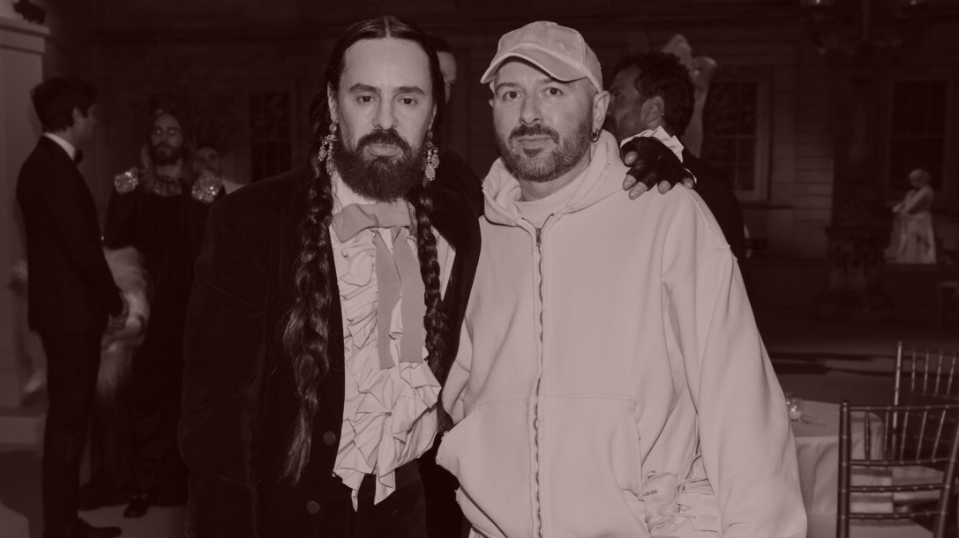
| The end of the year is the height of the gossip season. On Friday, it was finally, formally announced that Matthew M. Williams, the doomed designer of Givenchy, would be exiting the LVMH-owned couture house by December 31, closing out his three-year contract. Condolences to those who really enjoyed Matthew’s work. I, too, started to feel bad for him by the end. Luckily for everyone, Williams just got backing for his own line from an enthusiastic investor, so there will be more seatbelt belts in our future.
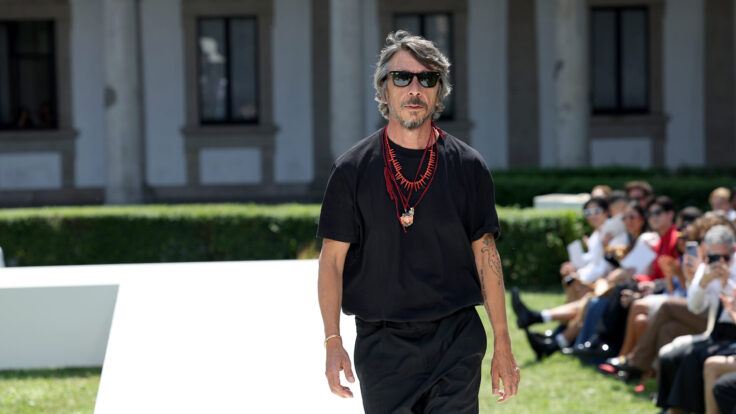
Williams’ long-rumored, painfully attenuated departure sets in motion a number of other interesting dominoes. The talk just a week ago in Paris had Kim Jones, of Dior “Men” and Fendi womenswear fame, headed to Givenchy, where he would be looking for help creating a new brand identity. That tracks, especially if Alessandro Michele is about to be announced at Fendi, the Roman furrier-turned-fashion house, which is feeling increasingly likely. If Michele is indeed working at Fendi, he’d have to be taking over the whole thing: The reason to hire him is to overhaul the brand, not to patch things up.
Given that LVMH was interviewing designers to work on Givenchy couture specifically, perhaps Sarah Burton is taking that piece and Jones, who is extremely collaborative, is doing the rest. This would be a best-case scenario: One of the big problems with Clare Waight Keller at Givenchy was that the men’s business under her predecessor, Riccardo Tisci, had been so strong it was difficult to maintain. The combo of Jones, a great product designer, and Burton, a great dressmaker, could be winning. Now the only question is, What happens to Dior? |
|
|
| There is huge potential at Givenchy. After years of easy-to-digest, bourgeoisie fashion, there’s an appetite for strong-shouldered, aggressive-chic clothing. (See what’s going on at Alaïa, Phoebe Philo, Prada, etcetera.) Givenchy could satisfy that appetite for LVMH, if the designer in charge can exert the necessary rigor and control. They need to be skilled enough to rise above the 65-year-old guys wearing Givenchy-branded T-shirts at the craps table in Vegas. The new regime also needs to send a clear message that it is an LVMH brand worthy of mention in the same breath as Dior, Louis Vuitton, Celine, and now, Loewe.
There is also the management factor: As WWD first reported earlier this year, there is destined to be a change in the senior executive ranks, with LVMH fashion group head Sidney Toledano retiring and former Louis Vuitton C.E.O. Michael Burke replacing him. It hasn’t been announced yet, however, and Antoine Arnault is now floating after stepping away from Berluti. I suspect that whatever happens at Givenchy will be connected somehow to the incoming executive switcheroos. |
|
|
| Meanwhile, over in Kering land, all eyes are on Balenciaga and what its Los Angeles show means for the future of the brand. I was delighted that the show took place on a barricaded block of Windsor Square, one of the oldest of the old money enclaves, a historic neighborhood filled with mansions and freshly cut, magically green grass that’s adjacent to Hancock Park, right down the actual street from where I take trampoline class once a week.
I like Hancock Park a lot. It’s clean. There are (pretty) good public schools, even though everyone sends their kids to Harvard-Westlake and Marlborough. It’s a trick-or-treating hot zone, thanks to its flat sidewalks and deep-set lawns. Larchmont Village, the neighborhood’s high-street equivalent, is one of the most alluring stretches of retail in all of Los Angeles. There’s a magazine stand and a C.O. Bigelow-esque cosmetics shop living happily (or at least civilly) alongside a Diptyque and Buck Mason. Levain Bakery, the Stripes-backed maker of pornographic chocolate chip cookies, just opened there.
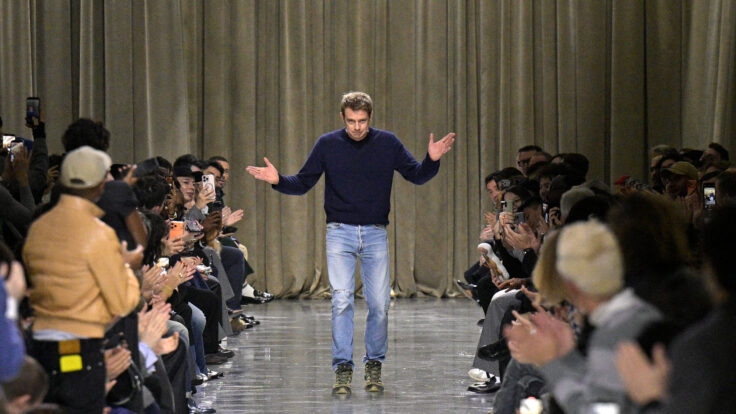
Every neighborhood of Los Angeles attracts a different set of people, and among the oldsters who are probably revolted by the amount of commerce that now happens along this strip, which I first visited almost 20 years ago, were young people in baggy gray jeans and sweatshirts, a ghost of the designs proselytized by Demna—first at his own brand, Vetements, and now at Balenciaga. My question from the last Balenciaga show was simple: Is Demna iterating enough on his signature design motifs to carry a brand of Balenciaga’s magnitude into the future?
This L.A. show was a good test, given that the goal of an in-between collection (a pre-collection, as many designers call them, but Balenciaga calls “Fall”) is commerciality. Demna, who was born in 1981 and raised in the Republic of Georgia, obsessed over American culture as a kid. (He once staged a Vetements runway show at a McDonald’s on the Champs-Élysées.) His idea for this collection was a fetishized version of L.A.: Juicy Couture-mimicking, butt-crack baring pink tracksuits, Ugg-influenced stilettos, black jeans, one-shoulder red-carpet gowns.
The naughties are ground zero for fashion inspiration right now, and much of what I saw on the marijuana smoke-scented runway looked exactly like what I saw over on Larchmont mere hours earlier: raggedy zip-ups, saggy denim, ambivalence in the form of a T-shirt. Backstage, Demna insisted that he wasn’t making fun of the lemmings. Rather, this was an ode to a world that he has never inhabited, but dreamed about.
Was the collection too on the nose? I think the answer, for many people, was yes. Demna (who, yes, goes by his first name only; he’s nice, let’s just give that to him) mentioned grunge as a reference—and in particular, what grunge looked like once it arrived in Los Angeles. During the show, I thought a lot about Marc Jacobs’ famous grunge collection for Perry Ellis, which was derided by the press and got him fired, but was ultimately viewed as a seminal moment in fashion that declared when the street started dictating the runway. That was the early 1990s, though, and everything might be too symbiotic now to be so literal. When Marc Jacobs did grunge, the clothes were inspired by thrifted fashion worn by young kids, and that look trickled down to the masses. Now, there is no trickle-down. Everything is accessible, all the time.
Did Demna tweak the formula enough to justify his take? The collaboration with Erewhon, the (also) Stripes-backed grocery store, the Dover Street Market of food that sells Hailey Bieber-designed smoothies, $12 heads of cauliflower, and $45 jars of nut butter, felt pat to some. I’d only defend it to say that Erewhon is only old news among a very small sliver of the coastal elite and that, to a European, it remains a novelty the way Europeans obsessed over Victoria’s Secret and Abercrombie & Fitch long after their American expiration dates. (I was, however, shocked to find out that Demna had never visited an Erewhon before this trip, even though he has been to Los Angeles 12 times. As a culture anthropologist, that is a crime!)
Nevertheless, Demna’s skill is obvious. This collection was immaculate trash: Everything from the sports bra to the sculpted handkerchief gown was tailored to a tee. It helped that the weather was perfect, the sun was shining, and the boulevard offered a straight-shot view of the Hollywood sign. (They must have had something very special to give the mansion owners, who stayed inside until the show was over. I ran into one guy scurrying out with a paper bag full of books. He was eager to get to the library.) But all of that aside, I’m not sure there is another designer who knows how to fit clothes that well.
Is any of this enough to keep Balenciaga relevant to consumers? It’s been a year since le scandale, and everyone involved, including the customer, seems to have moved on. My thought back then was that people were tired of the Demna look, and the QAnon controversy gave them a perfect excuse to abandon ship. Luckily for everyone involved, Kering C.E.O. François-Henri Pinault stood by him and his team, and they are stronger for it. Pinault, the still-new owner of CAA, was of course there on Saturday, flanked by his wife, Salma Hayek, and CAA client Nicole Kidman, Balenciaga’s latest ambassador. (Pinault and Hayek waited patiently backstage behind Demna as he completed the requisite interview with reporters.)
As for how to keep it moving, the solution may be to lean heavily into the motorcycle bag, the most iconic and original It-bag of the 2000s, which featured prominently, but not too prominently, on the runway. It is the right bag for this moment, as the kids toting second-hand versions all over, not just in Los Angeles, are proving. |
|
|
| Wow, people looked really good at the Academy Museum Gala in Los Angeles on Sunday night. It bodes well for the upcoming awards season that even the big-name brands, which usually turn out generic red-carpet looks, were bringing something more focused. My absolute favorite was Greta Lee in custom Loewe—give her an Oscar now—followed by Saoirse Ronan in Louis Vuitton, but also check out Lupita Nyong'o and Sofia Coppola in Chanel, Kaia Gerber in (polka-dotted) Celine, and Kim Gordon in Celine, too. Oh, and Zoë Kravitz in chocolate brown Saint Laurent—she never misses. [Vogue]
On the Saks Fifth Avenue-Neiman Marcus beat: Suzanne Kapner and Lauren Thomas confirmed much of my reporting, adding a number to HBC’s recently rejected offer to buy Neiman Marcus. ($3 billion.) [WSJ]
A deep dive on Shein’s troubles over the past year. [The Information]
I really do want to help. [My Twitter]
A backgrounder on Cassandra Grey, founder of Violet Grey, which she sold to Farfetch last year but is on the market once again. P.S., thank you for the reporting credit, always love a link, though. [Air Mail]
In minor-league musical chairs: Tod’s has a new creative director, Bottega Veneta vet Matteo Tamburini. [Vogue]
Alessandro Vigilante is now the creative director of Rochas, which is owned by Interparfums. (Another win for white, male, Italian designers who used to work at Gucci.) [Inbox]
The author of an article about the controversial celebrity dietician Tanya Zuckerbrot claims that Elle editor-in-chief Nina Garcia killed the piece because of a friendship with the subject. (The Daily Beast ended up running the piece instead.) [Business Insider]
I need someone to do a whole thing about the specific brand choices (Ilia makeup, Red Clay hot sauce) in May December, but this piece on the costume design is a good start. [Refinery29]
A fashion love story. “Thanks, Demna!” [Louis Pisano’s Twitter] |
|
|
Until Thursday,
Lauren |
|
|
|
| FOUR STORIES WE’RE TALKING ABOUT |
 |
| Niche Film Magic |
| Dissecting the post-Thanksgiving theatrical boomlet. |
| SCOTT MENDELSON |
|
 |
| The RedBird Coop |
| On Zucker’s Telegraph bid, Iger’s cold war, and more. |
| WILLIAM D. COHAN |
|
 |
|
 |
|
|
|
|
|
 |
|
|
|
Need help? Review our FAQs
page or contact
us for assistance. For brand partnerships, email ads@puck.news.
|
|
You received this email because you signed up to receive emails from Puck, or as part of your Puck account associated with . To stop receiving this newsletter and/or manage all your email preferences, click here.
|
|
Puck is published by Heat Media LLC. 227 W 17th St New York, NY 10011.
|
|
|
|