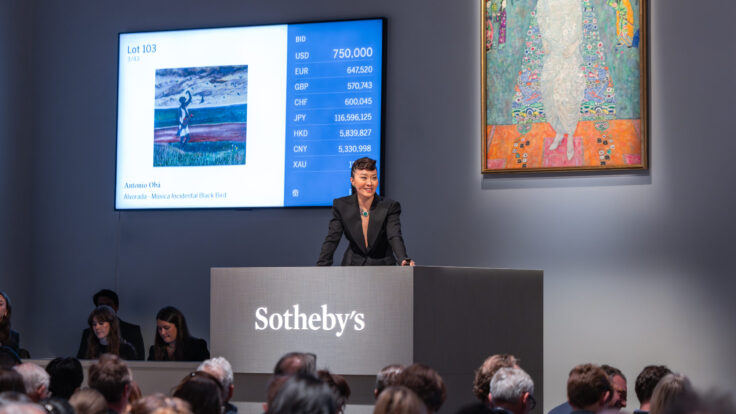
Welcome back to Wall Power. I’m Marion
Maneker.
Tonight, you’re in Julie’s good hands to hear more about the Coeur d’Alene Art Auction’s annual sale in about two weeks—the most visible event in a broad market for Western art. Julie also has a look at the Cecil B. DeMille auction at Heritage on Tuesday. Remember: If you have feedback for Julie, you can reach her at JDavich@puck.news.
|
|
|
A MESSAGE FROM OUR SPONSOR
|
ALWAYS CONTEMPORARY
With a bold silhouette that conveys movement even at standstill, the Range
Rover Sport is striking from every angle.
EXPLORE
|
|
|
 |
Julie Brener Davich |
|
On Tuesday, Heritage Auctions will hold a sale of 274 items from the legendary director
Cecil B. DeMille’s career, consigned by his granddaughter and grandson, Cecilia DeMille Presley and Joseph Harper. Estimated to bring in around $700,000, the offerings include a 1920s film camera, bound scripts, costumes, awards, props, and more, which are all being offered without reserve. DeMille’s career spanned four decades and 70 films, starting with The Squaw Man in 1914, which helped establish Hollywood as the epicenter of
moviemaking.
DeMille was known for sweeping historical and biblical epics like Samson and Delilah, The King of Kings, Cleopatra (the version from 1934, not to be confused with the 1963 Elizabeth Taylor remake), and, of course, the two versions of The Ten Commandments—the silent 1923 film and the 1956 version starring Charlton Heston, which still plays every year around Passover and Easter. “He is the guy who
created the Hollywood epic,” said Brian Chanes, who joined Heritage in 2021 as part of its acquisition of the L.A.-based auction house Profiles in History.
The top lot is a pair of tablets
made for promotional purposes for the 1956 version of The Ten Commandments. Estimated at $60,000, they’re made from red Mount Sinai granite and inscribed with the Ten Commandments in early Canaanite lettering. Also on offer is the pathé
camera that DeMille used to film The Squaw Man, which is estimated at $40,000. Heritage’s catalogue isn’t reserved about the film’s significance, claiming that “much of the triumph of the entire motion
picture industry hinged on the success of this one film.”
Other noteworthy lots include the storyboard for the parting of the Red Sea in The Ten Commandments, and DeMille’s 1952
Golden Globe for best picture for The Greatest Show on Earth—both estimated at $12,000. Famed typewriter collector Tom Hanks might eye the vintage
Underwood, estimated at $10,000, used by DeMille’s bookkeeper to type up the director’s longhand script of The Squaw Man.
In 1988, Christie’s auctioned more than 300 items from DeMille’s Hollywood estate, including
furniture and personal effects. According to a contemporaneous Times article, the sale made $710,919—almost $300,000 more than the highest estimated value. A money clip estimated at $100 made $1,870, and a turquoise and gold necklace worn by Anne Baxter in The Ten Commandments that was estimated at $2,000 made
$27,500. But, of course, that was 37 years ago, when DeMille’s career qualified as recent history.
|
|
|
The art scene of the American West, epitomized in the upcoming Coeur
d’Alene auction in Reno, is a thriving world apart from the otherwise dominant coastal art scene. And that’s fine with them.
|
|
|
Since its founding 40 years ago, Coeur d’Alene has been a major player in the field
of Western art, and its annual live auction weekend will take place in about two weeks at the Grand Sierra Resort in Reno on July 25 and 26. The two-day event is essentially one long party for attendees, who spend Friday previewing the works and attending a cocktail reception, before an early lunch on Saturday at around 10:30 a.m. (which in New York is called breakfast), followed by the auction.
The pace of the sale is quick—an average of one minute per lot, which means it will take about
five hours to get through all 354 lots. An open bar lubricates the proceedings; the come-one-come-all atmosphere means there are no skyboxes or reserved seats. Ringmen (or “yippers”) on the sidelines egg on the bidders—something more common in cattle auctions than their fine art equivalents.
|
|
|
A MESSAGE FROM OUR SPONSOR
|
ALWAYS CONTEMPORARY
With a bold silhouette that conveys movement even at standstill, the Range
Rover Sport is striking from every angle.
EXPLORE
|
|
|
Coeur d’Alene was founded by a trio of art dealers from the American West:
Peter Stremmel, Stuart Johnson, and the late Bob Drummond. (Mike Overby, a former gallerist, bought Drummond’s shares when he retired in the early 2000s.) As the market has come down from its 2008 and 2014 peaks, mirroring broader economic and art market trends, Coeur d’Alene has become more of a volume business. The number of lots they offer per auction has crept upward, with an average of 331 over the past decade, an increase
from 294 the decade before.
Meanwhile, their lot value has gone downward, from an average of $84,000 to $56,000 during the same period. Since Covid, they’ve also added dedicated online sales every November, which have grown rapidly. In 2023 they sold 67 lots in the online sale for about $645,000; last year they sold 241 lots online for about $3.8 million. But sales of works above $1 million have dropped, again mirroring the broader market. The most lucrative transactions are now happening
in private, and a lot of the best examples are in museums, so there’s less available for auction at the highest level.
Coeur d’Alene’s business is largely driven by collectors who made their money in the oil and gas sector. Many are based full-time in Oklahoma or Texas but own vacation homes in Montana, Idaho, or income-tax-free Wyoming. Several insiders explained that a growing number of coastal collectors are buying second homes in the West—and need art to decorate them. This demand is
helping to fuel the rising market for modern Western artists. Of course, you can also point to the popularity of Yellowstone or Beyoncé, but a Western ranch remains an enduring status purchase.
Overby, who oversees the historical section (1880-1940) in the sale, told me that bidder registrations for
this year’s sale are up 20 percent from the same time last year. I also caught up with Aviva Lehmann, head of American art at Dallas-based Heritage Auctions, who was on her way to see a client in Oklahoma City. “Western art is healthy and growing,” she told me, which is why they’re doubling down on the category and adding a dedicated Western art sale this November, in addition to the Texan art sales the house already holds. “There are some artists, like G.
Harvey, we could put six in a sale and get multiple bidders on each,” she said.
|
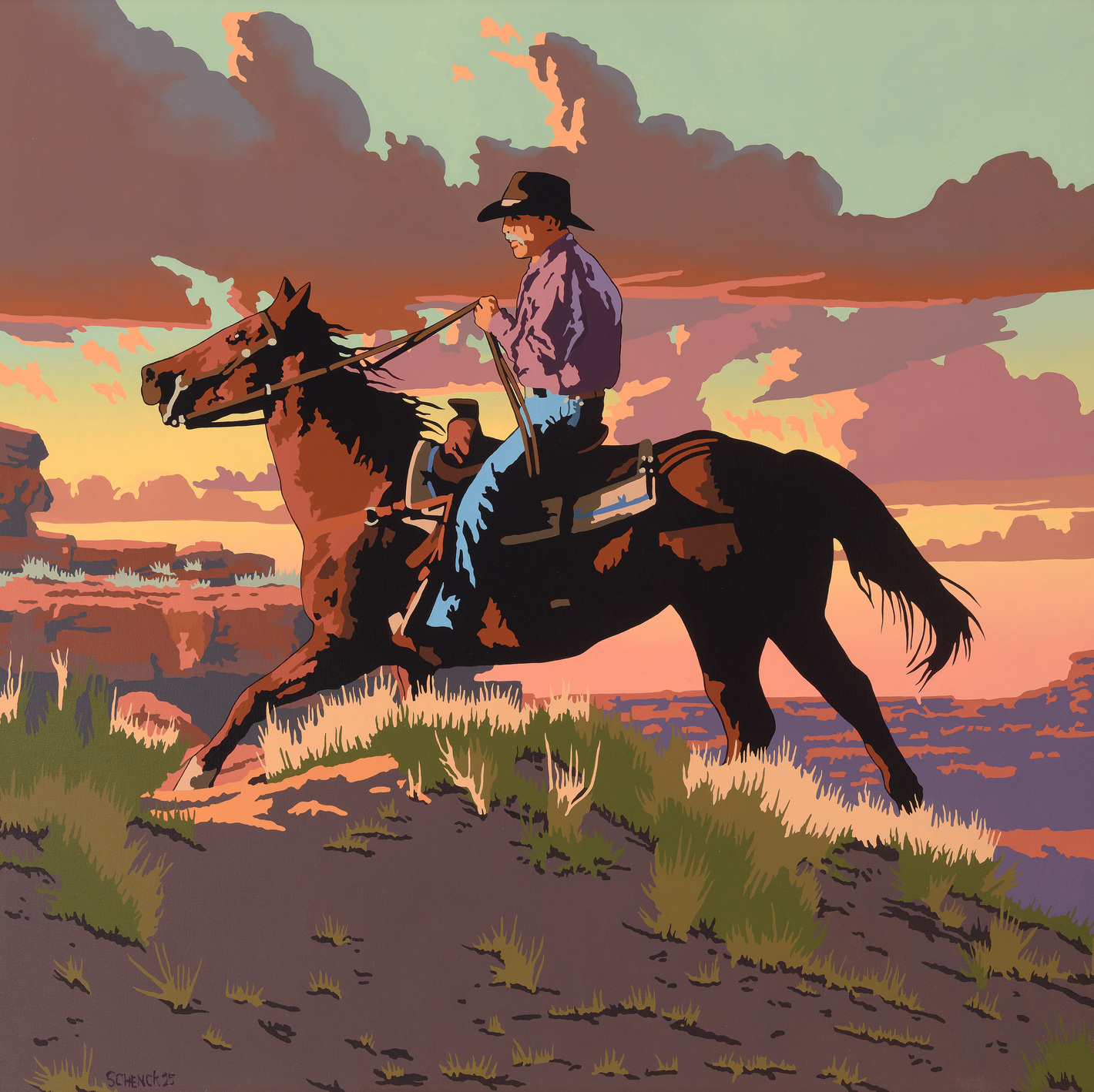
Billy Schenck, Strays Everywhere (2025). Photo: Courtesy of Coeur d’Alene
Art Auction
|
Coastal migrations aside, there’s also a generational shift shaping the market. In
short, Baby Boomer collectors who grew up watching Bonanza and Rawhide, and favor historical artists like Albert Bierstadt, Frederic Remington, Charles Russell, and the Taos Society artists like Joseph Henry Sharp, E. Irving Couse, and Walter Ufer, are finally downsizing. Their kids aren’t eager to inherit the work, and so they’re flooding the market and bringing down prices
for all but the very best examples.
When younger collectors do collect in the category, they tend to gravitate toward more graphic, modern works by the likes of Ed Mell, Billy Schenck, and Logan Maxwell Hagege. The buyers remain largely North American, with “international” usually meaning Canadian, but occasionally European collectors get excited by the offerings—like the Rembrandt
Bugatti sculpture of a small buffalo, estimated at $80,000, in Coeur d’Alene’s upcoming sale.
|
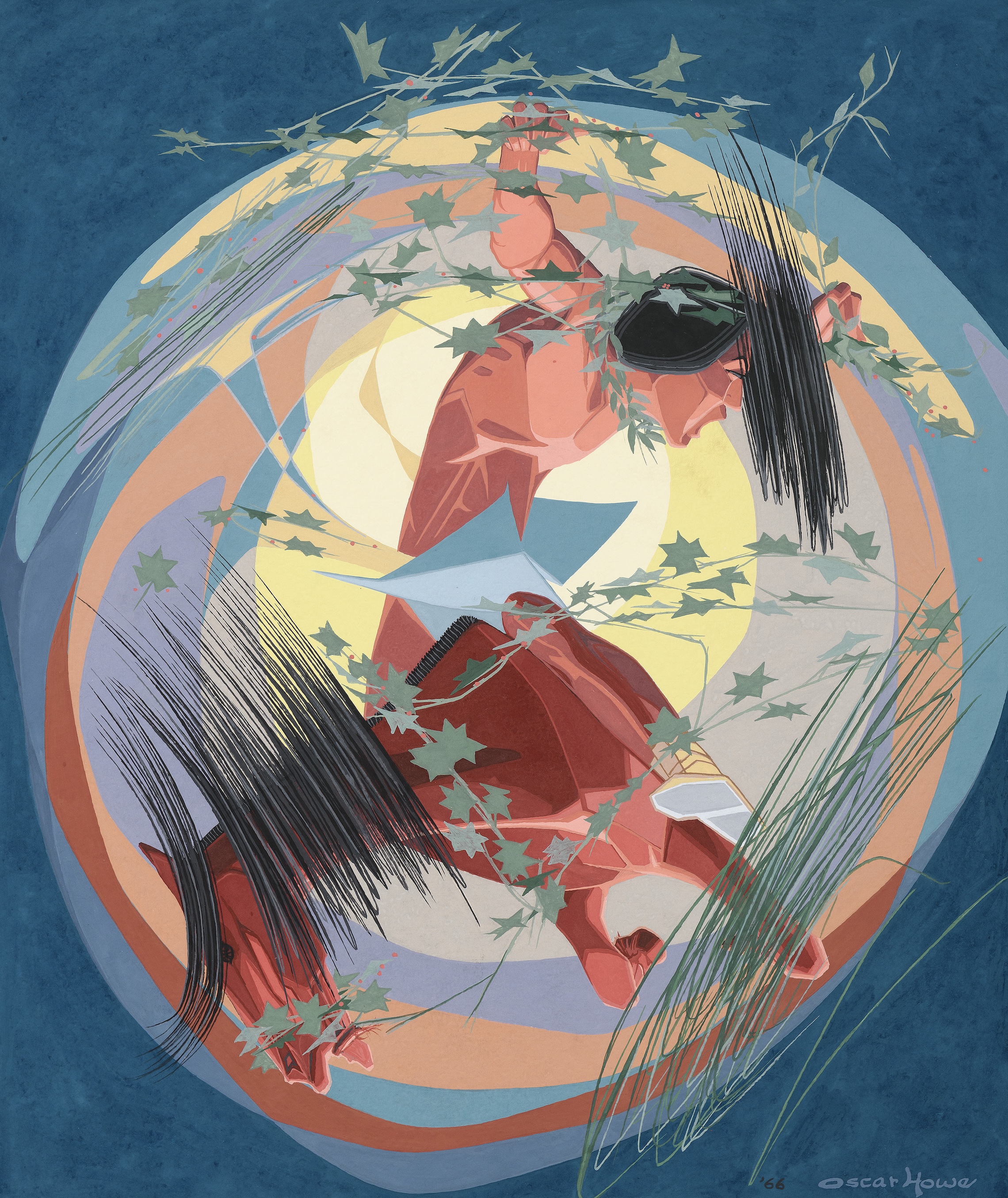
Oscar Howe, Dawn Rider (1966). Photo: Courtesy of Coeur d’Alene Art
Auction
|
In the past three or four years, Coeur d’Alene has seen an uptick in interest for 20th
century Native American artists like Fritz Scholder and Oscar Howe. This shift reflects both the broader diversification of the art world and the work that global houses—especially Bonhams—have done to grow the market for contemporary Native American art. Coeur d’Alene is offering a collection
of four Howe paintings in its upcoming sale, three estimated at $150,000 and one at $100,000.
|
The center of the Western art world’s gallery scene is in Santa Fe, where gallerist
Nat Owings has reigned for four decades at The Owings Gallery, along with Nedra Matteucci Galleries. “I’m paddle number one at Coeur d’Alene,” he told me proudly. (Owings’ father was the landmark architect Nathaniel Owings, a namesake of Skidmore, Owings & Merrill.) These galleries don’t seem to manage their artists’ career trajectories as the bigger New York galleries do, like arranging museum shows and brand deals, and preventing works from appearing at
auction, which can be risky to their primary market value and reputation.
|
|
|
Back in 2012, when Hagege was frustrated with his options for gallery representation,
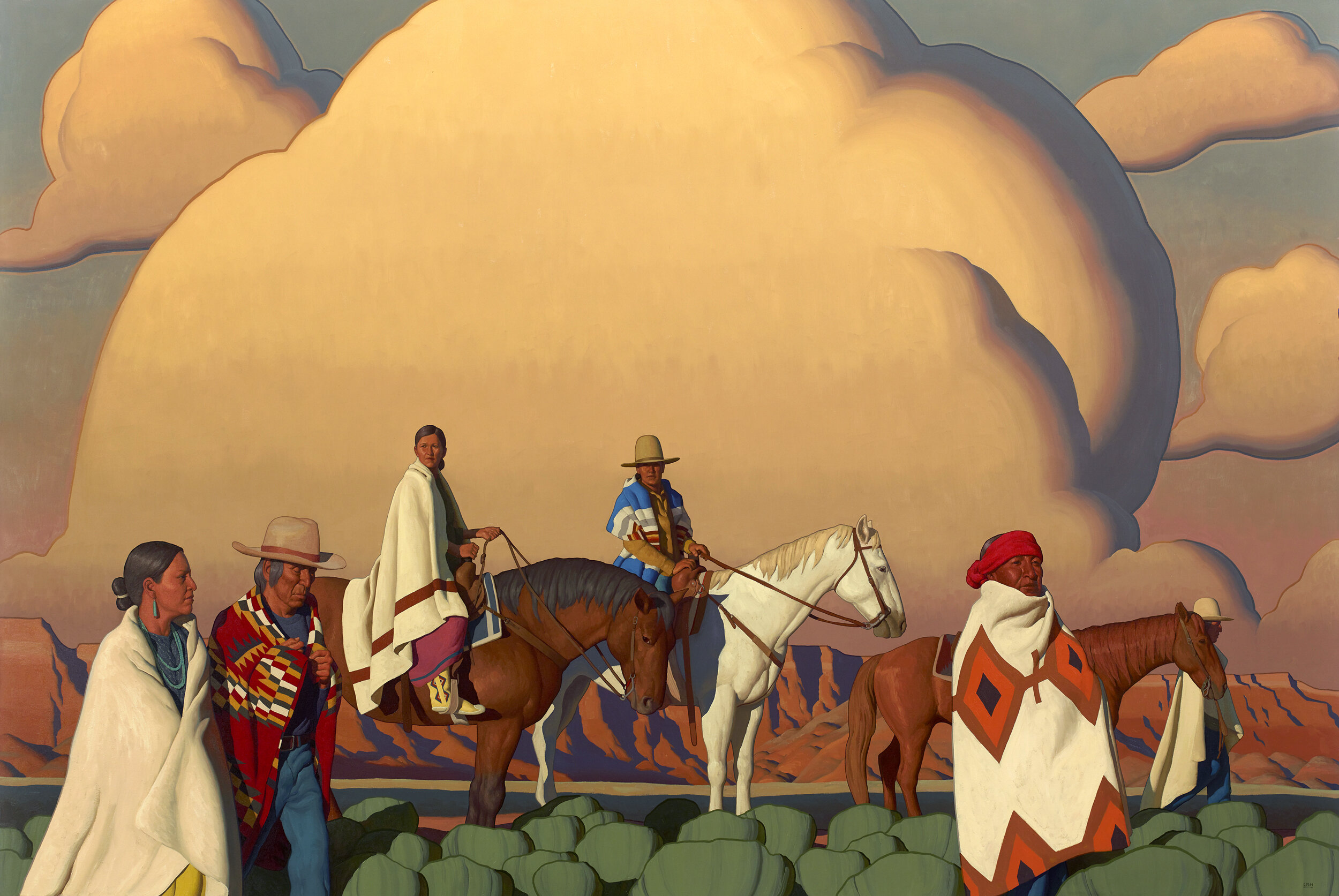
he and his brother Beau Alexander founded Maxwell Alexander Gallery in Pasadena. Hagege’s paintings now regularly command over $150,000 at auction, and he’s done brand partnerships with Stetson and Pendleton; he also has a solo show coming up next month at The Owings Gallery. The brothers offer collectors an alternative to Sante Fe with their contemporary “white cube” gallery space—not a stone hearth or cowhide armchair in sight. This weekend, they opened their annual Summer
Small Works group show, an accessible entry point for new collectors in the category.
|
Logan Maxwell Hagege, The Song at Sunset (2020). Photo: Courtesy of Maxwell
Alexander Gallery
|
Unlike
other contemporary artists, Western artists actually want to see their works at auction. Johnson, the Coeur d’Alene partner who oversees the contemporary offerings, also runs Settlers West Galleries in Tucson. He regularly puts “wet” paintings straight from his artists’ studios into the auction. There are 17 this year, including canvases by Schenck and Don
Oelze, and one of Rachel Brownlee’s realistic charcoal drawings, which were featured in last month’s Western Art Collector. This exposes the artists’ work to Coeur d’Alene’s thousand or so registered bidders, and hopefully makes a price that drives up their primary market. (Last year, one of Oelze’s paintings, estimated at $15,000, sold for
$166,600.) They are willing to pay a hefty seller’s commission for the privilege.
|
The Western art scene has its own annual calendar of must-attend events. In addition to
the Coeur d’Alene auction, there’s the March in Montana show in Great Falls every spring, and Prix de West in Oklahoma City in June. “It’s like Annie Oakley meets Gertrude Stein,” Lehmann said of Prix de West, “with cowboy hats and gowns, long hikes with horses, talking about art.” When I spoke with Overby and Lehmann, they both argued that New York is not the center of the Western art market.
Christie’s Tylee Abbott, whose family has a
ranch in Montana, said otherwise, pointing out that the highest-value works still come through their saleroom. Indeed, if Coeur d’Alene is a volume business, Christie’s offers a more curated selection, with an average lot value around $250,000, according to Abbott. But there, buyers are also paying a higher premium to acquire works, compared with Reno, where the buyer’s premium is lower: 21 percent up to $1 million, and 15 percent thereafter. Christie’s holds the records for the two most
expensive Western artworks ever sold: a Thomas Moran landscape for $17.7 million in 2008, at the market’s peak, and a Frederic Remington bronze for $11.2 million in 2017. Everyone I spoke to agreed that it’s unlikely we’ll see those kinds of prices in the category at auction again, at least not any time soon. But if the broader art market isn’t paying attention to this growing sector, perhaps it should be.
|
Thanks, Julie. More on Tuesday.
M
|
|
|
The industry's go-to source for unflinching reporting on the trillion-dollar business of artificial intelligence -
perhaps the single most important technology of our time. Ian Krietzberg, the powerhouse journalist behind The Deep View, delivers twice-weekly insights into the latest dealmaking and breakthroughs in A.I., and how the intersecting worlds of finance, entertainment, media, and politics are being transformed in its wake.
|
|
|
Finally, a media podcast about what’s actually happening in the media—not the oversanitized,
legal-and-standards-approved version you read online. Join Dylan Byers, Puck’s veteran media reporter, as he sits down with TV personalities, moguls, pundits, and industry executives for raw, honest, sometimes salacious conversations about the business of media and its biggest egos. New episodes publish every Tuesday and Friday.
|
|
|
Need help? Review our FAQ page or contact us for assistance. For brand partnerships, email ads@puck.news.
You received this email because you signed up to receive emails from Puck, or as part of your Puck account associated with {{customer.email}}. To stop receiving this newsletter and/or manage all your email preferences, click here.
|
Puck is published by Heat Media LLC. 107 Greenwich St, New York, NY 10006
|
|
|
|