Hello, sports fans. I’m Marion Maneker—and this is Wall Power, your four-times-a-week private email about the art world.
If you’re getting this email forwarded to you by a friend, colleague, or peer in the art industry, think about signing up for your own subscription. Not only does your subscription help us expand our coverage, but it will also give you access to some exciting new features we have planned for the future—especially if you become an Inner Circle member. That’s the tier where we conduct our most serious business.
Tonight, I’m going to take you on a field trip to Dasha Zhukova’s Ray Harlem, a red-brick apartment tower just off 125th Street that houses the National Black Theatre, as well as 222 apartments meant to create a community with art at its center. Julie Davich is also back from a visit to Jack Shainman’s upstate campus, The School. There’s plenty more detail below.
But first…
|
- Andrew Wolff closes the Artnet deal…: Andrew Wolff, the former Goldman Sachs partner who now runs Beowolff Capital (Beowolff, geddit?), has purchased 30 percent of the shares in Artnet from Rudiger Weng’s Weng Fine Art for €11.25 per share, yielding Weng Fine Art slightly more than €15 million. Beowolff now has 65 percent control over the company, and is requesting that Artnet be delisted from the German stock exchange with an offer of €11.25 for the remaining shares.
- … and reveals a stake in Artsy: As part of today’s announcement, Beowolff Capital also revealed that it has made a “majority investment in Artsy,” an online art marketplace. “These two transactions are foundational steps toward the creation of a portfolio of market-leading companies to enhance scale and drive collaboration and profitability,” Beowolff said in the statement, confirming some of the speculation that Wolff’s bid for Artnet was paired with an effort to buy Artsy’s debt at a deep discount. The company’s representatives offered no further details about the Artsy transaction.
|
|
|
|
A MESSAGE FROM OUR SPONSOR
|
A new campaign starring Julia Garner celebrates the House’s storied silk scarves and their enduring legacy within the House’s design codes.
DISCOVER MORE
|
|
|
 |
Julie Brener Davich |
|
|
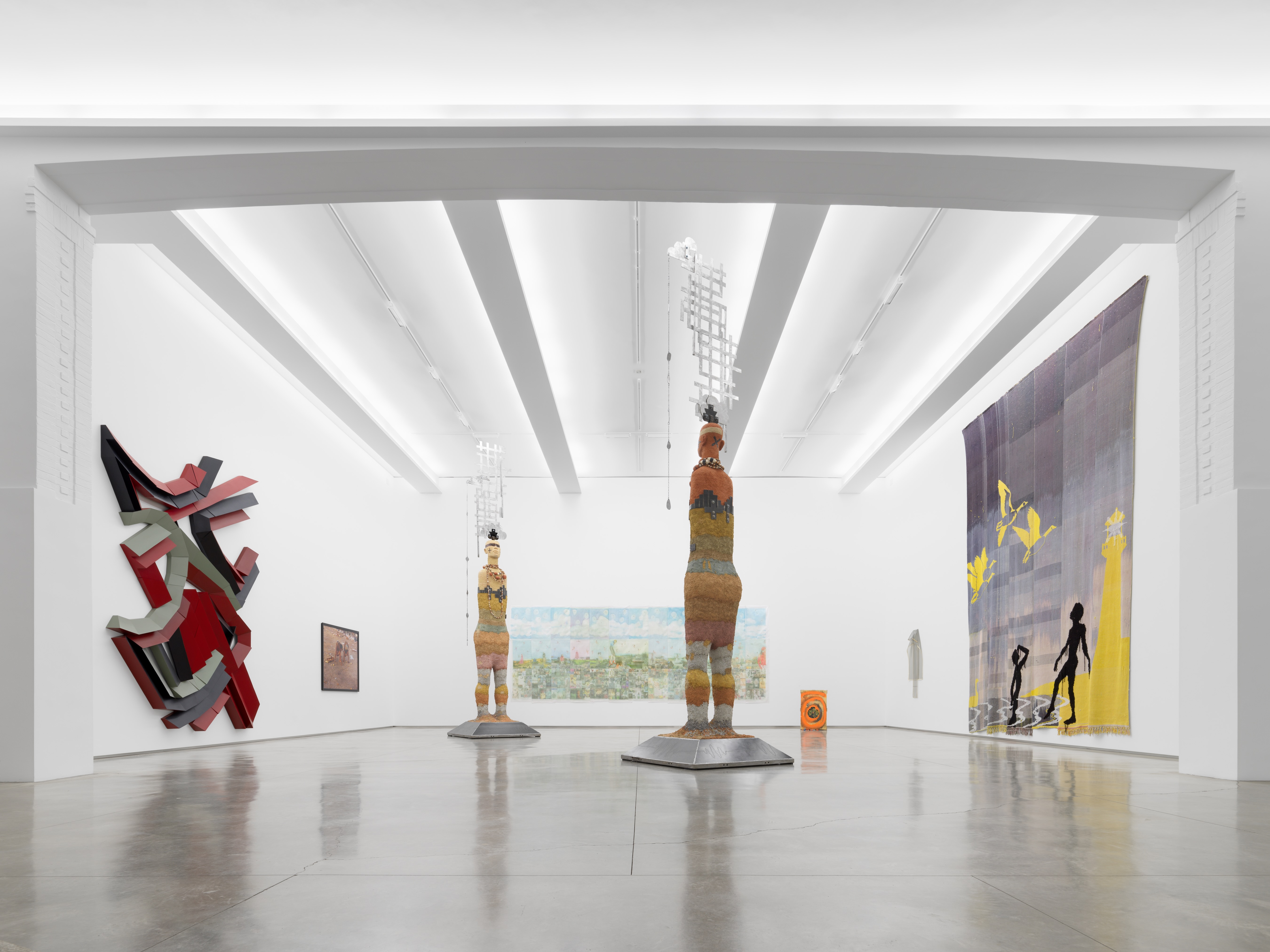
Installation view, General Conditions (2025), The School: Jack Shainman Gallery, New York. Photo: Dan Bradica Studio/Courtesy of Jack Shainman Gallery
|
|
When Jack Shainman was renovating the massive building that would become his new Tribeca gallery, his architect had a funny habit of fobbing off questions with a meaningless abstraction: “These are the general conditions.” Shainman held on to the phrase, which he considered the sort of hollow pablum that old-school hegemons might have used to justify their sway. Now the term has become the tenuous theme for this summer’s show at The School, Shainman’s gallery outpost in Kinderhook, near Hudson, about 90 minutes north of Manhattan. It befits the self-effacing dealer, who apologized for his jodhpurs when I bumped into him at the gallery this past Saturday.
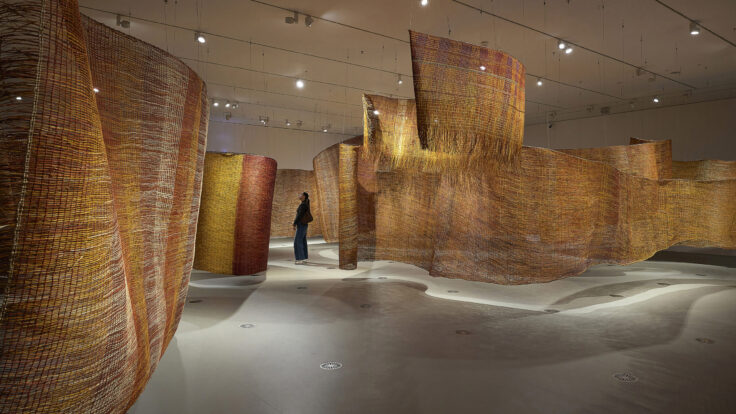
You may have heard the story of The School—Shainman bought the building in 2013 as a storage space, and ended up turning it into a three-story gallery. He dug down 10 feet in the lower level to show monumental artworks, like Rose B. Simpson’s 26-foot-high figures made from layers of clay, and the 15-foot-tall abstract wall installation by Brazilian artist Emanoel Araújo. The current show features 130 works by 29 artists, eight of whom are not on the gallery’s roster. Each of the artists questions the powers that be—the general conditions, as it were.
Richard Mosse, known for his use of infrared photography to document refugee camps, is represented with the 24-foot-long Skaramagas Camp, Athens, Greece (2016)—a digital c-print on metallic paper. Salt Lake City–based artist Jaclyn Wright’s art focuses on climate change as evidenced by the drying lake; her Desert Simulation (2025) is a multimedia installation of found objects from a firing range on an island in the lake. The paintings of gallery preparator Donyel Ivy-Royal, including how to stretch $20 for 2 weeks (i owe everything to you), from 2024, bracket the show. Shainman recommended that I also stop by September Gallery, Bill Arning Exhibitions, and the Shaker Museum outpost, which are all just down the street from The School in the one-intersection town of Kinderhook. But my daughter vetoed this idea in favor of lunch (we went to Quinnie’s).
|
|
|
|
Now let’s get to the main event…
|
|
|
|
Dasha Zhukova, the collector, philanthropist, and former society It Girl, has redefined herself by reimagining the role that art can play in working-class residential life. After a successful development in Philly, she just erected a new building in Harlem—with more to come in Phoenix and Nashville.
|
|
|
|
Dasha Zhukova, the art collector and museum benefactor, has discovered the joys of linoleum. “It’s a great material,” she told me as we toured the latest project developed by her real estate company, Ray, on 126th Street and Fifth Avenue in Harlem. She attested to linoleum’s wide variety of colors and patterns, all of which were versatile and inexpensive. The material is not quite a metaphor for Ray, but her appreciation of it speaks to her focus on a larger goal. The company, in Zhukova’s own words, is meant to demonstrate that “having cultural and social impact with financial success is both viable and essential.”
Linoleum’s utility also matters because Ray isn’t a luxury real-estate venture. Zhukova is trying to bring art and design out of her rarefied world and into the everyday lives of her tenants. That means having an aesthetic vision that is also fiscally achievable. Citing the lenders who made her real estate projects possible, Zhukova good-naturedly conceded, “No one is going to let us spend more to be creative.”
|
|
|
|
A MESSAGE FROM OUR SPONSOR
|
A new campaign starring Julia Garner celebrates the House’s storied silk scarves and their enduring legacy within the House’s design codes.
DISCOVER MORE
|
|
|
Ray Harlem is the company’s second real estate project built around the idea of living with art and artisans while also offering access to creative programming. Ray’s ideal tenant isn’t just someone who works in the plastic arts or a creative field; it’s someone who wants to be immersed in a community centered on art. Ray Philadelphia, the original 110-unit project, has become part of a neighborhood of makers in the area adjacent to Fishtown. The Harlem project, which just opened to renters, has 222 apartments. Next year, Ray Phoenix will open with 401 units in that city’s Roosevelt Row arts district. Ray recently broke ground on a building in Nashville that will rise 32 stories and contain 367 units. New residents should be moving in sometime in 2028.
|
|
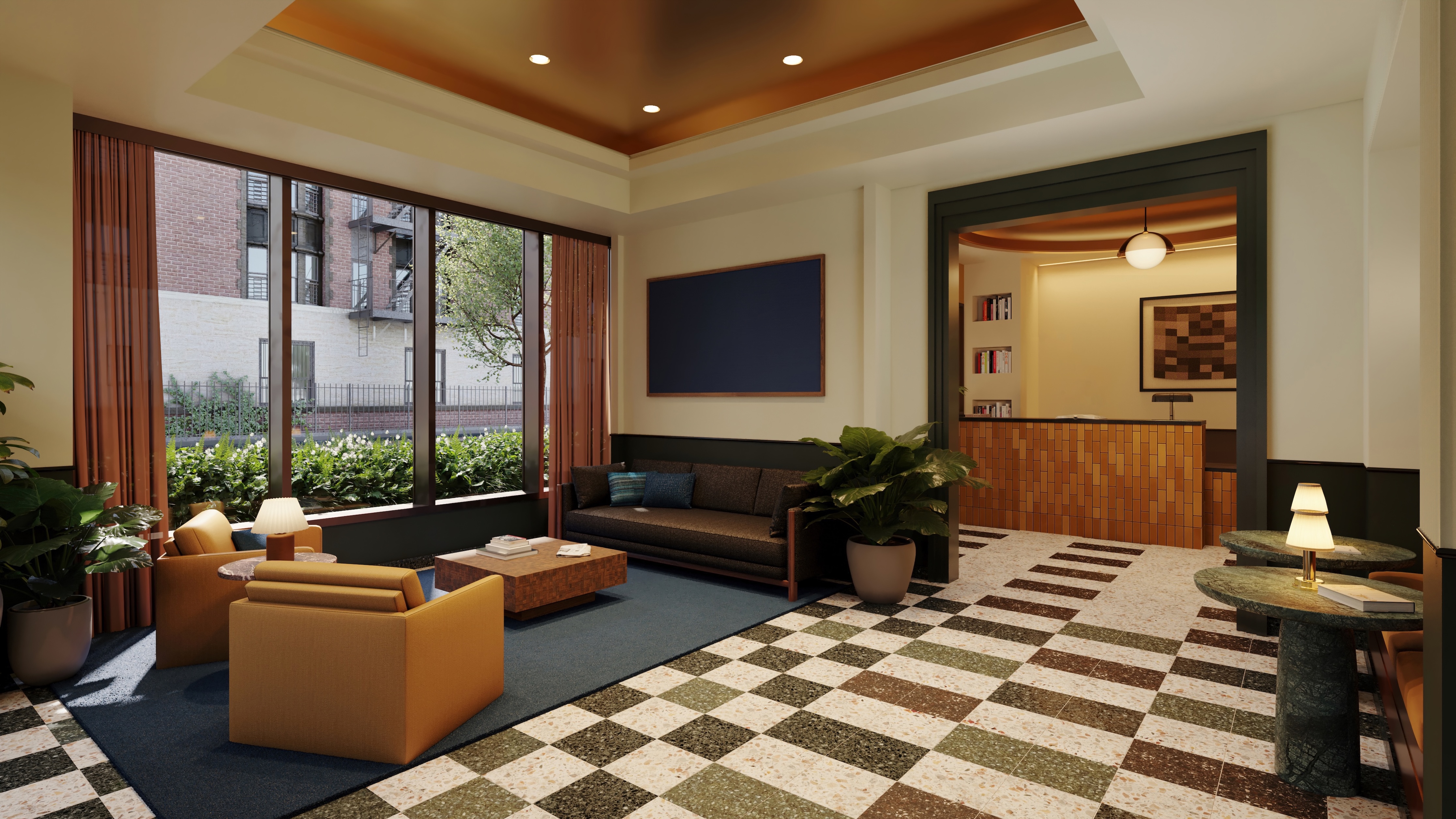
Rendering of lobby, Ray Harlem. Photo: Courtesy of Ray
|
|
When I asked Zhukova about her long-term vision for Ray, she said with disarming candor that she really wasn’t sure: She was feeling her way along, learning how to develop and program for the buildings once they were in operation. In Philadelphia, Ray has five artist studios incorporated into the footprint—and a rotating exhibition and event space. Events like collaging workshops and ceramics sessions led by a resident ceramicist have become an integral part of life at Ray. Zhukova says that curated, no-cost workshops for residents leads to a stronger sense of community and higher retention levels. In Harlem, though, it’s a whole different story.
|
|
Art, of course, is a central feature of Ray’s developments. But the endeavor goes beyond simply choosing art for public spaces, as some developers do to enhance the appeal of their buildings—a common sight in New York and Miami. It goes beyond even opening the interior of its buildings to rotating exhibitions, as with the 21c chain of museum-hotels. And Zhukova isn’t simply incorporating art from the artists she has relationships with—as, for instance, Hauser & Wirth does with its own artists at its hotels and restaurants.
Instead, Zhukova’s impetus to develop real estate comes from her experience building the Garage Center for Contemporary Art, in Moscow, starting in 2008. She noticed that people who visited the private museum were reluctant to leave, and she felt compelled to transport that experience to everyday life. “Why can’t we live like this?” she asked me rhetorically.
Obviously, Zhukova, who has an extensive art collection and sits on the boards of the Met and LACMA, lives with art in the way very few others do—she does, in fact, live like this. But I don’t think anyone would have guessed, after years appearing in party pictures as a jet-setter, that Zhukova would emerge as a figure doing the hard slog to actually figure out how to integrate art into more lives.
That’s what makes Ray so interesting. It addresses an unacknowledged issue at the center of the art world: Going to a museum or art gallery is not the ideal way to experience art. Art exists as something to live with every day—you shouldn’t have to have an epiphany, or an aesthetic experience, in the brief moment when you’re standing in front of an artwork at an exhibition. Ray is trying to scale art as an experience to a broader audience.
|
|
|
|
At Ray Harlem, which Zhukova says reached its first month’s target for new renters in the first two weeks, the apartments range from $2,700 per month for a studio to $4,800 a month for a two-bedroom. (A quarter of the units in the building have been set aside for below-market-rate housing.) That’s not cheap. Zhukova said the first wave of leases are going to professionals, from a variety of backgrounds, legal and medical; undergraduate and graduate students at nearby Columbia; and people in creative industries, both current Harlem residents and beyond. Of course, this is not the income bracket we generally associate with living with art.
|
|
My tour of Ray Harlem started with a quick run-through by Jonathan McCrory, the executive artistic director of the National Black Theatre—a Harlem institution, initially founded by Barbara Ann Teer in 1968 for Black actors and playwrights, that occupies the third and fourth floors of the building. NBT, now run by Teer’s daughter, Sade Lythcott, began working with Zhukova in 2019.
Ray has two entrances on the 126th Street side of the building, and sits on top of the National Black Theater and its two performance spaces: a 99-seat black box theater and a 250-seat “immersive technology performance space.” The latter is where McCrory says NBT, in addition to its other programming, will be able to mount ticketed performances that convey Black history and culture to tourists. Harlem is a major tourist destination for church services—and historic sites like Sylvia’s and the Apollo—but it currently lacks an easy-to-access venue for the culture of the African diaspora.
The 27,000 square feet of NBT’s two main floors also include classrooms, offices, and rehearsal space, and the basement houses a set-building shop where the company can train a new generation in the theater trades. The lobby and staircases of NBT, accessed on the 125th Street side, will be filled with commissioned works from artists like Sanford Biggers.
|
|
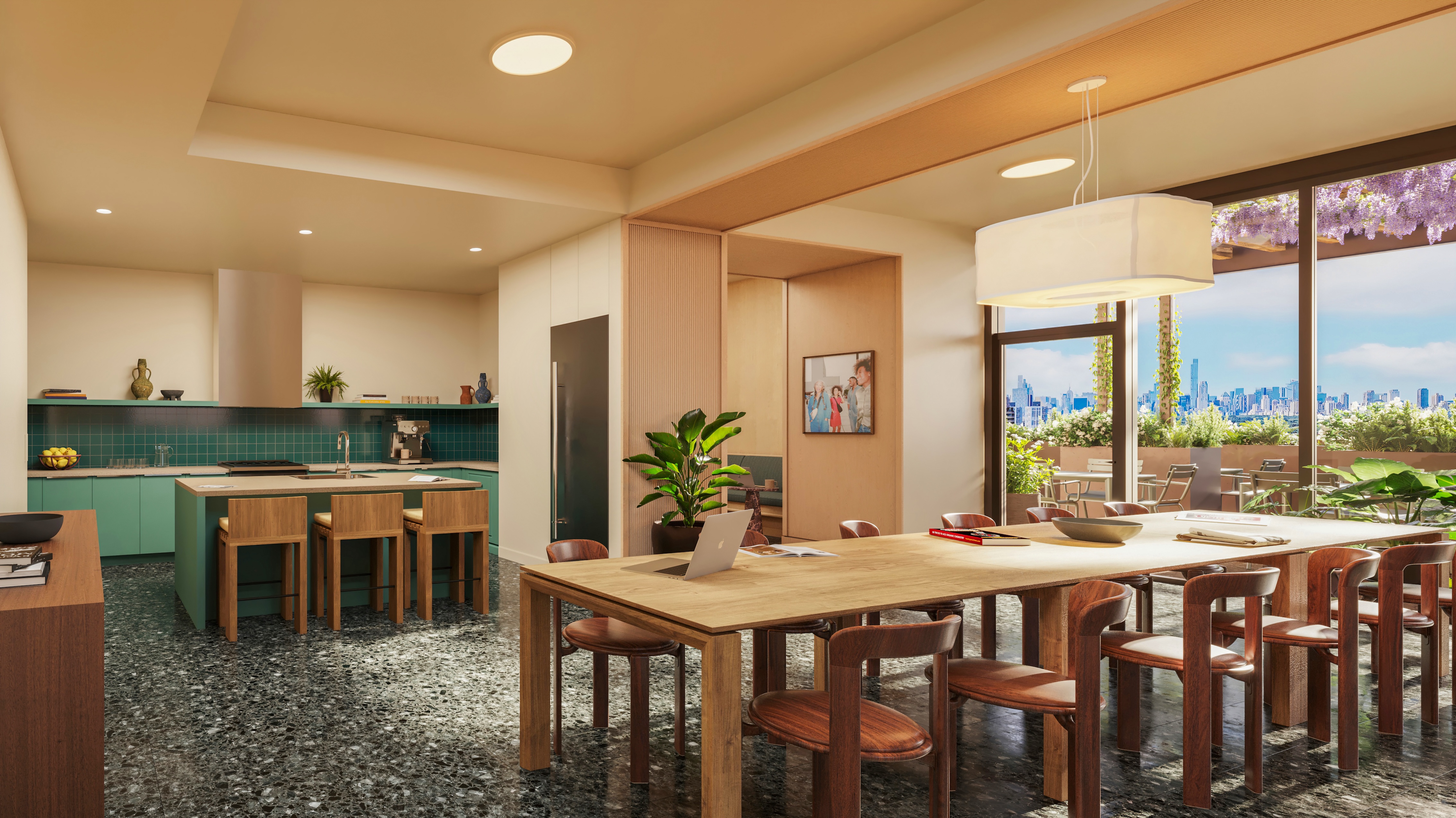
Rendering of rooftop lounge, Ray Harlem. Photo: Courtesy of Ray
|
|
African art has been central to NBT’s story. Teer had a connection to Nigeria, and the theater has several examples of artwork made by Osogbo artists in the 1970s. NBT’s connection to the Yoruba diaspora is so great that Zhukova, Lythcott, and Ray Harlem architect Frida Escobedo (working with Handel Architects) devoted a great deal of time to sourcing brick that would match the pink color of the clay in the Osun-Osogbo Sacred Grove, a UNESCO World Heritage site. (Linoleum can’t handle everything…) The brick also ties the 21-story building—whose height was the result of hard-won zoning changes—into the surrounding brownstones, whose shades vary from deep umber to a pinkish brown.
After our spin through NBT, Zhukova gave me the tour of Ray Harlem, toting a folder of printouts showing the paintings she’d chosen for the public areas. At each spot, she held up the sheet of paper with proper perspective and pride. Judging from the images of work by artists like Freddy Carrasco, Larissa Lockshin, Ellon Gibbs, Dylan Rose Rheingold, Nikko Washington, Michael Abel, and Jurell Cayetano, she had chosen good works, not trophy art. The details of the public spaces, designed by Little Wing Lee, are perfectly pitched to the nostalgic, organic modernism now so familiar to us all through Danish design. If you grew up in the ’70s, Ray has a familiar, homey aesthetic.
Zhukova showed me model apartments, an airy gym, light-filled hallways, a common “living room,” and a co-working/library space that was all curved edges and light woods. She was eager to get us up to the roof, where there are entertaining spaces that she hopes will be used by the artists and theater people. The view from the terrace puts an entirely different perspective on Harlem. To the east, I saw the Harlem River and the line of bridges that bisect its expanse. To the south, Marcus Garvey Park was lush and green, its new multicolored pool beckoning just two blocks away, and beyond lay the wide expanse of Central Park with rain clouds hovering. Rather than feeling gloomy, the view was peaceful, comforting, and cozy.
|
That’s it for today, folks. We’re back tomorrow with the Inner Circle, which will include an interview with Nick Acquavella and Jean-Paul Engelen.
Sign up for access here.
Until then,
M
|
|
|
|
The ultimate fashion industry bible, offering incisive reportage on all aspects of the business and its biggest players. Anchored by preeminent fashion journalist Lauren Sherman, Line Sheet also features veteran reporter Rachel Strugatz, who delivers unparalleled intel on what’s happening in the beauty industry, and Sarah Shapiro, a longtime retail strategist who writes about e-commerce, brick-and-mortar, D.T.C., and more.
|
|
|
|
Finally, a media podcast about what’s actually happening in the media—not the oversanitized, legal-and-standards-approved version you read online. Join Dylan Byers, Puck’s veteran media reporter, as he sits down with TV personalities, moguls, pundits, and industry executives for raw, honest, sometimes salacious conversations about the business of media and its biggest egos. New episodes publish every Tuesday and Friday.
|
|
|
Need help? Review our FAQ page or contact us for assistance. For brand partnerships, email ads@puck.news.
You received this email because you signed up to receive emails from Puck, or as part of your Puck account associated with . To stop receiving this newsletter and/or manage all your email preferences, click here.
|
|
Puck is published by Heat Media LLC. 107 Greenwich St, New York, NY 10006
|
|
|
|