Welcome back to Wall Power. I’m Marion Maneker—and this is Part Two
of What I Did on My Busman’s Holiday.
If you’re just joining us after the intermission, let me recap. On Sunday, I started telling you all what I did on my vacation last week. A large part of the Wallpower family loaded into the car and struck out for Maine to see a museum exhibition. On the way, we tried to visit as many museums as possible. Yes, that’s
my family doing on vacation what I do for a living—life imitating art, if you will…
As it happened, the trip coincided with the Trump administration’s escalating jihad on the “wokeness” of the Smithsonian, and, by extension, museums in America. So it seemed like a good moment to take stock of what’s happening inside a small but representative slice of art institutions up in New England.
In the
first installment, we visited Boston’s Museum of Fine Arts and Institute of Contemporary Art. Tonight, I’ll recount my trips to the Colby College Museum of Art and the Farnsworth Museum, both in Maine, against the backdrop of the political climate. There’s a lot of art to talk about, which I’ll do below the fold.
But first… |
-
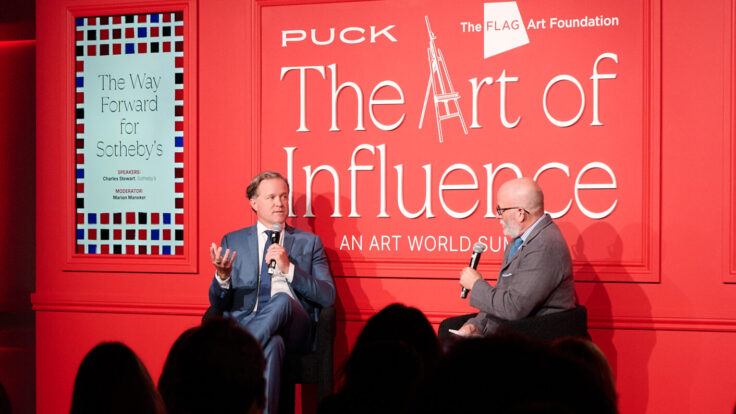
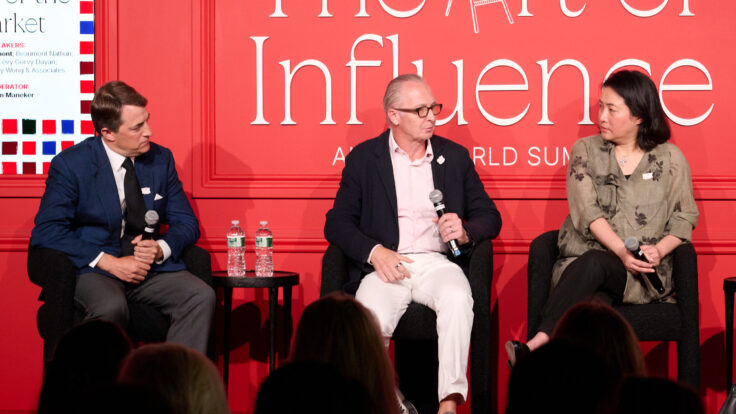
The Art of Influence summit is sold out: I am excited to be able to say that we have sold out the tickets for The Art of Influence on September 15. If you’ve bought a ticket, get ready for a very frank day of taking stock of the art world with Larry Gagosian, Nicolas Party, Charles Stewart, Dasha Zhukova, Michael Ovitz, Tom Hill, Glenn Fuhrman, Scott Rothkopf, Anne
Pasternak, Brett Gorvy, Wentworth Beaumont, Patti Wong—and, of course, everyone attending.
If you did not buy a ticket, we will be recording the sessions and presenting much of the content either as video in the Inner Circle or as transcripts in the newsletter. With luck, you’ll join us next time. - Wall Power x Independent on September 5: The Independent 20th Century is back at Casa
Cipriani at the Battery Maritime Building next week, and I’ll be moderating two panels on Friday, September 5. The first is a conversation with museum directors Nora Lawrence (Storm King Art Center), James Steward (Princeton University Art Museum), Cybele Maylone (The Aldrich Contemporary Art Museum), and Nicola Lees (Aspen Art Museum). The second is a talk with art dealers Jeanne Greenberg Rohatyn, founder of
Salon 94, and Alma Luxembourg, partner at Luxembourg + Co. Interested in attending? Email Fritz@puck.news to secure your spot.
|
|
|
A MESSAGE FROM OUR SPONSOR |
The first steps towards a masterpiece starts with a dream. The all-electric BMW i7 – the
evolution of brilliance. Learn more at BMWUSA.com |
|
|
- Amon Carter Museum’s director steps down: Fort Worth’s Amon Carter Museum announced yesterday that Andrew J. Walker, its executive director of 14 years, will be leaving at the end of the month. Scott Wilcox, the museum’s chief operating officer, has been named interim executive director while the board conducts a search for a permanent replacement.
In its release announcing Walker’s departure, the museum praised his leadership through
a 2019 expansion that renovated the existing galleries and added new space for special exhibitions. The release also credited Walker with leading acquisitions of works by American artists like Ruth Asawa, George Bellows, Dawoud Bey, Mary Cassatt, Gabriel Dawe, Richard Hunt, Norman Lewis, Glenn Ligon, and John Singer Sargent, and with
spearheading “the museum’s collecting initiative dedicated to amplifying Indigenous artists’ contributions to American visual identity through the history of photography, which saw the addition of artwork by more than 10 Indigenous photographers including Tom Jones, Shelley Niro, Cara Romero, Sarah Sense, and Hulleah Tsinhnahjinnie.” - Ugh, it’s O’Leary: Over the
weekend, someone paid nearly $13 million for the Kobe Bryant–Michael Jordan Dual Logoman card at Heritage. It was a record price for a sportscard, and looked like another breakthrough moment for the hobby, which has gathered so much momentum this year. Early Monday morning, Canadian entrepreneur, crypto booster, and Shark Tank talking head Kevin O’Leary
revealed on CNBC’s Squawk Box that he was a part of the investor group that acquired the card.
The announcement brought to mind the deflating let-down that the art market experienced when it was revealed that Justin Sun, another crypto booster, had bought Maurizio Cattelan’s Comedian, the
banana-and-duct-tape conceptual artwork, for $6.2 million—paid, naturally, in cryptocurrency. In case you were wondering, the memecoin that was launched alongside that record sale last November still has a market cap of $85 million, with some $14 million in trading volume just in the last 24 hours.
O’Leary and his partners—Matt Allen (known by his Instagram handle,
Shyne150) and Paul Warshaw—didn’t reveal whether they paid in fiat or crypto. But Allen did announce on his IG account the launch of a new company, Secure Collectibles, which has the strapline, “Lending, Private Sales, Sourcing.” So, as with the record-setting $10 million sale of the Birkin bag prototype, the buyer isn’t a collector, but someone promoting a business in the collectibles
space.
On CNBC, O’Leary discussed his interest in the collectible asset class. He said that the card will go into an “index” that he’s “going to continue to grow along with my partners”—which makes it sound more like he’s creating a fund or investment vehicle than an actual index to track trading values. In any case, O’Leary made it clear he was not, himself, a true believer in sports collectibles. At the end of the interview, he told Andrew Ross Sorkin: “The
people I’m meeting in the hobby are truly crazy.”
|
|
|
On a drive through Maine’s mashup of liberal arts college towns and
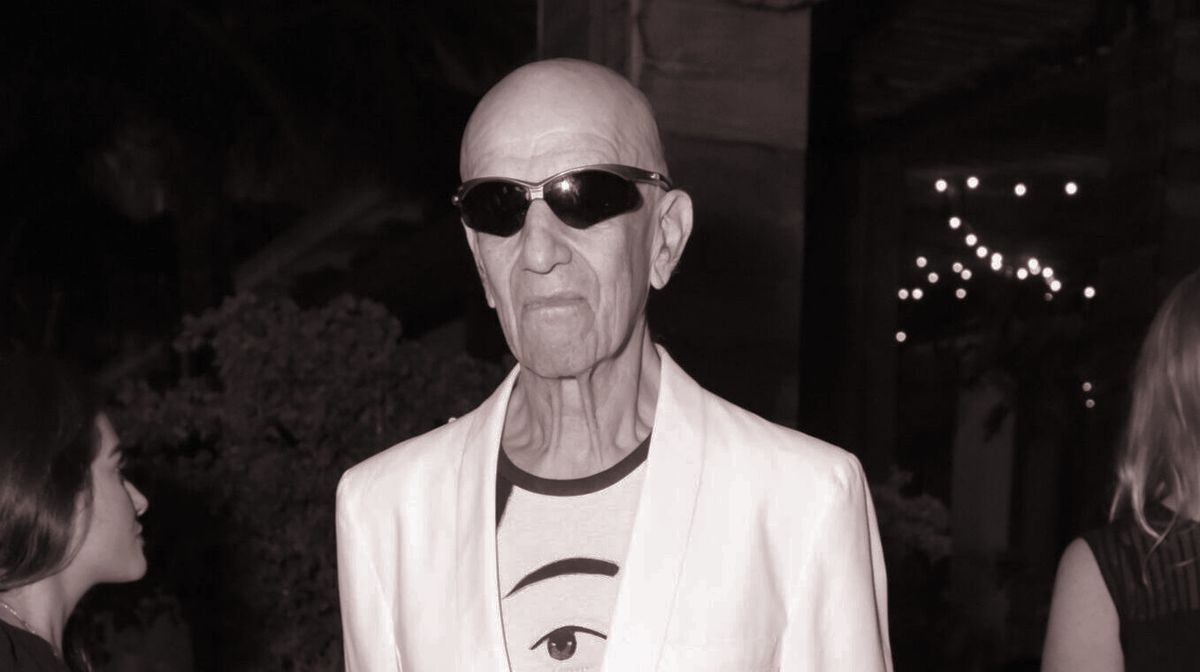
Trump Country, we saw a marvelous Gertrude Abercrombie show, admired Ann Craven’s sunsets along with the real thing, and ran into Alex Katz holding court at the Colby College Museum. |
|
|
One of the charms and frustrations of the Maine coast is how two places that are
short distances from each other, at least as the crow flies, can easily be a 30-to-50-mile drive. That makes it no small adventure to drive out for oysters and lobster rolls in Portland’s Old Port, but it also means that staying on Westport Island can feel like you’ve flown to Scandinavia. The other quirky thing about Maine is how it packs rural red-state folks so tightly in with blue-state retirees and summer residents—in Wiscasset, a black cutout of a cow, nailed to a farm fence and painted
with white letters spelling T-R-U-M-P, marked the turnoff to the island, where we stayed in an 18th century inn on a fjord-like inlet.
When we set out away from the coast and up toward Waterville, the last vestiges of the blue states disappeared until we rolled into Colby College. A small liberal arts school with fewer than 2,400 students but acres of playing fields and new dorms under construction in time for the fall semester, Colby has a 7 percent acceptance rate; a 2-year-old, $95
million performing arts center; and a museum that was founded in 1957, but expanded multiple times. One newer wing, built in 1996, houses some 900 works of art by painter Alex Katz, a summer resident of Maine since 1954. |
|
|
A MESSAGE FROM OUR SPONSOR |
The first steps towards a masterpiece starts with a dream. The all-electric BMW i7 – the
evolution of brilliance. Learn more at BMWUSA.com |
|
|
Katz isn’t only a featured artist at the museum, he’s also a major supporter: His
foundation has donated nearly 500 works by contemporary artists. Before we entered the Gertrude Abercrombie show we had come to see, the Wallpowers took a turn through a permanent collection that included works by Joan Mitchell, Carmen Herrera, Al Held, Maya Lin, Bob Thompson, Alice Neel, Francesco Clemente, Lois Dodd, Etel Adnan, Faith
Ringgold, and so forth.
Colby has large holdings of American art, which have been enhanced with examples by Black and Indigenous artists. As we saw in Boston, the galleries were hung with a counterpoint of works, like Pueblo pottery from the Southwest near a beaux arts bronze of a pioneer mother holding a rifle in one hand and a small child in the other. Some of the works are contemporary to the ones beside them; others comment from a distance of decades or
centuries.
Where a work wasn’t available to comment, the wall text took over. Some were written by students (a clever idea at a college museum) and others by relevant voices. For example, one card hanging beside a 19th century depiction of Mount Katahdin—Maine’s tallest peak and a sacred site to the Abenaki tribe—was simply a complaint about the cultural ignorance of the image, pointing out that the conventional spelling of “Katahdin” ignored the basics of the Wabanaki language. This was
written by a prominent Indigenous figure, which gives you a sense of what the university’s museum was trying to accomplish—exposing their students to other viewpoints that may be legitimately antagonistic.
This is the kind of thing, I would venture to guess, that drives the MAGA crowd nuts. But the point of pluralism is to balance the needs of different groups, rather than impose a blinkered American boosterism. In the context of a college museum, this makes sense and should be celebrated
or, at least, encouraged—certainly tolerated. Viewed from the other side, you can see how too many see this open-mindedness as negativity. In the current climate, that leaves everyone vulnerable to attacks from MAGA and the administration. How long until elite and expensive schools like Colby begin to worry about their exposure—and whether their donors will back them up? |
We weren’t in Waterville to worry about MAGA. We had come to see the retrospective of
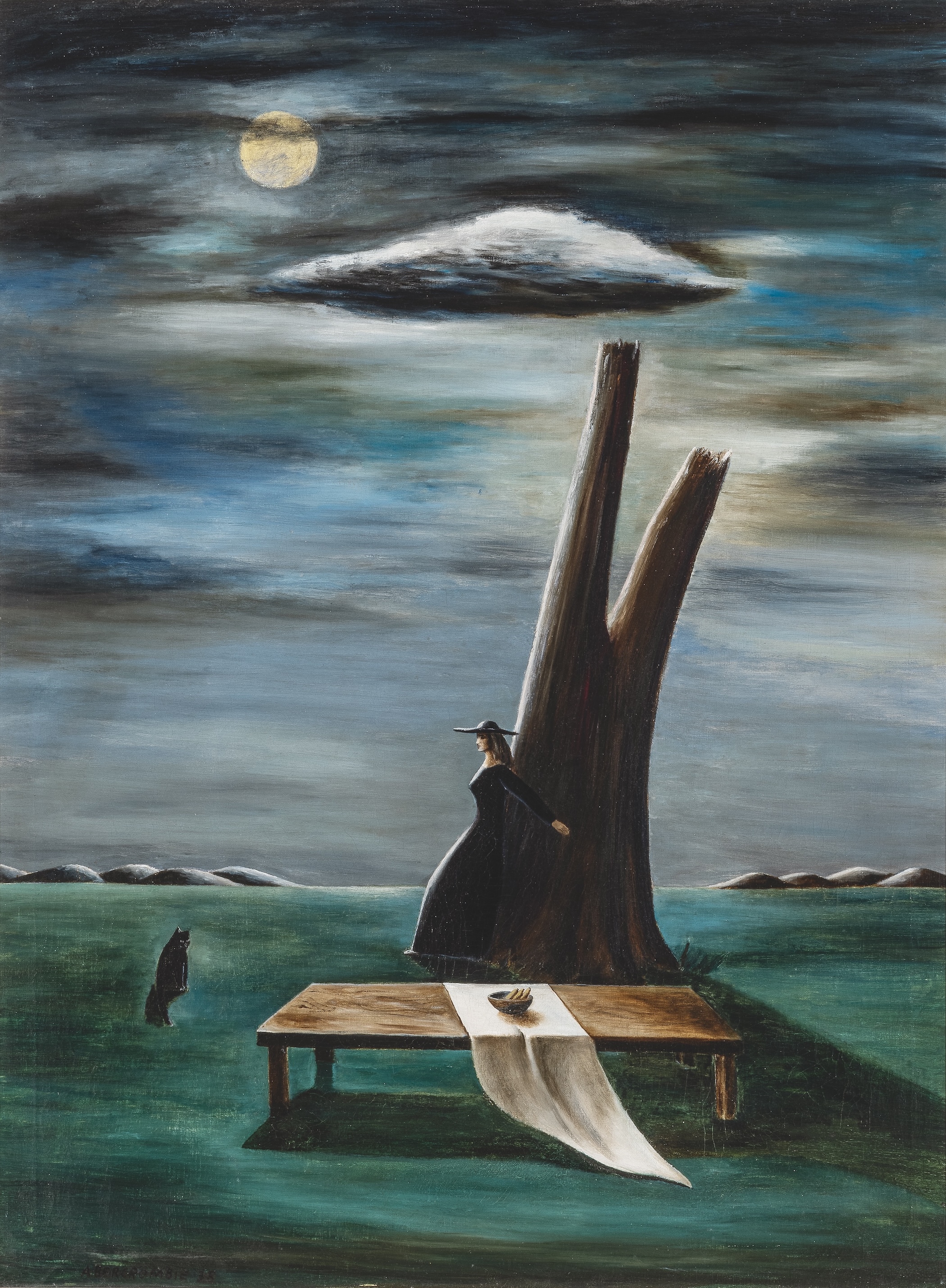
Abercrombie’s haunting surrealist works. Her distinctive subject matter of barren, often moonlit landscapes—painted in signature teal-and-aquamarine tones featuring fractured trees, lonely figures—and the occasional cat or owl have made her the patron saint of witchy women everywhere. |
Gertrude Abercrombie, Tree, Table, and Cat (1937). Photo: Michael
Tropea/Courtesy of Colby College Museum of Art |
The daughter of two itinerant opera singers, Abercrombie led a hard but free-spirited
life in Chicago’s midcentury jazz community. (Dizzy Gillespie played at her second wedding in 1948.) But ill health, alcoholism, and limited success as an artist diminished her output after the ’50s, and she made few works until her death in 1977. The show’s own marketing emphasized itself as a celebration of Abercrombie’s “marginalization” due to “who she was and how she lived and worked.”
One doesn’t have to see Abercrombie’s difficulties or bohemianism as a result of
her marginalization to be entranced by her art. Even though she was painting at the height of American modernism, with its heroic abstraction, her work clearly fits in the surrealist vein of René Magritte and Giorgio de Chirico, to cite European influences, or the work of Hughie Lee-Smith and Edward Hopper, to go the American route. A few years ago, the Art Institute of Chicago
hung its famous Hopper image of lonely figures at a diner, Nighthawks, from 1942, in between a work by Abercrombie and one by Smith. Yes, Smith was a Black artist and Abercrombie was a woman, but it doesn’t take more than a few seconds of observation to understand that the paintings all look better together. |
|
|
Here in Maine, the show was a marvel. There’s not a huge change in Abercrombie’s work
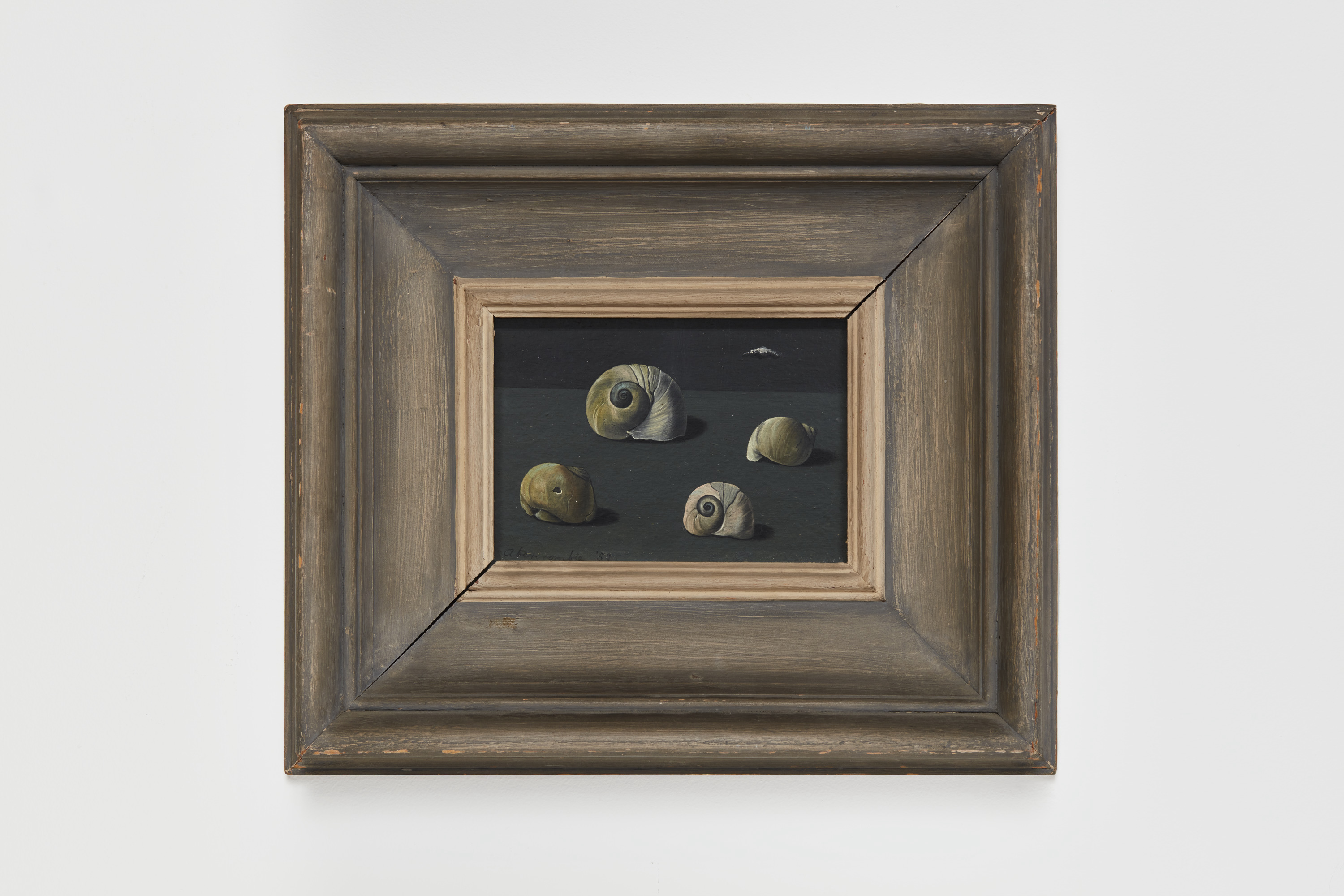
over the course of her quarter-century career. But there are real differences as her work becomes smaller and more surreal. Abercrombie is one of the few artists whose smaller works attract a premium, and one of the show’s delights is a vitrine of tiny paintings depicting still lifes of fruit bowls, a jack, or seashells—some only 1 inch square—that are mounted in tiny frames and could be worn as brooches. |
Gertrude Abercrombie, Four Shells (1952). Photo: Courtesy of Ortuzar
Projects/Colby College Museum of Art |
As we wandered the exhibition, a group of eight or more museumgoers shuffled down a set
of stairs toward the wing featuring Alex Katz’s work. They were boisterous and clearly comfortable in the place, which made sense, because among the group was the 98-year-old artist himself along with one of his grandsons, who now plays a role in his studio. Katz was still holding court before the gaggle of twentysomethings and museum staff when we wandered through the wing half an hour later. On display were a number of his works, ranging from full-length but small-scale aluminum cutout figures
(painted like portraits front and back) floating on tiny sticks, to the sparse botanical etchings that Katz was explaining to his crew. And then there were Katz’s massive paintings of friend groups, double portraits, landscapes, and even flowers. Katz’s sunny subject matter sometimes means his talent as an artist gets overlooked. Up at Colby, his range and originality really shone through. |
It’s more than an hour’s drive from Waterville back down to Rockland, where the
Farnsworth Museum takes up a couple of blocks of downtown real estate, including a substantial retail footprint. (Vacationers and museumgoers like their souvenirs.) We missed out on burritos at Wiley’s because they had sold out by the time we arrived. Nevertheless, we lunched well at Atlantic Baking Company across the street. Inside the Farnsworth, which has a separate building devoted to works by several generations of the Wyeth family, we saw the same thoughtful juxtaposition
of American artists—all with some connection to Maine—that we enjoyed in Boston and at Colby. The pluralism—a less-charged word than multiculturalism—of museums is orthodoxy, not an exception.
We also saw a show of Ann Craven’s paintings—part of a four-pronged exhibition of the artist’s work being presented in Maine this summer, including related museum shows at the Portland Museum of Art and Bowdoin College’s museum. Craven’s dealer, Karma, also had a pop-up in Thomaston
to capitalize on the interest the shows might generate. And we all know the current state of the art market means galleries have had to get creative.
Craven is mostly known for her paintings of moonlight landscapes, flowers, and birds. Here the themes often merge with birds painted over background images of large flowers, or birds in moonlight. A number of the paintings were shown in near-identical images that the show wants us to accept as a kind of “conceptual framework.” I’m not sure
the show or Craven needs the critical boost. Her work is impressive and leaves a lasting afterimage in one’s memory—like some of Katz’s scenes, it’s faithful to the Maine sunsets we observed, the kind that make you stop the car and get out to marvel at the glow through the trees with the inlets behind. Art doesn’t have to be realist to capture reality.
Also featured at the Farnsworth was Anne Buckwalter, a painter who depicts interiors in a very 19th century style, mixing
complex patterns from wallpaper and rugs with flat perspective objects. You might confuse her work with naive period paintings, except for her cheeky depictions of sex, reflected in mirrors, glimpsed through doorways, or shown in paintings within the work. Buckwalter’s sexual imagery at this point looks less provocative than cringey, which takes nothing away from her skills and inventiveness. In a gallery setting, you might easily chuckle and wonder who buys some of the more explicit
works. In a museum, it seems hard to sustain claims of her edginess when the culture is so suffused with sexuality that pornography is increasingly just another medium.
In any case, MAGA hasn’t really come for these museums so far. But if the first salvos at the Smithsonian prove successful, I’m sure we’ll see efforts to pick fights with some of the more challenging and provocative museum shows, as Rudy Giuliani did 26 years ago with the Sensation show at the
Brooklyn Museum. But I’m not sure I see where there will be enough outrage to get anyone interested. Art remains a very small category with limited appeal to the MAGA base. |
That’s it for today, folks. I’ll be back tomorrow with my recounting of the New
Yorker story heard round the industry.
M |
|
|
The ultimate fashion industry bible, offering incisive reportage on all aspects of the business and its biggest
players. Anchored by preeminent fashion journalist Lauren Sherman, Line Sheet also features veteran reporter Rachel Strugatz, who delivers unparalleled intel on what’s happening in the beauty industry, and Sarah Shapiro, a longtime retail strategist who writes about e-commerce, brick-and-mortar, D.T.C., and more. |
|
|
Finally, a media podcast about what’s actually happening in the media—not the oversanitized,
legal-and-standards-approved version you read online. Join Dylan Byers, Puck’s veteran media reporter, as he sits down with TV personalities, moguls, pundits, and industry executives for raw, honest, sometimes salacious conversations about the business of media and its biggest egos. New episodes publish every Tuesday and Friday. |
|
|
Need help? Review our FAQ page or contact us for assistance. For brand partnerships, email ads@puck.news. You received this email because you signed up to receive emails from Puck, or as part of your Puck account associated with {{customer.email}}. To stop receiving this newsletter and/or manage all your email preferences, click here. |
Puck is published by Heat Media LLC. 107 Greenwich St, New York, NY
10006 |
|
|
|