 |
 |
|
Hi, and welcome back to Line Sheet. The best thing about living in L.A. is that, even on these very hot days, it cools down enough at night to shut off the air conditioning.
Today, I’ve got the latest on Condé Nast’s renewed global ambitions—there have been a couple legal hiccups, ruh roh!—plus some news from Milano. Seems that there is about to be yet another designer changeup. And while we’re on the subject, at least one of the major creative director appointments will be announced soon, right? Or has time stopped? Also on offer: a sprinkling of what’s coming, Olympics-wise.
🚨🚨 Programming note: On tomorrow’s episode of Fashion People, I’m joined by Casey Lewis, author of the must-read newsletter After School, to talk all things Gen Z. We got into Gap, Abercrombie, Brandy Melville, Garage (heard of it?), and a whole lot more. Also, Puck’s resident branded-vest expert, Dylan Byers, stops in for a quick review of the fashion at the Allen & Co. conference. Dylan’s on the ground in Sun Valley, reporting on important things, but none as important as Stacey Bendet Eisner’s crazy-lady outfits. (You have to love—and laugh.) Subscribe here not to miss it.
Also: subscribe to Puck not to miss me, or anyone else!
Mentioned in this issue: Sun Valley Fashion, Barry Diller, David Zaslav, Diane von Furstenberg, Lauren Sánchez, Josh Kushner, Karlie Kloss, the Paris Olympics, Condé Nast, Roger Lynch, Anna Wintour, Vogue China, Margaret Zhang, Missoni, LVMH, Oprah, François-Henri Pinault, Alexandre Arnault, mesh flats, Stacey Bendet Eisner, Jack Schlossberg, and many more…
|
|
A MESSAGE FROM OUR SPONSOR
|
 |
| Away’s been committed to making travel more seamless since 2016. Now, we’re changing the game again with our all-new Softside suitcases. You don’t have to sacrifice style for function just because you prefer a softer bag — we’re finally bringing you a stylish, flexible option with the same meticulous attention to detail, lightweight durability, and iconic design as our hardshell bags that are loved by millions. (And they’re backed by a lifetime warranty!) Find yours at awaytravel.com. |
|
|
|
|
- The Sun Valley promenade: No runway? No problem! The annual Allen & Co. conference in Sun Valley may be the provenance of big deals, but the outfits are scrutinized almost as closely these days. As mentioned, Dylan is joining me tomorrow on Fashion People to break down all the looks, but you won’t be surprised to hear that GLP-1s are the most popular accessory. These people are collectively much skinnier than they used to be! As for what they’re wearing? I spent way too much time perusing Getty Images to bring you the essential intel.
Stacey Bendet Eisner, the designer of Alice & Olivia (and wife of Eric Eisner, son of former Disney C.E.O. Michael Eisner), is really something. She might have trouble getting editors to come to her NYFW events (it’s a busy time), but she certainly doesn't have trouble getting people to look at her Idaho getups, which this week included a head-to-toe, floor-sweeping red ensemble (very Carmen Sandiego), and a white denim cowgirl set covered in black scribbles that was aptly described as, “Daft Punk f*$#@d a cowboy.” (You can guess who said it.) Her star accessory? A matching Stanley water cup.
The award for best dressed definitely goes to Oprah, who killed in head-to-toe Phoebe Philo (this top and these jeans, but in white) and a pair of Gabriela Hearst-era Chloé sneakers. Shout-out to Barry Diller and his printed blouse; Diane von Furstenberg, his wife, should be voted most classy. (Pretty sure her pants are High Sport.) Other notable moves: Bryan Lourd in a denim shirt (so funny how everyone gets thematic), Lauren Sánchez looking cute in a fitted knit skirt (not Chanel, almost definitely vintage, maybe Moschino?) and carrying a pink Louis Vuitton bag. Speaking of cute, Cutest Couple goes to Josh Kushner (loved the forest green sweater) and Karlie Kloss (great sandals). Keep me updated on what they’re up to!
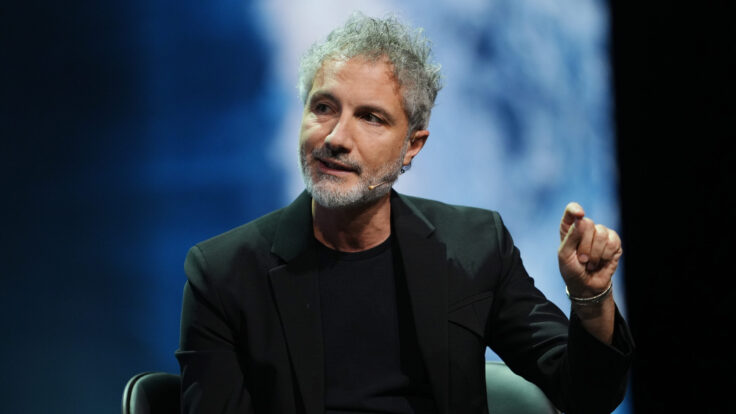
My actual best-dressed salutation might go to On Running co-founder Caspar Coppetti, captured in a nice blue shirt, a tan, and a beard. (As one reader noted, “The outfits, faces, and hair in Sun Valley make me want to gouge my eyes out. Thank God I’ll never be a billionaire.”) More kindly put, everyone else looks too try-hard next to the On Running guy. Especially David Zaslav, stuffed into a corduroy Brunello jacket. (Is his stylist reading this? If so, please reveal yourself. We need to talk!) There are still plenty of branded vests, but less than there used to be. People seem to care about fashion again, especially when in the presence of an increasing number of fashion people. (Kering C.E.O. François-Henri Pinault frequently shows up, and this year marked the first appearance of Tiffany executive and LVMH heir Alexandre Arnault, who was snapped in Nike running gear, deep in conversation with Kushner.) I have no comment on Shari Redstone’s purple church-mom-on-the-run look. Also, Dylan tried to explain to me why former Pittsburgh Steelers coach Bill Cowher is there, but I still don’t understand. More tomorrow on the show.
- Changes at Missoni slated for the fall?: Anyone with eyes and a bit of emotional intelligence can see that things are still being, um, worked out at Missoni. C.E.O. Livio Proli, installed in 2020, has embarked on a turnaround that has resulted in increased sales—they doubled between 2019 and 2023 to a still measly $137 million—without an increase in relevance.
Who is to blame? I have no idea, but I hear the September show is slated to be Filippo Grazioli’s last. A Missoni representative denied the rumor, but my closely connected source insists it’s true. (Time will tell, I suppose?) Grazioli, a Givenchy alum, was appointed in the spring of 2022. His collections are fine, but you can sense a disconnect between him and Proli. In a June WWD interview, Poli vehemently denied that Missoni’s owners—the Missoni family and an Italian fund called FSI—are interested in selling the business to a strategic group, citing their support of the company’s recent acquisition of one of its knitwear manufacturers.
Alas, owning a major supplier only makes Missoni more palatable to a strategic. But perhaps the investors have granted Proli additional time to try to bulk up sales before they offload the company. Meanwhile, I cannot underscore enough the size of this opportunity. I swear they could sell $137 million worth of beach towels alone. Unlike LVMH-owned Pucci’s branded swirls (which, by the way, looks super fab designed by Camille Miceli), Missoni zigzags are a much more approachable-slash-universal concept. In theory, it’s probably too small for one of the big groups to take on at this point, but it could scale up quickly in a larger, vertically integrated operation.
The problem with Missoni right now is that there’s nothing new to say about it. I’m not sure a new womenswear designer will help Proli fix that problem; it depends on if he picks the right person.
- Oh, yeah, the Olympics are coming: I’m sure we’ll be talking about this plenty more, but anyone attempting to worm their way into the LVMH-dominated Olympics conversation better start now. (By the time Bernard Arnault, Anna Wintour, Pharrell, and Comcast’s Brian Roberts co-host a party at Fondation Louis Vuitton—Arnault’s Frank Gehry-designed museum tucked inside a public park on the outskirts of Paris—the night before the Opening Ceremony, there will be room for no one else.) In a proactive move this week, Simon Porte Jacquemus hard-launched his Nike collaboration; Vogue released its smashing (and unfortunately digital only) cover of sprinter Sha’Carri Richardson (shot by Luis Alberto Rodriguez, styled by Julia Sarr-Jamois); and my friend Alex swears she’s bought the whole lot of Ralph Lauren paraphernalia to wear to the games in Paris. (Yes, I know people attending of their own accord. DM for details!) And tomorrow, July 12, everyone’s favorite maker of retro-collegiate-prep activewear, Tracksmith, will open a pop-up shop inside Merci, a very French, very touristy, but still very nice concept store in the Marais.
- Important feedback on your casting suggestions for the (non-existent) Will Welch character in the (future) sequel to The Devil Wears Prada:
- “You guys are being too nice to Will.”
- “Adam Driver feels too intense and Will is so disarming by bringing chill.”
- “I think Austin Butler is the most Will, but for movie-making purposes, you could argue that you make that character pure evil and then give it to Jake Gyllenhaal.” (A grave error on my part for not including Jake originally. We all love Presumed Innocent and Donnie Darko, Jake.)
|
 |
| Roger of Arabia |
| Discerning Condé Nast’s latest moves, entanglements, and disentanglements in the Middle East and China. |
|
|
|
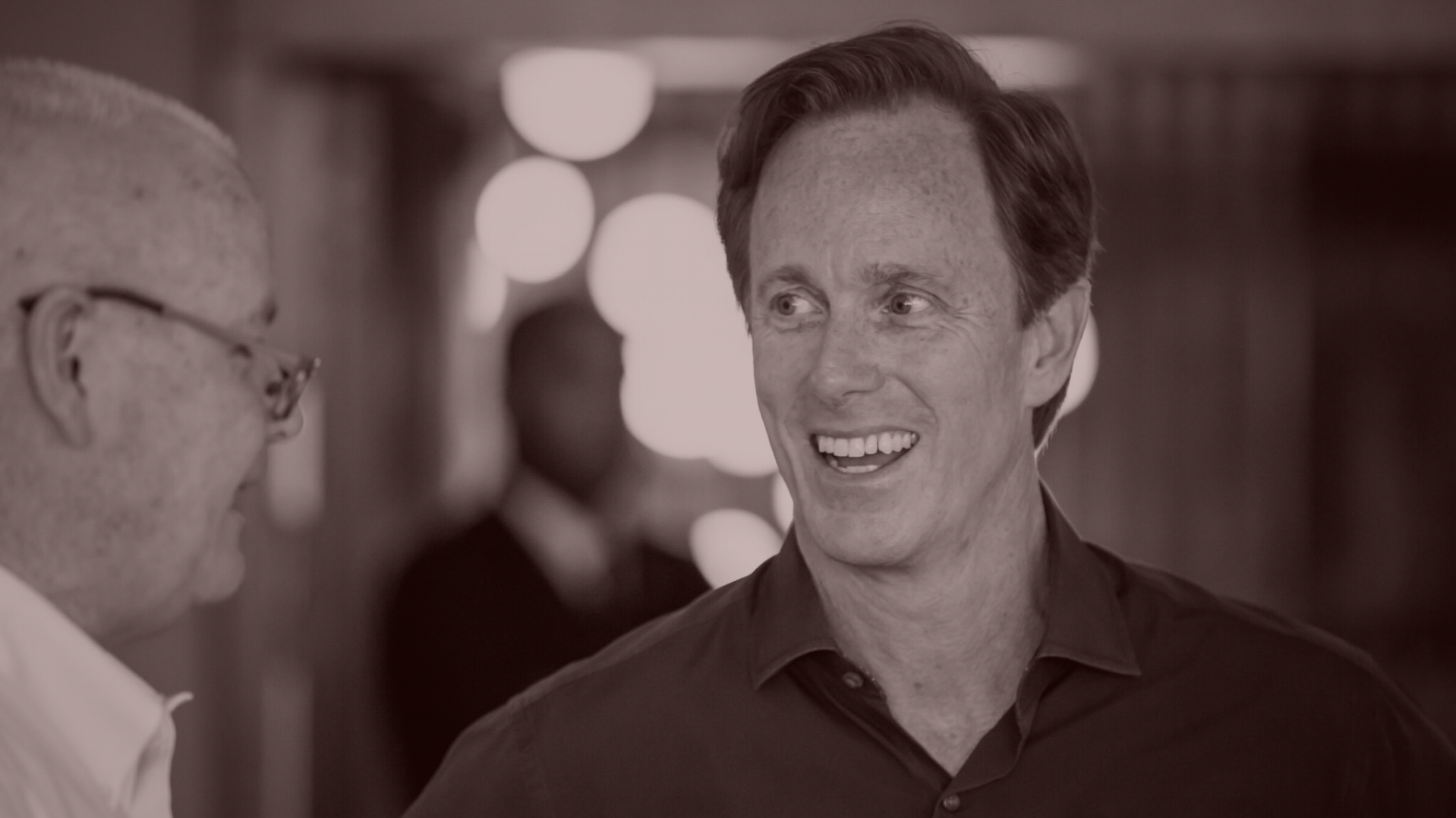
| One of the more underexplored recent Condé Nast subplots—beyond the Pam Drucker Mann departure, the internal labor turmoil, the Vogue World semi-success story, and next week’s board meeting—pertains to the publisher’s business endeavors abroad. Members of Condé Nast’s legal team recently spent considerable time in China working through a GQ licensing challenge that threatened to prevent its July issue, with its advertising commitments, from distribution. Meanwhile, its parent company, Advance, is engaged in a legal dispute with Nervora, the Middle Eastern publisher of Vogue Arabia and Wired Middle East.
Regarding the latter, Condé Nast appears to be contemplating exiting a nearly decade-long joint venture with Nervora next year. (“Advance has not engaged in the good faith negotiations for renewal of the license mandated by that License Agreement, but rather has only engaged in sham discussion while it plotted to undermine the protections,” reads the lawsuit, filed in New York’s Southern District Court.) After years of partnership, C.E.O. Roger Lynch may be attempting to fully integrate his foreign properties into the mothership, the final piece of the successful merger of Condé Nast with its sister company, Condé Nast International. If so, it would follow the pattern of many luxury brands, which launch operations with a local partner, gather intel, and eventually take them back in-house in hopes of generating a larger profit. According to my spies inside Condé, this should be resolved soon—and maybe soon enough for Condé to announce the new path forward.
The China sitch is a little more complicated. When Western companies decide to publish in the country, they are required to partner with a local institution that owns a license. These collaborations are typically called joint ventures, but they are actually transactions that open a new market to a publisher while allowing the CCP to manage the requisite censorship process. These licenses also have very specific use-case scenarios. To wit: The name of the Vogue license, 服饰与美容, can be roughly translated to “apparel and beauty.” The entity that holds the license—China Pictorial Publishing House—only has permission to bring foreign publications into the country. |
|
|
| Alas, GQ used a license that was backed by an institution whose mandate was to export Chinese culture, not import Western culture. In short, they were not fulfilling the brief. When I asked one company insider why GQ hadn’t hooked up with another licensor yet, they lamented that the licenses are both incredibly specific and rare. After all, they all need to be monitored by the government.
Yes, this is all a pain in the neck that will get resolved, if it hasn’t been resolved already. (I hear that there will be an announcement from Condé Nast China on Friday morning Shanghai time. Perhaps it will address this, or name the new editor of Vogue China.)
Even if GQ can’t publish its July issue in China, Condé Nast will manage the aggrieved advertisers. But the company’s operations in the country, and its relationship with the government, are indeed an increasingly relevant component of its future international strategy. And given all the gossip and bickering that generally takes place inside One World Trade, they are often overlooked. |
|
|
| The merger of Condé Nast and its international operations, initiated in 2018, was both necessary and overdue, but it has created some complications. A partly centralized content management system—one in which teams of editors create stories that are syndicated across multiple editions—scaled a brand’s footprint in a cost-effective ways. Yes, yes, the diminished amount of localized content might incrementally dampen these brands, but Condé Nast executives could also argue that not only is local content less relevant in the post-globalizalization social media world, and the juice just wasn’t worth the squeeze. These foreign titles were money jobs. As long as they carried the logo and imprimatur of Vogue or GQ or whatever, they didn’t have to be that great or culturally relevant.
Perhaps that’s why, a few years ago, senior management very publicly managed out overseas editors-in-chief, replacing them with less expensive and more pliant head-of-content types to follow chief content officer Anna Wintour’s global vision. When Lynch joined the business in 2019, in the midst of the merger, he made it clear that China would be a top priority for the newly united company, and a potential source of significant new revenue. Of course, this was pre-pandemic, when growth in China felt infinite. But it was also welcomed as one way to leverage the declining but nevertheless remnant value of the top brands in the U.S. to future-proof the business abroad.
But some advertisers crave specificity, and have backed away from the group. LVMH-owned Celine withdrew from Condé Nast publications after Emmanuelle Alt left French Vogue. In China, however, the exit of founding Vogue China editor-in-chief Angelica Cheung, now a partner at Sequoia Capital, was more damaging. At one point, Vogue China accounted for approximately 80 percent of the revenue coming out of the country. “Advertisers used the opportunity to pull commitments,” one person close to the company told me. (A representative for Condé Nast did not respond to a request for comment.)
Cheung’s replacement, Margaret Zhang, a young polymath with legitimate interests in photography, filmmaking, fashion, and modeling, among other pursuits, felt like Wintour’s most thoughtful appointment among the heads of content. For one, she was able to keep the editor-in-chief title, a signal to the market that she was running the show, and not merely an appendage for Wintour. But Zhang is Australian, born in Sydney to Chinese parents, and took a much more Western approach to editorial. While everything might be pay-to-play these days, in the West, editors and advertisers relish in the fantasy that there is some sort of Chinese wall between the creative and commercial interests. Ironically, in China, the Chinese wall does not exist. |
|
|
| Zhang, who has a reputation for being both brilliant and stubborn (and I don’t think she would disagree), commissioned quite a bit of work that was censored. She also received plenty of public criticism from readers. Recently, an image of Kim Kardashian on the cover of Vogue China Photo, a supplement, was published online-only because of censors. In print, it was published as a blank white page.
Zhang also reportedly clashed with Condé Nast China president Gill Zhou—once again, no response from the company on this—and at the end of last year, the organization began searching for a deputy editor-in-chief with local publishing industry roots to partner with her. Wintour even took the step of meeting with Cheung in Paris to seek her advice on the matter, according to people close to Cheung, who documented the meeting on social media. (For what it’s worth, Wintour meets with Cheung, and people like her, fairly regularly, so it wasn’t an out-of-the-ordinary occurrence.)
Instead, Zhang—who had Wintour’s steadfast support throughout—resigned at the end of her three-year contract. (A replacement has not been named, but perhaps one will be by the time you read this.) As I wrote back in March when the news was announced, I doubt Zhang would have wanted to stick around longer, even if it was going very well. On top of all the internal tensions, she was also accosted online by Chinese nationalists, and regularly threatened.
But regardless of the drama online and off-, Vogue China isn’t what it once was. That has required GQ to pick up some of the slack under head editor Rocco Liu, whose GQ Lab initiative, launched in 2017, is described as the “most profitable Wechat official account in China.” Liu was also responsible for managing the Chinese version of GQ Men of the Year, the brand’s most important franchise. |
|
|
| So fixing the GQ situation in China is essential. As for Lynch, he undoubtedly travels to Asia at least once a year, if not twice, to meet with his teams on the ground, so perhaps a visit is planned soon. But regardless, like any luxury brand, getting China right is essential to the future of Condé Nast. And like any other luxury brand, that’s never been more difficult. Just this week, a team of strategists at Goldman Sachs suggested investors sell European stocks that rely heavily on China for profits. Like LVMH. Not great news for Chinese publications that rely heavily on LVMH brands to buy advertising.
Resolving the Middle East dispute seems equally relevant, too. Ever since his appointment, Lynch has positioned himself as a global C.E.O., the sort of big-thinking executive who solves business problems by looking at the whole map. And just as everyone around the company knows that Condé Nast and CNI should have been combined ages ago, they also recognize that one obstacle to any such consummation was the fact that the foreign titles were afterthoughts—less prestigious, less admired, less lucrative. And yet, given the secular decline of the North American market, expanding a more engaged footprint in these backwaters is one way, though not the only, to assuage the company’s woes. |
|
|
| Mounjaro wins this round. [Los Angeles Times]
How much is Vogue paying Jack Schlossberg? If you know, let me know. Also, did you know George magazine relaunched in 2022 and it’s run by QAnon adjacents out of Arkansas? I’m crying. [Vogue and Mother Jones]
Not sure what to say about the Monse x Shein collab, other than: It’s tough out there. [Instagram]
If you’re sick of mesh flats… this one’s for you. [Neverworns]
Looks like Marc Jacobs and Nirvana are going to settle their legal battle out of court. Nevermind, then! [Rolling Stone]
This summer entertaining package is a real pleasure. [T]
Looking forward to this. Will it be underwritten by Chanel? [Deadline]
If you’re the kind of person who thinks Dôen is pretty but not for you, or maybe you only wore it when you were pregnant because you’re not really a floral prairie dress person, Dôen wants to turn you. [WWD]
Diana Tsui—a fantastic writer, stylist, and shopper, recently relaunched her Substack. I found this guide to buying your first grown-up girl watch helpful as I consider buying a second grown-up girl watch. [A Concept Store] |
|
|
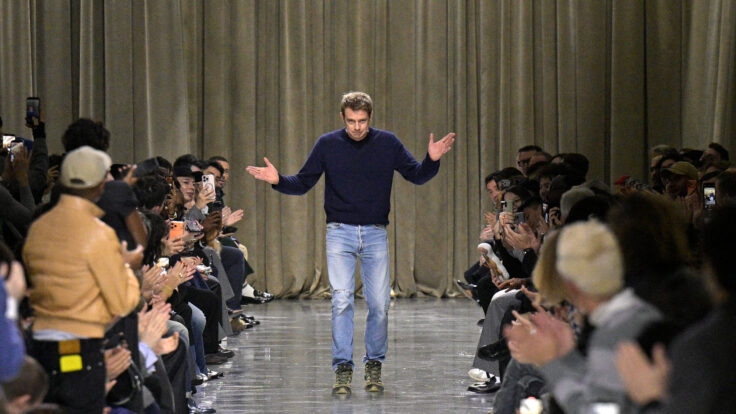
| And finally… Happy 90th birthday to Giorgio Armani. Nobody wears navy better.
Until Monday,
Lauren |
|
|
|
| FOUR STORIES WE’RE TALKING ABOUT |
 |
|
 |
|
 |
|
 |
| Pelosi Backpedals |
| Deciphering what Nancy Pelosi was really saying on MSNBC. |
| ABBY LIVINGSTON |
|
|
|
|
|
 |
|
|
|
Need help? Review our FAQs
page or contact
us for assistance. For brand partnerships, email ads@puck.news.
|
|
You received this email because you signed up to receive emails from Puck, or as part of your Puck account associated with . To stop receiving this newsletter and/or manage all your email preferences, click here.
|
|
Puck is published by Heat Media LLC. 227 W 17th St New York, NY 10011.
|
|
|
|