 |
|
Welcome back to Wall Power. I’m Marion Maneker.
Memorial Day weekend is traditionally a busy time for Christie’s, which holds major auctions in Hong Kong both during the May holiday and after Thanksgiving. Of course, all that is about to change, as I’ll explain below. I’ll also fill you in on Yuan Fang, a young painter making her London debut at Skarstedt gallery this week. Fang is a standout among a field of female abstract painters, and her show in London is just the latest step in her ascent.
But first…
- A Christie’s hack update: The latest twist in the Christie’s cybersecurity saga came Monday when Brett Callow, a Canadian “threat analyst,” posted on Twitter that the hackers who attacked Christie’s two weeks ago were in possession of personal client data. Apparently, the hacker group RansomHub resorted to threats on the dark web after Christie’s cut off communication midway through their demands.
In response, Christie’s released a statement indicating that there was indeed “unauthorized access by a third party to parts of Christie’s network” and that the hackers “took some limited amount of personal data relating to some of our clients.” However, the statement continued, “There is no evidence that any financial or transactional records were compromised.” The auction house says they are currently notifying “privacy regulators, government agencies as well as in the process of communicating shortly with affected clients.”
One curious wrinkle has been The New York Times’s repeated insistence that Christie’s had lost control of its own website. “During the initial course of the incident,” a spokesman for the auction house said in response, “Christie’s deemed it prudent to disable the website while we investigated the scope of the threat actors’ activities.” Since then, it seems that Christie’s has been engaged in a strategy of letting the hackers make the next move, which they appear to have done yesterday.
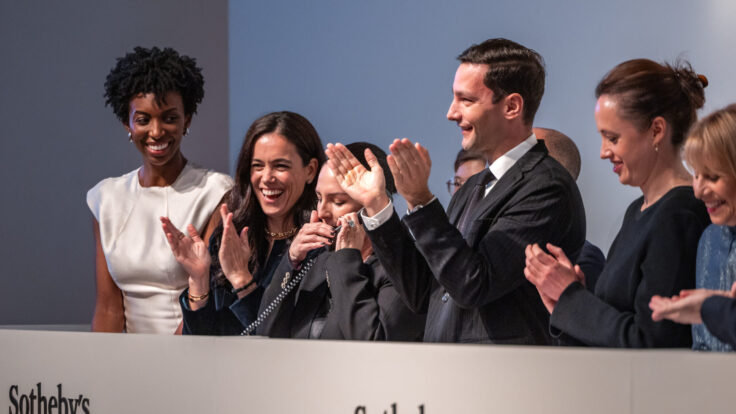
- Christie’s Hong Kong $92 million haul: Christie’s Evening sales of 20th century and 21st century art were held tonight in Hong Kong. Overall, the sales recapitulated themes seen in New York two weeks ago: Some of the marquee artists from the last several years seem to be fighting against expectations, while a selection of new artists is beginning to show momentum.
In 20th century art, there were strong showings for a 1931 Sanyu vase of flowers, which sold for HK$36.6 million ($4.7 million), and a Salvo painting of ruins which made HK$3.27 million ($420,000), joining nearly a dozen other Salvo works that have recently sold in that range. There was also a Magritte oil painting of a sunrise rose with a third-party guarantee that sold well above the estimates, and a 1962 Zao Wou-Ki, long held in private hands, that sold for about twice the estimate level at $1.75 million. Anita Magsaysay-Ho, the Filipina painter, overperformed at just under $1 million.
Meanwhile, Xue Song’s 2010 work sold for more than double the estimate, or $190,000. And Korean painter Rhee Seundja set a new record at auction with a 1962 painting that made $1.05 million. In 21st century art, Christie’s posted solid take-notice performances for works by Jonathan Gardner, Xia Yu, Marina Perez Simão, Ben Sledsens, Kei Imazu, Liu Xiaohui, Lee Bae, Michaela Yearwood-Dan, Miriam Cahn and Izumi Kato.
Alas, it was tough sledding for works by Cézanne, Wu Guanzhong, Bridget Riley and Zao Wou-Ki, where several paintings struggled against high estimates and too many recent sales. Sales for Yayoi Kusama, Yoshitomo Nara, Loie Hollowell, Andy Warhol, Keith Haring and others also faced real price resistance. Wayne Thiebaud and Nicolas Party, like Zao, just couldn’t escape the fact that their works were on the market so recently.
|
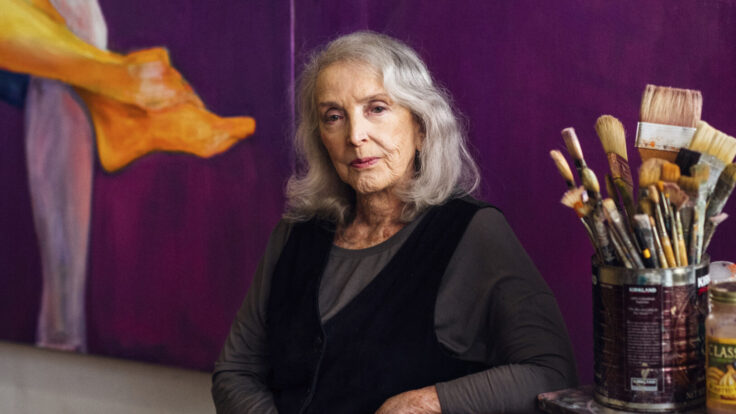
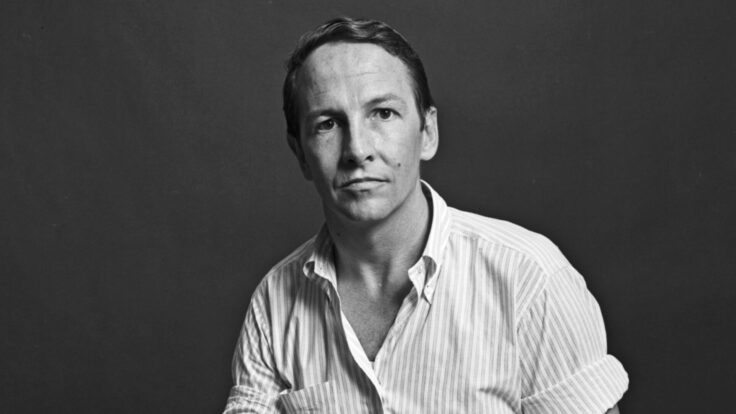
| Portrait of the Artist: Yuan Fang |
|
|
|
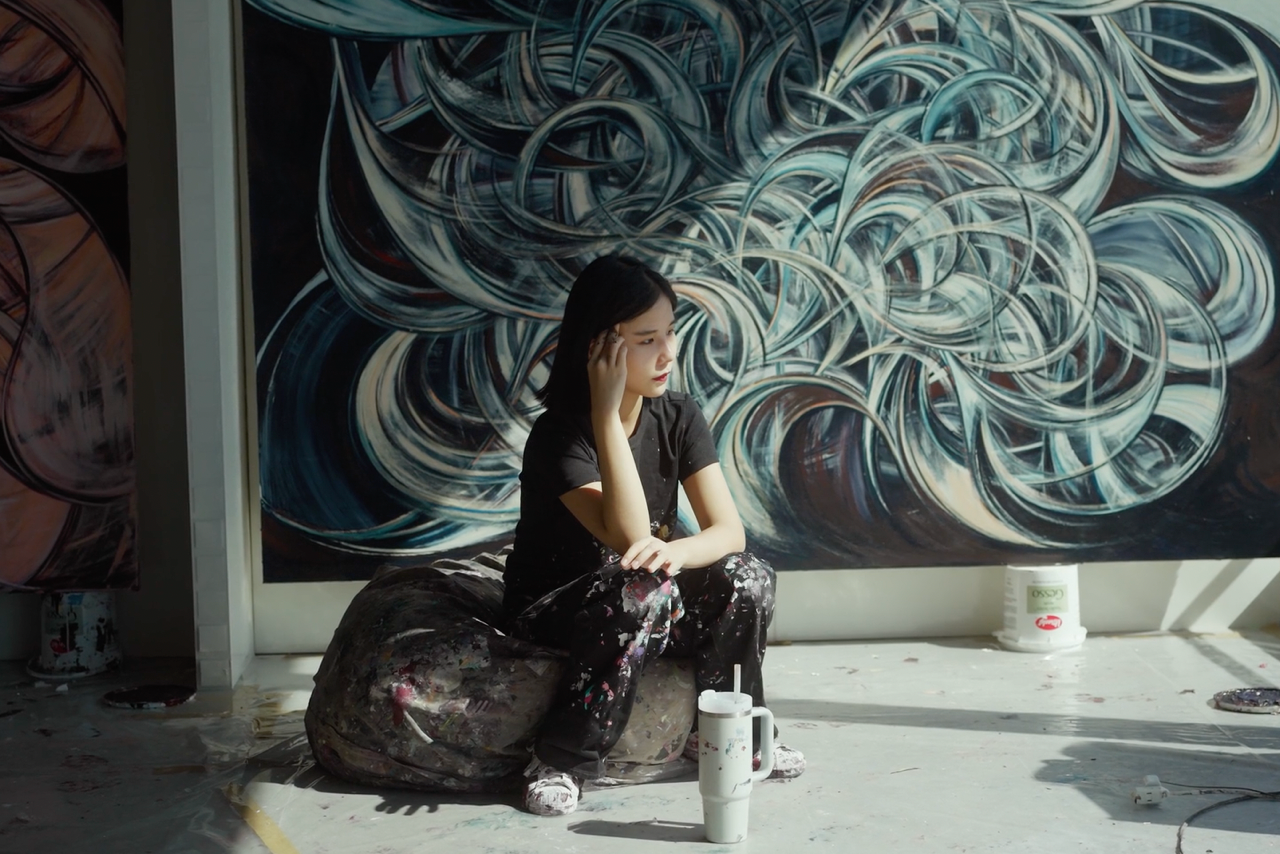
Photo: John Berens/Courtesy of Yuan Fang
|
|
|
| It’s been a banner year for Abstract female painters, with artists like Jadé Fadojutimi and Lucy Bull setting auction records and Lauren Quinn showing with Arne Glimcher at 125 Newbury. Joan Mitchell, Cecily Brown, Howardena Pindell, Catherine Goodman, Michaela Yearwood-Dan, and Rita Ackermann, among others, are all in high demand or have recently enjoyed major museum or gallery shows. There is also, of course, a new generation of younger female artists excelling in the genre, such as Julia Jo, Zhang Zipiao, Li Hei Di, all of whom were born in Asia and happen to be Instagram-appealing.
Add to that last group Yuan Fang, who moved from Shenzhen to attend SVA in Manhattan less than a decade ago, and now has a show opening at Skarstedt gallery in London on Thursday. Like her peers, Fang has had a progression of gallery shows over the past few years that have traced her upward trajectory in prominence and created a reliable market for her work. Her bright and colorful abstract paintings, dominated by large swirling patterns, were shown at Half Gallery last year.
The paintings Fang will exhibit at Skarstedt have a more muted palette, but are no less extraordinary. The gallery previewed the London show by bringing one of her large black-and-white works to The European Fine Art Foundation in New York two weeks ago. It sold without too much trouble to a movie producer breezing through town, who joins the ranks of collectors, like Steven Cohen and Glenn Fuhrman, who like to get in on the ground floor with an artist.
How did Fang move so far and so fast toward success? “I moved to New York in 2015 for college,” she told me via email from London. “But I didn’t start in fine art or as a painting major.” About five years ago, after trying a few different things, she “finally figured out that I am not good at anything besides painting.” Her parents were not keen on the idea, but they came to a compromise where she got an MFA and they left her alone.
She describes herself as “just an inconspicuous Asian kid” who didn’t really talk to other kids at school, “a fairly self-sustaining person.” She knew that she wanted to paint—and what she wanted to paint. Jackson Pollock, Willem de Kooning, Cecily Brown, and Francis Bacon, however uncool to her undergraduate peers, were the painters she looked up to. “Somehow,” she said, “I just found myself resonating with those artists.”
Shortly after she got her MFA in 2022, she had a show at Leo Rogath’s Prince & Wooster gallery. Last year’s show at Bill Powers’ Half Gallery was filled with colorful evolutions of her style that were less dependent upon figures like Bacon for composition. Some of the works sold through Half have found their way to the secondary market. Two of her paintings have sold for nearly $90,000 at auction, as well as talk of a private sale over $100,000.
But, mostly, the market has stayed under control as steady hands like Skarstedt’s continue to guide her path to collectors. The London show debuts work in a more restrained, almost two-tone palette. The muted colors reveal an even greater depth to Fang’s swirling, layered technique. Fang seems to be moving to another level.
“Everyone has been saying that I am one of the most hard-working artists they know,” she noted in her email. “But from my own perspective, it is just that I enjoy painting so much that it doesn’t feel like working to me. It is one of the few things that can bring me pure joy.”
And now to the main event… |
 |
| London Falling |
| News and notes on the art market’s quiet deprecation of London as the big auction houses set up shop in Hong Kong, resize their ambitions in Asia, and attempt to rewrite the auction calendar. |
|
|
|
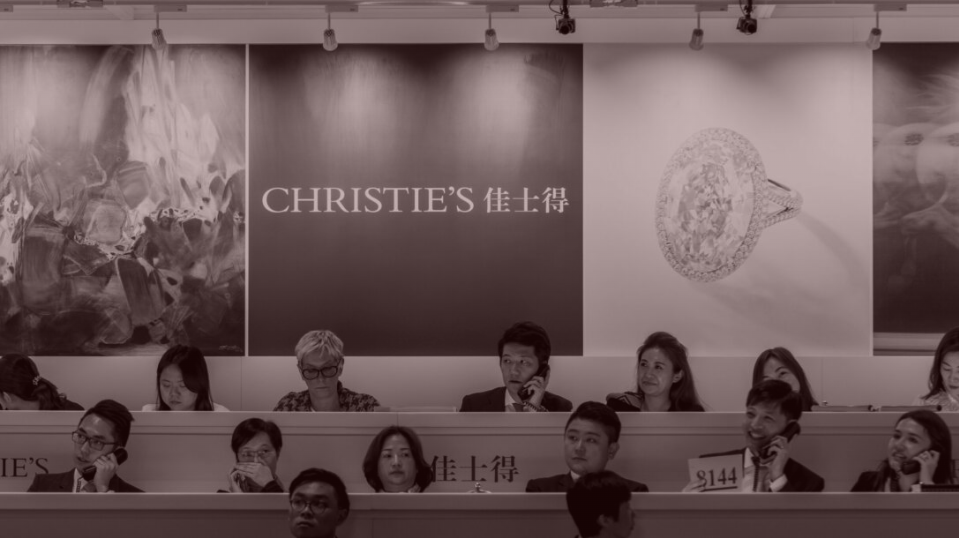
| Earlier today, upon the conclusion of its Hong Kong Evening sales, Christie’s offered a fascinating, and long awaited, announcement that confirmed both its global ambitions and the changing geography of the art market. Naturally, it’s all anyone is talking about.
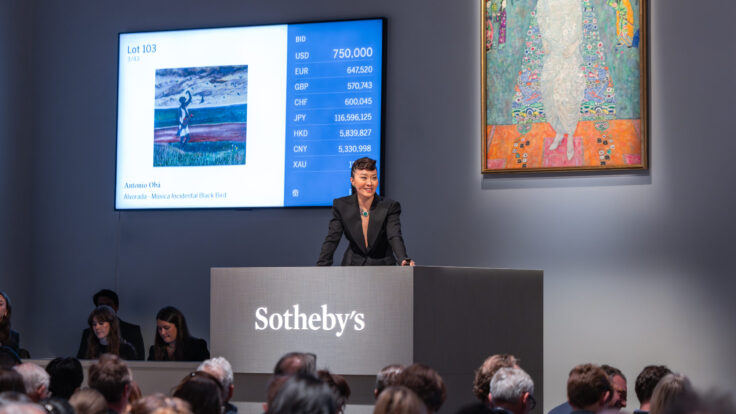
On a superficial level, the auction house simply reported that it would inaugurate its new Asia Pacific headquarters in the special administrative region, in late September, with sales of 20th and 21st century art. This, of course, was hardly controversial. In the past, the auction houses have shared Hong Kong’s convention center as their colonial outpost, which prevented them from holding simultaneous sales. More recently, though, each has pivoted to a boots-on-the-ground strategy. Phillips opened a dedicated Hong Kong space last year; Sotheby’s new location will open in July, with sales slated for September 17-19. The new Christie’s venue will debut a week later.
But this isn’t just a story about real estate. Coupled with the recent news that Christie’s is kiboshing its London evening sales in June, the announcement takes on larger meaning. Christie’s, like the rest of the market, appears to be rebalancing its priorities—mainly, away from London in its economic malaise and toward the wealth being created in Asia.
Grizzled auction veterans will recall that Christie’s de-emphasized London once before. About half a dozen years ago, after the auction calendar had unintentionally expanded to three auction seasons in London, Christie’s then-C.O.O. wanted to pare it back to two. The June London sales—coming after Art Basel and also competing with the Venice Biennale (which then opened in June)—had become a roadblock to a new, emerging global auction calendar beginning in London, in February, and ending in New York, in November. But the effort didn’t pan out: Christie’s left London in June, but Sotheby’s did not, and Sotheby’s made enough money staying in the season to force Christie’s to come back.
But, now, with all of the houses zeroing in on Hong Kong with an eye to increasing the sales intensity, something has to give. London’s minimization isn’t just a response to the growth of Asia—a phenomenon, of course, that is decades old. It’s also a recognition of the increased emphasis on Paris, as Europe looks to establish its own post-Brexit sales capital. Look, no one thinks that Paris will replace London, but there is a hope, especially after Sotheby’s moves its new headquarters around the corner in the 8th arrondissement, that the growth of the gallery community, the addition of a major global art fair, and recognition that Paris is the capital of the luxury goods industry, will bring greater auction volume to the city. Paris potentially also brings more European transactions to the city.
The London sales in June won’t disappear entirely, they’ll just be downsized. But perceptions can eventually become reality. Exacerbating all this, too, is the constant chatter right now that Sotheby’s is preparing to shrink their London footprint in a meaningful way. That, of course, is the backdrop to their Evening sale this June. |
| Fighting About the Calendar |
|
| The Hong Kong-ization of the market really raises a larger sotto voce truth about the art market: No one loves the calendar, and for good reason. For starters, the extremely competitive nature of the business prevents anything so simple as coordination. And ever since Sotheby’s former owner Alfred Taubman was sent to jail in the price-fixing scandal, two decades ago, the auction houses do not consult with each other or even communicate. There is merely a designated scheduler in each house who negotiates with the others about when they will hold a sale in a specific city. After all, the market is driven by bidders, and they cannot focus on two different sales at the same time. That would infuriate the clients.
There are also a few variables here that are important to remember: Each company wants to make the most efficient use of their premises, and they pay rent for the whole year even if the business is seasonal. For years it was easier and possibly cheaper to move the whole company to the Hong Kong convention center for a couple weeks than to have a dedicated space. Now that they're investing in real estate, they need to sell more. Then there’s the issue of managing a sales calendar that is frequent enough to accommodate the consignors, but not so frequent to dilute attention or value. For some time, there have been Old Master sales in December in London and one house still has them in January in New York. That’s not a problem if the buyers are regional, but it suppresses the market if they are international, all watching the same webfeed and browsing the same online catalogs.
So even if the auction houses can’t collude and don’t communicate, they do tend to want the same thing. And since they are investing in dedicated salerooms in Hong Kong, they want to replicate the system that works so well in New York, Paris, and London—two sales seasons a year where similar material is sold by each house within a few days of each other. This is primarily for the clients’ benefit, but it follows the economic pattern of having four gas stations each on the corner of the same intersection, rather than spreading the facilities out geographically. Or you can think of it like any of the spontaneously occurring luxury shopping districts that emerge in the world’s great cities.
Right now, the thinking seems to be that the calendar will have sales in Hong Kong in March to coincide with Art Basel Hong Kong, and also September. There will be sales in Paris in April and October to coincide with Art Basel’s Paris fair (renamed today as Art Basel Paris). Everyone will head to London in March (some say late February, some early April) and October, to catch the Frieze London crowd. And then there is New York in May and November. That leaves a solid three months in Summer for holidays (Greece, Puglia!) and gathering consignments mirrored by three solid months in winter for holidays (St. Barths, Gstaad!).
The seemingly unintended effect of this new calendar is that instead of spreading sales out across all of the months, there will now be months, like March and September, featuring multiple major sales and mid-market sales in different regions. All this, I assume, will get worked out in future years as this new calendar comes together. Having said all that, of course, there’s no guarantee this will all come together. At the moment, though, it looks like a butterfly flapped its wings in Hong Kong with the opening of the new sale rooms, and this can’t be unwound. |
|
|
|
| FOUR STORIES WE’RE TALKING ABOUT |
 |
| Heilemann on ’24 |
| On Trump and R.F.K. Jr.’s forays into Libertarian Land. |
| JOHN HEILEMANN |
|
 |
|
 |
| Wintour Murmurs |
| News and notes on the latest fashion industry trends. |
| LAUREN SHERMAN |
|
 |
|
|
|
|
|
 |
|
|
|
Need help? Review our FAQs
page or contact
us for assistance. For brand partnerships, email ads@puck.news.
|
|
You received this email because you signed up to receive emails from Puck, or as part of your Puck account associated with . To stop receiving this newsletter and/or manage all your email preferences, click here.
|
|
Puck is published by Heat Media LLC. 227 W 17th St New York, NY 10011.
|
|
|
|