Welcome back to Wall Power. I’m Marion Maneker.
Tonight, we’ve got some results from last week’s jewelry sales (and also a preview of the one remaining sale in this cycle). Then a look at the sale of daguerreotypes—which a leading photography expert recently told me should be pronounced da-guer-re-o-types—at Christie’s this week.
Before I hand it off to Julie, let me remind you that if you’re reading along on someone else’s subscription, now is a good time to sign up for yourself, especially to the Inner Circle, so you can stay on top of everything important in the art world.
|
|
|
|
A MESSAGE FROM OUR SPONSOR
|
Introducing FRAME Sotheby's—A first-of-it's-kind collaboration that brings together two cultural forces through craft, heritage, and
timeless style. Discover the full collection now at FRAME.
|
|
|
 |
Julie Brener Davich |
|
Like Beyoncé, the Blue Belle of Asia got famous, dropped her last name, and is now known simply as Blue Belle. The 392-carat sapphire, set in a tassel necklace of brilliant-cut diamonds, is back up for auction at Christie’s New York this week with an estimate of $8 million. It last sold in 2014 at Christie’s Geneva for $17.3 million, setting a world auction record for a sapphire. One of the world’s rarest sapphires in both size and quality, it was uncovered in 1926 in Ceylon, now Sri Lanka. It’s the star of Christie’s upcoming Magnificent Jewels sale, with 138 lots on offer this Tuesday.
The market may be softening for white stones, but it’s buoyant for colored gems and signed jewelry, Christie’s specialist Claiborne Poindexter told me. Another expected standout from the sale is the Marie-Thérèse, a ring featuring a 10-carat fancy purple-pink brilliant-cut diamond, estimated at $5 million (and backed by a third-party guarantee). Set by JAR, the fine jewelry firm founded by designer Joel A. Rosenthal, in blackened platinum with a crown of white diamonds, the color-saturated gem is named for its onetime owner, Marie Antoinette’s daughter (it originally belonged to her mother, natch). Its value derives equally from the quality and rarity of the stone and its place in history—it was among the jewels snuck out of the besieged Tuileries Palace during the French Revolution. In 2018, when Sotheby’s Geneva sold a pearl and diamond pendant that had once belonged to the ill-fated French queen, it made €36.4 million against an estimate of €1 million.
|
|
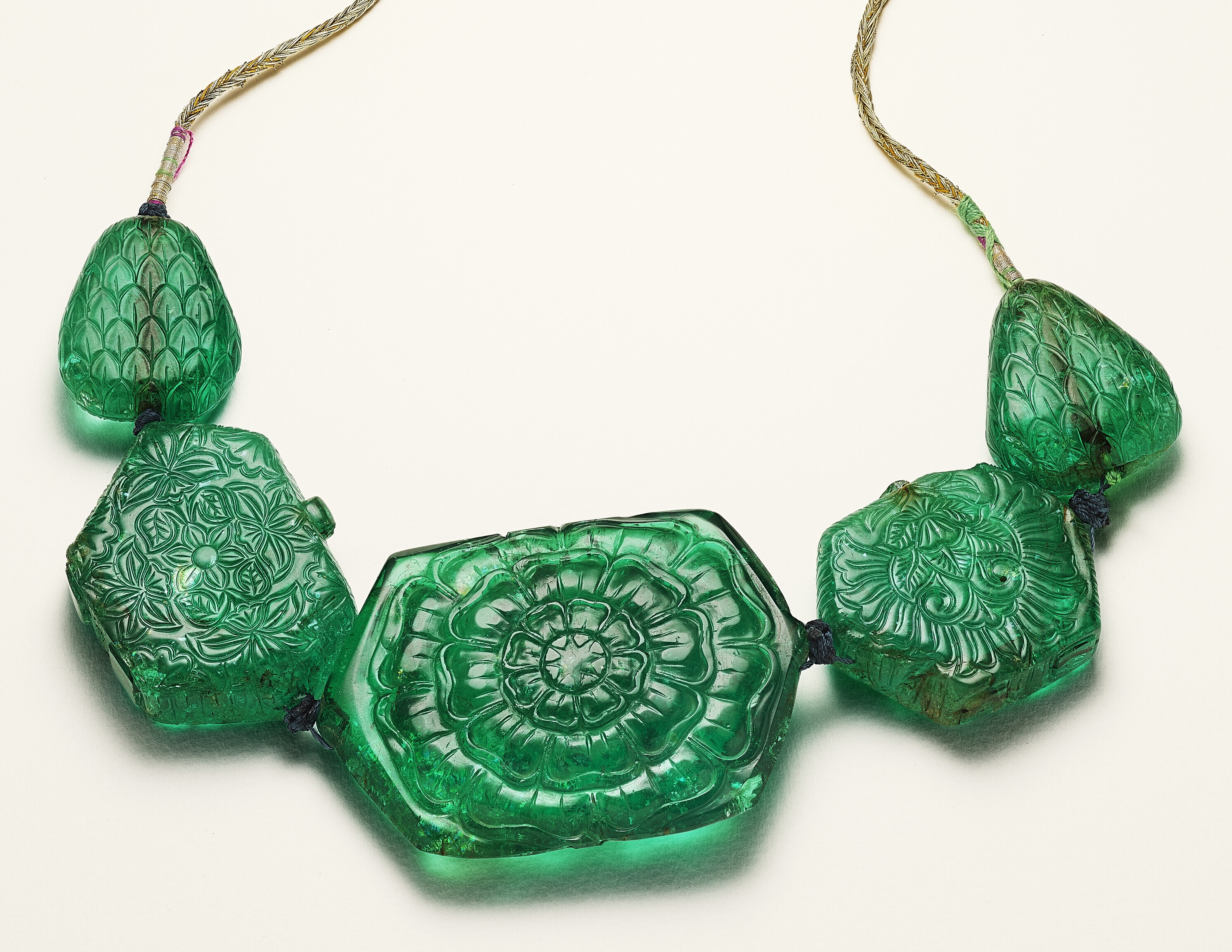
A Mughal carved emerald necklace (c. 1750). Photo: Christie’s Images Ltd.
|
Another highlight of the sale are three necklaces from a royal collection dating to the Mughal dynasty (1526–1857). There are two circa 1750 emerald necklaces, each estimated at $2 million. One has five Colombian emeralds, totalling 1,150 carats, carved with floral motifs derived from the architecture of the period. The other emerald necklace features 800 carats of emeralds—also Colombian—strung with pearls and spinel and ruby beads. The last in the trio is a three-stand necklace comprising natural pearls and 2,000-plus carats of spinels, also circa 1750, estimated at $1 million. Their sale comes at a time of growing interest in Mughal arts, including a major exhibition that just closed at the V&A in London.
Christie’s also has two extraordinary named collections this season. The collection of New York philanthropist Lucille Coleman, who died last year, features nine mystery-set Van Cleef & Arpels jewels. The patented mystery-setting technique involves inserting meticulously cut gemstones into gold rails, which renders the setting invisible. Each design can take up to 10,000 hours. Highlights include a ruby and diamond flower brooch estimated at $400,000, and matching earrings estimated at $200,000. (In a unique collaboration, Doyle auction house is selling some of the more moderately valued jewelry and fine art from the Coleman collection in September and is currently displaying some of those works at Christie’s.)
There is also a selection of jewels from Anne H. Bass, the New York philanthropist and art patron, whose fine art collection was sold by Christie’s in May 2022 for $363 million. Bass was among a handful of collectors who had access to JAR jewels, and the auction features 11 pieces by the contemporary designer, including a necklace with 22 drop briolette emeralds and eight strands of sapphire beads, estimated at $200,000. The jewels are being offered alongside an online sale of some of the contents of Bass’s New York apartment.
|
|
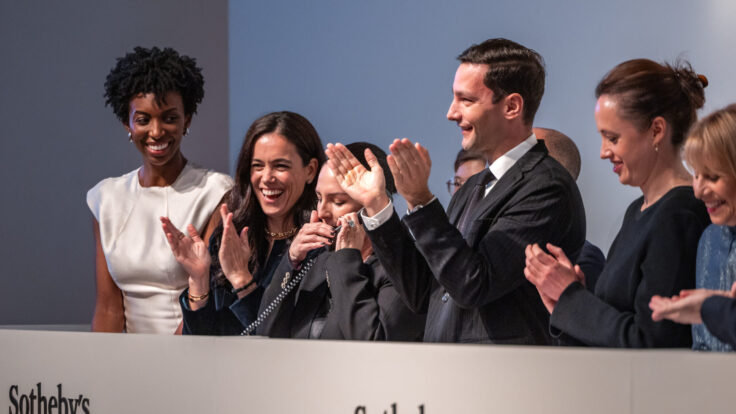
Sotheby’s recent sale of “High Jewelry”—newly renamed from Magnificent Jewels to better align with the nomenclature of the retail marketplace—totaled $31.4 million, and was 91 percent sold by lot, with 104 of the 110 items finding buyers. Before coming to sale, highlights toured to Dubai, Singapore, Taipei, Hong Kong, Geneva, and Los Angeles, giving a sense of where Sotheby’s thought buyers might come from.
The top lot was a 35-carat Graff emerald-cut diamond ring that sold for $3.2 million, against an estimate of $2 million. Otherwise, colored stones and signed jewelry were the order of the day, especially signed jewelry with colored stones. Three rings in particular—all guaranteed, and with irrevocable bids—exceeded expectations. Each estimated at $500,000, a JAR 8.6-carat square emerald sold for $1.6 million; a step-cut 7.5-carat sapphire sold for $1.4 million; and a square-cut 8-carat fancy vivid yellow diamond sold for $1.1 million.
Part of a collection of Harry Winston jewels, a 12.6-carat cabochon sapphire and diamond ring estimated at $100,000—also guaranteed and carrying an irrevocable bid—sold for $571,500. A Boucheron bracelet with seven Colombian emeralds made $609,600, or three times its estimate of $200,000. Perhaps the most surprising result was a large Lalique brooch, circa 1904, with a peridot flanked by glass plaques carved with nudes, that soared to $279,400 against its estimate of $30,000.
Bonhams’ sale followed the same trend. The highest prices, again, were achieved for colored stones; the top price of $597,400 was for a necklace with 116.5 carats of emeralds and 67.2 carats of diamonds, estimated at $120,000. A Boucheron pendant in the art nouveau style, circa 1900, featuring the goddess Juno sold for $508,500 against an estimate of $200,000. Lastly, regional house Stair Galleries, in Hudson, New York, made the top price of the week for Schlumberger for Tiffany & Co. when a gold and diamond tulip necklace and matching earclips sold for $128,000 (with fees) against an estimate of $100,000.
|
|
|
|
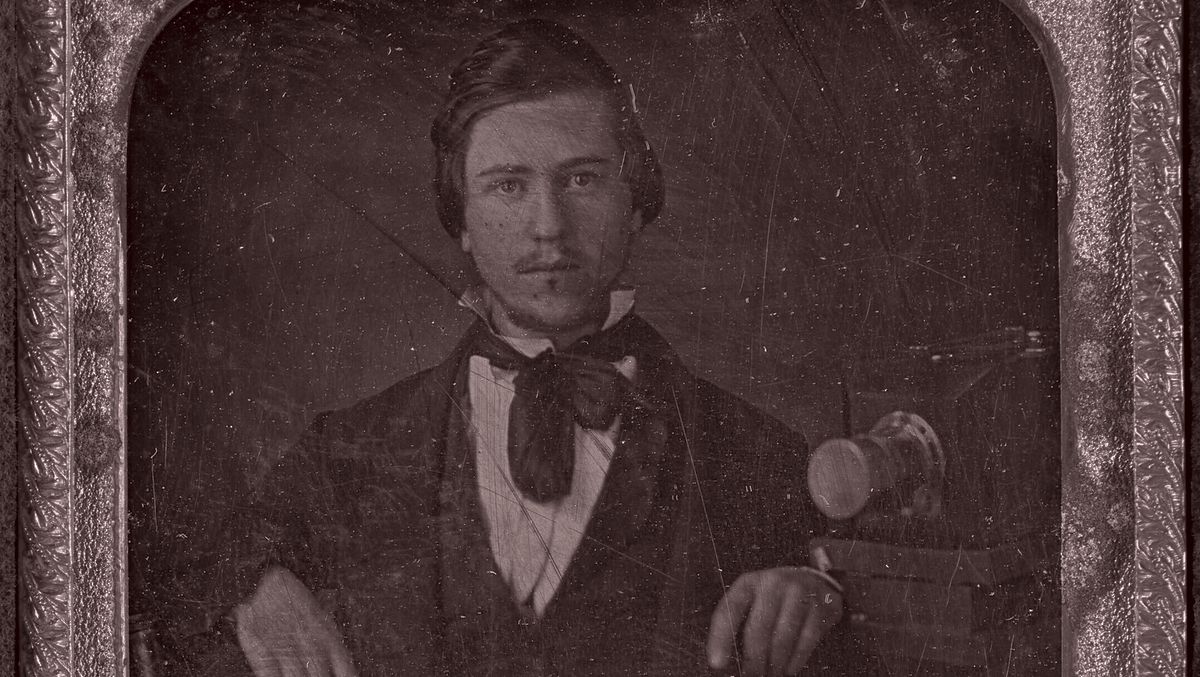
Christie’s sale of a vast collection of rare daguerreotypes, including a portrait thought to be of John Wilkes Booth, evokes the artistry and mystery that’s been lost in the digital age.
|
|
|
|
Imagine a world without photographs—not knowing what distant places or deceased relatives actually looked like, reading newspapers without images. That was life before 1839, when Louis Daguerre introduced his daguerreotype to the world. It remained the commercially dominant form of photography for 20 years, until less expensive mediums, like the tintype, became available. Making a daguerreotype—or “dag,” as they are known in the photography community—is a highly scientific process that has become celebrated as an art form, if not as an asset class. Christie’s is currently holding an online sale of one of the most important troves to come to market in the past 25 years. The presale viewing period begins Saturday, June 21.
The collection of Lynn and Yann Maillet comprises an astounding 265 lots that they began acquiring in the early 1970s, soon after daguerreotypes became collectibles. Unlike most daguerreotype collectors, who focus on one theme, like the California gold rush, what unites the Maillets’ collection is that all the photos are rare or extraordinary in some way. What is also remarkable, given that 95 percent of makers are unknown, is that there are examples by 50 named photographers, including the English writer John Ruskin and Samuel Morse, the painter and inventor of the telegraph.
|
|
|
|
A MESSAGE FROM OUR SPONSOR
|
Introducing FRAME Sotheby's—A first-of-it's-kind collaboration that brings together two cultural forces through craft, heritage, and timeless style. Discover the full collection now at FRAME.
|
|
|
The market for daguerreotypes kicked off in 1970 with the sale of the Sidney Strober collection at Parke-Bernet, where the top price for a daguerreotype was $560 for a circa 1854 image of a San Francisco commercial building, as reported in The New York Times. Today, the auction record for a daguerreotype is £565,250 ($927,000), set in 2003 at Christie’s London by an 1842 image by Joseph-Philibert Girault de Prangey of one of the temples on the Acropolis. At that early stage in the history of the daguerreotype, the technology was new enough that high-quality examples are scarce, making them valuable.
The process of making a dag starts with a silver-coated copper plate that is polished to a high shine, then fumed with iodine to make it light-sensitive. After the image is captured, the plate is removed from the camera, and fumed again with mercury to make the image appear. Then it is submerged in a fixing solution to set it. The images are even more remarkable when you realize there were no artificial light sources at the time.
Last year, Sotheby’s sold a circa 1846 daguerreotype of first lady and Washington hostess Dolley Madison by John Plumbe Jr., a rare combination of famous sitter and known maker, as well as being fresh to the market. It made $456,000, almost 10 times its estimate of $50,000.
Historians’ best estimate is that about 6 million daguerreotypes were made in their heyday. Only about 2 percent would be considered the highest quality, and few of those have survived. The five most expensive works in the Maillet collection sale are landscapes or buildings, the top three of which are by Ruskin from his travels in Italy, circa 1846. Since many of his works are now in museums, the opportunity to purchase one is rare. Leading the sale is his View Towards Fiesole, Florence, estimated at $150,000, followed by San Miniato al Monte, Florence, estimated at $100,000.
|
|
Portrait of a Young Actor, Believed to Be John Wilkes Booth, Wearing a Shakespearean Costume (c. 1855), from The Maillet Daguerreotype Collection. Photo: Christie’s Images Ltd.
|
There are also plenty of opportunities in the sale for portrait collectors. A highlight is an 1839 Portrait of a Young Man by Morse. He met Daguerre in Paris, where he was securing a patent for his telegraph, and became one of the first Americans to produce a daguerreotype. Outside of one at the Met, this is the only other known surviving example by Morse. For Lincolniana collectors, there’s a portrait of a young actor believed to be Abraham Lincoln’s future assassin, John Wilkes Booth, circa 1855, estimated at $40,000. There’s also a circa 1855 depiction of Edward Everett, who gave a two-hour lecture at Gettysburg before Lincoln’s famous three-minute address, estimated at just $3,000.
|
|
|
The sale contains 29 plates by the Boston studio Southworth & Hawes, including a medallion-style portrait, circa 1850, with a central oval-shaped image surrounded by eight smaller oval-shaped images of the same sitter, estimated at $30,000. Foremost daguerreotype expert Grant Romer, who consulted on the sale, told me that portraits of ethnically diverse sitters, of which there are several examples in the Maillet sale, are in high demand by museums trying to expand representation in their collections.
|
|
Christie’s won the Maillet trove noncompetitively after a seven-year relationship with the couple, and then brought on Romer, who was a close friend of theirs. “They were as much historians as any curator,” said Romer, the curator emeritus of the George Eastman Museum, a photography museum in Rochester. Lynn Maillet died in 2022, and Yann died just last week in Florida, a couple of days after the sale catalogue went live on Christie’s website. He spent his last few days poring over the legacy of his life’s passion.
The timing of Yann’s death, and of the Christie’s sale, is particularly poignant. “The primary photographic record is no longer material. It is digital,” Romer wrote in his introductory essay in the catalogue. “Knowledge of what photography was and how it was experienced is rapidly being forgotten.” But there continues to be interest in daguerreotypes. A current exhibition at the Met, The New Art: American Photography, 1839–1910, explores the early history of the medium. And Romer expects the market to be revived around the daguerreotype’s 200th anniversary, in 2039.
Daguerreotypes, after all, are a type of “memory technology” unlike anything we have today. “It turned an intangible visible experience into a tangible object,” Romer told me, “fixed in a moment in time.”
|
|
Thanks, Julie. More to come on Tuesday.
Speak then,
M
|
|
|
|
The ultimate fashion industry bible, offering incisive reportage on all aspects of the business and its biggest players. Anchored by preeminent fashion journalist Lauren Sherman, Line Sheet also features veteran reporter Rachel Strugatz, who delivers unparalleled intel on what’s happening in the beauty industry, and Sarah Shapiro, a longtime retail strategist who writes about e-commerce, brick-and-mortar, D.T.C., and more.
|
|
|
|
Finally, a media podcast about what’s actually happening in the media—not the oversanitized, legal-and-standards-approved version you read online. Join Dylan Byers, Puck’s veteran media reporter, as he sits down with TV personalities, moguls, pundits, and industry executives for raw, honest, sometimes salacious conversations about the business of media and its biggest egos. New episodes publish every Tuesday and Friday.
|
|
|
Need help? Review our FAQ page or contact us for assistance. For brand partnerships, email ads@puck.news.
You received this email because you signed up to receive emails from Puck, or as part of your Puck account associated with . To stop receiving this newsletter and/or manage all your email preferences, click here.
|
|
Puck is published by Heat Media LLC. 107 Greenwich St, New York, NY 10006
|
|
|
|




_01JXDDJ8628NPTEBVV16781GSS.jpg "Frame")


_01JXTED1C5S01DW1JH9HW3A986.jpg)

_01JXDDJ7WY0X81Z8G6ZTRJF9D7.jpg "Frame")