|
Good evening, sports fans. Welcome back to Wall Power, where we keep an eye on the art market so you don’t have to. I’m Marion Maneker.
Today, my partner Julie Davich digs deep into the story of two emerging artists who inadvertently became symbols of the collapse of the young artist market last year, after the publication of a poorly conceived New York Times story. Julie explains how the artists are fighting back.
But first…
|
- Scrambling for an Artnet majority: The clock is ticking on Artnet since the annual general meeting last Thursday ended with neither of the warring parties in a position to determine the company’s future. Yesterday, a German stock market filing revealed that Hans Neuendorf had sold 600,000 shares in the company at a price of €10 apiece on the day of the A.G.M. Though the sale involves only about 40 percent of the Neuendorfs’ holdings in the company, it puts the family below the negative rights threshold. Their previous position, and voting rights, had been a longstanding deterrent for many potential buyers.The likely buyer of the Neuendorfs’ stake was former Goldman Sachs partner Andrew Wolff, who is maneuvering to acquire control and potentially merge Artnet with other, similar digital companies in the art space. (Those plans, of course, are a long way off.) In the meantime, rival bidder Garry McGuire and his Art Technology Holdings claim they now have 40 percent of the outstanding shares committed to their special purpose vehicle. If they get to 51 percent, the firm will launch a tender offer at €11 per share. McGuire thinks he will get over the hump by next week.Caught in the middle of this battle are the Artnet employees who have carried on under the Neuendorfs’ regime for decades and now face uncertain futures. The A.G.M. revealed that the family gave up their control of the company, which normally would have resulted in the removal of family member Jacob Pabst, whose contract ends in June, as C.E.O. Instead employees received a one-sentence email from Pabst that said, essentially, things are looking good.But things are not looking good at all. This week, I’m told, Pabst fired a handful of employees due to budget constraints. Even though new board member Roy Israel loaned the company $1 million last year, and is believed to be in negotiations to loan more, Artnet does not have short-term funding in place yet. Why Artnet doesn’t shut its money-losing auction and brokerage business remains a mystery to me. I tried to contact a spokesperson for the family, but they didn’t respond.
- Surrealism’s £48m surprise in London: Just when it seemed like all of the action in the market for surrealist works had moved from specialized sales to the marquee auctions, where works by Leonora Carrington and René Magritte have become focal points, the surrealism evening sale held at Christie’s this week reminded us that there’s still plenty of action left in the category. The sale posted a £48 million ($61.5 million) total and a blistering hot hammer ratio of 1.56, meaning bidders spent 56 percent more than estimated.
The bulk of the gains lay in the sales of work by three artists: Max Ernst, Jean Arp, and Paul Delvaux. Ernst’s Coloradeau de Méduse, a vibrantly red landscape of the Colorado River, where he took Dorothea Tanning on a nine-day rafting trip for their honeymoon, had never been auctioned before. The work, painted in 1953-54, was estimated at £700,000 and backed by a third-party guarantee, but that didn’t stop bidders from pushing it all the way to £3 million.Two works by Jean Arp also drastically outperformed estimates. A large unique Étoile, carved in white marble in 1960, was offered at £1.4 million and also backed by a third party. It, too, was bid above the estimate to £3 million with fees. An Arp wall relief in bright blue and white—which Christie’s surrealism guru Olivier Camu said was the largest he’s ever seen—had been owned by friends of Arp and held in the same family for nearly a century. The work was estimated at £1.6 million and sold for £3.4 million.
These are all good stories, but none compare to the strange tale of three Delvaux paintings that Camu was selling at the same time. Delvaux’s most sought-after works come from the period between 1936 and 1941, and have sold for as much as $10.6 million. It just so happens that Camu had been storing three works by Delvaux from this period for decades, having been entrusted with them by their nervous owner, a client who thought they were too valuable to keep at home. The client would come to view his possessions every few years until recently, when he died without heirs. The lawyers overseeing the estate gave Camu wide latitude in conducting the sale, allowing him to put very conservative estimates on the works and sequencing their sale to create the most competition.
It worked. Nuit de Noël, from 1956, was estimated at £1 million and sold for £2.3 million with fees. La ville endormie, from 1938, was estimated at £1.2 million but got bid to £6.2 million with fees; and Les belles de nuit, from 1936, was estimated at £500,000 and wound up selling for £4.4 million. All three works had a combined hammer ratio of 3.92, or nearly quadruple the estimates.
A collector who was in the room at Christie’s told me that all of the works were purchased by one buyer. (Christie’s wouldn’t comment, citing client confidentiality.) The same collector saw billionaire Magritte buyer Ken Griffin make a rare appearance at an auction. Would the sky lord of finance hoover up three Delvauxes in one fell swoop? Possibly. But there’s a greater chance Griffin showed up at Christie’s to bid on a Michael Andrews painting that he was seen discussing with specialists, and which sold for a record £6 million in the 20th/21st sale just before.
|
Anthony Caro’s Art to Appear at Christie’s in May
|
|
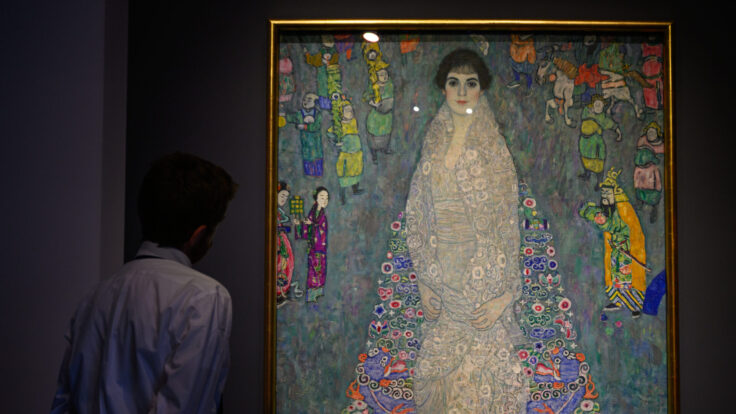
Kenneth Noland, Purkinje Effect (1964), estimated at $1 million
|
|
Anthony Caro, the pioneering British abstract sculptor, and friend to Helen Frankenthaler and Kenneth Noland et al., accumulated a collection of art from his peers who had an impact on his own work. Often credited with removing sculpture from an isolating plinth, Caro worked for Henry Moore for two years in the early 1950s. He came to the United States in 1959 on a Ford Foundation grant, and here met the famed activist critic Clement Greenberg, who pushed his work toward abstraction. He also became associated with David Smith and adopted his approach to sculpture as “drawing in space,” according to Rachael White Young, who is handling the Caro sale for Christie’s. (White Young previously oversaw the dispersal of other artists’ art collections, including Wayne Thiebaud, Frank Stella, and Robert Indiana.)
The sales begin this May, when 10 or 11 works owned by Caro will appear together in a single-owner section of the day sale. Caro had an “artist’s collection of artists,” White Young said, including a 1964 Noland chevron painting in green, blue, and orange, titled Purkinje Effect and estimated at $1 million. Another Noland, Exmoor, from 1970-71, is estimated at $200,000. Frankenthaler’s Hansel and Gretel, from 1975, will be offered with a $700,000 estimate, and Hans Hofmann’s Hazy Sun, from 1961, will be estimated at $200,000. Additional works will be sold in the appropriate sales in New York and London.
Now, let’s get to Julie and her artists…
|
|
|
|
When two ascendent artists showed up on the front page of the Times as examples of a young art market collapse, they decided to rally together, offering their generation a little more agency in a ruthless, unforgiving system.
|
|
|
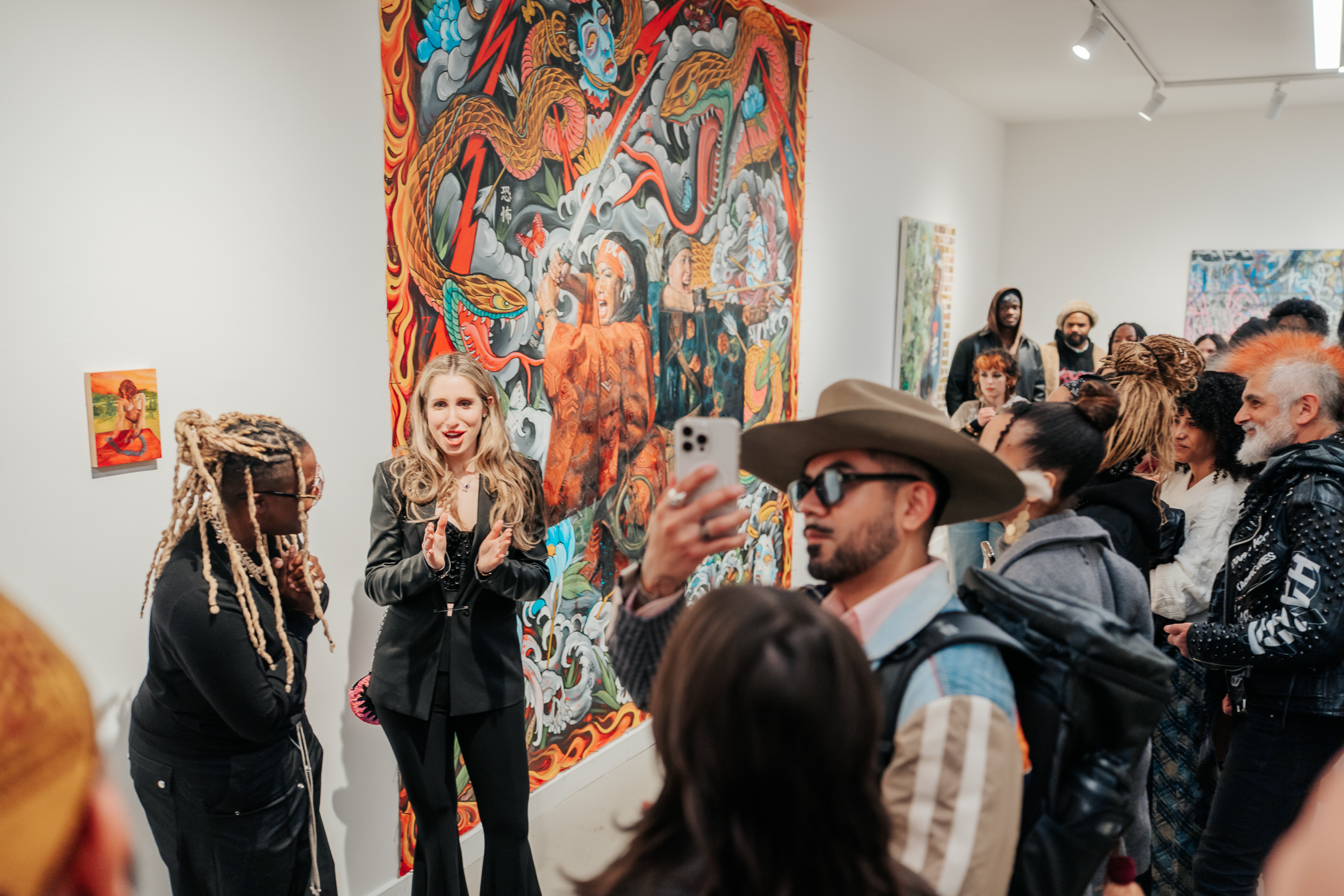
Amani Lewis pulled up to 311 East Broadway last week with two paintings in the trunk of their car. Lewis, who paints soulful, brightly colored portraits of the people in their life, was in town for the installation of their group show, Primary Voices in a Secondary World. The Miami-based artist had driven 18 hours up I-95 because it’d been too expensive to ship the artworks to New York. Their co-curator was Brooklyn-based artist Allison Zuckerman, who paints uproarious mashups of famous portraits with cartoonish iconography.
You may recognize these names from a much-discussed front-page New York Times article last August, which identified them as young artists who “rode a $712 million boom” before “the bust”—and featured a photo of Lewis alongside. The story about “ultra-contemporary artists” (born after 1974) experiencing the meteoric rise and fall of the pandemic market became a flashpoint in the art world and got pushback on a number of fronts. Guillaume Cerutti, who was C.E.O. of Christie’s at the time, pointed out in a rebuttal on his LinkedIn page that the decline in the ultra-contemporary market was in line with the broader contemporary art market. (As it happens, this was in reply to my partner Marion Maneker’s own response to the article.)
Lewis and Zuckerman had ended up in the story together by chance—they’d had only a loose, art-circle familiarity with each other at the time—but after it was published, they started messaging. “When this happened to us, we weren’t sure how to handle it at first, but we chose to tune out the noise and kept creating,” Zuckerman told me. She and Lewis discovered they both wanted to fight having their artistic legacy defined by market forces, and wanted to educate other artists about the pitfalls of a system that often overhypes and then abandons young artists. “The conversation gravitates toward auctions instead of your art,” Zuckerman said.
So about a month later, they launched the Artists First Collective, whose mission is to champion fairness, transparency, and collaboration in the art world—or, in other words, to “support artists in the ways we needed to be supported,” Lewis told me. In addition to creating community by doing virtual studio visits and mounting exhibitions, they hope to provide practical support for artists who are essentially running small businesses without any commercial experience. The organization will offer mentorship and education on navigating the art market, and offer resources like sample consignment and buyer agreements.
|
|
Amani Lewis and Allison Zuckerman at the opening of Primary Voices in a Secondary World. Photo: LaMont Richardson
|
|
Lewis and Zuckerman started with the consignment and buyer agreements for the Primary Voices exhibition, drafted pro bono by the Art Law Group at Patterson Belknap Webb & Tyler. The buyer agreement sets a new standard for an artist’s control over their work, including broader resale restrictions for works sold within a three-year period. Under the Artists First Collective’s contract, the buyer has to consult the artist to decide what is best for them—either a royalty, no sale, or even buying it back—and includes a transparency clause for works sold privately. In those cases, the artist needs to know who the second buyer is, and the second buyer has to agree to the remaining amount of time on the resale restriction. “Just call me up if you’re thinking of selling,” as Lewis put it.
It’s quixotic, but understandable, for artists to want to participate in their own legacies, especially given their experience as documented in the Times article. To illustrate Lewis and Zuckerman’s market downturn, reporters Zachary Small and Julia Halperin pointed to two paintings that were purchased in November 2021 at Christie’s and Phillips day sales, then resold in Christie’s online sale in June 2024 for 1/10th of their previous prices. The reporters failed to point out that both works were offloaded at auction by the same collector who also sold 40 other works that season under the same designation; thus, they didn’t entertain the possibility that the artists’ works suffered the same price trajectory because they were both part of a likely distressed sale. In other words, the price collapse could have had something to do with the collector’s financial needs or sense of urgency offloading the works, and not just with the art itself. The collector might have adopted a less judicious sale strategy in order to ensure a sale. At the same time, Christie’s had guaranteed the works and certainly did not want to be stuck with them. Christie’s also inadvertently recategorized Lewis’s piece in the lot description as a work on paper instead of a painting, which demoted it to a completely different value band. (Lewis confirmed to me it was a canvas.) Whoever bought it must have gotten a nice surprise when a painting arrived in the mail.
Regardless, the Times didn’t capture this nuance, which didn’t fit their sky-is-falling narrative. The artists’ markets experienced a downturn, for sure, but it was more of an undulating downhill than a cliff. The article, in fact, may have even created a bit of a self-fulfilling prophecy. “We’ve seen fewer ultra-contemporary artists coming to auction,” said Patrizia Koenig, a contemporary art specialist at Phillips, at a panel hosted this week by the Artists First Collective. “Clients are less willing to take the risk now.” No wonder these artists want to join forces.
|
|
We’ve run long today. So I’ll save the endnotes for another time.
See you Sunday,
M
|
|
|
|
Puck founding partner Matt Belloni takes you inside the business of Hollywood, using exclusive reporting and insight to explain the backstories on everything from Marvel movies to the streaming wars.
|
|
|
|
The ultimate fashion industry bible, offering incisive reportage on all aspects of the business and its biggest players. Anchored by preeminent fashion journalist Lauren Sherman, Line Sheet also features veteran reporter Rachel Strugatz, who delivers unparalleled intel on what’s happening in the beauty industry, and Sarah Shapiro, a longtime retail strategist who writes about e-commerce, brick-and-mortar, D.T.C., and more.
|
|
|
Need help? Review our FAQ page or contact us for assistance. For brand partnerships, email ads@puck.news.
You received this email because you signed up to receive emails from Puck, or as part of your Puck account associated with . To stop receiving this newsletter and/or manage all your email preferences, click here.
|
|
Puck is published by Heat Media LLC. 107 Greenwich St, New York, NY 10006
|
|
|
|