|
Welcome back to Wall Power, gigaweek edition. I’m Marion Maneker.
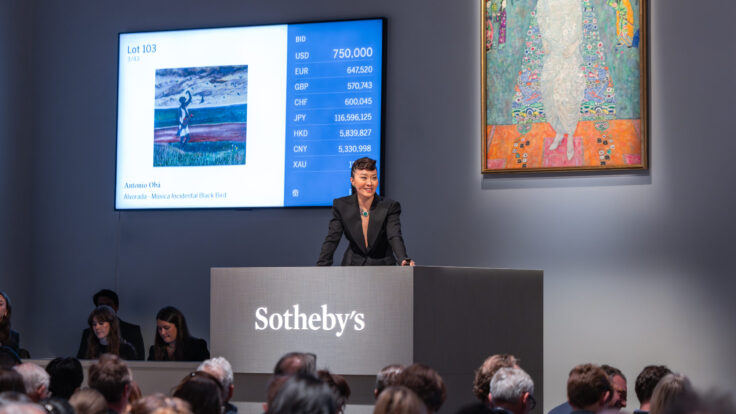
By the time you’ve opened this email, I’ll be headed to (or already at) Sotheby’s Modern Evening sale. I’m looking forward to seeing many of you there. Meanwhile, tonight’s newsletter is a recap of the Leonard and Louise Riggio sale at Christie’s, and the 20th century sale that followed. I have lots of detail on the bidding below the fold.
Mentioned in this email: Ken Griffin, Keith Gill, the Riggios, Sid and Anne Bass, David Mugrabi, Peter Brant, Wendy Goldsmith, Jeffrey Deitch, Rebecca Wei, Katharine Arnold, Alex Rotter, Paolo Vedovi, David Nahmad, Ralph DeLuca, Kim Heirston, and many more…
But first…
|
- Christie’s half-billion-dollar night: The Leonard and Louise Riggio collection made $272 million, with one lot withdrawn and another unsold. The various owners included in the 20th century sale made $217 million, with two lots withdrawn. Of that latter haul, works from Sid and Anne Bass’s historic Paul Rudolph house in Fort Worth made $73 million.
|
|
|
|
A MESSAGE FROM OUR SPONSOR
|
A new campaign starring Julia Garner celebrates the House’s storied silk scarves and their enduring legacy within the House’s design codes.
DISCOVER MORE
|
|
|
- A Gagosian director’s tabloid wedding: The Daily Mail, among several outlets, saw fit to report on Gagosian director Bernie Lagrange’s marriage to Australian actress Phoebe Tonkin—an unsurprising development, given Tonkin’s famous friends. Congratulations to the happy couple. In particular, I enjoyed the Daily Mail’s description of Lagrange as an international man of mystery. “Little is known about Bernard, but he is believed to be an art dealer for Sotheby’s,” the website offered. But, as you all know, Lagrange is a former Sotheby’s employee who now works for Gagosian Art Advisory. He was also back at work Monday night.
|
|
Now, let’s get to last night’s sale…
|
|
|
|
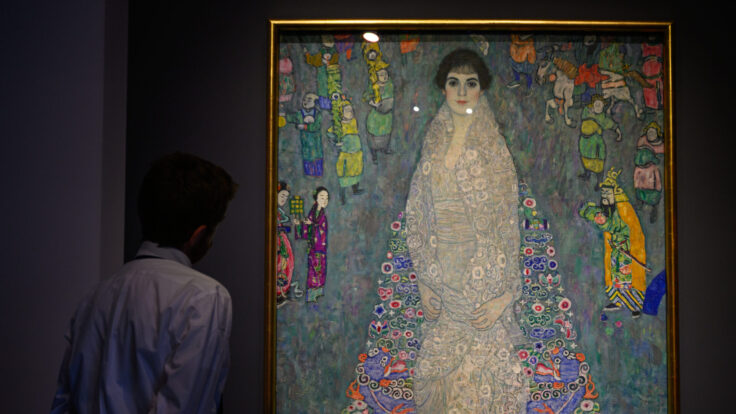
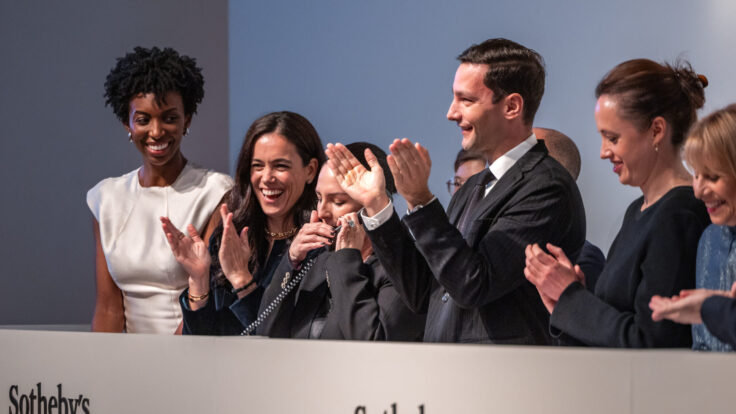
There were some pockets of spirited bidding at Christie’s for works from the Leonard and Louise Riggio collection and Anne Bass’s estate. And yet the well-managed and heavily guaranteed sale revealed the market’s cautious mood.
|
|
|
|
Judging from my conversations while touring the auction houses on Sunday afternoon, a number of active market players spent the weekend refreshing the Christie’s website to see whether the dealmakers were making any progress in laying off the house’s risk by offering third-party guarantees on the lots for sale. By Sunday night, at least by my count, slightly more than half of the lots were covered—accounting for 60 percent of the combined presale value of the Leonard and Louise Riggio estate sale and the 20th century evening sale, which included works from Sid and Anne Bass’s historic Fort Worth home. Christie’s eventually announced at least six more third-party guarantees, covering an additional $50 million from the rostrum, including one for Magritte’s L’empire des lumières.
It wasn’t only Christie’s risk that was being managed over the weekend. The nearly $450 million presale value for the Monday evening auctions amounted to 39 percent of the week’s overall presale estimate—so there was a lot riding on last night’s sale for the entire market. The bidding would set the tone for the rest of the week, and by the end of the evening, a significant portion of the market value would be determined. No wonder so many participants were glued to Christie’s website looking for clues and micro-updates.
There was another reason for the infatuation, too: A number of people at the center of the action were flying blind. I’m told that interest meetings—the pre-auction gatherings where specialists share information on their clients’ likelihood of bidding—have gotten less transparent. Not only are specialists increasingly wary of sharing too much information with their colleagues, but much of their contact with the market actually goes through advisors who simply cannot say with real confidence whether their clients will bid in this environment. Meanwhile, a number of advisors told me that they’d never seen decision-making among their clients get so close to the wire. Also, not all of the buyers were eager to engage ahead of time, even if they did perk up once they saw the art in person.
|
|
|
|
A MESSAGE FROM OUR SPONSOR
|
A new campaign starring Julia Garner celebrates the House’s storied silk scarves and their enduring legacy within the House’s design codes.
DISCOVER MORE
|
|
|
Anecdotally, it appears that rich people are fully aware that the economy could get much worse. Everyone has heard the reports of the container traffic slowing to a trickle on the West Coast. Monday’s announcement of a potential trade deal with China might have moved the markets, but I doubt it quieted the nerves of many who have just been reminded how trying the next year or two will likely be. No less a figure than Ken Griffin was in the press this morning saying that the best way to navigate Trump’s erratic trade policy might be to stay in cash. It’s no wonder the professionals were having trouble gauging interest.
But this foggy environment explains why Christie’s made the deals and got the works sold before the sale. This season, there was less an auction-before-the-auction, and more a series of standoffs that were resolved by the time the lights went down at Rockefeller Center on Monday night.
|
The Bidding on the Top Lots
|
|
Among the most valuable lots of the evening were the Riggios’ Piet Mondrian, Composition with Large Red Plane, Bluish Gray, Yellow, Black and Blue, from 1922, which made $47.6 million with fees. That’s slightly below the $50.6 million and $51 million paid for similar works in 2015 and 2022. Claude Monet’s Peupliers au bord de l’Epte, crépuscule, from 1891, made nearly $43 million with fees. The guarantor seemed to come in at $28 million, but it looked like the actual guarantee lay at $30 million. It didn’t matter: There was determined bidding from Keith Gill’s client, leaving the guarantor to make a final bid at $32 million before another specialist tried to snipe the lot at $33 million. Gill’s client would not be dissuaded, however, and kept bidding until he reached a $37 million hammer price and a new record for a poplar work. By comparison, Anne Bass’s autumn version of Monet’s poplars sold for just over $36 million in 2022; the next year, another version sold for just shy of $31 million.
The Mark Rothko painting from the Bass house, No. 4 (Two Dominants) [Orange, Plum, Black], from 1951, was backstopped early with a third-party guarantee. If I had to guess from the bidding, the guarantee was at $32 million, but Wendy Goldsmith, the advisor formerly based in London and now in Palm Beach, got bids in early. In the end, she topped the guarantor by half a million. As with the Monet, it seemed telling that the guarantors were not up for much additional bidding.
One result that has to be a relief for the market is that the Riggios’ Magritte sold again for just under $35 million, the same price the couple paid a year and a half ago. This demonstrates that some pricing is stable and there is a depth of buyers for certain works. Meanwhile, the Riggios’ Picasso painting of photographer Lee Miller, one of a series painted on successive days in September of 1937, was estimated at $20 million. Five bidders, including Jeffrey Deitch and Rebecca Wei bidding in the room, chased it up to a $24 million hammer price. It sold to a telephone bidder at the highest price for the series, beating the $24.5 million paid in 2023 and the nearly $14 million paid in 2022 for very different versions of the same subject matter.
The Riggios’ Giacometti Femme de Venise I, from an edition of six works cast in 1958, was chased by four bidders, but still made only the $15 million estimate, and sold for under $18 million. Their big Magritte, Les droits de l’homme, from 1947-48, was sold at a compromise price of $13.5 million hammer against a $15 million estimate, for just about $16 million with fees.
One of the surprise performers of the night was Gerhard Richter’s 1968 romantic painting Korsika (Schiff), which slipped into the sales almost unnoticed. Clearly, though, two collectors were paying attention, because an extended bidding war between telephones glued to the ears of Katharine Arnold and Alex Rotter took the bidding from a $9 million estimate to a nearly $13 million final bid. Along the way, Francis Outred lobbed in a late bid from the audience, only to have the two bidders continue along over the top of him. The final selling price for the Richter was just about $15 million.
The last two lots among the top 10 prices were sculptures from the Riggio collection, both of which sold for prices at the low estimates. Giacometti’s Composition avec trois figures et une tête (La Place), an edition of six cast in 1952, surpassed its $9 million estimate and sold for nearly $11 million with fees. And Barbara Hepworth’s substantial bronze, The Family of Man: Figure 2, Ancestor II, cast in 1974, sold for its $8 million estimate, or nearly $10 million with fees.
|
Some Other Lots Worth Noting
|
|
Other bright spots in the sale included the Riggios’ Robert Ryman painting, which made a solid $6.1 million, though a smaller, similar work from the same period made $4.9 million four years ago. Their Clyfford Still, PHX-14, from 1945, sold for $7.5 million. There isn’t much in a similar size by the artist to compare that price to, but it’s a strong one. The surprise bidding war of the evening was a battle in $50,000 increments over Willem de Kooning’s Woman and Child, from 1967-68, that ended up selling for more than $7 million. Meanwhile, Paolo Vedovi made a play for the Riggios’ Jean Dubuffet, while David Nahmad took a shot at a Fernand Léger and a Wassily Kandinsky late in the sale.
|
|
|
|
The Bass family’s Gino Severini did quite well, as did their Calder snowball mobile. Six bidders, including advisor Ralph DeLuca, chased the Bass Frank Stella work, Firuzabad III, from 1970, to $3.3 million—a price nearly three times the estimate. Four bidders, by my count, including advisor Kim Heirston, were after the Helen Frankenthaler, Basin, from 1979. It sold for $4.5 million, nearly double the estimate.
There were also record prices for Dorothea Tanning and Remedios Varo. In a surprise, at least to me, David Mugrabi bought a painting by Franz von Stuck for almost two and half times the estimate. And, in the final odd note of the evening, Peter Brant sat off to the side of the rostrum and bid on the Riggio’s Warhol of James Cagney. I guess he couldn’t resist getting the work, estimated at $2.5 million, for a $1.9 million hammer price—even as he was selling a 1962 Lichtenstein drawing, his second in two seasons, at a significant discount to his own estimate.
|
|
In a season when most of the top lots are already fully priced by the market and estimates can turn out to be aspirational, the market may feel disappointing. Over the weekend, a “mega” gallery partner lamented to me that the market pullback had gone on longer than the gallery had expected. This person even flicked at the near-halt in the market in the early 1990s as a comp. When I mentioned this juxtaposition to a very experienced private dealer at TEFAF, they scoffed and insisted that this time is different: “The market’s just stuck in third gear. It can’t take off,” this person said. In other words, there’s a sufficient amount of commerce taking place; there’s just a lack of market acceleration—though “second gear” might have been the better analogy. Relatedly, a major collector forwarded me a headline that called last night’s sale “lackluster.”
An advisor pointed out to me that the auction last night was more of a “retail performance,” with deals having been made in advance, and most of the attendees there to observe, not participate. The advisor was calling attention to the room’s lack of engagement—if we left the art market to evening sale attendees, we’d be in dire shape, the advisor intimated. I’m sure that’s right. Strong sale management, at this phase of the art market, is essential. This is one of Christie’s strong suits.
In the end, the sales provided evidence that art buyers still want to feel like they’re able to get bargains. Buyers’ willingness to walk away was particularly noticeable in the bidding for Pablo Picasso’s Grand vase aux danseurs, from 1950, which was estimated at $400,000. I saw two separate bidders hesitate to go above the $450,000 where the object hammered. This dynamic was also visible in the bidding for Robert Rauschenberg’s beat-up Cusp (Hoarfrost), from 1975, which was estimated at a measly $30,000. Five bidders were trying to get this minor work. It got bid to $60,000 by three of them. I saw the other two try to get bids in, but give up once it reached $60,000. (Had they really wanted the work, they would have paid another $10,000 to $30,000.) Buyers have their limits right now, and it’s no wonder. Maybe they’re following Griffin’s admonition to stay in cash.
|
Tomorrow in the Inner Circle, I’m going to continue on with the sales reports. If you’re not already a member, think about upgrading here. Remember that you’re getting actionable information at a bargain price. Don’t think of it as us charging you more; think of it as us charging those who aren’t active in the art game less, to get them involved and keep them entertained.
As always, if you see me at the sales, please say hello/don’t hesitate to tell me what I’ve gotten wrong. Everyone is an editor… But, truly, your opinions and observations make this product better.
Yours,
M
|
|
|
|
The ultimate fashion industry bible, offering incisive reportage on all aspects of the business and its biggest players. Anchored by preeminent fashion journalist Lauren Sherman, Line Sheet also features veteran reporter Rachel Strugatz, who delivers unparalleled intel on what’s happening in the beauty industry, and Sarah Shapiro, a longtime retail strategist who writes about e-commerce, brick-and-mortar, D.T.C., and more.
|
|
|
|
Finally, a media podcast about what’s actually happening in the media—not the oversanitized, legal-and-standards-approved version you read online. Join Dylan Byers, Puck’s veteran media reporter, as he sits down with TV personalities, moguls, pundits, and industry executives for raw, honest, sometimes salacious conversations about the business of media and its biggest egos. New episodes publish every Tuesday and Friday.
|
|
|
Need help? Review our FAQ page or contact us for assistance. For brand partnerships, email ads@puck.news.
You received this email because you signed up to receive emails from Puck, or as part of your Puck account associated with . To stop receiving this newsletter and/or manage all your email preferences, click here.
|
|
Puck is published by Heat Media LLC. 107 Greenwich St, New York, NY
10006
|
|
|
|