Welcome back to Wall Power. I’m Marion Maneker.
In tonight’s
issue, Julie will take you on a wide-ranging tour. There will be updates from Anna Weyant’s new show at the Thyssen-Bornemisza Museum, in Madrid; notes on a fascinating antiques talk in haute Newport about, among other things, the next generation of collectors; and an update on the jewelry market, which has had a surprisingly strong first half of the year. |
|
|
A MESSAGE FROM OUR SPONSOR |
The first steps towards a masterpiece starts with a dream. The all-electric BMW i7 – the
evolution of brilliance. Learn more at BMWUSA.com |
|
|

| Julie Brener Davich
|
|
- Anna in Madrid:
Anna Weyant’s work defies categorization. The 30-year-old painter has drawn upon art-historical references, spanning Baroque to modern, to construct her own visual language of realism, surrealism, and magic realism. Her female subjects and still-lifes are often imbued with a hint of dark humor; for example, a woman in a sleep mask lying amid white sheets, yawning widely, and a still life of three silver lidded pots, reflecting a shadowy figure in the doorway.
The market has rewarded
Weyant—who’s been represented by Gagosian since 2022—for her talent and unique perspective. This summer, she’s being recognized by the institutional community with a show of 26 paintings and works on paper at the Museo Nacional Thyssen-Bornemisza in Madrid. They are complemented by five paintings from the museum’s collection, ranging from Old Masters to surrealism. The show is up through October 12.
|
Balthus, The Card Game, 1948-1950, and Anna Weyant, A Disaster, Such a
Catastrophe (2022). Photo: Courtesy of Museo Nacional Thyssen-Bornemisza |
-
The museum’s permanent collection of 800 works belonged to the late industrialist Hans Heinrich Thyssen-Bornemisza, whose name you may recognize from ThyssenKrupp escalators. In the early ’90s, he famously pitted European governments against each other to acquire his trove of artworks, which he ultimately awarded to Spain, the home country of his fifth (and final) bride, Carmen, and her son, Borja, whom he adopted.
Borja and his wife,
Blanca, discovered Weyant at Gagosian Paris a few years ago, and began exploring the possibility of a show. The museum’s curatorial team had the idea of pairing her paintings with works from the collection to illustrate some of her art-historical inspirations. Their final selections were Baroque paintings by Mattia Preti and Piazzetta, and 20th century works by Balthus, Christian Schad, and René
Magritte. “Their choices were inspired,” Weyant wrote to me. “Each work speaks to a certain aspect of my process, or is an artist or work that has directly influenced me. As a group, they also reflect the evolution of my practice over the past decade or so.”
The work she is particularly enamored with is Balthus’s The Card Game, from 1948-1950, showing a boy trying to cheat at cards while his female opponent smiles knowingly. “The artist’s unique approach to storytelling
is so compelling,” Weyant wrote. It hangs in the exhibition alongside her 2022 painting A Disaster, Such a Catastrophe, of two girls, one looking upward with closed eyes, as if sighing in exasperation, and the other wearing a cartoonish smiling mask.
The show is also the first chance for the public to see Weyant’s Feted, from 2020, which was bought straight out of her studio and loaned to the museum for the show. The painting depicts a woman who has just jumped out of a
prop cake, wearing pearls and a frilly blouse, slumped over the icing. - More than a feeling: This past Thursday evening, I pulled into the driveway of Rosecliff, one of the 11 magnificent mansions and gardens managed by the Preservation Society of Newport County. If you’ve watched HBO’s Gilded Age, you’ve almost certainly seen these stately, turn-of-the-century homes on the show. The properties, held in a public trust, are on the same part of
the peninsula as Stephen Schwarzman’s Miramar, which he has promised to put in a private trust and open to the public after he and his wife pass away.
I was in Newport for a talk titled “Discovering America’s Treasures” by Preservation Society trustee Lark Mason, a former Chinese art specialist at Sotheby’s, and one of the original appraisers on the American version of Antiques Roadshow, which began airing in 1997. (He now runs his own small
auction house outside San Antonio.) Alongside trenchant insights on how to properly value objects and fun anecdotes from Roadshow, Mason offered a thought-provoking perspective on the next generation of collectors. He differentiated between the intrinsic value of a work of art—objective issues like quality, rarity, and provenance—and its extrinsic value, which is the emotion it stirs. Every generation has art and objects to which they feel an emotional connection, he
said.
Of course, we’re seeing this play out now. For children of the ’80s and ’90s, those objects are often Michael Jordan trading cards, Super Mario Bros. video games, Ferris Bueller’s vest, etcetera. If the galleries and auction houses want to develop the next generation of collectors for other categories, perhaps the answer lies in creating those emotional connections through experiences.
|
|
|
Luxury sales at the auction houses have grown exponentially as a
percentage of their global business in the past few years, just as prices for fine and decorative arts have fallen. Jewelry, in particular, is performing exceptionally well. |
|
|
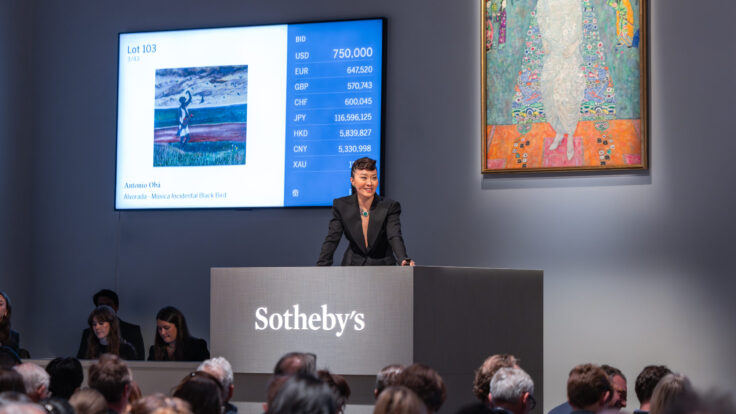
Christie’s released its midyear earnings last week, breaking down auction performance
by category, including luxury—which they first broke out as its own line item just four years ago. As expected, luxury sales at the auction houses have grown exponentially as a percentage of their global business in the past few years, as prices for fine and decorative arts have fallen. Jewelry, in particular, is performing exceptionally well.
In 2021, the luxury category for both Sotheby’s and Christie’s was about 15 percent of total auction sales. But the two houses have since diverged:
Sotheby’s luxury sales have accounted for a larger percentage of its business every year since then, topping out at 33 percent in 2024. (Sotheby’s did not release a luxury sales total for the first half of this year.) Between 2022 and 2024, however, Christie’s luxury sales hovered between 13 percent and 17 percent. |
|
|
A MESSAGE FROM OUR SPONSOR |
The first steps towards a masterpiece starts with a dream. The all-electric BMW i7 – the
evolution of brilliance. Learn more at BMWUSA.com |
|
|
During the first half of this year, though, that number increased to 23 percent for a
total of $468 million. The jump was driven by the acquisition of classic car company Gooding, whose sales totaled $63 million, and by jewelry, which accounted for 57 percent, or $265 million—a 25 percent jump in sales value from the same period last year.
Last month, Christie’s Magnificent Jewels sale in New York made $87.7 million—the highest total ever for a various-owners jewelry sale at Christie’s in the Americas. Christie’s global head of jewelry, Rahul Kadakia,
called it a “well-rounded” sale, which included a selection of Mughal jewels, a pink diamond ring once owned by Marie Antoinette, and the collections of Anne H. Bass and Lucille Coleman, all of which sold well above their estimates. Both the Magnificent Jewels sale in New York and another in Geneva, which made $72 million, were 100 percent sold. Kadakia told me it was the first time in his 20 years at the house that he had seen
that result for a various-owners sale (collection sales are more frequently white-glove). Meanwhile, Christie’s Joaillerie Paris sale last month made €16.7 million, the house’s highest total ever for an online jewelry sale, led by a Van Cleef & Arpels ruby ring for €2.4 million. |
|
|
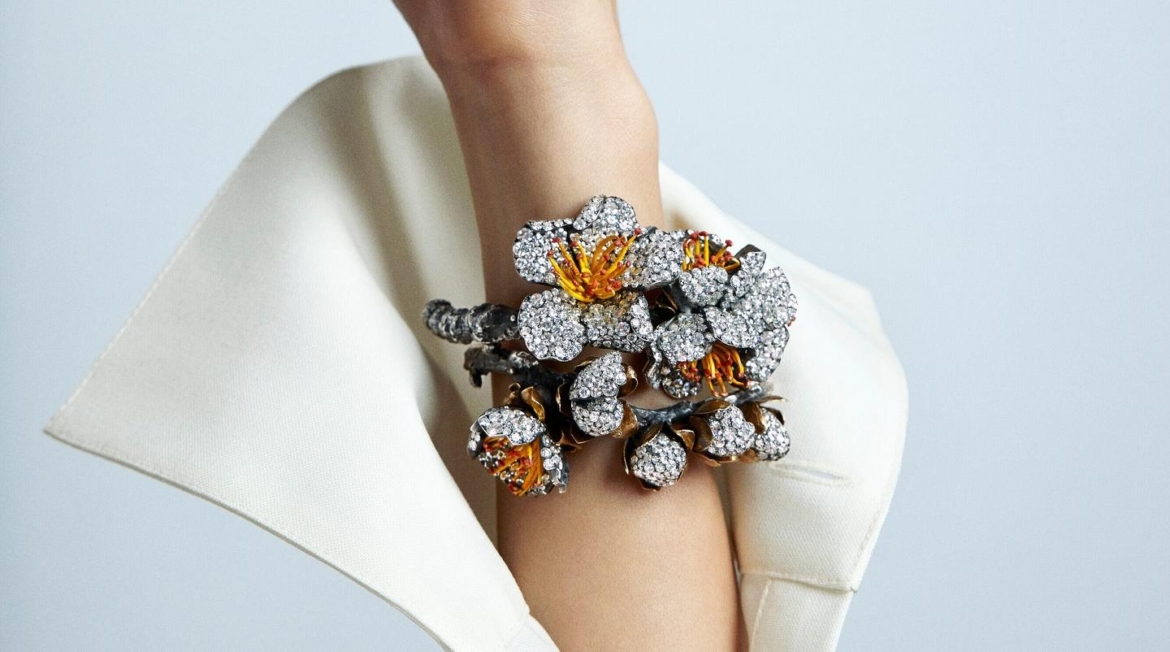
JAR Diamond Apricot Blossom Bangle. Photo: Christie’s Images Ltd. 2025
|
Demand for jewels by JAR, Joel Arthur Rosenthal’s brand—which have been
collected by the likes of Elizabeth Taylor, Lily Safra, and Ellen Barkin, according to Christie’s—is also at an all-time high. Christie’s has benefited from its close relationship with the brand since the early 1980s, when chairman François Curiel met Rosenthal and put his jewels in a Geneva sale. “It took off from there,” Kadakia told me. This May, in the Geneva sale, a group of JAR jewels made CHF 5.9 million
against an estimate of CHF 2 million, led by an apricot blossom bangle that sold for CHF 2.4 million against an estimate of CHF 280,000. |
Meanwhile, Sotheby’s dedicated jewelry auctions totaled $132.4 million in the first half
of the year, with $21.5 million coming from the sale of a 10-carat, brilliant-cut vivid blue diamond in Geneva, the most expensive jewel sold this year. Last month, at their various-owners sale in New York, the auction’s sell-through rate was 95 percent, the highest for a various-owners jewelry auction at Sotheby’s in New York. “Demand is far outstripping supply,” said Quig Bruning, who oversees jewels in the Americas. |
|
|
The house reported an average of 5.7 bidders per lot in the first half, up from 5.1
in the same period last year. And, bucking doom-and-gloom reports coming out of Asia, the average number of bidders per lot in the April sale in Hong Kong was 5.9, up from 4.6 in last year’s equivalent sale. These bidders drove up the average sale price to 151 percent of the estimate, compared to 100 percent in 2024.
The rising fascination with jewelry has also manifested in sales in the luxury retail sector. Gucci parent company Kering doesn’t break out jewelry sales in its earnings
reports, but sales in its “other houses” category—which includes Boucheron, Pomellato, and Alexander McQueen—were down less than its other categories. LVMH reported that jewelry and watch sales were up 1 percent in the first quarter year over year, while fashion and leather goods declined by 4 percent. And Richemont, in the most recent quarter ending June 30, reported an 11 percent increase (at constant exchange rates) in sales year over year for its four jewelry brands—Buccellati, Cartier, Van
Cleef & Arpels, and Vhernier.
Some have theorized that the post-“Liberation Day” bump is the result of wholesalers stocking up ahead of tariff-related price increases. But at the Luxury by JCK trade show in Las Vegas in May, suppliers reported robust sales from both consumers and retailers, despite price increases on gold and due to tariffs. “It’s only
going to get more and more difficult to find quality product,” Kadakia told me. “If you find that, you will find buyers.” |
Thanks, Julie. I’ll be back on Tuesday with more.
M |
|
|
The ultimate fashion industry bible, offering incisive reportage on all aspects of the business and its biggest
players. Anchored by preeminent fashion journalist Lauren Sherman, Line Sheet also features veteran reporter Rachel Strugatz, who delivers unparalleled intel on what’s happening in the beauty industry, and Sarah Shapiro, a longtime retail strategist who writes about e-commerce, brick-and-mortar, D.T.C., and more. |
|
|
Finally, a media podcast about what’s actually happening in the media—not the oversanitized,
legal-and-standards-approved version you read online. Join Dylan Byers, Puck’s veteran media reporter, as he sits down with TV personalities, moguls, pundits, and industry executives for raw, honest, sometimes salacious conversations about the business of media and its biggest egos. New episodes publish every Tuesday and Friday. |
|
|
Need help? Review our FAQ page or contact us for assistance. For brand partnerships, email ads@puck.news. You received this email because you signed up to receive emails from Puck, or as part of your Puck account associated with {{customer.email}}. To stop receiving this newsletter and/or manage all your email preferences, click here. |
Puck is published by Heat Media LLC. 107 Greenwich St, New York, NY 10006
|
|
|
|





_01K0MTQ3PBHF5JF7Z48P541HXV.JPG)