Welcome back to Wall Power, where the days are getting just a tiny bit longer, I promise. I’m
Marion Maneker.
We did it. We got past the solstice—the shortest, darkest day of the year. And now we’re slowly gaining hope that spring will arrive in a few short months. Let’s all get together with our nearest and dearest to recommit ourselves to a common purpose and mutual support to get through the hard winter days ahead. Or let’s just celebrate Christmas and New Year’s. Your choice.
🎁 Speaking of Christmas, Wall Power makes a great gift for that person you
know who loves art and culture—and is curious about how value and significance are created in the markets for cultural property. We’re currently offering a 20 percent discount on the first year of a
new subscription with the discount code
ENDOFYEAR2025.
Also, for those of you at galleries or museums where the newsletter is getting forwarded around, we offer group discounts. Just reply to this email and/or email Fritz@puck.news.
One more thing: a little visibility into the next week or two of Wall Power. There will be no newsletter on the days before and after Christmas. (I guess we’re observing Boxing Day.) I’ll be back on Sunday, December 28. On Tuesday, December 30, and Wednesday, December 31, we will be off again. Our regular publishing schedule will resume on January 2.
Mentioned in this newsletter: Pablo Picasso, Anish Kapoor, Roy Lichtenstein, Andy Warhol, Jean Dubuffet,
Safeya Binzagr, Mohammed Al Saleem, Mahmoud Sabri, Samia Halaby, Etel Adnan, Peter Born, Charles Stewart, Leonard Lauder, Emily Fisher Landau, Sydelle Miller, Elizabeth Dee, Bendor Grosvenor, and more…
Let’s get started… |
-
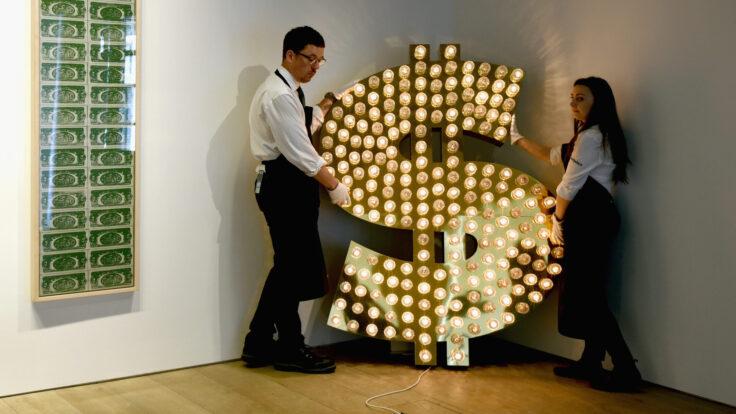
Sotheby’s reveals second Saudi sale: Following its inaugural $17 million sale in Saudi Arabia this past February, Sotheby’s will return to the region with a 70-lot auction on January 31. The sale coincides with the Diriyah Contemporary Art Biennale, and takes place just a few days before Art Basel Qatar opens on February 3. It will feature a mixture of works by the likes of Pablo Picasso, Anish Kapoor, Roy Lichtenstein, Andy
Warhol, and Jean Dubuffet, alongside Saudi and Middle Eastern painters like Safeya Binzagr, Mohammed Al Saleem, Mahmoud Sabri, and Samia Halaby.
- Speaking of Doha…: In early February, Art Basel Qatar will feature 84 single-artist exhibitions from 87 galleries, including Etel Adnan at Anthony Meier/Waddington Custot, Mona Hatoum
at Galerie Chantal Crousel, Marlene Dumas at David Zwirner Gallery, Philip Guston at Hauser & Wirth, Simone Fattal at Karma International, Lynda Benglis at Pace Gallery, and Shirin Neshat at Lia Rumma Gallery, to name only a few. The fair will also include special projects programming by the fair’s artistic director, Wael
Shawky, which will “explore the environmental and social histories that have shaped contemporary life in the MENASA region and beyond.” Abraham Cruzvillegas, Bruce Nauman, Hasan Khan, Khalil Rabah, Nalini Malani, Nour Jaouda, Rayyane Tabet,
Sumayya Vally, and Sweat Variant (Okwui Okpokwasili and Peter Born) will all contribute works debuting at the event.
|
Now, let’s get to the main event… |
|
|
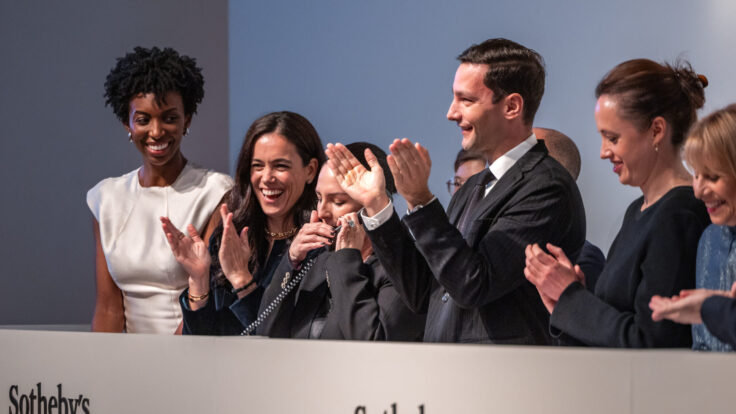
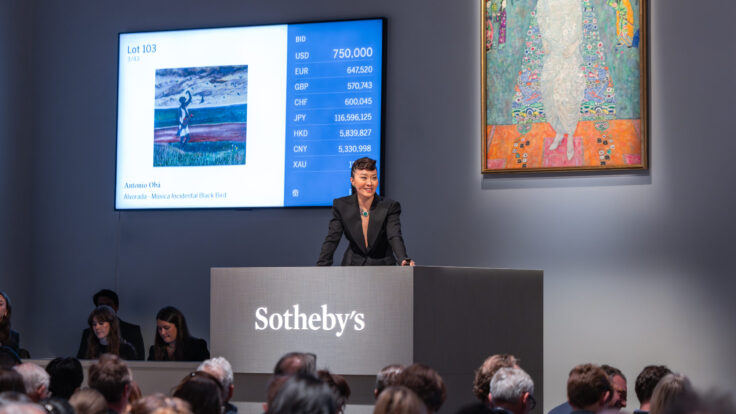
It’s been a monumental year for Sotheby’s, which secured nearly $1 billion from the
Emiratis, sold the Macklowe and Lauder collections, and made a new home on Madison Avenue. C.E.O. Charles Stewart sits down for a candid discussion about his auction house’s big year and the emerging Gulf market. |
|
|
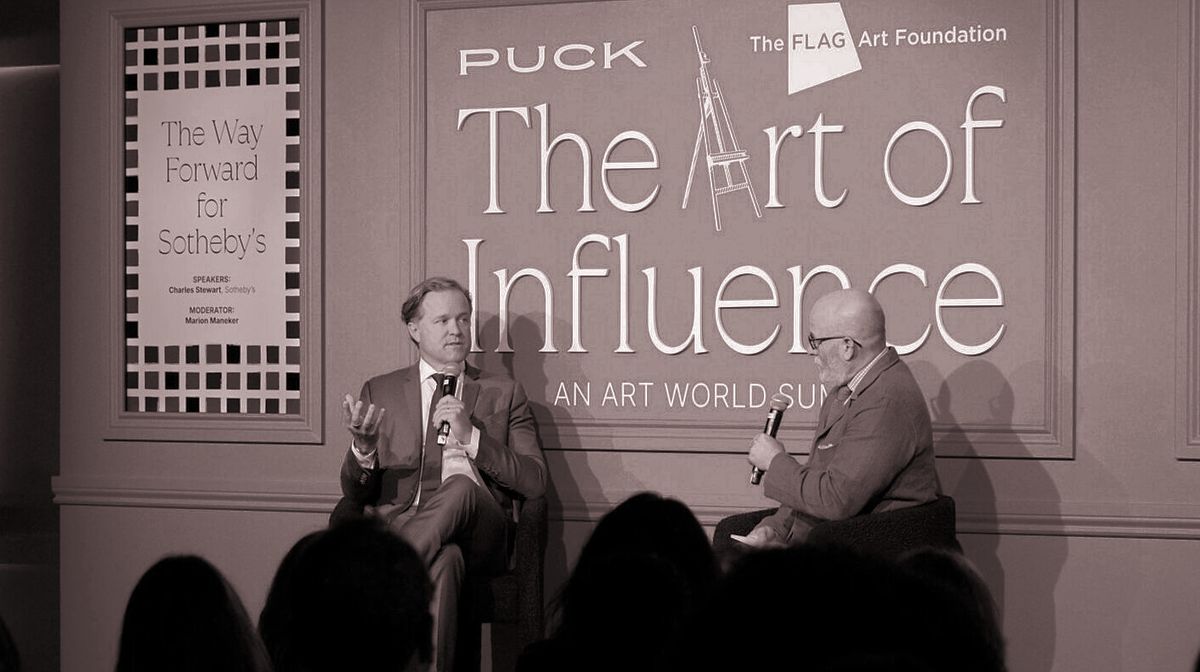
In the art world, Charles Stewart is a man who needs little introduction. As the C.E.O. of
Sotheby’s since 2019, he has guided the auction house through the challenges of Covid as well as the successful sales of the Macklowe, Emily Fisher Landau, and Sydelle Miller collections. Perhaps most crucially, he led the team that secured a nearly $1 billion investment from ADQ, an Emirati sovereign wealth fund; carved out a new flagship gallery in the Breuer Building; and built a bridge between the auction house and the Middle
East as much of the art market turns toward that region.
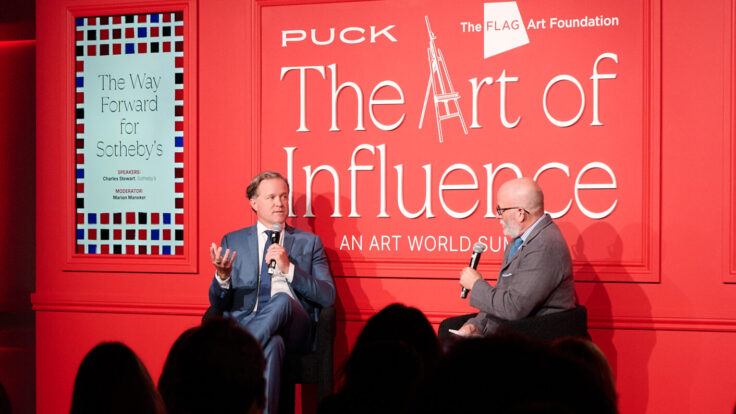
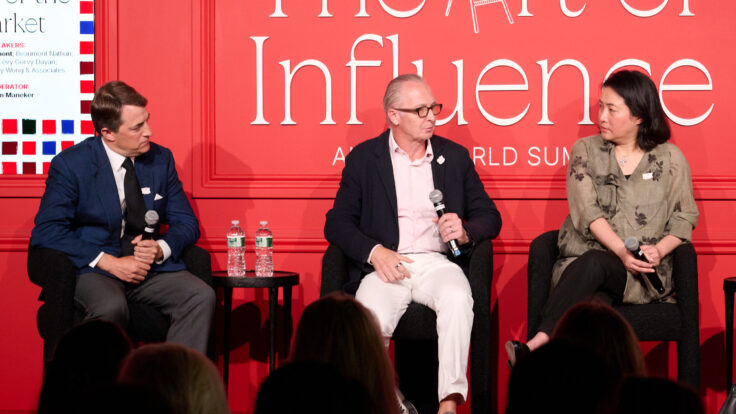
I spoke with Stewart at our summit, The Art of Influence, produced in September in partnership with the FLAG Art Foundation. The conversation took place mere hours before it was announced that Sotheby’s had secured the Leonard Lauder collection for its debut sale in the Breuer Building. At the time, no one knew that 25,000 visitors would queue up along Madison Avenue to see the Lauder and other collections, which
would eventually secure $1.2 billion in auction sales during the November cycle. But Stewart, correctly, was already predicting its success. As always, the following has been lightly edited for length and clarity. |
Marion Maneker: I figured a good place for us to start is the Breuer
Building, which has become part of Sotheby’s personality. How do you envision that working beyond just being a landmark where Sotheby’s will hold its auctions?
Charles Stewart: The more time we spend with this building, the more we are falling in love with it, and the bigger and broader the opportunities seem to be. For Sotheby’s, it’s a return to Madison Avenue. That’s a part of our history we’re excited to embrace again. The location
changes a lot in terms of expectations—a world of maybe more always-on programming. Most significantly, there’s the building’s architectural history and, of course, its museum pedigree. We’re discovering more and more about those things as we lean into the building.
And your staff will work out of the building while they’re there? You have this sort of temporary office space, so when there’s an influx of clients, people will be on site and able to engage not just with the clients
they have appointments with, but also with people they run into.
Yes, exactly. Our corporate staff will remain largely at York Avenue, and there are hundreds and hundreds of people there. Frankly, there’s no office space closer to the Breuer that can accommodate a group of our size, so I think we’ll stick with that. And we’ll work a little more project-based that way. There’s probably up to 100 people who can be working at the Breuer at any given
time, which I think is perfectly appropriate given how we plan to use it. But we’re going back to using the full envelope of the building for gallery and exhibition space, which will be really exciting.
And you’ve solved one of the main problems with that space, with a whole new way to load work in and out of the building.
Yeah, the biggest intervention we’re making in the building is actually the big freight elevator, which
dramatically simplifies the loading dock. I think for most people, when you come in and see it for the first time, it will hopefully be exactly as you recall it at its best.
You mentioned continuous programming in the space, and you announced that Independent 20th Century will be held there next September. How did that come about? And what other sorts of things will happen?
It really started with the Breuer itself. Whether it was
Elizabeth Dee [the co-founder of Independent 20th Century] or some of the key dealers who’ve been a big supporter of that fair, when we had our very first discussion on it, it seemed like something very intuitive and exciting. Hopefully the announcement was well-received. It’s a good example of the way we can use the space in ways that go beyond an auction house convention.
You’ve had a longer-term outreach toward galleries. Is this something you see helping with
that?
Absolutely. For all the reasons that everyone knows, there are points of tension, and just tradition and custom. But I think it’s an interesting moment for a lot of that to be questioned and challenged. We’re trying to do things that can increase audience and grow audience engagement. So if we can use our space in a collaborative way, I think it makes a lot of sense. And we would say the same to prominent galleries and dealers as well.
Figuring out how we can collaborate in interesting ways that seem relevant in this next chapter of the art market is front of mind. I think the Independent Art Fair is the first such collaboration that we’ve announced, and is hopefully only the beginning of those types of possibilities. |
The Middle of Museum Mile
|
With your client base being so centrally located, do you anticipate a changing relationship? York
Avenue, for better or worse, is off the path of commuting. Now, you’re going to be in the middle of Museum Mile, right on Madison Avenue. In what ways do you hope that changes the relationship?
Most people were coming to Sotheby’s to see something specific, or for a specific reason. As you point out, with the Breuer, we expect much more drop-in. This has been a very deliberate strategy for us. It started with the space we’ve opened in Hong Kong,
which has had over 300,000 people visit this year. Our new building in Paris is up three to four times [in visits] compared to the same period a year ago. It’s very important, and I think we will multiply the audience at the Breuer as well.
It seems like we’ve been struggling with the auction calendar for probably a decade or more. But now there’s been this evolution of doing special sales at different times.
Right, there are more
and more of these collections. We all talk in broad terms about generational change and wealth transfer and collections, and we’re absolutely seeing it. Believe it or not, we’re trying to do fewer auctions—we’ve tried every year to lessen the number. We try to consolidate wherever we can, partly to make room for these single-owner collections. But you can’t exactly predict the timing or location, and you need to have space available for it.
The Middle East is a place we’ve been adding
auctions. It’s a region that is calling out for more focus. It’s definitely an X factor that everybody is interested in learning more about. As we’ve invested there, and certainly with the benefit of our Emirati shareholder, we’re excited about the potential.
But is the Gulf really the future of the art market? The bullish people tell me that there’s a deep commitment in many of these cities, states, and countries to make a broad investment in art. Is that the boom? Or is the boom
that it’ll bring in other potential collectors?
[Government] agendas are hugely significant. They’re not always linear in how they get there. But I’m really encouraged to see the announcement of the Art Basel fair in Qatar in February, for example. In Saudi Arabia, in some ways, it’s the biggest and most complex, because there’s a lot of different stakeholders. But the ambition is the biggest of all, with dozens of museums as part of the vision
for 2030. Their idea is to make it into a new kind of crossroads. Similar to Art Basel Paris, which is not only about the French audience. The whole world assembles for that, and that’s the kind of idea [the Middle East] has as well. |
Are there more things you’re looking at that you might invest
in?
First and foremost, we are fine art–focused. If you look at our business mix, the proportion of fine art versus other things has not changed very much over the last few years. We’ve had some investments, but I think that’s more a byproduct of following the clients. The art market has known for a long time that the secondary markets are really important, and that’s been coming to life a little bit on the luxury side. We aim to be front of mind
with our global client base, and we need to have that infrastructure and all those relationships in place.
What do you see as being the next potential innovations in the auction world or the art world?
A lot of times people associate innovation with technology investment. And we’ve made pretty significant investments in our product and technology team to grow our digital audiences and make our clients’ digital experience better.
But innovation, to us, takes many shapes and forms. I think buying a museum and turning it into our flagship gallery is a form of innovation. It’s sort of unprecedented. The collaboration with Elizabeth and the Independent is innovation. Everything we’re doing goes back to trying to increase the size and engagement of our audiences. People talk about whatever the challenges of the market are, but we’ve seen the strongest demand and buyer metrics in the last 10 years—bidders per lot, sell-through
rates, hammer versus low estimate. And some of that is just because markets are strong, and there’s interest; some of it is because we’ve really been focused on trying to improve that conversion and that engagement. |
It’s been a very busy season, and I’m just catching up on my reading. If you haven’t yet looked at
Bendor Grosvenor’s great piece in the Financial Times about the decline of connoisseurship—the knowledge of an artist’s work that comes from sustained examination—let me give you a taste. Grosvenor uses the Sotheby’s
sale of a recently rediscovered Rembrandt to point out that there’s no longer any recognized expert on the artist whose judgment about authenticity is widely accepted. (The preeminent Rembrandt connoisseur died in 2021.) Nor is there a viable alternative provided by
technology. We may live in times of giddiness about the potential of A.I., including its purported ability to verify an artwork’s authorship, but Grosvenor warns that “A.I. connoisseurs are not very good.”
The technology, he notes, is hampered by poor inputs. For instance, the Dutch master’s oeuvre underwent a wholesale revision in the 20th century, and a large number of paintings formerly considered Rembrandts had their attributions downgraded to the studio or circle. Recently, many of
those determinations were reversed, but the algorithm can’t determine which of these conflicting opinions is correct. Then there’s the issue of image quality—many Old Masters paintings are not in great condition, or have not been photographed with enough resolution, to enable the L.L.M.s to do their best work.
But Grosvenor’s central point is deeper than what he calls his “self-serving attempts to delay the arrival of our A.I. overlords.” He writes: “The real reason we should resist A.I.
connoisseurship is that it would mean giving up the most critical, and most enjoyable, aspect of art history: looking.”
Finally, thanks
to Curtis Rowser for all his help taming today’s transcript.
Happy Christmas to all who celebrate. For the rest of us, stay warm and close to the ones you love.
M |
|
|
Finally, a media podcast about what’s actually happening in the media—not the oversanitized, legal-and-standards-approved
version you read online. Join Dylan Byers, Puck’s veteran media reporter, and Julia Alexander, a longtime media analyst, as they sit down with TV personalities, moguls, pundits, and industry executives for raw, honest, sometimes salacious conversations about the business of media and its biggest egos. New episodes publish every Tuesday and Friday. |
|
|
The ultimate fashion industry bible, offering incisive reportage on all aspects of the business and its biggest players.
Anchored by preeminent fashion journalist Lauren Sherman, Line Sheet also features veteran reporter Rachel Strugatz, who delivers unparalleled intel on what’s happening in the beauty industry, and Sarah Shapiro, a longtime retail strategist who writes about e-commerce, brick-and-mortar, D.T.C., and more. |
|
|
Need help? Review our
FAQ page or contact us for assistance. For brand partnerships, email ads@puck.news.
You received this email because you signed up to receive emails from Puck, or as part of your Puck account associated with {{customer.email}}. To stop receiving this newsletter and/or manage all your email preferences, click here. |
Puck is published by Heat Media LLC. 107 Greenwich St., New York, NY 10006 |
|
|
|