{{ 'now' | timezone: 'America/New_York' | date: '%b %d, %Y' }} |
|
|
|
Hi, and welcome back to Line Sheet. I’m on a flight to New York for a week of Puck stuff and more.
Hope to see you around.
In today’s issue, Rachel “Rachel@puck.news” Strugatz is back to share what’s happening behind the scenes at Estée Lauder Cos.–owned Bobbi Brown, which announced this morning that it would be exiting almost every major department store in the U.S. (Rachel
broke the story yesterday.) In the early aughts, one of E.L.C.’s biggest strategic mistakes was leaning on department store distribution as Sephora infiltrated the American market. The company’s big brands—Estée Lauder, Clinique, and Bobbi Brown in particular—suffered over this miscalculation. Is this change too little, too late? Rachel has all the
info.
Up top, you’ll find Sarah Shapiro’s analysis of Lyst’s hottest brands and products from Q1 2026. Many of the winners are no-brainers, sure, but we were surprised by some absent names. Plus, Malique Morris shares why Adidas’s street-beating first-quarter earnings were not entirely positive, and Rachel has an update on the potential merger between Puig and E.L.C.
Also mentioned in this issue: Lahnie
Strange, Jose Manuel Albesa, Bobbi Brown, Sara Foster, the London Marathon, Matthieu Blazy, Phoebe Philo, Fabrizio Freda, Sabastian Sawe, Bjørn Gulden, Sephora, Charli XCX, Aïda Moudachirou-Rébois, Ulta, Stéphane de La Faverie, Wuthering Heights, Yomif Kejelcha, Lisa
Sequino, Tara Simon, Bad Bunny, Giuseppe Marsocci, Marisa Meltzer, Margot Robbie, Bruno Pavlovsky, and more… |
Three Things You Should
Know…
|
|
|
|

| Rachel Strugatz
|
|
- The Puig–E.L.C. marriage
foretold: Along with Puig’s earnings this week came questions about its potential merger with the Estée Lauder Companies, which is now reportedly considering a takeover bid for all of Puig’s Class B shares at €18 to €19 apiece. On an earnings call yesterday, Puig C.E.O. Jose Manuel
Albesa confirmed that talks are “ongoing” and that “no final decision has been made yet.” He did not comment further, much to everyone’s disappointment.
Lauder is said to be working with J.P. Morgan to structure a €5 billion-ish package to fund the merger, and I’m sure both parties are doing absolutely everything in their power to get this deal across the finish line. The conglomerates have extremely complementary strengths, and a combined entity would greatly
benefit everyone involved.
|
|
|
|
A MESSAGE FROM OUR SPONSOR |
Agentic commerce isn’t a future concept. It’s already reshaping how people shop. Static storefronts are giving way to
guided, conversational experiences that don’t just surface products. They drive decisions and conversion in real time. Swap’s Agentic Commerce 101 breaks down what’s real and what it means for brands right now. Inside: |
• What agentic commerce is and why most AI tools don’t qualify • Why AI discovery platforms aren’t built to convert for your brand • Why owning your AI experience and your data is becoming non-negotiable |
|
|
|

| Sarah Shapiro
|
|
- The designer Lyst: More
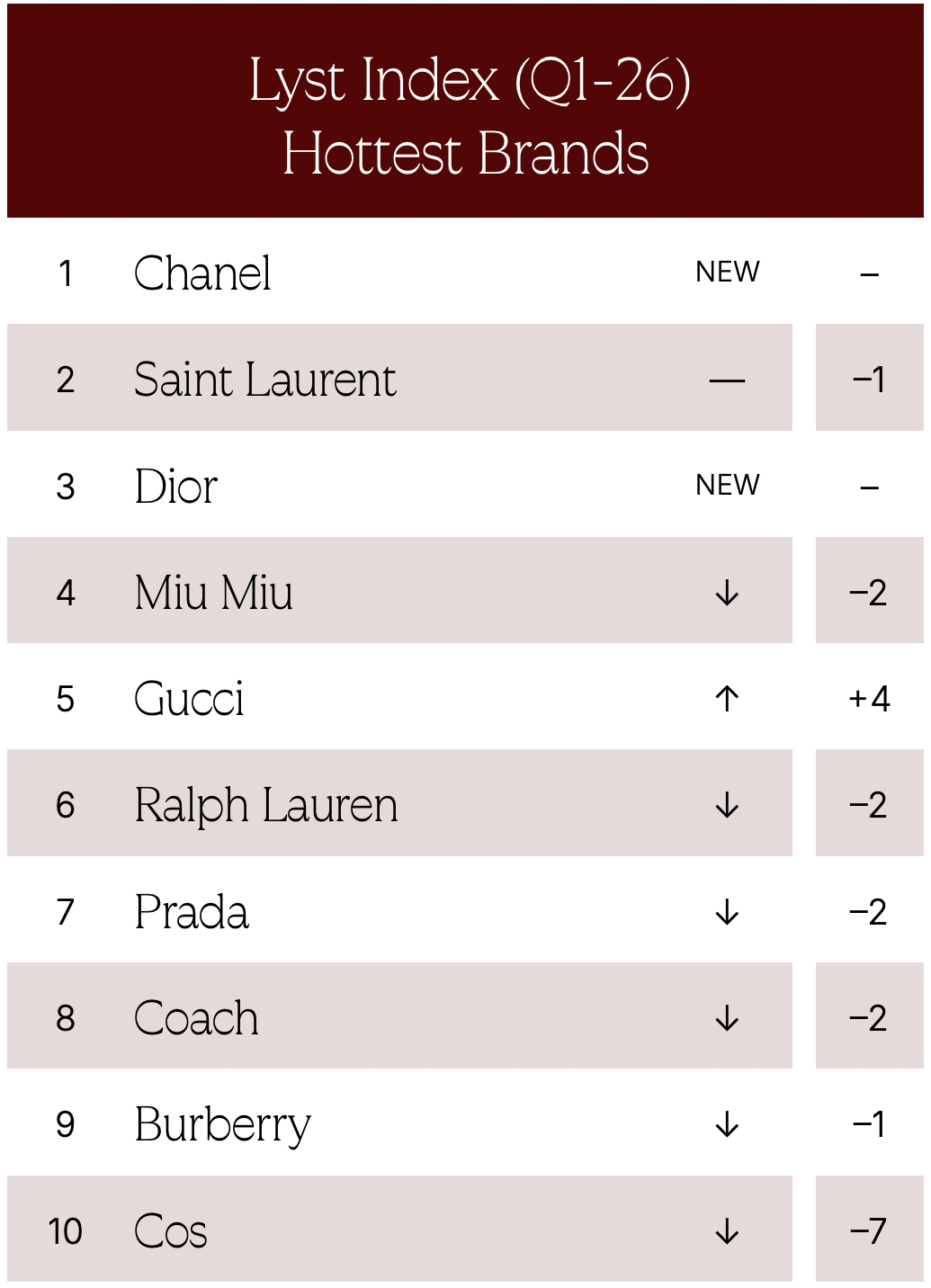
than any other trend, the Lyst Index’s Q1 2026 rankings marked the return of designer-led brands. Chanel, for example, was absent from the top 20 in the final quarter of 2025, but debuted at number one this time around, driven by Matthieu Blazy’s first collection for the house. Chanel also has two top-10 products: the Chanel pumps and the
Maxi Flapbag. Dior also reentered the rankings at number three.
|
- This is a complete reversal from a
year ago, when creative directors were shuffling around and changes at more than a dozen fashion houses opened the door for accessible basics to take over. In Q1 2025, Cos became the first mass-fashion brand to crack the top 10—and while it landed at number three in Q4 2025, it’s at 10 in the latest rankings.
Meanwhile, the hottest-products list was filled with pop-culture-relevant pieces and seemed less influenced by the runways. In the wake of Margot
Robbie and Charli XCX’s Wuthering Heights press tour, Vivienne Westwood’s Long Fond gown landed in the top 10, and Love Story elevated the Kangol Tropic 504 flat cap.
One notable absence is Phoebe Philo. But as Lauren reported on Monday, the brand is expanding its wholesale footprint and embracing a somewhat
unorthodox marketing strategy. We’ll see whether it’s enough to make the Lyst in Q2.
|
|
|
|

| Malique Morris
|
|
- Back on the Adidas beat:
Sportswear’s second-favorite brand reported higher-than-expected earnings on Wednesday. In the first quarter of 2026, net sales grew 7 percent year over year, to €6.5 billion, and net profits were up 14 percent. China and Latin America logged double-digit growth, while North America (still reeling from Trump’s tariffs) and Europe lagged behind with single-digit increases. But the all-important footwear division underperformed: Sales dropped 2 percent on a pure
year-on-year basis, although they grew 4 percent at a currency-neutral rate.
As I wrote yesterday, Adidas’s revenue growth steadily declined as people largely moved on from the Samba. The brand has yet to find another standout in its lifestyle assortment, despite having some success with niche gems including Bad Bunny’s BadBo
1.0 and Pharrell Williams’s Jellyfish. On Wednesday’s earnings call, C.E.O. Bjørn Gulden blamed the category’s underperformance on “lack of units and lack of energy” and the fact that retail partners “are merchandised with a lot of discounts.”
At least the company is seeing success with its running styles. On Sunday, Sabastian Sawe and Yomif Kejelcha simultaneously broke the world record for the fastest marathon time (sub
two hours!) while wearing Adidas’s $500 ultra-light Adizero Adios Pro Evo 3. The style sold out on Monday, and it’s fetching four figures on the resale market. The brand is pushing for another viral moment at the upcoming FIFA World Cup in June. Ahead of the earnings call, Gulden teased new releases including another Aidzero silhouette and a 3D-printed running style. But in the absence of Yeezy, Adidas will likely need a string of new hits to restore growth.
|
|
|
|
And now, more on Bobbi Brown’s department store retreat… |
|
|
|
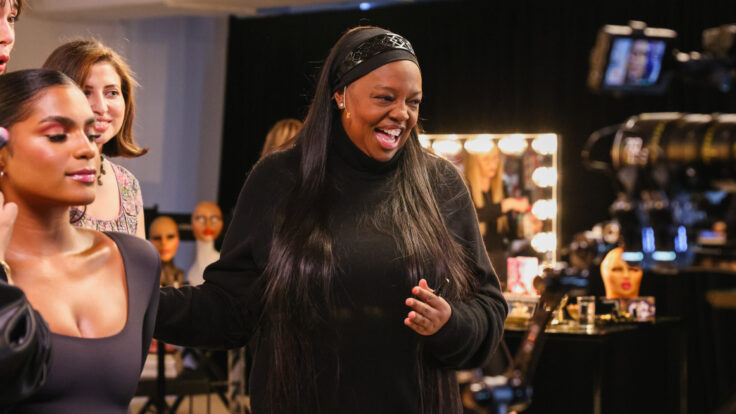
In just a few weeks, Bobbi Brown, the original no-makeup makeup, will exit nearly every
major U.S. department store to focus on Ulta and Amazon instead. Will the brand survive Estée Lauder’s attempted takeover of Puig? Or could it end up back in the hands of Brown, herself? |
|
|
|
It’s been a rough decade for Bobbi Brown, the original makeup-artist brand that mainstreamed the concept of
“no-makeup makeup” in the ’90s. Ever since visionary founder Bobbi Brown left the brand in 2016—exactly 25 years after it was acquired by the Estée Lauder Companies—revenue has steadily declined, from a $1 billion peak to around $400 million last year, according to a person with knowledge of the situation. (Another person said the figure is “above $500 million.”) Alas, besides that cream eyeshadow stick, no one in my informal poll could name a single product the
line sells anymore. (R.I.P. shimmer bricks.) |
|
|
|
A MESSAGE FROM OUR SPONSOR |
Agentic commerce isn’t a future concept. It’s already reshaping how people shop. Static storefronts are giving way to
guided, conversational experiences that don’t just surface products. They drive decisions and conversion in real time. Swap’s Agentic Commerce 101 breaks down what’s real and what it means for brands right now. Inside: |
• What agentic commerce is and why most AI tools don’t qualify • Why AI discovery platforms aren’t built to convert for your brand • Why owning your AI experience and your data is becoming non-negotiable |
|
|
|
But now, as Brown continues her extraordinary and extraordinarily lucrative latest act with
Jones Road, Lauder is making some sweeping changes to what used to be one of its biggest and most important brands. A few weeks ago, it was announced internally that the brand’s global general manager, Lahnie Strange, would be leaving the company. But the bigger headline, as I reported yesterday, is that Bobbi Brown will exit nearly every U.S. department
store, including Dillard’s, Macy’s, Bloomingdale’s, and Saks Fifth Avenue, at the end of May. Nordstrom, which has a foothold on the West Coast, is the one exception. I’m told the retail strategy going forward will focus on Ulta Beauty and Amazon.
The pivot arrives just as Stéphane de La Faverie, Estée Lauder Cos.’ newish C.E.O., is trying to get his house in order amid merger talks with Puig, the Spanish beauty and fashion giant. (M&A seems to be part of the plan too,
given that Lauder today announced a minority investment in London-based skincare line 111Skin, just a few months after investing in Mexican fragrance brand Xinú.) Puig’s makeup category rose nearly 10 percent in the most recent quarter, but the category is still down at Lauder, where most of the brands in its “makeup
cluster”—including Bobbi Brown, MAC Cosmetics, Too Faced, and Smashbox—have struggled and inhibited E.L.C.’s overall turnaround effort. (While things aren’t great at MAC, it’s still a huge business with some momentum, and I’ve heard that Sephora North America is pleased with the recent launch.)
Perhaps the most shocking element of the retreat is that half of Bobbi Brown’s North American business is said to come from department stores. Sure, one of
Lauder’s biggest missteps was doubling down on the channel, which started to decline when Sephora and Ulta gained market share, and this feels like a dramatic, if necessary, attempt to rectify that original sin. Internally, I’m told there’s optimism around Bobbi Brown’s exit from the channel. “People knew that the brand needed a strategic shift, and that’s finally happening,” said a person close to the brand. But a retail exodus of this magnitude means that Bobbi Brown has to recoup those sales
somewhere else—an enormous undertaking, especially for a brand that has lost so much cultural capital in the decade following the departure of its iconic namesake. (Although I can’t help but wonder if it was possible to salvage the businesses at any of the Saks or Bloomingdale’s flagship stores…)
If anyone is up for the job, though, it’s Tara Simon, E.L.C.’s newish head of North America, who has worked at both Sephora and Ulta. After all, the organization
needs someone who can take charge of the commercial relationships in the region and oversee Lauder’s Amazon expansion. Bobbi Brown’s door count and in-store space at Sephora have already been reduced (I hear the business has now “leveled out”), but the real opportunity is at Ulta. Unlike Sephora, Ulta still prioritizes department store stalwarts and nonexclusive legacy labels like Clinique, one of its bestselling brands.
|
Of course, addressing Bobbi Brown’s issues will require more than simply rejiggering distribution. The brand
has been mired in a decade-long identity crisis, and has struggled to identify its ideal consumer. After trying to court Gen Z several years ago, it pursued the 40-plus set with global ambassador Sara Foster, but neither push was really effective. A person familiar with the business explained that many of the brand’s problems stem from the fact that former C.E.O. Fabrizio Freda gave the different regions “too much control” over
their local markets. “They were shooting their own creative and looks that were locally relevant,” this person explained. “They changed whatever they needed to by market, but there wasn’t a centralized touchstone.”
But what’s probably hurt Bobbi Brown the most—aside from Brown’s departure—is the onslaught of younger, cooler, newer “no-makeup makeup” lines with superior marketing and branding that know exactly who they’re targeting. Over the past decade or so, this makeup subcategory has
seen a massive influx of competitors, including Westman Atelier, Merit, Saie, Ilia, and most importantly, Jones Road, which Brown launched in 2020 on the very day her 25-year noncompete with Lauder expired. In just five years, Jones Road has become one of the most successful D.T.C. beauty brands—a fact that surely keeps Lauder’s top executives up at night. |
|
|
|
However, Lauder’s larger makeup problems extend beyond Bobbi Brown. There’s Too Faced’s rumored sale,
Smashbox’s basically nonexistent business, and although it’s not technically part of the makeup cluster, Tom Ford Beauty can’t seem to get color right. “Bobbi Brown is just another casualty,” said a person close to Lauder’s senior leadership. “It all goes back to everyone being so focused on fragrance and skincare, but really running a true artistry brand is so specific. MAC is the only one that’s sustained [its success].”
If the Puig deal goes through—C.E.O.
Jose Manuel Albesa confirmed on Tuesday that “talks are ongoing, but no final decision has been made yet”—it would make strategic sense to combine MAC and Charlotte Tilbury under one division, ideally led by a Puig executive. Lisa Sequino, Lauder’s head of makeup and the former C.E.O. of JLo Beauty, has a lot on her plate. She’s been overseeing MAC ever since the exit of global general manager Aïda
Moudachirou-Rébois earlier this year, and I hear she’ll be the interim head of Bobbi Brown, too. But it’s probably in Lauder’s best interest to eventually install seasoned makeup operators with expertise in running global, multibillion-dollar businesses and turnarounds—and soon.
Anyway, the upshot is that every sign points to Lauder reinvesting in Bobbi Brown while searching for ways to drive efficiency. But a question that often comes up among industry types is whether Brown,
herself, would buy back her namesake brand. Plenty of beauty founders exit their first brands and start second ventures, but Brown has managed to do something no one else has: capture lightning in a bottle twice. |
Armani announced 2025 performance figures today. Actual revenue was down 4.6 percent, to €2.2 billion, but
profits were up. C.E.O. Giuseppe Marsocci said that the board has not “started meetings” with the three potential buyers named in Armani’s will: LVMH, EssilorLuxottica, and L’Oréal. [WWD]
Marisa Meltzer is all about eccentric rich people.
[Vanity Fair]
I’m not sure there’s a better collab idea than Hill House Home x American Girl. [WWD]
Bruno
Pavlovsky on Chanelmania: “We were concerned about the customer reaction because after the first show, not all our clients were convinced this new, looser silhouette was for them. Those fears have been laid to rest.” Expect double-digit Y.O.Y. growth in 2026. [WWD]
Anne-Marie has
quickly become Rachel’s favorite beauty Substacker. This week, she dives into the current state of makeup-artist brands. [Trucco Journal] |
Until tomorrow,
Lauren
P.S.: We use affiliate links because we are a business. We may make
a couple bucks off them. |
|
|
|
Need help? Review our
FAQ page or contact us for assistance. For brand partnerships, email ads@puck.news.
You received this email because you signed up to receive emails from Puck, or as part of your Puck account associated with {{customer.email}}. To stop receiving this newsletter and/or manage all your email preferences, click here. |
Puck is published by Heat Media LLC. 107 Greenwich St., New York, NY 10006 |
|
|
|
|