 |
|
Hello, and welcome to Wall Power, my twice-weekly private email about the business of art and the art world—the somewhat vague name we give to the constellation of collectors, advisors, dealers, auction houses, museums, and other public and private institutions that enshrine the industry’s extraordinary value. Annual art sales are estimated at a steady $65 billion a year, but that doesn’t come close to quantifying the economic impact of art, which also plays an essential role in the travel, luxury, and fashion industries.
I’m Marion Maneker, and I’ve been covering the art world, in one way or another, for more than 25 years. This newsletter is a continuation of the work I did with my website, Art Market Monitor, and my Substack newsletter, Artelligence. Whether you’ve followed me to Puck or have signed up for the first time, welcome.
In this inaugural email, I want to explain why I joined Puck, and, in broad strokes, catch everyone up on the backstory that led us to this particularly remarkable moment in the art market.
|
 |
| Art Market Shocks & Leon Black’s Math |
| The business of art, often misunderstood in the media, is a mysterious alchemy of ego, economic cycles, and a genuine passion for the sublime. But explaining the unexplainable is why I joined Puck. |
|
|
|
| For all the commentary about the art world, there is a stunning lack of writing that actually attempts to understand the business itself. Last week, for example, I was speaking to the C.E.O. of one of the major auction houses when he brought up something I had written a few months earlier about a competitor. Surprisingly, this executive thanked me for taking the time to actually analyze the company. He wasn’t being mean-spirited. Rather, he was expressing a frustration shared by many art industry insiders about their portrayal by the media, both in the trade press and when global news outlets attempt to write about the industry.
Too often, of course, media coverage of the art industry is driven by melodrama and caricature. The people who inhabit this world are partially responsible: Our culture has created a secular religion around artists and art, and everyone has something invested in those shibboleths. But like religion, the art world is also shot through with sanctimony—a reaction, perhaps, to the market’s own irrationality.
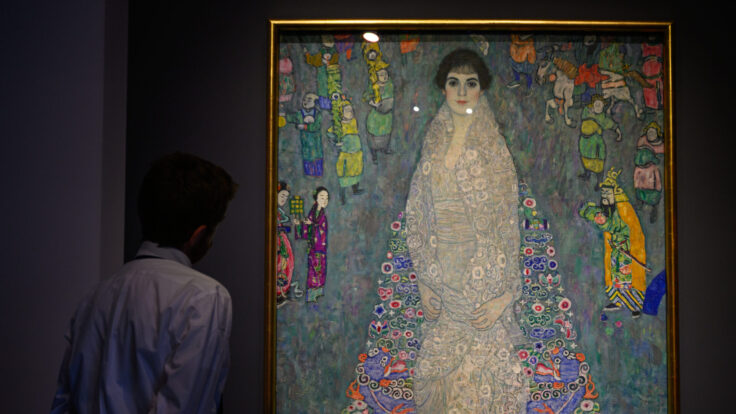
This isn’t something that’s lost on people in the art world. Individuals who are shrewd, successful, and unsentimental in their business lives often behave in seemingly irrational ways when it comes to buying art. We had a very public dissection of this kind of behavior earlier this year, when billionaire Dmitry Rybolovlev exposed his dealings with Yves Bouvier in a lawsuit against Sotheby’s. Rybolovlev was trying to hold Sotheby’s accountable for his own lack of due diligence—and basic common sense—in overpaying by a billion dollars, by his own claim, for dozens of works of art. But who is to say what is the true value of a Gustav Klimt, or René Magritte, or Leonardo’s Salvator Mundi? In fact, Rybolovlev made an extraordinary profit when Salvator Mundi was resold to Mohammed bin Salman, an even wealthier buyer.
My Puck partner William Cohan offered a perfect example of this rational irrationality when he questioned billionaire Leon Black, a massive buyer of art, about how he could have lost track of paying Jeffrey Epstein more than $150 million in advisory fees. “I’m known to be a ruthless negotiator, a penny-pincher,” Black told Cohan. “I’m also known to pay $50 million for a Raphael twice—not once, twice, two Raphaels, $50 [million] each, this big.” Here, Black indicated to Cohan he was talking about something the size of a sheet of paper. “Why is it implausible?” he continued, “[when] I’m a value investor and never paid the high bid?”
Ben Graham, the great sage of Wall Street, once said that the stock market is a voting machine in the short term and a weighing machine in the long run. But the art market is only ever a voting machine. There’s nothing to weigh, no external scientific measure of its worth. Art’s value is ultimately social, and the price of an individual work is not a measure of its quality—though it often coincides with quality—but a measure of its desirability. The person who pays more for a work of art is the person who wants it most.
When art dealers, collectors, or curators talk about a painting that commands a room and dominates the viewer, they will often say that it has “wall power.” Fittingly, that is also the title of my new column here at Puck. A work with wall power is impressive, compelling, and important. These attributes might prefigure an astounding sale price. But the notion of wall power isn’t only about the art itself. It is also a reflection of the artist, the dealer (or auction house), and, ultimately, the owner. The most admired collectors demonstrate a level of knowledge, vision, and access that mere money cannot purchase. In the art world, power doesn’t necessarily lie with the person who has the most financial strength. What makes this world so endlessly fascinating is the ways in which it continually frustrates the brute force of wealth.
Power is evanescent everywhere, but that’s particularly true in art, where a change in taste (and therefore values) can be as sudden as it is mysterious. We can point to visible events, like major museum shows and auction results, but those are usually isolated phenomena. Too often in the art world, what looks like cause and effect are coincidence. But that’s not to say everything’s an accident. The art world is nothing if not a seething cauldron of ambitions—to promote artists and ideas, to achieve status or make money, to touch the sublime or simply prove a thesis.
Who has the power to create value in art, and how do they wield it? We often forget that the art world is filled with people—some with the best intentions, others with the worst—just trying to succeed. Naturally, the effort to profit from the ineffable often has comical results. So if you’re thinking Wall Power sounds a little bombastic as the title for this column, that’s kind of the point. The art world can take itself very seriously. That doesn’t mean we have to. Balzac and Trollope would have loved this place, too. |
|
|
| I first entered this soap opera in the late 1980s, when the Japanese economic supernova created enormous excess liquidity. The combination of a newfound taste for Impressionist art among buyers in Asia, including some Australian debt-fueled industrialists, plus a new generation of American collectors, drove a veritable revolution in the art market. Even then, the interest in art had twin trajectories.
First, there was the explosion in top prices that would feed on itself until 1990, when Van Gogh’s Portrait of Dr. Gachet sold for $82.5 million, or $199 million in today’s dollars, just before the early ’90s recession. (Ryoei Saito, the buyer, had threatened to have the painting cremated with him when he died in 1996. His heirs don’t appear to have followed through.) Also around this time, there was the emergence of Contemporary art as a broader cultural phenomenon and economic force. Today, of course, Jean-Michel Basquiat’s market rivals the biggest names like Warhol, Picasso, Monet, and Richter. But it took decades for the market for Basquiat—like his peer, Keith Haring—to fully develop, as the art market came to put a higher premium on politics and identity.
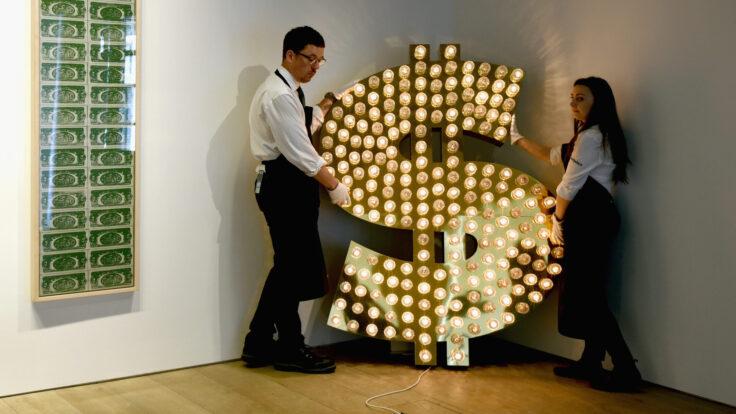
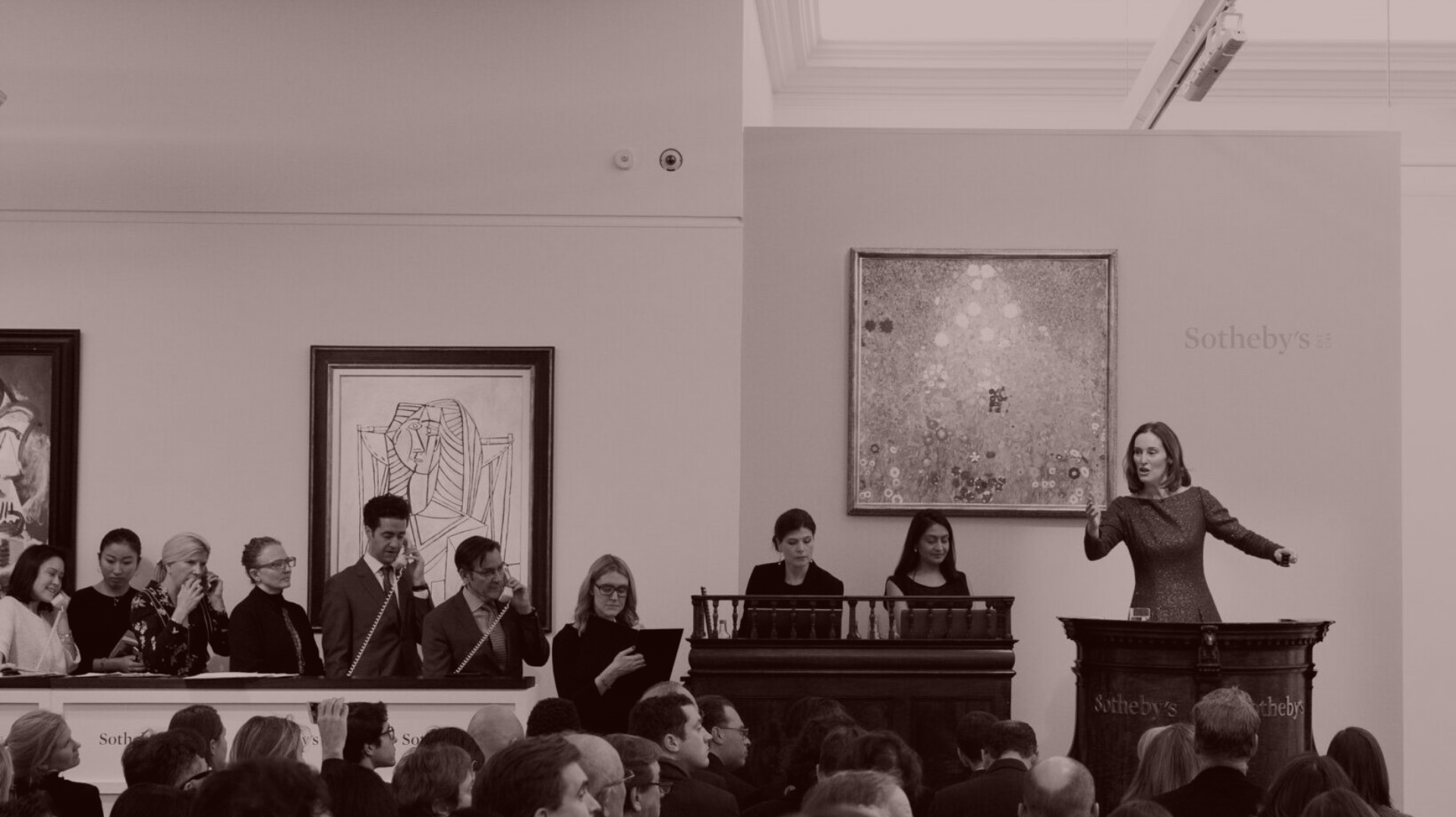
In the 1980s, both trends—the masterpiece market and the rise of Contemporary art as a reflection of current social issues—were just beginning. But the art market doesn’t follow a linear path. The ’80s boom was followed by a severe recession in the art market through most of the ’90s, followed by an economic rebound a few years later. In 1998, Si Newhouse paid $17 million at auction for Andy Warhol’s Orange Marilyn (1962), marking the beginning of the Contemporary art market that gained momentum through the early 2000s before reaching escape velocity in 2004. From 2005 to mid-2008, the market became a rocket ship as new buyers from all over the world rode a wave of global liquidity and low interest rates. Art Basel expanded from Switzerland to Miami in 2002. Frieze debuted in London in 2003. New buyers from the commodity-rich regions in the Gulf States and Russia began to show up at auctions. In 2006, a “mystery bidder” way in the back of Sotheby’s sale room waved a paddle and bought a $95 million Picasso. No one knew who he was.
The auction houses, which had already established footholds in Hong Kong in the 1990s, became an easy access point to legions of newly rich persons from around the world. Galleries like Gagosian, and later Zwirner, Hauser & Wirth, Pace, and eventually many others, began to open multiple exhibition spaces around the world. The auction houses used their expanded reach to improve their economics by guaranteeing art works at auction. With a minimum price guarantee from an auction house, a seller’s risk was reduced while still benefiting from the upside. Artists, too, began to see the auction houses as platforms for new economic opportunities. The auctioneers, in turn, had an information advantage that allowed them to expand their margins. For a brief, beautiful moment, the art market seemed destined to go up forever.
Then the global financial crisis hit. Everyone’s first expectation was that the art market would enter a long winter, perhaps more severe than the hibernation of the 1990s. The “generational low” in the stock market was in March 2009. A few weeks earlier, however, Christie’s held a sale of the art works and collectibles of Yves Saint Laurent and Pierre Bergé. Even as the global financial system was seizing up, wealthy buyers attracted to superb objects with a glamorous provenance were willing to spend like they had nothing to fear of the future. The sale’s €373 million total would stand as a record for a single-owner collection for nearly a decade, until the billion-dollar David Rockefeller sale.
Even with the Saint Laurent sale’s extraordinary success, it would take another five to six years before the art market peaked again, in 2014 and 2015. Total sales pulled back in 2016, rising again until 2018. Although it was interrupted by the pandemic, another cycle of rising sales began in 2019 and peaked in 2022. Today, we’re feeling our way through a dark period of doubt. Will the market recover or continue to contract?
Although we talk about the art market as a single market, it really is—like the financial markets—a collection of smaller markets in works from a particular period or style or artist, or even specific bodies of work within an artist’s broader career. These markets wax and wane with considerable volatility. Picasso and Warhol were the twin engines of the art market’s rise over the last 25 years. Their dominance has faded some, but other artists, particularly Gerhard Richter and Basquiat, rose up to support them. All markets go through cycles. Some artists fade into obscurity. The history of the market is littered with once-valuable artists whose work is no longer coveted. Others require a change in taste, a change in mood, or a willingness by previous buyers to sacrifice work for prices less than hoped for. |
|
|
| One of the leitmotifs of my reporting, as you’ll soon learn, is that healthy markets go up and they go down. There are global economic factors and changing tastes, of course, as well as exogenous shocks. Too often the press—and market participants—ignore the benefit of falling prices, which renew interest in artists or shift attention from one artist, period, or style to another.
One reason that I joined Puck is that its co-founder and editor-in-chief, Jon Kelly, understands what I think is the right tone and approach for covering this predictably irrational world. I’ve also come for the people, including colleagues like Bill Cohan, Matt Belloni, Dylan Byers, Julia Ioffe, and many others, who have created markets for their own work. Over the last 20 years, journalism has become a terrible and frustrating business. At one time or another in this period, most media organizations have gone through a period of suffering, often through no fault of their own. What impresses me most about Puck is that it offers a solution: bundling newsletters together around a central, functional core, while giving readers the option to subscribe to as many, or as few, as interests them.
Meeting Puck’s new C.E.O., Sarah Personette, reminded me of something Warren Buffett once said about why James Kilts was hired to be C.E.O. of Gillette, a favorite Berkshire Hathaway holding. Buffett said that Kilts analyzed a business situation with “no baloney,” in a way that just made sense. “Frankly,” Buffett said, “finding someone like that is a rarity.” I feel the same way about Sarah, Jon, our C.O.O. and co-founder Liz Gough, and everyone else I’ve met and begun to work with at Puck. Just making sense really is a rarity.
Besides the business model and the great writers they’ve assembled, the real beauty of Puck is in the mission to move beyond news headlines to the inside conversations that are truly driving the businesses of finance, entertainment, politics, media, fashion, business, and now art. That requires a deeper understanding of power, the people who wield it, and where it intersects across each of these worlds. It also often requires breaking the fourth wall between journalists and readers.
The leaders of the art industry, especially the most successful ones, recognize the absurdity of what they do. Art is not a commodity. No one needs it. You’re not providing energy or building houses or feeding people; no one needs what you’re selling. At the same time, what is life without meaning? Visual art—paintings, sculptures, sometimes other objects too—and cultural property (whether luxury items like jewelry, watches, sneakers, and handbags, not to mention other collectibles) are a physical record of our lives, our beliefs and our ideas.
But what makes visual art different from other cultural products like music, movies, books, and performances is that some of its power comes from scarcity. Because of that, owning a work of art—or other scarce collectible—becomes a status symbol. Leon Black doesn’t care how much it cost him to own a Raphael (or a Munch, or any of the dozens of exceedingly rare artworks he owns) because part of the satisfaction of owning those works is knowing that few others could possibly possess them. What price do you put on being immortality adjacent?
As grandiose as that sounds—and I don’t know for a fact that Black feels that his Raphaels let him look through a chink in the universe toward eternity—it masks the other side of art. None of this is worth anything if no one else thinks it is important or valuable. That process is also, even more so, the subject of this newsletter. In other words: There’s a lot to talk about here. Art is a lot like a spectator sport. (Hello, sports fans!) We can all get a great deal of enjoyment out of following along. I hope you’ll stick with me. |
|
|
|
| FOUR STORIES WE’RE TALKING ABOUT |
|
|
|
|
|
 |
|
|
|
Need help? Review our FAQs
page or contact
us for assistance. For brand partnerships, email ads@puck.news.
|
|
You received this email because you signed up to receive emails from Puck, or as part of your Puck account associated with . To stop receiving this newsletter and/or manage all your email preferences, click here.
|
|
Puck is published by Heat Media LLC. 227 W 17th St New York, NY 10011.
|
|
|
|