Welcome back to Wall Power, transatlantic edition. I’m Marion
Maneker.
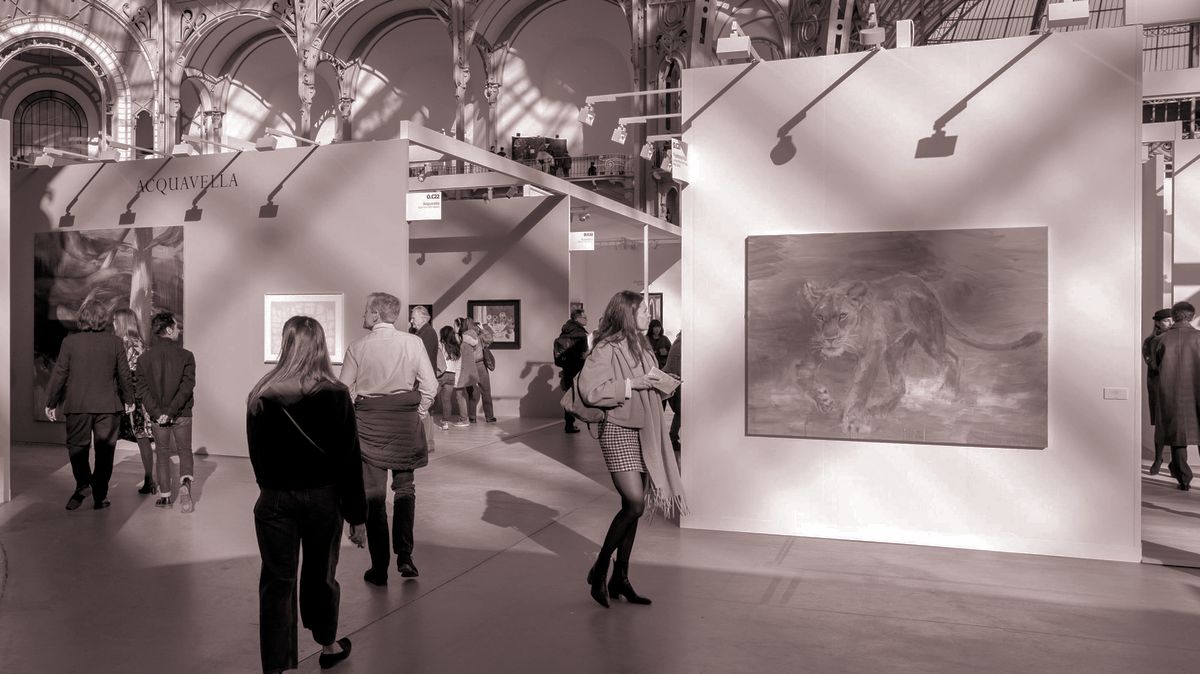
Tonight, I’ll be winging my way back to New York as you receive this newsletter. It’s been a roller-coaster week for me in the City of Lights, as I’ll explain below. But for the art market, it’s been another solid Art Basel Paris, with the fair rapidly asserting itself as the apex event on the global art calendar. The museum groups, the collectors, the dealers, and the auction houses are all here, enjoying Paris while they eye one another with suspicion and not a little
bit of competition. All the details, below the fold. |
|
|
A MESSAGE FROM OUR SPONSOR |
|
|

| Julie Brener Davich
|
|
- The Louvre heist
brooch’s checkered past: Among the treasures stolen from the Louvre last weekend was Empress Eugénie’s diamond bow brooch, and internet sleuths have made their own discovery while French law enforcement works to track down the thieves. It turns out that the brooch, which also once belonged to New York socialite Caroline Astor, had wound up in the
collection of Ralph O. Esmerian, former owner of Fred Leighton. The Louvre got it back in 2008 after Christie’s arranged a private sale to the American Friends of the Louvre for $10.7 million. So France managed to regain one of its lost treasures only to lose it again in a heist 17 years later.
- Golden prices for the Golden Age: Christie’s live sale this week of 174 lots from the G.B. Espy collection of sports and entertainment memorabilia, in partnership with Hunt Auctions, totaled $8.4 million—“solid results for exceptional stuff,” as one specialist put it. Lou Gehrig’s jersey from his final Yankees home game in 1939 sold for $2.7 million; Jackie Robinson’s 1962 Hall of Fame induction ring made $693,000 against an estimate of $250,000; a Red
Grange Chicago Bears jersey, circa 1933-34, made $548,100, more than five times its estimate of $100,000; and Marilyn Monroe’s signed Department of Defense ID card achieved $176,400, nearly nine times its estimate. In an interesting case study of the importance of estimate, context, and timing, a pair of autographed Muhammad Ali training trunks from 1980—which failed to sell at Julien’s in 2019 at an estimate of $20,000—sold at Christie’s for $56,700…
against an estimate of just $4,000. Christie’s online auction of Ali’s draft card closes on Tuesday.
- More memorabilia: Michael Jordan had a decades-long exclusivity contract with Upper Deck that prevented him from putting his signature on anything that wasn’t sold by the trading card
brand. But recently he has begun doing private signings. A rare 1986 Fleer rookie card, which Jordan autographed last year, just made $2.7 million at Goldin in a private sale, a record for a card with an “aftermarket” signature—i.e., one not already signed when you pull it out of a pack. Back in June, another card from the same
signing made $2.5 million at Joopiter. There are still seven more out there.
|
|
|
Now, let’s get to the main event… |
|
|
The global fair’s Paris edition is now Europe’s undisputed apex art
event. But is Paris more of an attraction to buyers, or a distraction from the real deal heat? Depends whom you ask. |
|
|
I had such high hopes for the final leg of my three-week sojourn with Mrs. Wallpower
across Scotland, England, and Paris that even a four-day fever couldn’t derail them. I started mending just in time for our packed agenda, which included hitting the city’s dual set-piece fairs—Design.Miami.Paris and the city’s edition of Art Basel—as well as getting in some auction action. But it all started with a Metropolitan Museum event.
The Met was one among many major American museums with a presence in Paris this week—museum groups and directors were seemingly
everywhere, escorting their trustees to shows and meetings with Brigitte Macron, or hosting dinners and arranging private tours. (You can do this sort of thing at the fair in Basel—sans Madame Macron, of course—but it doesn’t have quite the same effect or appeal as doing it in Paris.) The event was held at 7L, Karl Lagerfeld’s former library, which is now preserved
as a bookstore and event space—a bibliophile’s fantasy, with 30,000 volumes stacked vertically in a skylit room. One would think Lagerfeld’s book collection would be useful to curators and students of fashion, but the Met’s David Breslin joked that he got his hand slapped on the one occasion he tried to remove a volume from the shelves to examine it more closely. |
|
|
A MESSAGE FROM OUR SPONSOR |
|
|
Breslin was with his boss, Max Hollein, to announce that
artist Liu Wei had been chosen for the 2026 Genesis Facade Commission. That means Liu will create four sculptures to fill four alcoves in the museum’s Fifth Avenue facade, following artists like Wangechi Mutu, Carol Bove, Nairy Baghramian, Lee Bul, and Jeffrey
Gibson. The Met also used the occasion to have architect Frida Escobedo walk the assembled group through her plans for the Met’s Tang Wing, construction of which will begin in earnest soon.
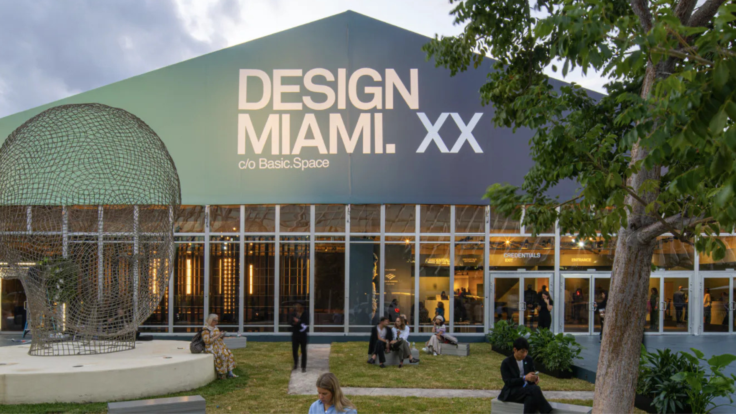
Alas, I couldn’t linger in Lagerfeld’s archive for long. Design.Miami.Paris was opening a few blocks away at l’Hôtel de Maisons, the huge private mansion that used to contain Lagerfeld’s rented Paris apartments. Design.Miami has quickly emerged as the Art Basel Paris opener,
with similarly exceptional exhibitors, and the event space’s massive garden is an ideal venue for them to display their Lalanne tortoises and purpose-built sound-healing structures. Julie Hamisky, a Lalanne granddaughter, was there showing her electroplated flowers and other flora, and Vienna’s Yves Macaux gallery had brought Wiener Werkstätte gilded metal objects to the fair.
Throughout the morning, more and more significant collectors
streamed into the grand building, and even a few exhibitors at Art Basel appeared as a prelude to the off-the-books opening of that fair scheduled for the afternoon. Still recovering from my illness, I skipped the Art Basel Paris Avant Première in favor of going back to my hotel to send you my Tuesday newsletter and have one of the best meals of our trip around the corner at Kubri, a Lebanese restaurant. |
Wednesday morning, after Mrs. Wallpower and I demolished some
l’escargot chocolat pistache from Du Pain et Des Idées, we set off for the Grand Palais. Despite Paris’s endless diversions—not just the pastries—all anyone seemed to be talking about was who had and had not gotten early access to the fair. Indeed, Art Basel seems engaged in a natural tension—leveraging the cultural attractions of Paris to make it the apex art-dealing
fair while still protecting the stature of Basel… and hoping that the delights of the city didn’t distract buyers.
A West Coast advisor told me that many American collectors who normally skip Art Basel in Switzerland had come to Paris instead. A gallery owner offered a counterpoint. “Paris is a problem,” he told me repeatedly, because the city’s cultural grandeur overshadowed the trade fair aspect he was paying for—it was a distraction from getting business done. Meanwhile, dealers have
begun to bring their very best objets to Paris, and more than one person suggested the quality of work on display this week was equal to or better than what’s normally on offer at Basel’s flagship fair in Switzerland in June. You definitely can’t please everyone.
Art Basel’s organizers circumnavigated this challenge with a simple art world solution—optimizing deal flow while trying to make people feel special. They wanted to give galleries a chance to get important works
sold before the crush of the fair began on Wednesday. I was told that the galleries were each given six passes for Tuesday afternoon, when the fair opened early for serious buyers. With a little more than 200 galleries, assuming most buyers come with a spouse, advisor, or trusted colleague, that would amount to 1,200 to 2,500 early-access visitors. Inevitably, in an age of instant and constant communication, bruised feelings soon followed.
Once word got out that some collectors and
advisors were headed to the fair early, the FOMO spread quickly. I spoke to some advisors who were very happy to have gotten in before everyone else, bought several works for their clients, and returned on Wednesday. I spoke to collectors who shrugged, admitting that they were maybe not the most important collectors, and thus were okay with having been excluded from the early access. Still others went to the fair late Tuesday afternoon perhaps just to be part of the scene. |
|
|
If anything, the late Tuesday opening took a little pressure off the fair’s Wednesday
preview without dissipating any of its heat. Most of the galleries I stopped into on Wednesday were teeming with visitors. One gallerist’s publicist had asked me to say hello to their principal, but I couldn’t get past the crush of clients after I arrived. |
On Thursday, Mrs. Wallpower came back with more morning pastries, this time cinnamon
rolls from Mamiche, our favorite patisserie. Before we wrapped up our stay in Paris, I wanted to see the minimalism show at the Bourse de Commerce. These exhibitions, in the massive, circular 18th century building, use works from the Pinault collection as the spine for larger and more comprehensive shows. The sections built around Lygia Pape and On Kawara were particularly effective.
Afterward, in the few hours we had left, we headed over
to Christie’s to join the crowd in the tiny basement sale room (which the auction house’s chairman jokingly instructed me to describe as large but also packed) for the €59 million Avant Garde(s) sale. There we watched the massive, 14-foot Yves Klein painting sell for just a smidge below the advertised price. With fees it was more than $21 million, the sixth-highest price for a Klein at auction. I also spoke to an art advisor there who was still chuckling over
the Max Ernst painting estimated at €800,000 that got bid to four times that price with fees. The advisor was pleased to have paid the premium. I asked another collector if he had bought something after getting outbid recently in London. He said no, but his friend had just made an unexpected windfall on a third-party guarantee for a bright yellow
Lucio Fontana painting, which had been estimated at €600,000 but was bid to nearly twice that with fees.
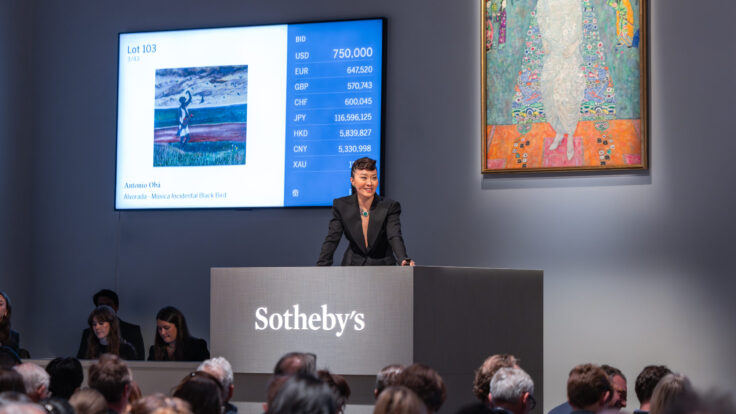
I was back to writing this newsletter by the time Sotheby’s held its Paris sales, which opened with a tiny 5-by-5-inch René Magritte painting of a cloud-filled sky. It was priced with a robust €200,000
estimate, which would have yielded a solid €10,000 per square inch selling price. Turns out that was unrealistically low, and the tiny painting hammered at almost five times the estimate, or €950,000—nearly €38,000 per square inch. The big-ticket Magritte, La magie noire, from 1934, was
estimated at €5 million but performed as well. After a slow start to the bidding, the final hammer price was €8.8 million, which translated to a $12.3 million selling price with fees. The top lot at Sotheby’s was a $31 million Modigliani, and all told the house hammered down nearly €90 million, or more than $104
million, in art. Clearly, there’s something more than vibes driving this market.
Many of the advisors and dealers I spoke to this past week in Paris asked me what I thought would happen next month in New York. I told them what I tell everyone: I can only reflect back the opinions people share with me, and I can’t independently verify either the dour gripes or the bullish hype. That’s why auctions are so important to the art market—they provide data. But I can say that many advisors feel
the quality of artworks available on the market, especially the many estates coming up at auction in New York, has changed the playing field and the mood. |
Thanks for taking the time to come along with me through our Paris sojourn. It’s such a
pleasant, human-scaled city. It should be a model for us all.
We will be back on Sunday with more art world stories.
M |
|
|
The ultimate fashion industry bible, offering incisive reportage on all aspects of the business and its biggest
players. Anchored by preeminent fashion journalist Lauren Sherman, Line Sheet also features veteran reporter Rachel Strugatz, who delivers unparalleled intel on what’s happening in the beauty industry, and Sarah Shapiro, a longtime retail strategist who writes about e-commerce, brick-and-mortar, D.T.C., and more. |
|
|
Finally, a media podcast about what’s actually happening in the media—not the oversanitized,
legal-and-standards-approved version you read online. Join Dylan Byers, Puck’s veteran media reporter, as he sits down with TV personalities, moguls, pundits, and industry executives for raw, honest, sometimes salacious conversations about the business of media and its biggest egos. New episodes publish every Tuesday and Friday. |
|
|
Need help? Review our FAQ page or contact us for assistance. For brand partnerships, email ads@puck.news. You received this email because you signed up to receive emails from Puck, or as part of your Puck account associated with {{customer.email}}. To stop receiving this newsletter and/or manage all your email preferences, click here. |
Puck is published by Heat Media LLC. 107 Greenwich St, New York, NY 10006
|
|
|
|