Welcome back to Wall Power. I’m Marion Maneker.
This morning, Art Basel announced that it is expanding its archipelago of art fairs to Qatar, with a new event debuting in February 2026. As art fairs proliferate, the events are becoming more local or regional in focus. But “regional” doesn’t necessarily mean “minor.” As one dealer pointed out to me, galleries are looking for fairs that reach actual collectors, not ones that just boast heavy foot traffic. Spending quality time with potential buyers may be what Doha can offer. I’ll discuss that in more detail below the fold.
If you’re receiving this email forwarded from a friend or colleague—and I know many of you are—think about signing up for your own subscription. Just pay already. You can afford it, but can you afford to live without it?
Mentioned in this issue: Robert Manley, Miety Heiden, Cheyenne Westphal, Jean-Paul Engelen, Michael Findlay, Julian Ehrlich, Max Falkenstein, Jacob Coley, Aviva Lehmann, and many more.
About yesterday’s personnel announcements…
|
- Manley and Heiden rise: At Phillips, Robert Manley and Miety Heiden were both elevated to the role of chairman. Manley will preside over modern and contemporary art; Heiden’s domain will continue to be private sales.
- Westphal and Engelen depart: In a small wave of departures of a kind we usually don’t see until the end of the year—or at least until the second half of the year—Phillips and Christie’s both lost prominent figures. Cheyenne Westphal is leaving Phillips, where she has served as global chairwoman for the past eight years. And Jean-Paul Engelen, who was president of the Americas and co-head of modern and contemporary art, will move to a new role as director at Acquavella gallery.
|
|
|
|
A MESSAGE FROM OUR SPONSOR
|
The first steps towards a masterpiece starts with a dream. The all-electric BMW i7 – the evolution of brilliance. Learn more at
BMWUSA.com
|
|
|
- Ehrlich decamps: At the advanced age of 29, Julian Ehrlich has already been poached twice from auction house jobs. He joined Christie’s from Sotheby’s four years ago. Thoughtful, well-versed in art, and with a disarmingly diffident manner, Ehrlich has had a rapid rise through both organizations and made some powerful friends and allies along the way. Now, he’s decamping to Gladstone gallery to work for Max Falkenstein.
After Ed Dolman left his position as C.E.O. at Phillips, it could hardly count as a surprise that two of his key hires would follow him out the door. Engelen, in particular, has worked with Dolman through three companies: at Christie’s, the Qatar Museums Authority, and Phillips. But when a not-yet-30-year-old specialist decides that his future looks more promising at a gallery than an auction house, you have to wonder if that’s more evidence of a broader shift in emphasis away from auction and toward the private market.I’m not suggesting this reveals a problem with auction houses. It’s no secret they’re missing momentum, even though there seems to be no flagging interest in art. Something is going to break that logjam, and offer an entry point to new buyers—I just don’t know what that something will be. If you’re working in the industry, you have to ask yourself where you’ll be better positioned in the next few years: at an auction house, a gallery, or working as an art advisor. The corollary question is which sector of the art market recaptures the cool factor first. No one has the answer, but these moves are reminders that things are in flux.
|
|
Now, here’s Julie Davich with some notable results and a lesson in what makes a work of antiquity valuable…
|
|
|
 |
Julie Brener Davich |
|
Triumph of the Illustrators
|
|
Maurice Sendak, Max Arriving at the Island of Wild Things, Where the Wild Things Are first drawing (1963). Photo: Courtesy of Heritage Auctions
|
|
After the American Art sales at Heritage Auctions this past Friday, Aviva Lehmann, who leads that department, sent me a celebratory note. “In a world where everyone is talking doom, we saw activity I haven’t seen since 2007,” she said. Some 332 unique bidders vied for about 220 lots across two sessions—the first, a various-owners sale of American art; the second, a sale of property from the Boy Scouts of America Settlement Trust. Altogether, the sales brought in $12.2 million, with sell-through rates in the high 90s—well above the industry average.
As Christie’s and Sotheby’s have shrunk their American Art departments, Heritage has quietly become the leading seller of works from the so-called Golden Age of Illustration—i.e., the era of Norman Rockwell and J.C. Leyendecker. On Friday, the house set a world auction record for the beloved children’s book author and illustrator Maurice Sendak. Thirteen bidders chased the original and first drawing for his 1963 classic, Where the Wild Things Are, which eventually sold for $625,000 against an estimate of $150,000. This was almost double Sendak’s previous auction record of $336,000, achieved by Sotheby’s this past December for a poster design.
Heritage also sold 13 paintings by Rockwell, eight of which achieved prices above $500,000. The top lot of the day was Rockwell’s 1972 oil on canvas Can’t Wait, depicting a young boy wearing his older brother’s too-large Boy Scout uniform, which sold for $1.3 million. A family scene from 1958, Mighty Proud, of a middle son being fussed over in his Boy Scout uniform, sold for $1.1 million.
A consignment from John W. Mecom Jr., the original owner of the New Orleans Saints, included four Ernie Barnes paintings that Mecom acquired in the early 1980s directly from the artist. The group was led by Sandlot Saints, which went for $450,000 against an estimate of $300,000.
|
Object Lesson: Head of a God
|
|
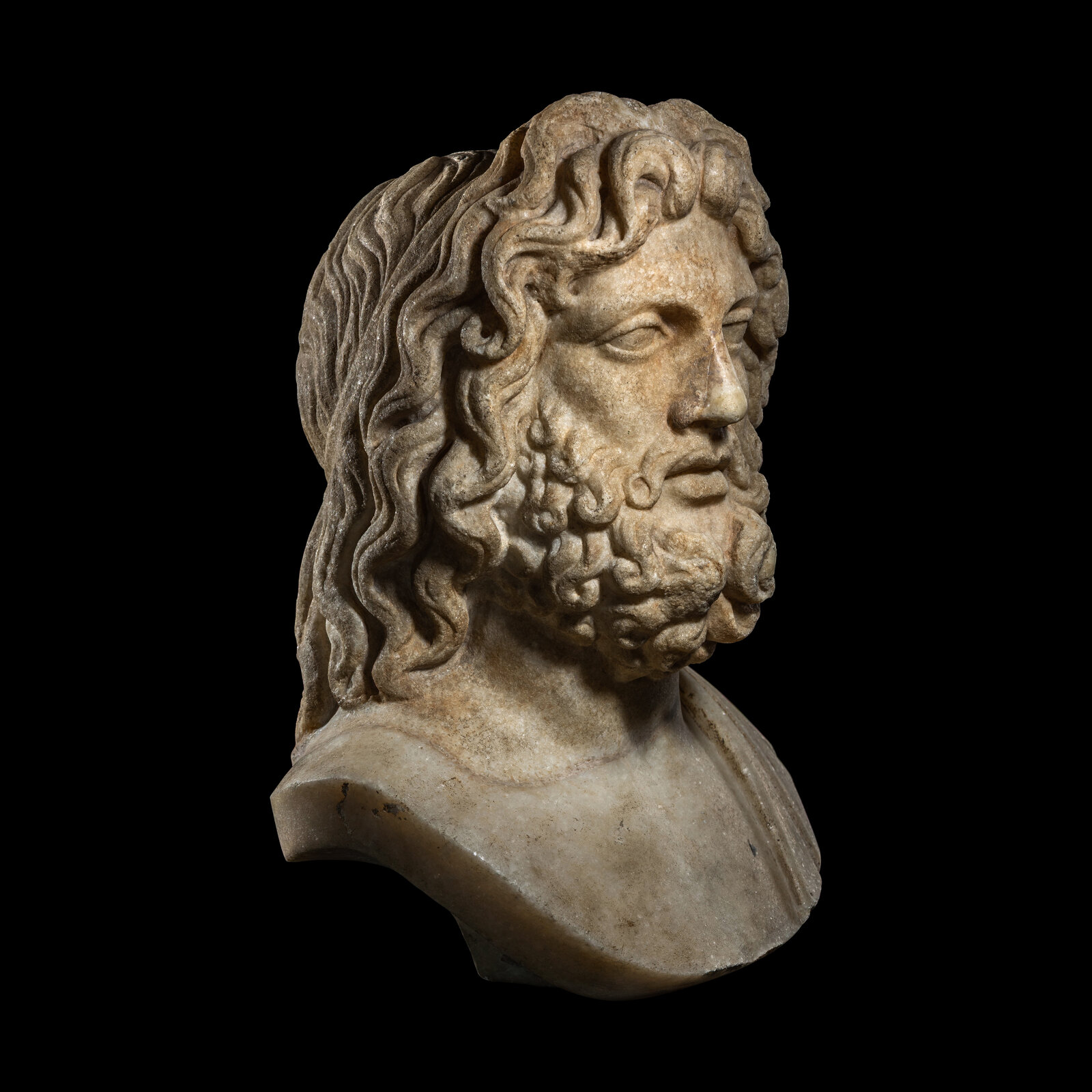
A Roman Marble Head of a God, circa 1st-2nd Century A.D. Photo: Courtesy of Freeman’s Hindman
|
What makes an object from antiquity desirable? First, there’s the material: Classical sculptures are most commonly bronze, marble, or terracotta, and are valued in that order. Bronze is the most rare because so many sculptures were melted down to reuse the metal. Larger objects, of course, are more valuable than smaller ones—a full figure is more valuable than a torso, and a torso is more valuable than a head. And then there is the subject matter and quality. Recognizable subjects, like gods, are generally prized.
Marble Roman Head of a God, from the Freeman’s Hindman sale on Thursday, is a good case study, according to Jacob Coley, head of antiquities and ancient art at the house. It is nearly life-size, well-rendered, and features exquisite detailing with Anastole (or Alexander) curls. Quality is especially important for ancient objects—they’ve all gone through centuries of deterioration, but the question is where and how badly. Since the makers are rarely known, the restorer can sometimes add value, and with Marble Roman Head of a God, you can see the seam around the neck where the restorer rounded it out to fit a new bust. It also has a desirable golden-red and brown patina. The preference among today’s collectors is an authentic patina that reflects the object’s age, as opposed to something that glistens like new.
Of course, the question of provenance is crucial in the antiquities market as well, given the legalities around the trade in cultural artifacts. Coley undertakes extensive research to date every object in his sale, often scrutinizing works for the method of conservation or mounting, both of which have changed throughout the centuries. While the world auction record for an ancient marble sculpture is $24.6 million (paid for the “Hamilton Aphrodite” at Sotheby’s in 2021), Coley is quick to note that ancient objects don’t have to cost millions, or even thousands. There’s a Sumerian clay cuneiform tablet in Thursday’s sale estimated at just $500 that would look great on any bookshelf.
|
|
|
|
Now, let’s get to the main event…
|
|
|
|
Art Basel’s entrée into the Gulf, which will occur in February, takes advantage of the balmy climate, the walkable downtown, and, above all, the money sloshing around Qatar, a petrostate-cum-financial center.
|
|
|
As soon as I saw the press release this morning that Art Basel would be launching a new fair in Doha, Qatar, to take place in February, I texted a prominent art advisor to gauge the interest of the community. “I love Doha, a very chic place” was the response. “Good hotels, restaurants, shopping, beach. Nice time of year. I’d definitely go.”
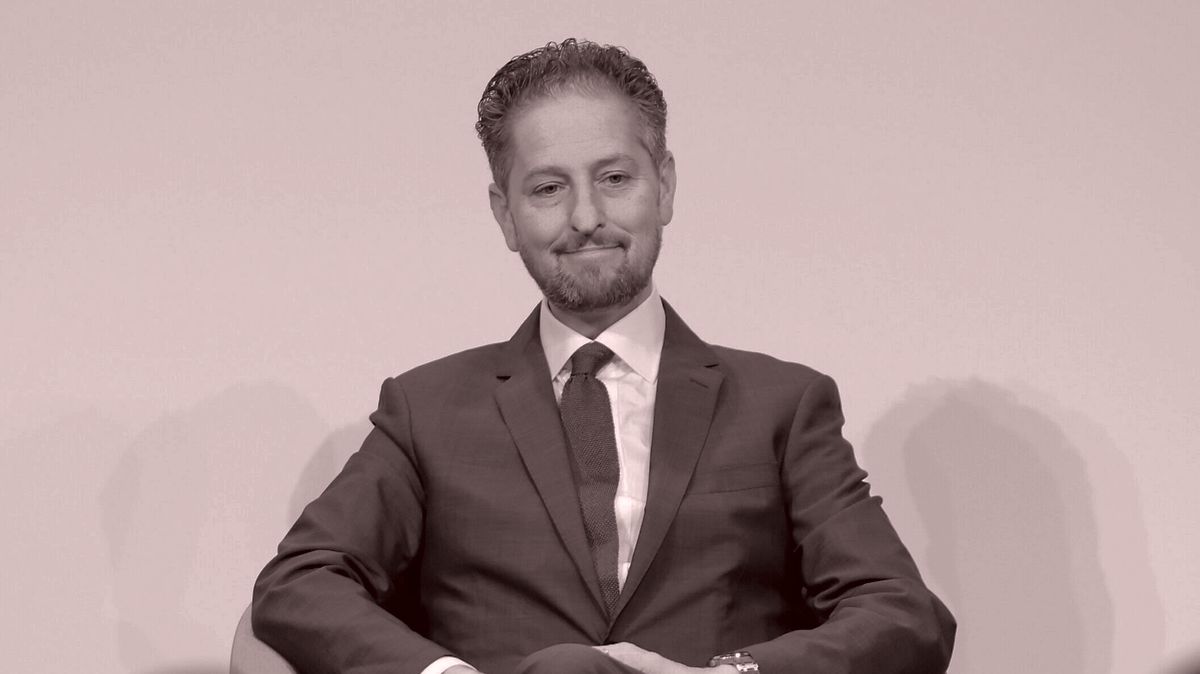
These days, where there is money, there’s art. But Art Basel’s decision to partner with Qatar Sports Investments and QC+, “a strategic and creative collective specialising in cultural commerce,” as the website puts it, isn’t intended to be a boondoggle. That hardly fits with Art Basel’s—or the art market’s—need for growth. When I spoke with Art Basel C.E.O. Noah Horowitz from his hotel room in Doha—he had just been at the opening of the Qatar Economic Forum, a Bloomberg event that’s meant to underline the country’s evolution from a petrostate to a financial center—he was pretty forthright about how all the partners are viewing the path ahead. “We all want a major new Art Basel show, but it has to be built, and we need to build it intelligently,” he said. “Not any of us think this can be done overnight. It has to be done step by step to build a sustainable, commercial market ecosystem.”
|
|
|
|
A MESSAGE FROM OUR SPONSOR
|
The first steps towards a masterpiece starts with a dream. The all-electric BMW i7 – the evolution of brilliance. Learn more at
BMWUSA.com
|
|
|
|
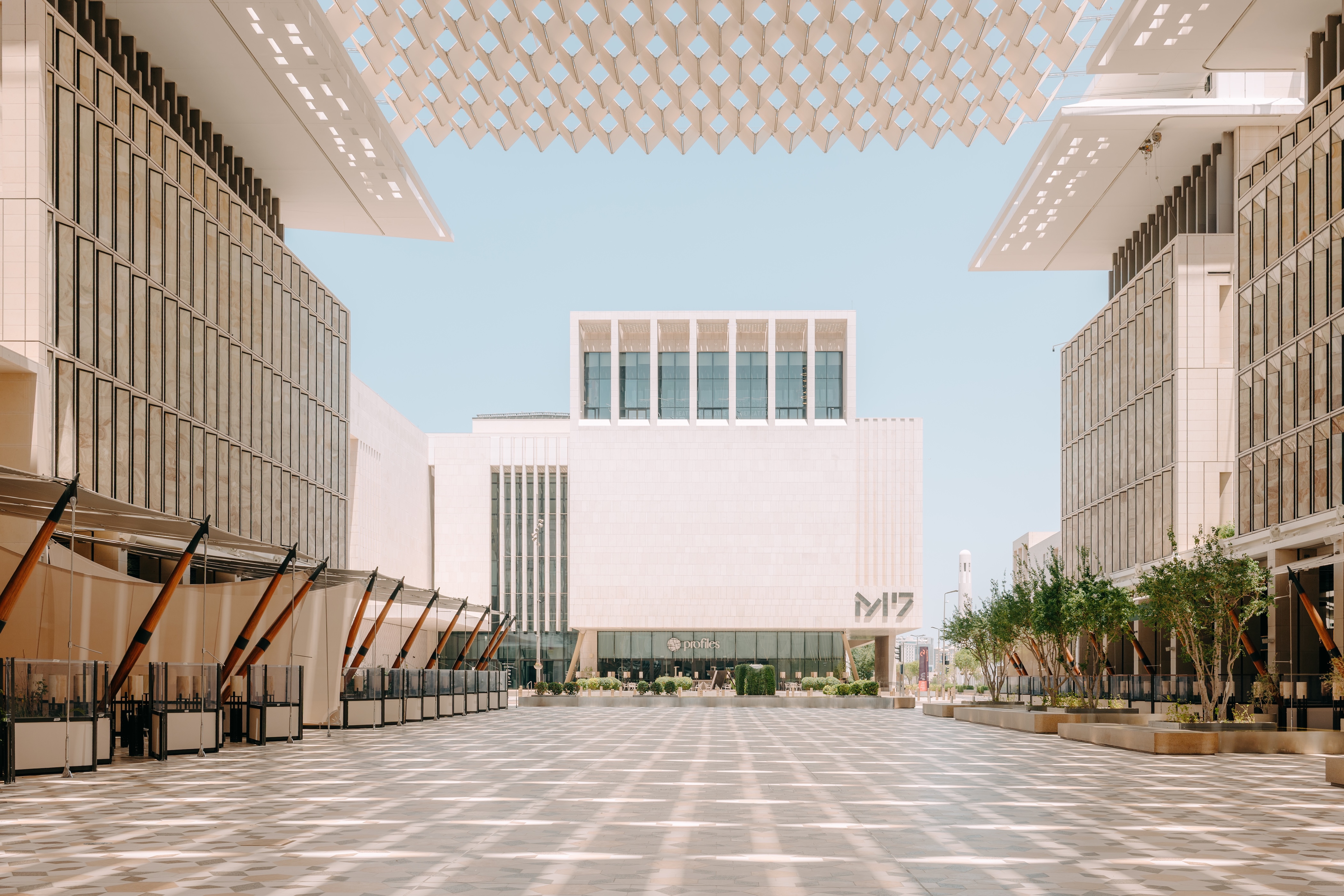
The fair will be held at M7 in the Msheireb development, Sheikha Al-Mayassa’s venue for showcasing fashion, design, and now art, in a walkable downtown. “It’s an area with a lot of foot traffic, very human in scale,” said someone who lived in the area while the venue was being built and has an art-world pedigree. “The Mandarin hotel is there.”
|
|
The M7, Doha. Photo: Courtesy of Art Basel
|
|
Over the phone, Horowitz emphasized that the plan to start small is intentional. “We’ll alight with a very bespoke Art Basel of roughly 50 galleries,” he told me. The fair’s dates were also chosen with care. February gives Art Basel a buffer from its December event in Miami, with enough time after Christmas to get sorted, but before Ramadan, which starts next year in mid-February, and six weeks to go before its Hong Kong event in March. There’s also Qatar’s weather to think about. In February, Doha averages in the low to mid-70s, and it’s already quite hot by this time of year. The
temperature hit 109º today.
Both Horowitz and Qatar are looking to turn Doha into another regional hub for Art Basel, like Miami and Hong Kong. Although Miami was launched on the strength of a handful of local power collectors, the fair draws enthusiasts from all of Latin America. (The region has a strong history of art collecting in general, and contemporary art collecting in particular.) Hong Kong has recently built more cultural infrastructure, but its appeal was not as a place to give galleries access to local collectors, but rather because the island city was a convenient point for all of Asia to converge. Even Basel itself, while home to local art galleries—especially the gallery of Ernst Beyeler, the fair’s founder—was never a commercial center on the level of New York, London, or Paris.
That doesn’t really matter so much. Art Basel wants to help Qatar build a local art market, but that can only be done, as Horowitz said, “hand in hand with the region spanning across North Africa, India, and the Gulf. And, of course, this being an Art Basel event, it will attract people from around the world.”
|
|
Doha, it hardly needs saying, is far from being a one-horse town in the sticks. There’s been intense competition between the U.A.E., Saudi Arabia, and Qatar to build the dominant regional center. Qatar has been investing in the necessary infrastructure for decades. The 2022 FIFA World Cup is merely the most recent high-profile example.
|
|
|
Art as an attraction has been a part of daily life in Qatar for a decade now. Horowitz reminded me that the Qatar Museums Authority is 20 years old. The government recently unveiled a pavilion in Venice’s Giardini so Qatar can have a regular presence at the Venice Biennale. There’s an Urs Fischer sculpture of a teddy bear slumping under a desk lamp at the airport that is now a local mascot. Site-specific works by Olafur Eliasson, Damien Hirst, and Richard Serra dot the desert. In many ways, Doha is a more cosmopolitan Marfa. “Even if you go there just to see the Richard Serra in the desert,” the former resident assured me, “it’s worth the trip.”
There’s also the local investment in universities. The ruling Al-Thani family has used education to incubate a broader and more cosmopolitan culture. Just as the fair will attracting the art-curious from across the region, establishing so many universities was a way to bring people from Lebanon, Egypt, and Saudi to Doha for a Western education, without the need to actually move to the West. Those schools affected a whole generation, according to the former resident, and that cohort is now 10-15 years older—entering a life stage where they are likely to want to, and be able to, buy art.
The fair will also benefit from Qatar’s investment in hospitality and experience hosting events on the global sporting circuit. Qatar, you’ll remember, built a lot of hotels for the World Cup. The city hosts an annual Formula One race, with additional events that make for a fun-filled five-day visit.
But as my guy with local and far-reaching art-world knowledge reminded me, and as he warns gallerists who participate in the fair, the buyers in the region are no rubes. “You’re not going to Aladdin’s cave,” he said. “They’re not going to throw money at you. They’re smart buyers. They know their stuff.”
|
I know we’re throwing a lot at you today, but here’s one more thing.
The New York City Landmarks Preservation Commission designated the Breuer Building an Individual and Interior landmark today. Good luck figuring out what that actually means from the self-congratulatory press release. But, according to Sotheby’s, the exterior, and parts of the interior (lobby, coat check, main stairwell, and portions of the lower level facing Madison avenue) were all landmarked. None of that throws off Herzog & de Meuron’s plans—and Sotheby’s still hopes to be in the building in time for the November sales.
So we’ve got that to look forward to. Meanwhile, I’m slicing and dicing the ARTDAI numbers from last week. I’ll have all of that for you tomorrow in the Inner Circle. Sign up here if you want to get that newsletter directly to your inbox, not forwarded from a friend or colleague ;-).
M
|
|
|
|
The ultimate fashion industry bible, offering incisive reportage on all aspects of the business and its biggest players. Anchored by preeminent fashion journalist Lauren Sherman, Line Sheet also features veteran reporter Rachel Strugatz, who delivers unparalleled intel on what’s happening in the beauty industry, and Sarah Shapiro, a longtime retail strategist who writes about e-commerce, brick-and-mortar, D.T.C., and more.
|
|
|
Need help? Review our FAQ page or contact us for assistance. For brand partnerships, email ads@puck.news.
You received this email because you signed up to receive emails from Puck, or as part of your Puck account associated with . To stop receiving this newsletter and/or manage all your email preferences, click here.
|
|
Puck is published by Heat Media LLC. 107 Greenwich St, New York, NY 10006
|
|
|
|




%201_01JVQK2HQFEGWFQXM9H9S0N8J0.jpg)