Welcome back to Wall Power. I’m Marion
Maneker—getting on the Henri Matisse train with our partners at Air Mail.
Later this week, Acquavella gallery will open its first major Matisse show since 1973. The more than 50-year gap is a bit of a surprise, since
Bill Acquavella, the gallery’s paterfamilias, famously bought the inventory of the gallery owned by Henri’s son, Pierre Matisse, in 1990. That deal was a seminal event in the art market. I’ll get into all of that on Friday when I write about the Matisse show. In the meantime, I thought I would prime the pump with the always-excellent Nicholas Fox Weber on the recently opened show of Matisse’s late works at the Grand Palais in
Paris.
Up top, the market for South Asian art continues its leap into hyperdrive with Saffronart’s recent sale results. And I stopped by La Mercerie in SoHo to get a better sense of what Marcel—the new restaurant opening inside the Breuer Building on April 16—might be like.
Also mentioned in this issue: Rembrandt, Cézanne, Merce Cunningham, Raja Ravi Varma, Cyrus Poonawalla,
M.F. Husain, Robert Rauschenberg, John Cage, Léon Bonnat, Thomas Eakins, John Singer Sargent, Anni Albers, and more… Let’s get to it… |
-
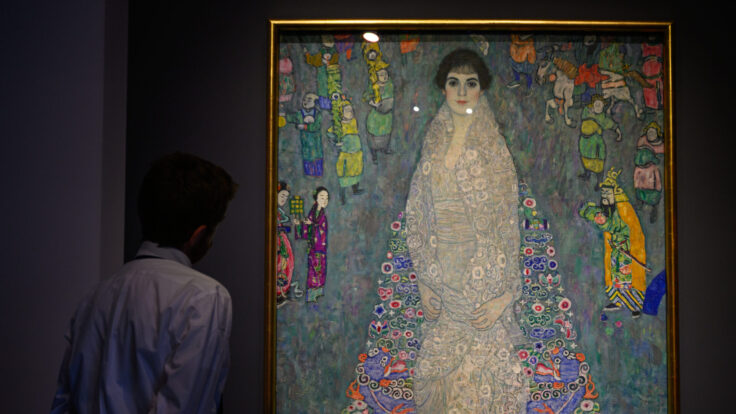
Saffronart sets a record with an Indian Old Master: Raja Ravi Varma may be the Indian art world’s version of an Old Master. The 19th century painter’s scenes from Hindu myths, and his depictions of deities using Western perspective and realism, are so commonly reproduced on the subcontinent that many ordinary Indians have images from his prints in their household shrines. On Wednesday, Saffronart included the painting Yashoda and
Krishna, from the 1890s, in their spring sale with an estimate of more than $8 million. It eventually sold to vaccine producer Cyrus Poonawalla for nearly $18 million. That price surpasses the nearly $14 million paid for an M.F. Husain mural at Christie’s last year, and makes Yashoda and Krishna the most
valuable work of Indian art to be sold at auction.
The rest of Saffronart’s sale also outperformed expectations. Husain’s untitled view of Benares made nearly $1.7 million, and an S.H. Raza abstract work from 2001, Kundalini,
sold for more than $1.5 million. The top 10 lots were all classic names in Indian art—including Akbar Padamsee, V.S. Gaitonde, and F.N. Souza—except the final entry, a work by American Orientalist painter Edwin Lord Weeks. The child of wealthy New England spice merchants, Weeks studied
painting in Paris with Léon Bonnat, just like Thomas Eakins and John Singer Sargent. And like Sargent, he lived as an expatriate. Weeks traveled to India for the first time in 1883. Two years later, he painted Two Nautch Girls, which sold for more than $500,000. Three of
Weeks’s top five prices at auction are for works he painted in India, including his top auction price of $2.9 million, achieved within the last two years. That was followed last year by a nearly $1.4 million hammer price at Saffronart for another work depicting a scene in India.
|
|
|
|
CHANEL Connects, the flagship arts and culture
podcast, goes global for Season 6. From the Hamburger Bahnhof in Berlin to Tokyo’s Nexus Hall, tune in to a series of intimate conversations in iconic places. In this episode, recorded live at the Guggenheim Museum in New York City, celebrated artists Sarah Sze and Julie Mehretu connect with Yana Peel, President of Arts, Culture & Heritage at CHANEL. The conversation moves from the now to the next, exploring both artists’ ongoing commitment to their communities and abstraction as a launch pad
for radical invention. Listen Now. |
|
|
|
- Lord, have Mercerie…: Speaking of the South Asian art sales, I stopped by the Breuer Building 10 days ago to view the South Asian art and hear about the results of Sotheby’s sale. While I was in the building, I got a quick tour of the new restaurant, Marcel, which will open on April 16. I also met one of the restaurant’s partners, Robin Alesch, who along with her husband, Stephen, runs Roman and Williams, the design team that
also owns and operates La Mercerie.
I promised not to write about Marcel until after the opening. But to prepare for that—and get a better sense of the Alesches’ retail and hospitality concept—Mrs. Wallpower and I decided to have dinner at La Mercerie on Friday night. What you don’t know is that a young Mrs. Wallpower did her time in French kitchens, including a Michelin-starred restaurant in Biarritz. I tell you this only so you understand that her opinion of the food and service at La
Mercerie isn’t entirely random.
La Mercerie is not a particularly large restaurant, though one’s sense of the room is enhanced by the dining area, which opens out onto the Guild showroom filled with furniture, shelves of ceramic dishware, and vitrines of silver place settings. We opted to sit by the door, where we had a better view of the unobstructed restaurant and open kitchen presided over by Heloise Fischbach. One of the nice things about La Mercerie is the way it
takes some very old-school restaurant ideas— banquets where couples sit side by side, or the waiter bringing around dessert to tempt you—and presents them in an unfussy way.
Our meal was perfectly paced: crisp, briny, and plump oysters with an unforgettable mignonette paired with Crémant d’Alsace, which helped us transition to two salads. Haricots bergamote balanced beans with the fat of ricotta, the salt of pistachios, and the sweetness of grapes. Beets with slightly sour crème fraîche
and salty salmon roe were the counterpoint. Next came a perfectly cooked filet de boeuf au poivre, a lighter take on a French classic, and a lovely tourte de saumon, here made like a beef Wellington but with salmon instead of beef and cabbage rather than mushrooms.
I asked one of the captains, a dead ringer for Isa Briones—who plays Trinity Santos on The Pitt—if she knew who would be in the kitchen at Marcel. She told me the details of what’s
happening uptown have been kept secret even from them. More will be revealed about Marcel in the next two weeks. Until then, my experience at La Mercerie suggests there will be many people making the trip to the Breuer Building, even if they care nothing for art.
|
|
|
|
An exhibition in Paris collects more than 230 works created by the
French artist in his last decade, when illness confined him to a life in bed but sparked a spectacular burst of creativity. |
|
|
|
In one of the last self-portraits Rembrandt painted before he died,
in 1668, he is laughing heartily. His humor suggests that the only way to face the ultimate is to be as alive as possible. Cézanne’s final version of The Card Players (1894–95) presents us with a moment in which mental concentration and human bodies, thought and matter, merge. In all of art history, however, there is no greater fusion of ethereality and immortality than in the work produced by Henri Matisse during the last 13 years of his life. The
spirit of his colors and the forcefulness of his lines are boundless.
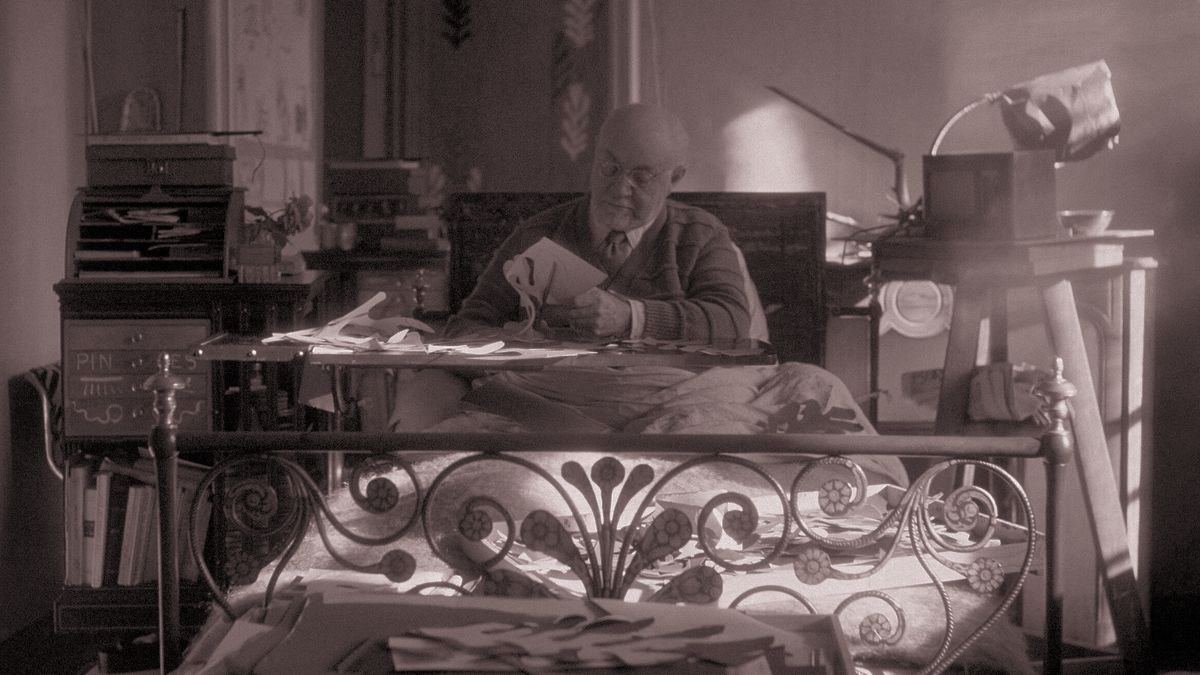
In 1941, when he turned 72, Matisse was diagnosed with duodenal cancer. Convalescing from arduous surgery in his house in Nice, a safe distance from his home in Paris, now occupied by German troops, he was limited to either his bed or a wheelchair. Until his death, in 1954, Matisse
was cared for by a group of nuns who were his neighbors. They devised a long stick that allowed him to draw on the walls, and equipped him with special scissors that enabled him to lie flat on his back and cut brightly colored paper—cosmic blues and greens, yellows as vibrant as sunlight, passionate reds—into forms that leap and bow. |
|
|
|
In this episode of CHANEL Connects, meet renowned
painter and critic David Salle. For more than five decades, the artist has been creating across disciplines: on the canvas, behind the camera, and now, in dialogue with artificial intelligence. He connects with Yana Peel, President of Arts, Culture & Heritage at CHANEL, for a live conversation recorded at LACMA in Los Angeles. Set against this backdrop, they discuss Salle’s formative years at the legendary art school founded by Walt Disney, his collaborations—from Martin Scorsese to AI
engineers—and the enduring power of human intention as the digital frontier evolves. Listen Now. |
|
|
|
In unprecedented shapes that are full of rhythmic movement, these cutouts use a
revolutionary vocabulary. They re-state the exoticism of the Moorish architecture the artist had encountered as a young man traveling in Morocco. They evoke subjects ranging from the life of Christ to jazz music. Sensuous and possessed of boundless vitality, these artworks celebrate life itself while sending the viewer’s endorphins to new heights. |
A
Master’s Late Life Resurgence
|
“Matisse: 1941–1954” opened late last month at the Grand Palais,
Paris’s recently renovated showcase for blockbuster exhibitions. It is the largest assemblage ever of the artist’s spectacular late flowering. More than 230 works—paintings, drawings, cutout gouaches, illustrated books, textiles, and stained glass—have been gathered from all over the world, no mean feat considering how complicated and costly the transport of art has become.
A precedent occurred in 1993 in
New York, when the entire Museum of Modern Art was taken over by the largest Matisse retrospective to date. I took my 78-year-old father to see it. In 1951, he and Mom had bought a Matisse rug—part of a signed and numbered edition—for $100. Its looming presence in the front hall of our typical suburban Colonial came to embody the ambient well-being of my
childhood. I felt that I owed it to Dad to get him to New York.
I took him to the show on a day when the museum was only open to a lucky few. He marveled from the start, but after we reached the sensual Blue Nude of 1907, his energy began to flag. We went directly to the rooms of the late cutouts, where we were both enthralled. When a beatific man with angelic curly hair walked in, Dad said, “I know that man.” I responded, “Yes, Dad, that’s the dancer Merce
Cunningham. You met him when he and Robert Rauschenberg and John Cage linked forces for an amazing performance in Hartford in 1963.”
“I want to say hello,” he said. “Oh, Dad, why not leave him alone? You can see how absorbed he is.” Dad, who had no interest in fame, went in spite of my request that he hang back. Merce was graciousness itself, appearing to remember Dad from Hartford and warmly recalling a meeting he and I had had with
Anni Albers.
Looking at Merce and Dad with Matisse’s forms gyrating behind them, I saw that the energy of the cutouts was infusing both of them with high spirits. Here were three septuagenarians—Merce and Dad in the present and Matisse when this visible effusiveness blossomed. All was clear: Old age might not be as bad as I feared. In fact,
it might induce a maximal appreciation of life. |
Thanks, Nick. Before I go, I did want to clarify something from Friday’s email. One
reader suggested my comments on the Domenico Gnoli show at Lévy Gorvy Dayan came across as blasé. If they did, let me say the show really is an event (as is the Vuillard show at Skarstedt downtown). I think the last time we had this many Gnoli works on view in one place was when Amalia Dayan put on shows in 2012 and 2018 at Luxembourg & Dayan, her previous gallery. That’s a reminder that if you miss this spring’s show, you’re going to have to
wait at least another six to eight years to see this much of the artist’s work again.
Until Tuesday,
M |
|
|
|
Puck founding partner Matt Belloni takes you inside the business of Hollywood, using exclusive reporting and
insight to explain the backstories on everything from Marvel movies to the streaming wars. |
|
|
|
Ace media reporter Dylan Byers brings readers into the C-suite as he chronicles the biggest stories in the
industry: the future of cable news in the streaming era, the transformation of legacy publishers, the tech giants remaking the market, and all the egos involved. |
|
|
|
|
|
DYLAN BYERS & IAN KRIETZBERG |
|
|
|
Need help? Review our
FAQ page or contact us for assistance. For brand partnerships, email ads@puck.news.
You received this email because you signed up to receive emails from Puck, or as part of your Puck account associated with {{customer.email}}. To stop receiving this newsletter and/or manage all your email preferences, click here. |
Puck is published by Heat Media LLC. 107 Greenwich St., New York, NY 10006 |
|
|
|
|