Welcome back to Wall Power. I’m Marion
Maneker.
Tonight, I’m taking a look at the end-of-year sales figures that Phillips, Sotheby’s, and Christie’s released this week. Even after a strong season, we’ve merely returned to a number roughly in line with the average for the last several years. But that’s a good thing following a long period of doubt and trepidation in the art market. I’ll get into all that below.
And don’t forget, I like to hear from all of you. It helps me do my job better. If you
have a tip or a concern or just want to tell me that I’m wrong, you can always hit reply to this email or reach me at +1 917.825.1391 on SMS, Signal, or WhatsApp.
Mentioned in this issue: Sam Spiegel, Steve Ivy, Elaine Wynn, Michael Govan, Francis Kéré, Dana Lee, Greg Lee, Roger Thomas, Arthur Libera, Clyfford
Still, John Middleton, Leigh Middleton, David Mugrabi, Andrew Fabricant, Laura Paulson, Clarissa Post, Jose Mugrabi, Paul Gray, Miety Heiden, and many more…
Let’s get started… |
-
Heritage promotes Sam Spiegel to C.O.O.: Sam Spiegel, a coin expert with a degree in classics and history from the University of Chicago, has evolved over his dozen years at Heritage Auctions into an operations specialist. (Mothers, let your babies grow up to be humanities majors!) The 34-year-old has been named chief operating officer and technology principal for the Dallas-based coin and collectibles behemoth, which has broken its sales records for
five years in a row. “Sam represents the next generation of leadership at Heritage,” Steve Ivy, co-founder and co-chairman of the auction house, said in a statement this morning. “His deep understanding of our business, his disciplined operational approach, and his passion for innovation make him uniquely qualified to help guide Heritage into the future.”
- And Heritage is on a growth tear: Heritage has yet to release
their end-of-year figures, but a representative for the firm told me that they expect to sell more than $2.1 billion worth of merchandise in 2025. That’s a big number to begin with, but some perspective makes it even more noteworthy. Five years ago, total sales at Heritage were $873 million. Last year, they were close to $1.9 billion, which makes topline growth this year around 10 percent. This year’s record will represent nearly 2.5x growth in overall sales over five years. That’s a blistering
pace, and a reminder of the rising importance of cultural property in the market.
|
|
|
A MESSAGE FROM OUR SPONSOR |
The first steps towards a masterpiece starts with a dream. The all-electric BMW i7 – the
evolution of brilliance. Learn more at BMWUSA.com |
|
|
- Design for Elaine Wynn’s Las Vegas Museum of Art revealed: The Las Vegas Museum of Art is still targeting an opening date in 2029. But the project—championed by Elaine Wynn and supported by LACMA’s Michael Govan, who has promised an art-sharing partnership—made two big announcements this week.
The first was the release of Francis Kéré’s plans for the museum. Kéré is a Pritzker Prize–winning architect from Burkina Faso whose
practice is based in Germany. His design for the 60,000-square-foot museum, to be built in the downtown Symphony Park, features African savannah motifs that evoke baobab trees, and a massive brise soleil that will provide shade for the building as well as the outdoor plaza and sculpture park.
The second announcement was that the museum had surpassed the halfway point in its $200 million fundraising goal. In addition to Wynn’s seed money, funding was secured from founding trustees
Dana and Greg Lee, Roger Thomas and Arthur Libera, and the Elaine P. Wynn and Family Foundation. - About that Clyfford Still painting…: In Tuesday’s newsletter, I mentioned that
Sotheby’s Icons exhibition featured Clyfford Still’s 1949-A-No. 1, from 1949, and that the painting was reportedly bought by the Al Thani family of Qatar in 2011 for nearly $62 million. But it turns out that the owners of the painting are not in the Gulf region at all. John and Leigh Middleton, Philadelphia collectors of American art—including 120 works that will be on view next year at the Pennsylvania
Academy of Fine Arts and the Philadelphia Art Museum—are now listed as the lenders of the Still painting at the Breuer Building. Middleton, as you sports fans are surely aware, is the managing partner of the Philadelphia Phillies.
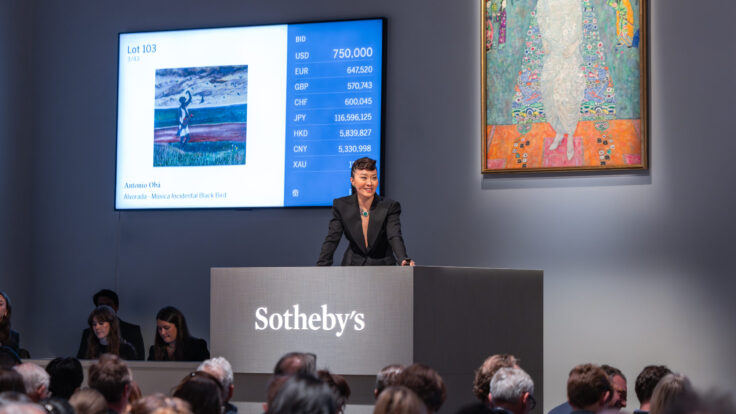
- Sotheby’s Icons delivers: There are two days left to see Sotheby’s Icons exhibition, and I highly recommend you find some time to stop by the Breuer Building. A lot of folks from the art industry seem to be availing
themselves of the opportunity. Courtney Kremers, Sotheby’s head of private sales in the Americas, and postwar and contemporary art V.P. Charlotte Van Dercook showed me around on Wednesday, and I spotted David Mugrabi, Andrew Fabricant, Laura Paulson, and advisor Clarissa Post, just to name a few.
They all seemed to be coming by to see works they had a connection with. Mugrabi’s father,
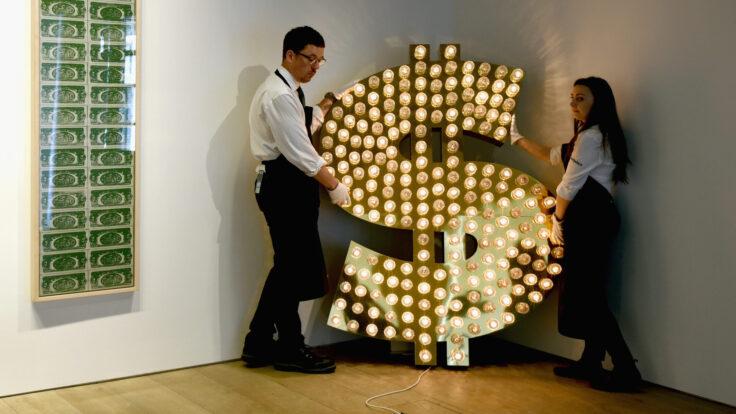
Jose, bought Andy Warhol’s 1962 painting Marilyn Monroe (Twenty Times) for a record price in 1988, kicking off a four-decade career making a market in Warhols. The rarely seen painting sits just outside the elevators. Meanwhile, Fabricant played a role, alongside Paul Gray, in the sale of Jasper Johns’ False Start, from 1959, as well as that of Willem de Kooning’s Interchange, from
1955, conveying both works in separate deals from David Geffen to Ken Griffin. Paulson and Post are both former Sotheby’s staffers, and I’m sure they had connections to many of the sales. But you don’t have to be an art world professional to enjoy the show.
There are some hidden gems, including John Singer Sargent’s incredible Group with Parasols, from around 1904. The painting set the record for Sargent, at $23.5 million, more
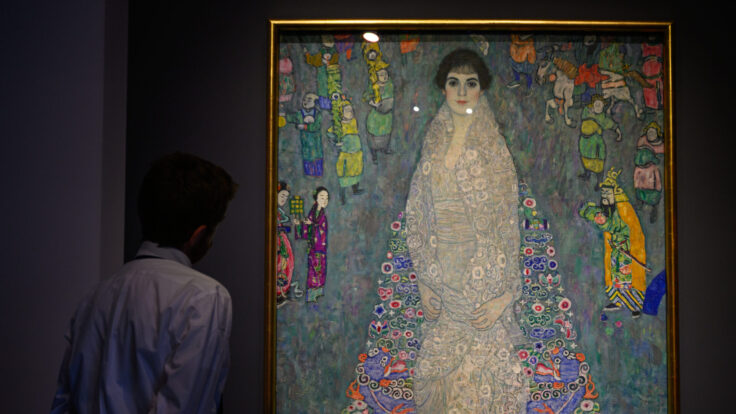
than 20 years ago. You might also want to compare Gustav Klimt’s Dame mit Fächer, from 1917-18, with the recent record-setting $236 million Portrait of Elisabeth Lederer from the Lauder collection. (The Dame made $11 million in 1994 and $108 million in 2023.) Seeing Frida Kahlo’s Autoretrato con chango y loro, from 1942, is a rare opportunity as well, since the painting usually lives at MALBA in Buenos Aires.
I was also introduced to Angelo Morbelli, whose In Risaia, from 1901, is an Italian neo-impressionist banger shimmering with jewel tones.
For those of you who can’t make it to the show, Kremers and Van Dercook edited a book of 100 iconic works that have been sold at Sotheby’s. Arranged chronologically and featuring selections from almost every collecting category, it’s a compendium of extraordinary objects that also fits with Sotheby’s nascent merchandising
strategy. In addition to the Icons book, there’s a pop-up shop in the lobby, merchandise on the fourth floor, and, in partnership with art bookseller Karma, rare volumes connected to the art and artists on view. Granted, these sales probably won’t materially affect Sotheby’s bottom line. But the centerpiece of the Breuer Building strategy is bringing the public through the doors on a regular basis, not just for auction exhibitions. Icons is an impressive first step toward that always-on
approach.
|
Now, let’s get to the main event… |
|
|
In the space of a few short months, we’ve seen the public art market
return not only to viability, but vibrancy—even if we’re only just returning to a baseline level of sales. |
|
|
As recently as this spring, many people in the art world harbored major doubts about
the long-term health of the market. But in the space of a few months, we’ve watched the public art market not only return to viability, but perhaps even vibrancy—even if we’re only just returning to what was previously a baseline level of sales. Together, the Big Three global auction houses sold nearly $14.2 billion worth of art this year. And while that number is about 20 percent off the peak year of 2022, when the auction houses sold $17.7 billion worth of art and luxury collectibles,
no one thinks returning to an overheated apex is the solution to the art market’s structural constraints.
For clarity’s sake, I’m going to break down the sales from each of the three houses. Sotheby’s, whose total includes real estate auctions, sits on top with $7 billion; Christie’s follows with $6.2 billion; and then comes Phillips, which made $927 million. It’s also worth noting that Heritage Auctions, which deals primarily in the coin and collectibles markets, had record sales of
$2.1 billion this year. |
|
|
A MESSAGE FROM OUR SPONSOR |
The first steps towards a masterpiece starts with a dream. The all-electric BMW i7 – the
evolution of brilliance. Learn more at BMWUSA.com |
|
|
As a reminder, the strong luxury results mixed into all of these sales means that
this market has prioritized objects of cultural significance. Art plays a central and even leading role, but is by no means the exclusive driver of these businesses. |
Sotheby’s $7 billion in sales this year represents a 17 percent increase from 2024. The
total broke down into $5.7 billion in auction sales, up 26 percent for the year, and $1.2 billion in private sales, which fell by $100 million—a decline of less than 8 percent. Across the company, the sell-through rate was 87 percent, which speaks to the discipline of the specialists in securing property and offering it at estimates that would ensure bidders and buyers showed up. Sotheby’s says there was an average of 4.5 bidders per lot, and total auction sales represented 161 percent of the
aggregate estimate, including the buyer’s premium. Subtracting the buyer’s premium would still suggest a hammer ratio for the entire firm above 1.30—a strong number indeed.
Obviously, much of this recovery comes from the top end of the market, where Sotheby’s says it sold 33 lots for more than $15 million, including houses from Concierge and cars from RM Sotheby’s. Sotheby’s also says that 35 percent of bidders were new clients, and that people under 40 accounted for 17 percent of the
bidding on fine art and 29 percent of the bidding on luxury items.
Meanwhile, the Global Fine Art division accounted for $4.3 billion in sales, a 15 percent increase over last year’s $3.7 billion total. The luxury businesses contributed $2.7 billion in sales, which includes more than $1 billion from the classic car division, RM Sotheby’s. That’s a 22 percent boost for the luxury category from 2024, when it netted $2.2 billion. |
Christie’s $6.2 billion haul was up 6 percent year over year. Auction sales increased 8
percent, to $4.7 billion, while private sales were flat at $1.5 billion. Seventeen lots sold at auction for more than $15 million‚ up from 13 in 2024. Adding in private sales brings that number to 30.
The house also included a very interesting statistic about private sales: Half of the clients in private transactions were new to the sales channel. Given the market’s resurgence, it will be interesting to see if Christie’s can maintain this level of client acquisition, although past
experience suggests it won’t. That said, the company revealed that its three most expensive sales this year were private transactions. From what I’ve heard, that would probably include a Jean-Michel Basquiat painting and a René Magritte.
The sell-through rate at Christie’s was 88 percent. Again, this suggests that the specialists were able to get the estimate level into territory that is attractive to bidders. Christie’s also recorded an overall hammer
ratio of 1.13, which indicates positive momentum without any worrying signs that the bidding is getting too hot. Meanwhile, 35 percent of bidders and buyers were new to the auction house, and a third of the client base was Millennial or Gen Z, which means most of them were under 40. |
|
|
Breaking it down by region, Christie’s said that the Americas accounted for $2.58
billion in sales, which is up 15 percent from last year. EMEA (Europe, the Middle East, and Africa) contributed $1.44 billion in sales, which was up in dollars but flat in euros. Sales for Asia, however, fell to $686 million. If you flip the regional analysis to buying, the Americas accounted for the largest share of buyers at 41 percent; EMEA followed with 36 percent of buyers; and Asia had only 23 percent. Weakness in the Asian market still weighs upon the overall market for cultural property,
as was also reflected in the breakdown of the types of property sold. Only Asian and World art saw a decline in sales at Christie’s—it was down 6 percent, to $351 million.
Finally, sales in the 20/21 division rose 6 percent, to $2.86 billion. Luxury sales rose 17 percent, to $795 million. The new category of cars accounted for $234 million, a 14 percent rise. And classics were up 15 percent, to $285 million, while Old Masters rose 24 percent, to $182 million. |
At Phillips, the $927 million total broke down to $725 million at auction and $202
million in private sales. Bacs and Russo, Phillips’ watch division, accounted for $370 million, or almost 40 percent of all sales. But that doesn’t mean the rest of the company isn’t pulling its weight.
This year, private sales in the watch division at Phillips shot up to $80 million, a massive 177 percent jump from 2024. By contrast, the rest of private sales at Phillips rose a still-impressive 31 percent, from $93 million to $122 million. “Our focus this year has been on higher-value
sales,” Miety Heiden, Phillips’ chairman for private sales, told me. “And the focus of our selling exhibitions has been on the more active markets, like our Crossing Borders exhibition in London focused on South Asian art.” That’s one of the stealth categories in the art market, currently.
Heiden’s success also points to one of the most important factors that explains these numbers: There’s a continuing shift in what kind of cultural property is valued,
and by whom. The weakness in the Asian market may be the key driver of the perception that there’s an overall decline in interest in cultural property, but in the Western Hemisphere, there’s clearly a strong demand and widening aperture for what is considered valuable. If Asia returns as a buying force, as it first did more than a dozen years ago, the market for cultural property might recapture the popular imagination. That may yet come to pass. It just didn’t happen this year. |
That’s all I got. Enjoy your weekend, and I’ll be back in touch on Sunday.
M
|
|
|
The ultimate fashion industry bible, offering incisive reportage on all aspects of the business and its biggest
players. Anchored by preeminent fashion journalist Lauren Sherman, Line Sheet also features veteran reporter Rachel Strugatz, who delivers unparalleled intel on what’s happening in the beauty industry, and Sarah Shapiro, a longtime retail strategist who writes about e-commerce, brick-and-mortar, D.T.C., and more. |
|
|
Finally, a media podcast about what’s actually happening in the media—not the oversanitized,
legal-and-standards-approved version you read online. Join Dylan Byers, Puck’s veteran media reporter, and Julia Alexander, a longtime media analyst, as they sit down with TV personalities, moguls, pundits, and industry executives for raw, honest, sometimes salacious conversations about the business of media and its biggest egos. New episodes publish every Tuesday and Friday. |
|
|
Need help? Review our FAQ page or contact us for assistance. For brand partnerships, email ads@puck.news. You received this email
because you signed up to receive emails from Puck, or as part of your Puck account associated with {{customer.email}}. To stop receiving this newsletter and/or manage all your email preferences, click here. |
Puck is published by Heat Media LLC. 107 Greenwich St., New York, NY 10006 |
|
|
|