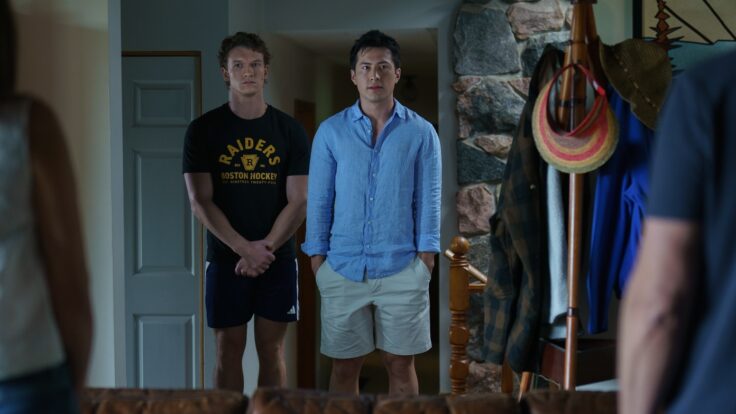
Hi, and welcome back to Line Sheet, coming at you from Hollywood, where last night I attended Everybody’s Live with John Mulaney, a Netflix experiment, at Sunset Gower Studios. Thanks to John for wearing a great jacket and shirt, Richard Kind for choosing a three-piece suit, their stylist Michael Fisher for making it happen, and my enthusiastic seatmate, who I’m pretty sure is a professional clapper. (He put the rest of the audience to shame.)
If you’re in Los Angeles next week, and would also like to see Mulaney live, why not join us on Tuesday, I have a deal for you! On May 20, John will be interviewed by the most feared man in entertainment (and notable plaid-shirt-wearer), Puck’s very own Matt Belloni, for the Emmys edition of Puck’s Stories of the Season event. Meanwhile, I’ll be quizzing White Lotus star Parker Posey on her Lorazepam knowledge. Anyone who is a voter in a guild or what have you is invited, but you can also come if you’re my friend. Email Fritz@puck.news and CC me and we can figure it out.
In today’s super-duper dispatch, accessible only to Inner Circle subscribers (upgrade here), I take a closer look at what Bernard Arnault and his son Alexandre really want from the White House. Up top, I’m lifting the lid on the intensifying battle between natural and lab-grown diamonds, initiating my coverage of Under Armour (remember, John Varvatos works there?), and giving the people what they really want: a Vanity Fair editor-in-chief search update. I’ll be back next week with Chanel earnings news (hearing the business was down overall in 2024) and more on what’s happening at Kering.
Mentioned in this issue: Bernard, Delphine, and Alexandre Arnault, LVMH, Donald Trump, the Goodman family, Saks Global, Jonathan Anderson, Dior, Dara Kaye, diamonds, Simeon Siegel, Under Armour, Kevin Plank, Anna Wintour, Roger Lynch, and many, many more…
|
|
|
|
A MESSAGE FROM OUR SPONSOR
|
The refined BMW 7 Series is all luxury. With the ability to define your design, the ultimate glamour is yet to be. Learn more at
BMWUSA.com.
|
|
|
Three Things You Should Know…
|
- Bergdorf stumbles into the natural vs. lab-grown diamond debate: A couple of weeks ago, a jeweler named Dara Kaye landed on the fine jewelry floor at Bergdorf Goodman to shrieks of outrage. Of course, people were being snobby about Kaye, a publicist whose year-old collection is more Miami than Manhattan. After all, have you seen what’s happening in the West Village these days? The real controversy was about value rather than taste. Kaye uses lab-grown diamonds. This is the first time Bergdorf has showcased a lab-grown brand in the fine jewelry section, and a lot of people are angry about the placement. This includes the natural-diamond brands sitting next to Dara Kaye in the space, but also the more-established lab-grown brands, which have struggled to make their way into fine jewelry boutiques that often refuse to carry them.
A few caveats on the partnership. To start, it’s a monthlong “trunk show,” meaning that the store is testing the brand to see how the customers react, and everything is being sold on consignment. Secondly, it’s being sold in the Arcade, the section of the fine jewelry department that is a tad more accessible (both in terms of price and aesthetic). From what I know, Bergdorf isn’t trying to make a statement about diamonds by partnering with Kaye—the buyers just think the customer will like it, lab-grown or not.Alas, the situation is a microcosm of a larger battle over the industry’s narrative. Lab-grown diamonds were initially dismissed for being as worthless as cubic zirconia. But just as lobbyists spent decades convincing consumers that diamonds are rare (they aren’t), proponents of lab-grown diamonds have persuaded plenty of consumers that their version is just as good as the real thing.
Now there are a bunch of chic lab-grown brands popping up, and the industry doesn’t know what to do. De Beers announced just last week that it’s closing Lightbox, its lab-grown diamond brand, and recommitting to natural diamonds only. Couture, the fine jewelry industry’s big, exclusive trade show, doesn’t allow brands that deal primarily in lab-grown diamonds to rent booths. One industry insider called all the hemming and hawing “gemological whiplash.”
My guess is that it’s going to take time, but in a decade (or two) the cost of lab-grown and natural diamonds will reach parity. Remember, they’re all technically real diamonds, and price is simply determined by demand. It’s worth it if you think it’s worth it. (Prada is currently selling a lab-grown diamond ring for $28,000.) Meanwhile, many collectors are opting more and more for jewelry featuring rubies, emeralds, amethysts, and other truly rare gemstones. If you’re going to the Couture show, which takes place in Las Vegas during June, let me know what you hear!
- Peeking under the armor of Under Armour: Analysts are bullish on the future of the Baltimore-based activewear brand, which our bud Simeon Siegel over at BMO Capital Markets rated “outperform” after its most recent earnings report. (Siegel cited management’s plan to “prioritize health before growth.”) The company’s most recent quarter was slightly better than Wall Street anticipated, although sales were down 11 percent year over year.
Internally, though, I hear there are some conflicting narratives. People seem to be into chief product officer Yassine Saidi—a former Puma and Adidas executive who is aiding in the crucial development of footwear—as well as Eric Liedtke, who helped develop Yeezy at Adidas. (He joined Under Armour late last year, after the company acquired his firm, a regenerative fashion brand called Unless Collective.) That all makes sense. But then there’s the John Varvatos factor.In September 2023, Under Armour founder Kevin Plank recruited Varvatos, the type of designer who dresses aging rockers, to be chief design officer. While Varvatos’s own line was tremendously successful for decades before going bankrupt in 2020 (it’s been owned by the same private equity firm since 2012), there is no obvious connection between what Varvatos does and what Plank needs. I’m told that his designs are only now about to land on the sales floor. According to insiders with opinions on the matter, the look is not congruent with the direction in which Under Armour needs to be moving. (Nobody needs houndstooth on leggings.) Anyway, Varvatos has done zero press since accepting the role nearly two years ago, and perhaps he never will. A rep did not respond to a request for comment regarding the Varvatos situation.
- Casting a really, really, really wide net: There are more layoffs coming to Condé Nast next week, I hear, across several different brands, but I guess that’s a quarterly ritual at this point. Meanwhile, in equally depressing news, this Vanity Fair editor-in-chief search is verging on comical. The breadth of people invited to participate in the first round of interviews is downright astounding, ranging from the usual suspects (Kristina O’Neill and Sarah Ball types) to less-conventional candidates. (I heard former Paper magazine editor-in-chief Justin Moran went in, which is interesting.) There are also people I’ve heard are “going for it” that I’m not going to name here because I find it embarrassing for everyone involved.The biggest impediment to hiring someone good, other than the job being with Condé Nast (have you read Michael Grynbaum’s book?), is that the salary quoted to some people is absurdly low for a leadership role of that magnitude. (There’s a rumor going around that it’s well under $300,000 for the base, but that can’t be true. Naturally, a representative for Condé Nast did not respond to a request for comment.) My guess is that the people quoted a low-ball number were never in the running anyway, and it may have actually been used as a tactic to scare them off.Anyway, if Condé Nast wants the next iteration of Vanity Fair to be successful, they’ll need to invest in a top talent—a known quantity and someone whom advertisers will support. Yes, we all know that these are rapidly transforming businesses, and many are paying the price for early inactivity, but constant shrinkage (ambition, talent, resources) is self-fulfilling. Still, I expect that Anna Wintour—plus Condé C.E.O. Roger Lynch and H.R. head Stan Duncan, who is inserting himself in the process as much as possible—will choose a known quantity. I just hope the budget doesn’t deter people from considering it.
At the Tory Burch party on Monday night in Los Angeles, a friend suggested that Wintour consider (fellow attendee) Phillip Picardi, the former Teen Vogue editor and Them creator, who left Condé to edit Out magazine. (He’s currently the chief brand officer at WeightWatchers, which just filed for Chapter 11 bankruptcy.) Phill would be a smart choice—he’s crafty, ambitious, and has Hollywood connections—but he makes good money now and is self-directed. He also lives in Los Angeles, which I assume would not fly with Wintour, although maybe it should.
|
|
|
|
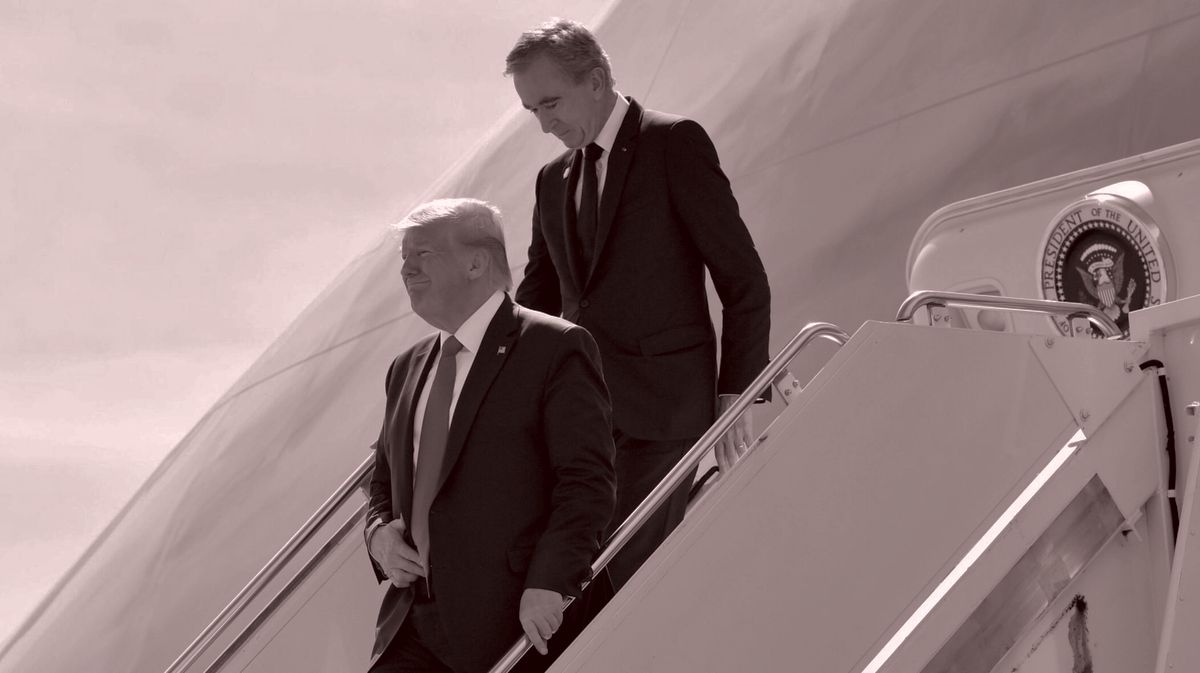
The LVMH royal family’s courtship of Trump at the inauguration, once mocked, now looks wisely proactive, with Bernard and Alexandre returning to meet with the president in the Oval Office. Were they lobbying for a luxury carve-out on looming 20 percent tariffs?
|
|
|
Last week, while the rest of the fashion industry was fretting over who was best or worst dressed at the Met Gala, LVMH C.E.O. Bernard Arnault and his son Alexandre, the zealous co-C.E.O. of the company’s beleaguered wine and spirits division Moët Hennessy, headed to Washington, D.C. They had a meeting with the president of the United States to discuss tariffs and various other matters of importance to their multinational conglomerate, which controls a large percentage of the luxury industry.
What happened after the Oval Office door closed? Well, these are people who converse on a semi-regular basis and have known each other for at least 40 years, so after the requisite pleasantries were exchanged, my educated guess is that they got down to dealmaking, or at least the prospect of dealmaking. Looming “reciprocal” tariffs are a growing concern for LMVH—particularly the wine and spirits tentacle of the business. As I’ve reported, the company is uniquely reliant on the U.S. in the category, and they have less control with alcohol, because they distribute it through third parties. The additional 20 percent tariffs are a major threat, on top of impossible-to-ignore changes in consumer behavior.
|
|
|
|
A MESSAGE FROM OUR SPONSOR
|
The refined BMW 7 Series is all luxury. With the ability to define your design, the ultimate glamour is yet to be. Learn more at
BMWUSA.com.
|
|
|
|
After a late-pandemic, martini-fueled Rumspringa, alcohol sales are down—especially hard liquor—as younger generations spend more of their money on legal marijuana and almost-legal psychedelics. When I was hopping from Met-adjacent party to party, I noticed that barely anyone was drinking. Blame impulse-killing GLP-1s or peer pressure, but there’s no denying that it’s not as fashionable to imbibe now as it was even six months ago. Restaurants are feeling it, too.
Anyway, the Arnaults have some leverage in this regard. The Trump administration, whatever its plan may be, has shown an openness to exemptions for powerful multinationals and blue chip brands. Many of Apple’s most consequential imports were exempted. As part of the deal the U.S. just made with the United Kingdom, tariffs were lowered on the car brands Rolls-Royce, Bentley, and Jaguar, which Trump called “super-luxury.” It’s the Arnaults’ responsibility to lobby for their business, especially if they sense flexibility.
The European Union and the U.S. must come to an agreement by mid-July, when Trump’s tax on imported goods will jump to at least 30 percent. It just so happens that, less than a week after the Arnaults met with Trump—to talk tariffs, yes, but also stateside production—the U.S. went back to the European Commission, looking to make a deal.
|
|
Indeed, those who thought Arnault and kids Delphine and Alexandre looked obsequious for standing on the dais at Trump’s inauguration are now, in many cases, relieved that they were there. Even if nothing comes of it today, there is a belief that Arnault’s engagement with Trump will benefit LVMH in the short, medium, and long term—and that the industry should enjoy the derivative benefits, too.
The president is a dealmaker, and fascinated by transformative wealth. Arnault, once beneath Trump on the developer totem pole, has accumulated more money than Forbes or Fortune could ever count. For Trump, having Arnault in his inner circle is a great achievement. The word in Washington is that Trump loved having Elon Musk around because he was tickled by the prospect of the world’s richest man working for him. In Arnault, he also has the world’s sixth wealthiest person seeking his attention.
It’s also important to remember that these men have been doing business together for years. LVMH’s rental of 6 East 57th Street—first to house a temporary Tiffany store, and now a short-term Louis Vuitton store, replete with faded-but-still-present Nike swoosh logos throughout the building from when it was still a NikeTown—was a boon to Trump during the four years he was out of office as his business dealings in the city were challenged by government officials.
Yes, tariff relief is top of mind right now, but there are other benefits to playing nice, particularly surrounding tax status and consequences. Perhaps the president could even ease tied-house laws, which restrict alcohol manufacturers from having any financial interest in retailers, which would transform the industry and undeniably boost Moët Hennessy’s sales. Regardless, Arnault’s confidence in his process is evident in the way he continues conducting business in the U.S. While there has been a company-wide retrenchment (budgets halved in some cases), the U.S. business is operating relatively normally.
|
|
|
And while the Saks Global situation is not ideal—there are LVMH brands that wholesale to Saks, Neiman Marcus, and Bergdorf Goodman—it will inevitably benefit LVMH in the long run. Not only does the retailer’s debt crisis give Arnault’s many deputies further ammunition to negotiate more favorable terms, but a restructuring of Saks Global could make way for Bergdorf Goodman—which Arnault has coveted for years—to be spun out of the group.
Arnault has no delusions about multibrand retail; he has admitted publicly it’s a dumb business. But he invests in things with cultural value, be it a restaurant or a single-location department store. While the Goodman family still owns the Bergdorf building, and most signs point to them keeping it, Arnault and his team have made it clear that they are happy to also rent prime properties. If they had Bergdorf, they’d further dominate that stretch of Fifth Avenue, which New York Mayor Eric Adams has promised to “beautify” with at least $150 million.
In some ways, America actually represents more opportunity than ever for Arnault. The problem is still product fatigue and slow growth in China. Arnault may have Trump on lock, but that Jonathan Anderson Dior menswear collection can’t come soon enough.
|
The Alaïa Summer campaign, shot by Tyrone Lebon and starring one of the few models I care about, Binx Walton, is pretty gorgeous. [ Instagram]
Burberry C.E.O. Josh Schulman says designer Daniel Lee is staying. [ WWD]
Despite things getting tough out there, Mytheresa reported increased sales and improved profitability in its most recent quarter, right ahead of the acquisition of Yoox Net-a-Porter Group. By the way, the new parentco, LuxExperience, recently sent employees a very cute box with pencils printed with each brand. (Including Yoox, which I guess they are really not getting rid of.) [ Vogue Business]
Prada has officially launched a fund to benefit young filmmakers—even if the group has already been supporting young filmmakers for years through various projects. This one, though, is probably the most altruistic to date. [ Variety]
R.I.P. painter Christoph von Weyhe, the lifelong partner of Azzedine Alaïa. [ WWD]
Eek, the Giacometti bust not selling feels like a harbinger of something worse. [ WSJ and Puck]
|
|
Until tomorrow,
Lauren
P.S.: We are using affiliate links because we are a business. We may make a couple bucks off them.
|
|
|
|
Puck fashion correspondent Lauren Sherman and a rotating cast of industry insiders take you deep behind the scenes of this multitrillion-dollar biz, from creative director switcheroos to M&A drama, D.T.C. downfalls, and magazine mishaps. Fashion People is an extension of Line Sheet, Lauren’s private email for Puck, where she tracks what’s happening beyond the press releases in fashion, beauty, and media. New episodes publish every Tuesday and Friday.
|
|
|
Need help? Review our FAQ page or contact us for assistance. For brand partnerships, email ads@puck.news.
You received this email because you signed up to receive emails from Puck, or as part of your Puck account associated with . To stop receiving this newsletter and/or manage all your email preferences, click here.
|
|
Puck is published by Heat Media LLC. 107 Greenwich St, New York, NY 10006
|
|
|
|