Welcome back to Wall Power. I’m Marion Maneker.
The fall
auction season is coming to its climax with everyone to-ing and fro-ing around town—from auction previews to gallery shows to pop-up events and fairs. I’ll have more on the outcome of the sales next week. For tonight: I visited three important institutions in Philadelphia last weekend, one with a show commemorating the 100th anniversary of surrealism, and two separate shows highlighting the legacy and work of Henri Rousseau and Alex Calder. I’ll tell you all
about that below the fold.
But first, a fascinating story from my colleague Julia Ioffe about how a museum in California smuggled documents out of Russia via Poland, and a tip on a documentary about Marilyn Minter from Julie Davich.
Let’s get started…
|
|
|
 |
Julia Ioffe |
|
- Maybe museum work
isn’t so dull after all: The L.A. event for my new book, Motherland, was held at Culver City’s Wende Museum, which is one of the weirdest and, to my taste, coolest I’ve ever visited. Wende—which is German for “turning point” or “change”—describes the period around the end of the Cold War, and relics from that era comprise the bulk of the museum’s rich collection. Justin
Jampol, the museum’s director, began accumulating it all when he was a Ph.D. student in Russian history some two decades ago, although he’s had help over the years.As Jampol showed me around the museum, he pointed out a recent addition: a trove of Soviet Jewish dissident materials, often explicitly religious and incorporating Hebrew, that he had just smuggled out of Russia. The Kremlin tightly controls the export of anything with historical value—measures that have gotten even
stricter since 2022. So the museum asked a Polish diplomat to stash the materials in his diplomatic pouch—in this case, essentially a shipping container that, per international law, cannot be searched by the host country—and smuggle them out as he was leaving his post in Moscow a couple months ago.
The Russian authorities, of course, stopped the container on the Polish border, and threatened to break the seal. In the current climate, this would have caused yet another international
incident. In the meantime, someone tipped off Wende that the Polish government wasn’t planning on turning the documents over to them after all, and was instead going to send them to a museum in Poland. So one of Wende’s staffers jumped in an Uber to LAX, flew to Poland, rented a truck, and managed to catch the container when the Russians finally released it and it crossed into Poland. Once it was there, the Wende staffer managed to offload the dissident treasures into their truck, and get them
safe and sound to Wende, in Culver City. Not quite the Louvre robbery, but still a wild look at how museums extract precious works from hostile nations.
|
|
|
A MESSAGE FROM OUR SPONSOR
|
|
|
 |
Julie Brener Davich |
|
- Minter’s Pretty
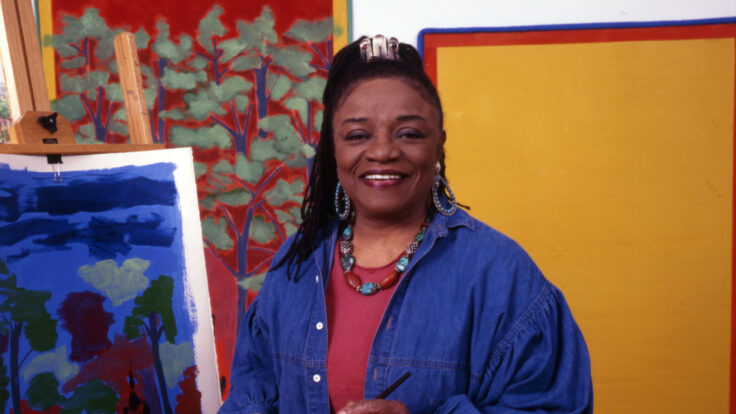
Dirty era: The latest art documentary from Debi Wisch, one of the producers of The Price of Everything, is an 80-minute dive into the life and work of septuagenarian artist Marilyn Minter, known for her colorful, photorealist portraits behind steamy glass. Directed by Jennifer Ash Rudick and Amanda M. Benchley, the film takes its title, Pretty Dirty, from the 2015-17 traveling retrospective of Minter’s then 40-year
career.As her New York gallerist Jeanne Greenberg Rohatyn says in the film, the artist didn’t become “Marilyn Minter” as we know her until she was in her 50s. That’s when she began taking her own photographs to base her paintings on, namely close-ups of body parts like eyelashes and lips. Most of the footage in the documentary shows the process of making her latest series of celebrity portraits of Jane Fonda, Lizzo, and visual artists
including Nick Cave, Jeff Koons, and Cindy Sherman. These portraits are the subject of her current show at Regen Projects in L.A.
In the film, Rohatyn says that the upper limit of Minter’s primary market is $1 million, for the monumental painting of lips from her 2023 show. She adds that while Minter has
achieved success among private collectors, including Glenn Fuhrman, who appears in the film, her work has not been acquired by many institutions. Brooklyn Museum director Anne Pasternak surmises in the film that it’s because her imagery makes people uncomfortable. Minter is also not an auction darling: Her auction record for a painting is only $269,000, set at Phillips in 2015. You can decide your comfort level for yourself on November 20, when the film is
screened as part of DOC NYC.
|
|
|
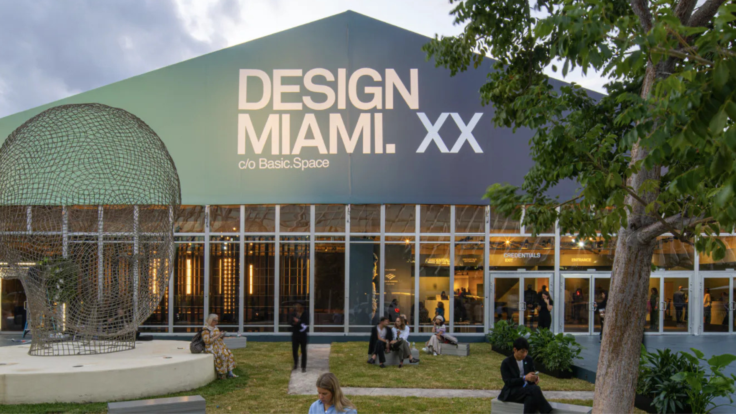
- Basic.Space invades New York: Last night was the debut of Basic.Space NY, the party-as-shopping-experience pop-up design and art fair from Basic.Space founder Jesse Lee. It was the kind of scene where people like Nicky Campbell—the TikTok, Instagram, and YouTube style critic—could be seen waiting in line to get in.The event is an iteration on the Design.Space event that Basic.Space held in Los Angeles earlier this year, and revolves around
the idea that young buyers want to combine the real-life social experience of seeing and being seen (alongside some niche celebrities) with shopping for art and design. It comes a few weeks before its sister company, Design Miami, holds its annual fair in Florida—and days before another recently acquired sibling company, Platform, launches its second edition of the Chelsea Art Fair in the Chelsea Hotel tomorrow.
I ran into several art-world folks at the event. But recognizing that I was
neither tall or hip enough to hang with this crowd, I headed home before the crowded bar and gaming tables—attendees were given a poker chip that could be wagered to win a design object game table—got out of hand.
|
Now, let’s get to the main event…
|
|
|
Three new surrealism shows in Philadelphia—an unsung art center—arrive
at a moment when the genre has become a dominant theme in the art world.
|
|
|
Philadelphia is now hosting three major art-world happenings—and that’s not including
the spectator sport of the board-vs.-director battle at the Philadelphia Art Museum. But that institution is where Dreamworld, the 100th anniversary show of surrealism that has been touring Europe, is making its only American stop, which makes it a major event. Elsewhere in the city, the Barnes Foundation is presenting Henri Rousseau: A Painter’s Secrets, which highlights the institution’s large holdings of the painter’s work and brings many important examples together
for the first time. Then there’s the recently opened Calder Gardens, which is a tribute to one of the city’s native sons, Alexander Calder.
That complex of museums on the Benjamin Franklin Parkway, in the center of Philadelphia, is a reminder of how important art has become to the city’s sense of itself. Along with a Rodin museum that often gets overlooked, Philadelphia has become a true unsung art center.
|
|
|
A MESSAGE FROM OUR SPONSOR
|
|
|
Just days before the launch of Dreamworld—which
highlights and pays tribute to the wealth and depth of the Philadelphia Art Museum’s
own collection—the museum’s board chose to fire Sasha Suda, the museum’s well-regarded leader. It’s unfathomable to me that the board of a major art institution would fire its director on the eve of a prestigious exhibition, but Suda seems to have resigned herself to the fact that she could not satisfy her overbearing trustees. But I digress.
When the show debuted at the Centre Pompidou last year, in celebration of the 100th anniversary of the publication of André
Breton’s surrealist manifesto, it had an encyclopedic feel. Sprawling and digressive, it seemed to want to offer a taxonomy of surrealism. And, in that way, it looked more like the Whitney’s current show of ’60s surrealism—a wide, kitchen-sink approach that can seem aimless. To be sure, there were some extraordinary works in the Paris version of the show that did not make it to Philadelphia. (The one I missed most was René Magritte’s La Durée poignardée, from
1938, the famous sexual image of a locomotive emerging from a mantled fireplace.)
The Philadelphia Museum’s Dreamworld offers a more directional approach to understanding surrealism, beginning with Giorgio de Chirico, the proto-surrealist, and continuing through artists like Max Ernst, Man Ray, André Masson, and Joan Miró. There are early, challenging Magritte works and spooky Salvador
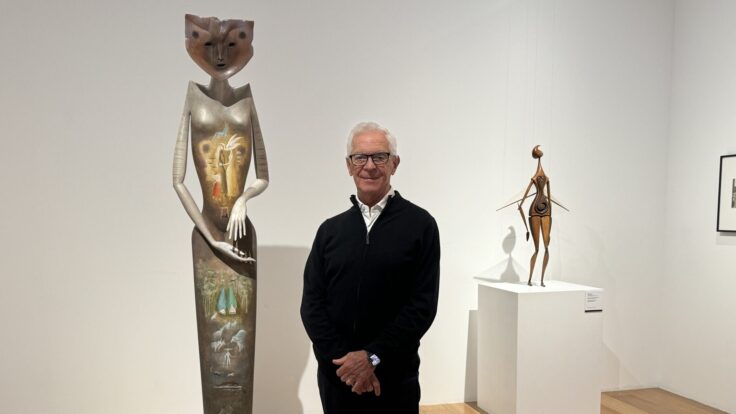
Dalí paintings. And, like the Paris show, Dreamworld reminds us of the many, many female artists who were involved in the movement at all stages—including Dorothea Tanning and Kay Sage—and culminates in a room of works by Remedios Varo and Leonora Carrington. Some of these works were in the previous versions of this show, but here, they take pride of place. The Philadelphia Museum was also able to show off its
magnificent holdings of Jackson Pollock, Adolph Gottlieb, and Mark Rothko—all of whom made surrealist work before their breakthrough to abstract expressionist styles that would eventually transform modern art.
To top it all off, the exhibition arrives at a moment when surrealism has become a dominant theme in the art world. Next week, Sotheby’s is selling a major collection of surrealist art, called Exquisite Corpus, assembled by
Nesuhi Ertegun and sold by his wife’s estate. Elsewhere, the major dealers Emmanuel Di Donna and Ben Brown have collaborated on an important show of work by René Magritte and the sculpture team of François-Xavier and Claude Lalanne, which is a must-see stop on the fall gallery tour of Madison Avenue. There are also a number of other works around town, and in the auctions, that are not strictly works of
surrealism, but certainly rely on the idea of the uncanny and the way the unconscious erupts into rational life.
|
For those in New York, the surrealism show is enough to justify a day trip to Philly.
But the new Henri Rousseau show at the Barnes Foundation should make it even easier to get up and go. The self-taught painter was a remarkably celebrated figure in early 20th century Paris—someone whom André Breton considered to be a proto-surrealist. And yet, there is some debate over whether Rousseau, whose onetime civil service job as a toll taker earned him the nickname “Douanier,” was truly a peer, or merely a mascot, of his contemporary set of professionally trained
artists.
|
|
|
There wasn’t any doubt for Albert Barnes, who
considered Rousseau an example—like Horace Pippin, who also appears frequently in the Barnes collection—of artistic talent emerging in a painter with no formal training. Barnes managed to amass the world’s largest collection of Rousseau’s work. To make room for Henri Rousseau: A Painter’s Secrets, the foundation removed works from the museum’s dogmatic display into the temporary exhibition, and was able to bring a number of works from Paris and other museums to show
Rousseau’s breadth and evolution as a painter.
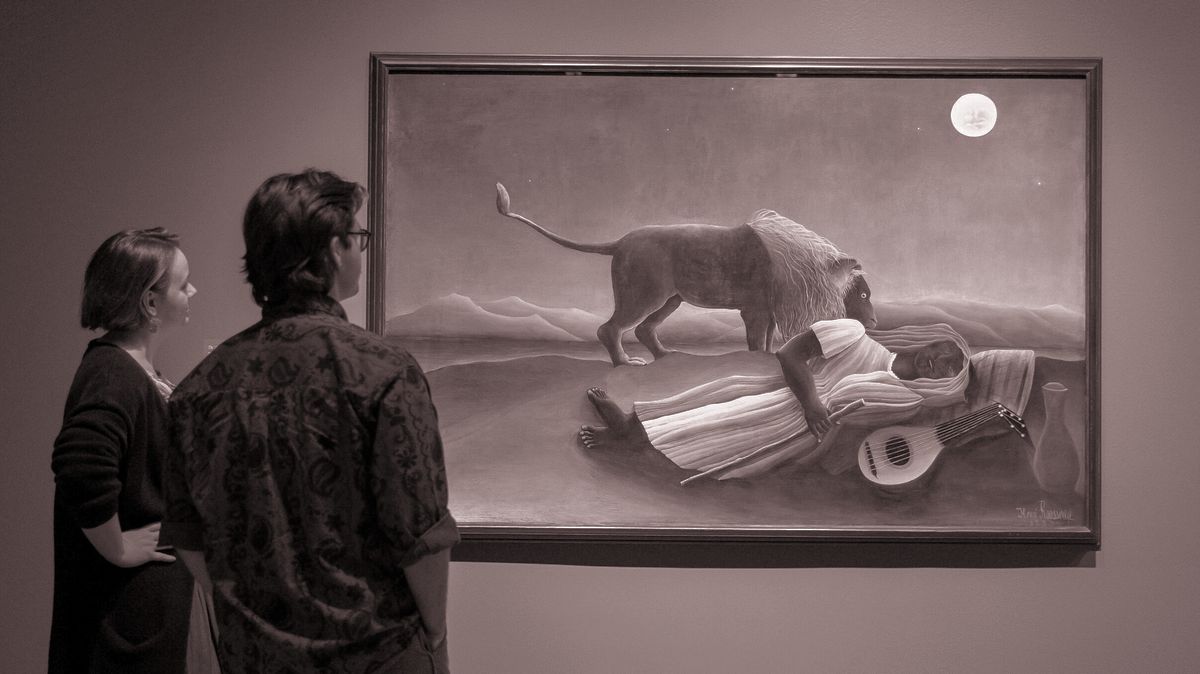
The show attempts to give Rousseau the recognition he felt he deserved. But it also labors to show how the artist, who made small landscapes that could decorate middle-class homes, was constrained by his desire to make a living to supplement his small pension. The exhibition culminates in a room uniting three of his large canvases that had the greatest impact on his proto-surrealist reputation. The Sleeping Gypsy, from 1897, is the
most recognizable; its dreamlike atmosphere features a lion hovering over a sleeping figure with a stringed instrument beside her, and a river and mountains in the background. The darker and more enigmatic Snake Charmer, from 1907, exudes an eerie calm. The entire room—which also includes Unpleasant Surprise, from 1899-1901—makes the case for seeing Rousseau as a proto-surrealist, and far more than a self-taught portraitist painter of imaginary landscapes.
Across the
parkway from the Barnes stands the Calder Gardens, which isn’t quite a museum, although it is operated by the Barnes Foundation. It is more of a showcase for Alexander Calder’s art, which comes from the Calder Foundation, an institution that is hard to define but plays an active role in the artist’s market. Like the Mirós and the abstract expressionists shown in Dreamworld, the works on display at the Calder Gardens—a few dozen stabiles, mobiles, and assorted other works—remind us how
one branch of surrealism evolved into abstraction; Calder’s early Constellation works were on theme with what others were groping toward. And while Calder’s own connection to Philadelphia is relatively slim, why let that detract from a good museum trip in the city?
|
I’d been aware for some time that The New York Times was working on a
story about Masterworks, only because I would occasionally get comments from friends who were interviewed by the reporter. Given that Angelica Villa had written almost
three years ago about the boiler-room-like tactics of Masterworks’s salesforce, I assumed the Times would advance the reporting on a not-insignificant company in the art market. Alas, I’m afraid we didn’t learn much new here. For example, one of the main issues with Masterworks has been their inability to create a
secondary market in the shares of the works they’ve fractionalized, leaving many of their investors frozen in an asset they might have thought would be more liquid.
Anyway, life goes on in the art market. Just to set expectations for next week, the New York sales will pretty much roadblock our coverage from Tuesday to Friday. Expect reports on Christie’s Weis and 20th century evening sales on Tuesday, Sotheby’s Lauder and contemporary sales on Wednesday
in the Inner Circle, and as much of a roundup of the week as we can put together on Friday. Later, I’ll have ARTDAI’s data to give you an eye-in-the-sky view of what happened. Does that sound good?
And, don’t forget, if you see something worth noting happen this week, say something. I can be reached at 917.825.1391 on SMS, WhatsApp and Signal.
More on Sunday,
M
|
|
|
The ultimate fashion industry bible, offering incisive reportage on all aspects of the business and its biggest
players. Anchored by preeminent fashion journalist Lauren Sherman, Line Sheet also features veteran reporter Rachel Strugatz, who delivers unparalleled intel on what’s happening in the beauty industry, and Sarah Shapiro, a longtime retail strategist who writes about e-commerce, brick-and-mortar, D.T.C., and more.
|
|
|
Finally, a media podcast about what’s actually happening in the media—not the oversanitized,
legal-and-standards-approved version you read online. Join Dylan Byers, Puck’s veteran media reporter, and Julia Alexander, a longtime media analyst, as they sit down with TV personalities, moguls, pundits, and industry executives for raw, honest, sometimes salacious conversations about the business of media and its biggest egos. New episodes publish every Tuesday and Friday.
|
|
|
Need help? Review our FAQ page or contact us for assistance. For brand partnerships, email ads@puck.news.
You received this email
because you signed up to receive emails from Puck, or as part of your Puck account associated with {{customer.email}}. To stop receiving this newsletter and/or manage all your email preferences, click here.
|
Puck is published by Heat Media LLC. 107 Greenwich St., New York, NY 10006
|
|
|
|