Hi, and welcome back to Line Sheet, coming at you live from New York City, where everything is too expensive. I’m headed back to (slightly less expensive) Los Angeles, but this was a great trip—Saturday night’s Grace Wales Bonner party at the Guggenheim was the best-dressed crowd I’ve ever seen, and I couldn’t think of any other city in the world where all those people would convene in one place.
Of course, there were many parties this week, including the grandest of them all: last night’s Met Gala. Did you have fun? I’ll be handing out superlatives tomorrow, so please send any and all nominations.
Today, some personnel news from WME Fashion (involving two ex-Condé Nasters). Then Sarah “ SShapiro@puck.news” Shapiro is back with a note on what San Francisco’s department store apocalypse says about the state of city-center retail. Sarah also has an interview with one of my favorite people: Rothy’s C.E.O. Jenny Ming, who made her name in retail at Old Navy in the 1990s. Jenny is awesome, and the story of how Rothy’s evolved from a private equity play into a legit brand is a fascinating case study.
Programming note: I’m on Jam Session with Amanda Dobbins today discussing the Met Gala red carpet, David Beckham’s 50th birthday, Prince Harry, and plenty more. Listen here.
Mentioned in this issue: Jenny Ming, Rothy’s, Stephen Hawthornthwaite, Roth Martin, Nordstrom, Susan Plagemann, David Stuckey, Kimberly Fasting-Berg, Alex Sagues, Bloomingdale’s, Saks, and many more…
|
|
|
|
A MESSAGE FROM OUR SPONSOR
|
For Spring 2025, we’ve turned the lens on the effortless allure of the It Girl, who—with quiet confidence and a cool, carefree attitude—makes every outfit uniquely her own. From chic tailored sets to denim with It Factor, discover the full collection at VeronicaBeard.com.
LEARN MORE
|
|
|
Two Things You Should Know…
|
- The last of the Nasties: Last week, WME Fashion head Susan Plagemann let go of David Stuckey and Kimberly Fasting-Berg—two of her closest confidants from her Condé Nast days whom she had brought in to run revenue and marketing, respectively, for the group. It’s not all that surprising: When Plagemann came into WME almost three years ago, there was a lot of criticism that she was too focused on building her division—including fashion-adjacent agencies IMG Models, the Wall Group, and Art + Commerce, plus events and other ancillary services—into a brand advisory rather than leaning into talent representation. Off-boarding Stuckey and Fasting-Berg suggests a reversion to the core agency business.WME Fashion has been pivoting for some time. The group’s participation in New York Fashion Week, for instance, had dissipated. At the end of last year, the group cut loose its production arm, Focus. (Dominic Kaffka, the guy who ran it internally, relaunched the business as an independent company earlier this year.) Meanwhile, last week, former WME executive Leslie Russo announced the launch of a “New York Fashion Week platform” that sure sounded like an attempt to replace the services that WME Fashion used to provide for designers during the twice-yearly trade show.Even before private equity firm Silver Lake consummated its take-private of Endeavor, the parent company of WME, I questioned the group’s commitment to the fashion space, and events in particular. Now that the transaction has been completed and various stakeholders have cashed out, Endeavor is in the midst of streamlining its business to focus on its core competency of talent representation and live sports. (The group recently announced that it was selling Frieze, the art fair, for $200 million to Endeavor executive chairman Ari Emanuel, who recently formed a new company focused on “events and experiences.”)
Perhaps Plagemann, an old-school magazine publisher, is finally hip to the fact that she is in the agency business. The next reality check is whether she ends up renewing her own contract, which is up in August. After all, I hear it’s actually going well with Sally Singer over at Art + Commerce. (Disclosure: WME represents Puck.)
- Sarah’s real estate reality check: The closure of Bloomingdale’s, Nordstrom, and Saks (not to mention the troubles at Macy’s and the ghost of Barneys) in San Francisco’s Union Square is merely the most obvious sign of the broader change in retail shopping habits. But it’s also accelerating transformative real estate strategies. Alex Sagues, who leads the urban retail team at CBRE, told me that San Francisco department stores were victims of the “pile of straw that broke the camel’s back”—the broader shift in Tier 2 cities like Seattle, Denver, Dallas, and S.F. from downtown shopping centers to suburban locations that better align with how consumers live and buy today.NorthPark Center, 7 miles north of downtown Dallas, has become the city’s premier shopping destination. The property has more than 235 stores, including Buck Mason, Isabel Marant, Glossier, and even a public library geared toward the under-12 set. Bloomingdale’s chose suburban University Village for their latest smaller-format store, Bloomie’s, in Seattle. In Wilmette, outside Chicago, Plaza del Lago is undergoing a transformation led by WS Development, which will update the nearly 100-year-old center with new retail and restaurants.Sagues told me that retailers are becoming “more efficient with space,” transforming physical locations from mere transaction points into brand experience centers that complement their already robust digital presence. Smaller stores have enhanced their personal shopping and styling offerings, while the shopping centers regularly host community events like workout classes, run clubs, and pop-up ear piercing studios. —Sarah Shapiro
|
|
And now for the main event…
|
|
|
|
Rothy’s has been resurgent ever since Jenny Ming, a retail veteran of Gap and Old Navy, left the boardroom and got back into the C-suite. In a candid interview, she discusses diversifying Rothy’s channels and supply chain as the shoe brand moves beyond D.T.C.
|
|
|
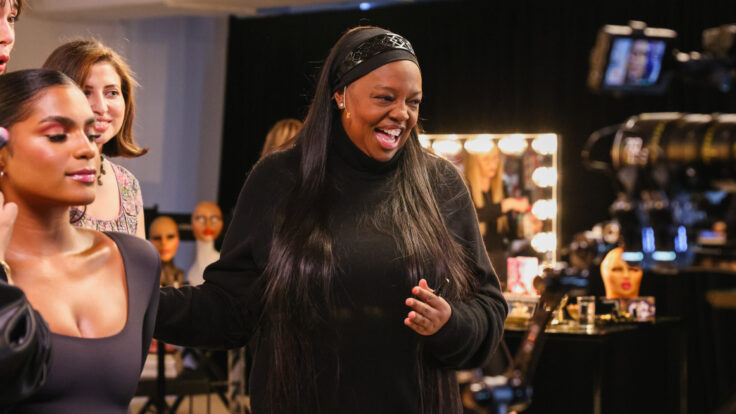
Jenny Ming wasn’t looking for another C.E.O. gig when Rothy’s came calling, and it took a few tries to persuade her to take the helm in 2024. A retail veteran who helped launch Old Navy with Mickey Drexler in the ’90s, and who had graduated to appointments on almost a dozen boards, Ming was comfortably semi-retired and focused on mentoring other leaders. Then Rothy’s co-founders Stephen Hawthornthwaite, an investment banker, and Roth Martin, who led most of the brand’s design, invited her to jump back in the game. She started as C.E.O. early last year.
Ming immediately helped propel Rothy’s past the $200 million mark in 2024 by growing top-line revenue at a double-digit clip and reaching profitability—no small feat in today’s fiercely competitive footwear landscape. Meanwhile, fellow Bay Area darling Allbirds (which was cool with tech bros and crypto folks for a minute) dropped below $200 million in 2024, with losses approaching $100 million. Its stock is down 99 percent in the past four years.
Rothy’s, which sold a 49.9 percent stake to Brazilian manufacturing company Alpargatas in 2021, has focused their messaging on sustainability. (All their shoes are made from plastic bottles and other recycled materials—another reason the brand was often compared to Allbirds.) But with Ming at the helm, Rothy’s began emphasizing product innovation, rolling out a broader range of styles, including more lasts (shoe silhouettes), open-toed sandals for warmer months, heels, boots, and a handbag line, at the same time that Allbirds kept pushing the same watered-down Yeezy-style wool sneakers.
|
|
|
|
A MESSAGE FROM OUR SPONSOR
|
Our latest drop captures the essence of true spring—a mix of statement pieces and wardrobe staples, from embroidered linen dresses to relaxed tailoring. Classics with a twist—polished, but always cool. Shop new arrivals at VeronicaBeard.com.
LEARN MORE
|
|
|
Ming also freed Rothy’s from the direct-to-consumer stigma stinking up a lot of its competitors, and has managed to please its core customer while attracting a new set of city walkers looking for cute Mary Jane flats that won’t cause blisters. The knitted look of the shoe’s uppers, once polarizing, is now being adopted by other brands. (When Lauren was in Tokyo, she noticed that tons of shoes in the shops looked a lot like Rothy’s.)
She has also elegantly amped up wholesale, securing prime real estate in select Nordstrom stores, Liberty of London, and Le Bon Marché while boldly establishing an Amazon presence. “We just want to be wherever the customer wants us to be,” Ming told me. The wholesale strategy has managed to keep Rothy’s ahead of a growing number of imitators and competitors in the knit ballet flat space. ( Vivaia, a Chinese brand that makes several similar shoes, opened their first permanent store last month, in New York, and is a few steps ahead of Rothy’s in Japan.)
Despite Rothy’s momentum, manufacturing remains the company’s biggest challenge. Unlike most D.T.C. brands, Rothy’s actually owns its Chinese factory—a once-competitive advantage that has suddenly become complicated by tariff politics. How Ming navigates this supply chain chess game could determine whether Rothy’s cements its position as sustainable footwear survivor or becomes another cautionary D.T.C. tale. We discussed all that, and more, in a freewheeling conversation last week. The following has been lightly edited for length and clarity.
|
The Art of Channel Diversity
|
|
Sarah Shapiro: Rothy’s financial performance has been really strong since you arrived, and you’re playing the game on multiple fronts between D.T.C. and wholesale. What’s next?
Jenny Ming: To me, it always starts with product innovation, and I still think there’s so much to be done. We did a lot last year, making sure that our product is relevant to the trends and our foundation is still good. The worst is when you walk away from something that you’re really known for. Of course you have to keep enhancing it, but you also have to bring in new
things.
How have you diversified and expanded Rothy’s channels?
We started online, and online is still the foundation of our business. A few years ago, we really started in retail, and last year was probably one of our banner years. We opened nine stores. We have 26 stores now, but it’s still very small. We have customers around the country and globally that want to touch and feel our products. We’ve been really diligently at work to open more retail stores. But no matter how fast we open, it’s still not enough.
One of our main strategies last year was to diversify our channels. So we dabble and play around and test, of course—like being on Amazon, because Amazon is one of the large search engines. A year ago, if you typed in “Rothy’s” [on Amazon], somebody else would show up. Not acceptable to me, because we need to be where a customer wants us to be. We tested Nordstrom Marketplace, Bloomingdale’s, Anthropologie, so we could dip our toes into wholesale, and it worked extremely well—in fact, we will be in 20 Nordstrom stores. We started in Marketplace, and we’re consistently in the top 10 of the brands that they sell.
|
|
How are you approaching the tariffs?
Having a factory in China has served us extremely well, but we’re shifting more production out of China—and not just because of tariffs. You would never have production in just one country, period. We’re moving faster now, but China will remain important to us. I can’t imagine it would ever be completely gone from our supply chain.
Are you building or buying factories in other countries, or starting with partnerships?
I would probably start with partnerships. The great thing about having our own factory in China is the technical expertise we’ve developed. When we move to another factory, we send people to help with knitting and assembly because we have that knowledge. It’s a luxury, because we can get operations up and running much faster.
|
|
|
|
Just like any business, you have to keep evolving. The more diverse your supply chain, the more options you have as you grow. Working for big companies, like Gap and Old Navy, I was always sent overseas to open new countries. I’ve probably been to 40-plus countries. Being on the Levi’s board also exposed me to diverse supply chains, so this is something I’m quite used to.
How do you balance pricing decisions with increased manufacturing costs, especially since Rothy’s sits at a specific price point that feels connected to your sustainability angle?
We’re not looking at price increases right now, but I’d never say never. That’s probably the last resort, because consumer sentiment is down. This is not the time to raise prices; usually it’s the opposite. We’re being careful about price because people are nervous. If you follow us, you’ve probably seen that we’ve broadened our price bands in the past few years. We have opening price points, and we also stretch depending on the item. We’re looking at other cost savings—renegotiating, managing inventory levels. The
good thing about retail is that we’re used to reacting to business. We’ve become much more nimble and agile than before. We can chase what’s selling well quickly, but we can also cut inventory when needed.
If Rothy’s isn’t taking price increases now, does that mean there’s enough wiggle room to cover tariffs, or will margins be impacted?
It’s a combination. There will be some impact, but we’re focusing on growth this year. We’re looking at where we can cut costs and renegotiate with vendors. We’re examining every line item—what we must have versus what’s nice to have—and trimming before taking the easy route of raising prices. Different channels also bring different margin dynamics. We’re still early in wholesale, but it’s making an impact on our total business. D.T.C. is still the biggest chunk, but wholesale affects us differently. It needs less manpower, with lower margins but also lower costs.
What have you learned about leading through these sorts of business challenges?
In times of uncertainty like this, you need to have a stable hand. It’s heads down, do what we do best, and focus on that. I love that our business is small enough that we can move quickly, because we don’t have many layers—we’re a very small team. We can do something immediately if needed. Like everything, this phase will also pass. Sometimes when you’re constrained by tariffs or supply chain issues, that’s when the best innovation emerges.
|
What We’re Reading… and Listening to…
|
Brock Colyar’s snapshot of what it’s like to be a young person living out a phony Carrie Bradshaw fantasy in the West Village would be a fabulous depiction, even if unofficial Line Sheet mascots Kim Vernon, Bonnie Morrison, and Savannah Engel were not quoted. And yet they are! I truly love and admire Brock. [ New York]
The great and powerful Becky Malinsky has ascended to her rightful perch as a newspaper columnist, solving reader fashion conundrums. [ Financial Times]
An unscientific, yet entirely revealing, look at the state of men’s fashion media. [ Feed Me]
Cora Harrington, a fashion historian, has been studying the costumes from the 1980s cartoon Jem and the Holograms and comparing them with Vogue issues from the same era. Lauren was a fan, which explains so much! [ X]
This is the breakdown of the Bill Belichick and Jordon Hudson drama that you didn’t know you needed. [ The Sports Gossip Show]
In its latest strategic leadership reshuffle, Nike promoted former global women’s division V.P. Amy Montagne to brand president, signaling a potential pivot to address their women’s market struggles. Meanwhile, president Heidi O’Neill is leaving and her role is being split into three focused areas reporting directly to C.E.O. Elliott Hill. [ Footwear News]
|
That’s it from Sarah and me. One final note: I’m not that much of a Saturday Night Live person—except for this Forever 31 skit, obviously—but I’m probably going to read the Lorne Michaels biography after listening to author Susan Morrison on Armchair Expert. (Thanks to the friend who recommended it.) The thing that has stuck with me was one of Michaels’ many rules for sketch comedy: “Do it in sunshine.”
Until tomorrow,
Lauren
P.S.: We are using affiliate links because we are a business. We may make a couple bucks off them.
|
|
|
|
Puck fashion correspondent Lauren Sherman and a rotating cast of industry insiders take you deep behind the scenes of this multitrillion-dollar biz, from creative director switcheroos to M&A drama, D.T.C. downfalls, and magazine mishaps. Fashion People is an extension of Line Sheet, Lauren’s private email for Puck, where she tracks what’s happening beyond the press releases in fashion, beauty, and media. New episodes publish every Tuesday and Friday.
|
|
|
|
Puck’s daily art market email, anchored by industry expert Marion Maneker, offers unparalleled access to the mega-auctions and galleries, elite buyers and sellers, and the power players who run this opaque world. Wall Power also features Julie Brener Davich, a veteran of Christie’s and Sotheby’s, who provides unique insights into how the business really works.
|
|
|
Need help? Review our FAQ page or contact us for assistance. For brand partnerships, email ads@puck.news.
You received this email because you signed up to receive emails from Puck, or as part of your Puck account associated with . To stop receiving this newsletter and/or manage all your email preferences, click here.
|
|
Puck is published by Heat Media LLC. 107 Greenwich St, New York, NY 10006
|
|
|
|