Welcome back to Wall Power. I’m Marion Maneker, just back from
Miami.
In tonight’s issue, I’m going to take you through my approximately 50 hours in the city. There’s so much going on during Art Week, and I find the best approach is to keep my window short and hit the ground running—and keep going until I leave. If you stop for too long, you’ll just give up. Thanks, as always, to everyone who was kind enough to say hello. Below the fold, I’ll give you my blow by blow.
But first… |
-
Another shake-up at the Lucas Museum: On my way home from Miami, I got a text from a thoughtful subscriber in Los Angeles who wanted me to know that Pilar Tompkins Rivas, the chief curator of the soon-to-open Lucas Museum of Narrative Art, had been fired. This comes less than a year after the museum’s director, Sandra Jackson-Dumont, left and was not replaced; six months after that, 15 employees were laid off. The museum is supposed to open in September
2026.
After I confirmed the departure with the museum’s communications team, the same Angeleno who had texted me followed up with another note, saying, “It seems to be a theme in that particular echelon, [the belief] that if you have success in one area it will be in all areas.” In any case, the departures will only raise the stakes for George Lucas himself, who will be solely responsible for figuring out just what “narrative art” is and what the museum’s mission and
vision will be.
|
|
|
The Breguet Classique Souscription 2025 represents a reinvention of a timeless icon
– paying tribute to the original aesthetic, elevated by a contemporary perspective. Join Breguet in celebrating 250 years of horological excellence. |
The Breguet Classique
Souscription 2025 represents a reinvention of a timeless icon – paying tribute to the original aesthetic, elevated by a contemporary perspective. Join Breguet in celebrating 250 years of horological excellence. |
|
|
- Art Basel Miami
Beach sales report: I’ll give you a better sense of what happened in Miami below, but it’s worth covering the self-reported sales from Art Basel’s fair separately. Remember, many of these sales are the result of weeks of prior conversations that are simply finalized at the fair. But some—a surprising number, for surprisingly high prices—were the result of buyers sauntering into the convention center and falling in love.
The most valuable work reported sold was the
Andy Warhol portrait of Muhammad Ali, from 1977, which Lévy Gorvy Dayan was offering for $18 million. The same painting was sold four years ago at auction for just a smidge more, and Loïc Gouzer’s Fair Warning recently sold a Brigitte Bardot, from 1974, for just under $16.7 million. The buyers surely saw that the Ali portrait had an easily defensible price. I heard from some other big-ticket dealers that they had potential deals
in the offing at a similar price point, and I take them at their word that there continue to be sales at that level.
Galleries including David Zwirner, Pace, and Hauser & Wirth copped to sales in the $1 million to $5 million range. Zwirner reported that they sold a Gerhard Richter abstract for $5.5 million; an Alice Neel portrait for $3.3 million; two Josef Albers Homage to the Square works for $2.5 million and $2.2 million; a
Dana Schutz painting for $1.2 million to an American museum; and a Ruth Asawa tied wire work for the same price. Hauser said it sold a George Condo work from 2011 for just under $4 million; a Louise Bourgeois bronze for $3.2 million and a painting for $2.5 million; works by Ed Clark and Henry Taylor for $1.2 million; and a Rashid Johnson work for $1 million. Pace says they sold
a Sam Gilliam for $1.1 million. While touring the fair, I noticed Karsten Greve had two Morandi still lifes in the booth. The asking price was $3.6 million. On day two, one of those had a red dot.
Meanwhile, Sprüth Magers sold a Condo made this year for $1.8 million and another work for $1.2 million. Yares noted that they sold Kenneth Noland’s Turn, from 1959, for almost $4 million. And PPOW said they sold a Martin
Wong painting to “a prominent U.S. museum.” It had an asking price of $1.6 million.
The Wong sale pointed to an interesting phenomenon in Miami: There was no single trend or price point that seemed to dominate. But plenty of galleries representing emerging artists seemed to do particularly well. I’m told Rele Gallery sold a 2025 work by Harmonia Rosales for close to its $200,000 asking price. And Tina Kim Gallery made solid sales of Ha
Chong-hyun, Kim Tschang-yeul, and Pacita Abad for prices ranging from $100,000 to $400,000. Diversity and inclusion may be under attack politically, but art buyers are still interested in representative talent.
|
|
|

| Julie Brener Davich
|
|
- Fabergé
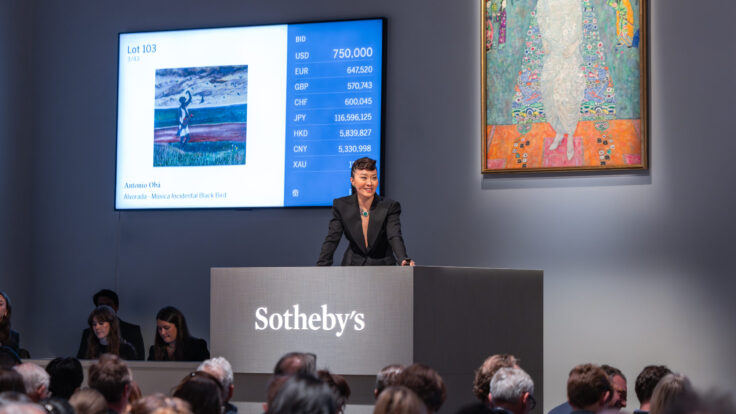
egg-flation: Earlier this week in London, Christie’s sold the Imperial Fabergé Winter Egg for £22.9 million ($30.2 million), more than tripling its 2002 auction price of $9.6 million. The price also broke the world auction record for any Fabergé, which was previously held by the Rothschild egg that made £9 million ($18.6 million) in 2014.
Christie’s was offering the Winter Egg, alongside 47 other Fabergé objects, from the collection of the late Qatari prince Saud bin Mohammed Al-Thani—all but four of which sold for an additional £4.9 million ($6.5 million) against an aggregate estimate of £3.6 million. Fabergé, itself, purchased a 400-page design album from 1911-16, one of only three known to exist, for £508,000 ($677,000). The brand was recently taken over by Sergei Mosunov, who is looking to
resurrect it.
Meanwhile, in Sotheby’s buoyant Fabergé, Imperial & Revolutionary Art sale, a new record was achieved for Russian seascape painter Ivan Aivazovsky, when his 1878 composition The Survivors sold for £4.2 million ($5.5 million), more than doubling its estimate of £2 million, and
more than quintupling its $1 million price from when it last appeared at auction, in 2004. - Tête-à-tête: The star lot of Christie’s African and Oceanic Art sale in Paris was a 12-inch Tête Fang, from Gabon, offered with an unpublished estimate; it sold for €5.2 million ($6 million), 70 percent more, in dollars, than it
made just five years ago in a contemporary art evening sale at Sotheby’s New York. The piece was originally acquired by dealer Charles Ratton in 1931, and then held in the collection of MoMA curator James Johnson Sweeney for five decades. Its success follows that of the Barbier-Mueller sale at Christie’s last year, when another Tête Fang made €14.8 million ($16 million), becoming the most expensive piece of African art ever sold.
|
|
|
Now, let’s get to the main event… |
|
|
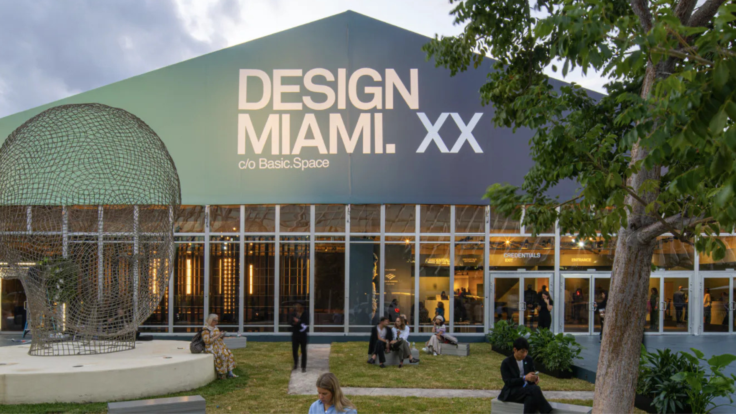
A mid-December tour of Design.Miami, Art Basel, the New Art Dealers
Alliance fair, and the ICA Miami opening revealed a steady flow of visitors, plenty of eager buyers, and an ostensible return to form for the city’s biggest annual art fair. |
|
|
It was 32 degrees when I left the house early on Tuesday to catch my 6 a.m. flight to
Miami. I had intended to wear clothes suitable to the humidity, but chickened out at the last minute. After all, what’s an extra sweater when you only packed for two days? And I didn’t regret the choice, even when I found myself changing in a Fort Lauderdale airport bathroom before jumping in a car bound for Design.Miami to catch their 10 a.m. press preview, which a brief delay at LaGuardia caused me to miss by half an hour.
No matter. I arrived in time for the tail end of the event, and
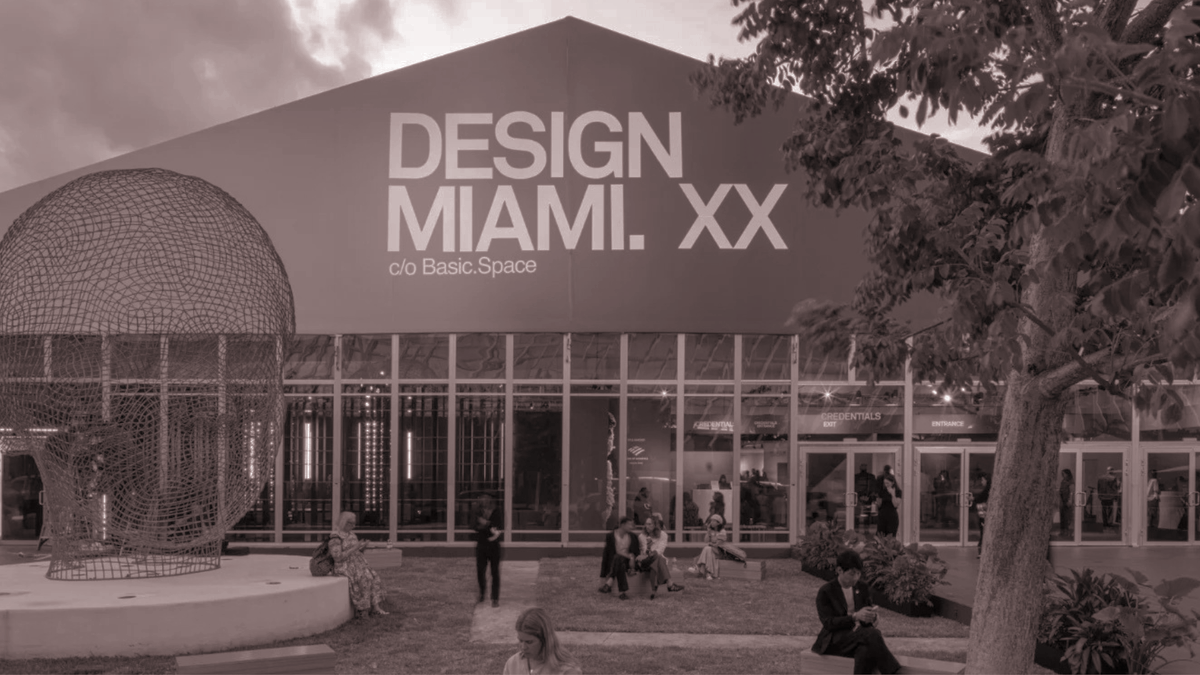
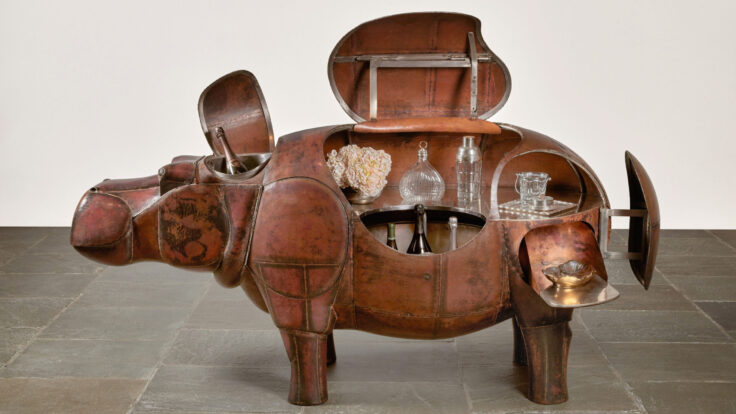
got to say hello to curator Glenn Adamson and parent company C.E.O. Jesse Lee. Design.Miami’s own leader, Jen Roberts, was too absorbed in conversations for me to get anywhere near her. But I would have told her that their reconfigured fair was impressive, and as V.I.P. guests started to trickle in, I was able to case some of the booths. |
|
|
The Breguet Classique Souscription 2025 represents a reinvention of a timeless icon
– paying tribute to the original aesthetic, elevated by a contemporary perspective. Join Breguet in celebrating 250 years of horological excellence. |
The Breguet Classique
Souscription 2025 represents a reinvention of a timeless icon – paying tribute to the original aesthetic, elevated by a contemporary perspective. Join Breguet in celebrating 250 years of horological excellence. |
|
|
I won’t pretend to be a design aficionado, but I was taken with some of the ceramics
I saw at London’s Adrian Sassoon, especially the work of Australian potter Pippin Drysdale. At Paris’s Galerie Scene Ouverte, I saw Francisco Aniorte’s ceramic-fronted cabinet.
And Achille Salvagni Atelier’s booth featured a combination of beautiful historic Italian design items and Salvagni’s own custom, limited-edition furniture and lighting fixtures. (Design.Miami is the kind of place where buyers get excited by an oversize $200,000 chandelier.)
I left on the early side to head to the New Art Dealers Alliance fair at Ice Palace Studios in the city. NADA is traditionally a place where collectors and advisors go to discover under-the-radar
galleries and talent, and advisors can pick up work to satisfy clients who can’t or won’t spend for more established artists. When the market swings toward young artists, the place is mobbed, and I expected things to be more subdued after last month’s turn of attention toward historic artists. But I was mistaken: There was a steady flow of visitors, and I found most of the gallerists to be upbeat and making solid sales.
From NADA, I made my way to the ICA Miami opening, where Alex
Gartenfeld was shepherding guests through his shows, one of which was for the sculptor Richard Hunt. Gartenfeld introduced me to Jon Ott, the head of the foundation and Hunt’s official biographer, who explained that the artist’s extraordinary success at a very young age—Hunt had a survey at MoMA in 1971, when he was just 35—translated into a career of 160 public art commissions.
Above the Hunt show, Gartenfeld had mounted a posthumous look at the
work of Joyce Pensato, an artist who, while she’s known for her use of cartoon figures like Felix the Cat, Bart Simpson, and Batman, isn’t really a pop artist in any way. In the museum’s garden, I ran into Alex Logsdail from Lisson Gallery, who represents Pensato, and also Masaomi Yasunaga, a ceramics artist whose show at the ICA was his first at a U.S. museum.
Just down the block, Jeffrey Deitch was
holding his annual show of emerging talent, which also had a steady stream of visitors. It was a reminder that while the emphasis in the art market might shift between the poles of historic and emerging, that doesn’t mean interest evaporates on either side. |
I arrived at Art Basel a few minutes after the 11 a.m. early preview opening the next
morning. As I waited for the lines to clear, I encountered Elena Soboleva, who just started a new role as head of audience growth for the fair. From the look of things, her job wasn’t going to be much of a challenge. It’s been a long time since anyone had to line up at the doors of an art fair to get access to the best works, and several people even remarked that the mood had seemed to switch back to “the old days.” But there really isn’t any going back—dealers are in touch with
collectors all the time, and there are more art fairs than ever before.
Of course, Miami Beach has also changed a lot since 18th and Collins, a short walk from the convention center, was the heart of the party scene. The city is now home to way more rich people, many of whom are art collectors, and the fair plays a role in their social calendar—but not quite in the way it used to. At dinner on Tuesday night, the advisor Josh Baer and I both remarked that many of
the original hotels that drove the Miami scene are currently closed or semi-demolished. But none of this seemed to affect the fair. I spoke with two different dealers who had walk-ins start serious conversations or buy significant works. One of those dealers told me that she closed a high-six-figure deal five minutes before the fair ended on the first day. |
|
|
There are a few possible reasons why this year’s fair was so well-attended. Not to
get political, but I’ve been wondering if the art market’s new mood is somehow intertwined with the serious cracks emerging in the MAGA coalition. This crowd mostly votes with its economic interests, even if its members often express a different social point of view from the Republican powers that be. But rich people got what they wanted from Trump, and now, perhaps believing they won’t have to suffer through a forever administration, they’ve started to feel better about
spending.
The other contributing factor, ironically, seems to have been the relentless drumbeat of negative news in the art press for the past year or more. Many dealers, advisors, and their clients were recoiling from all the gloom and doom—some of it warranted, and much of it presented for the sake of drama. Buying art is inherently social, and few collectors are self-directed enough to want to be the only one doing it.
During a lull in the early preview, I hopped a water taxi
over to the Pérez Art Museum. But I was late to my tour of the building with director Franklin Sirmans, because while Miami was smart to create the water taxi, they did little to provide adjacent transportation infrastructure. On the city side, that meant a half-hour walk through extensive construction to get to PAMM.
It was worth the walk, however. Sirmans showed me his incredible Woody De Othello show, with work made specifically to debut in Miami.
Primarily a ceramicist, De Othello is a hard-to-classify artist, but certainly a demanding one. He chose a highly specific orange-red color for the walls of his exhibition space. Later, coming out of the exhibition of works from twins Elliot and Erick Jiménez, we ran into architect David Adjaye. Sirmans also showed me two different photography exhibitions and a gallery with selections from the permanent
collection alongside works on loan from Ken Griffin.
I finished my Miami tour with a second lap of the fair on Thursday morning, and stopped by the Bass to see their refreshing Jack Pierson show. Then I hopped in a car and headed home. I had not expected this year’s Art Basel to be such a pleasant experience. Art people are always happy to complain about something, but the mood was light and buoyant—a refreshing respite after nearly three years of
frustration. |
That’s it for me today. I’ll be back on Sunday with more for you.
Until
then,
M |
|
|
The ultimate fashion industry bible, offering incisive reportage on all aspects of the business and its biggest
players. Anchored by preeminent fashion journalist Lauren Sherman, Line Sheet also features veteran reporter Rachel Strugatz, who delivers unparalleled intel on what’s happening in the beauty industry, and Sarah Shapiro, a longtime retail strategist who writes about e-commerce, brick-and-mortar, D.T.C., and more. |
|
|
Finally, a media podcast about what’s actually happening in the media—not the oversanitized,
legal-and-standards-approved version you read online. Join Dylan Byers, Puck’s veteran media reporter, and Julia Alexander, a longtime media analyst, as they sit down with TV personalities, moguls, pundits, and industry executives for raw, honest, sometimes salacious conversations about the business of media and its biggest egos. New episodes publish every Tuesday and Friday. |
|
|
Need help? Review our FAQ page or contact us for assistance. For brand partnerships, email ads@puck.news. You received this email
because you signed up to receive emails from Puck, or as part of your Puck account associated with {{customer.email}}. To stop receiving this newsletter and/or manage all your email preferences, click here. |
Puck is published by Heat Media LLC. 107 Greenwich St., New York, NY 10006 |
|
|
|