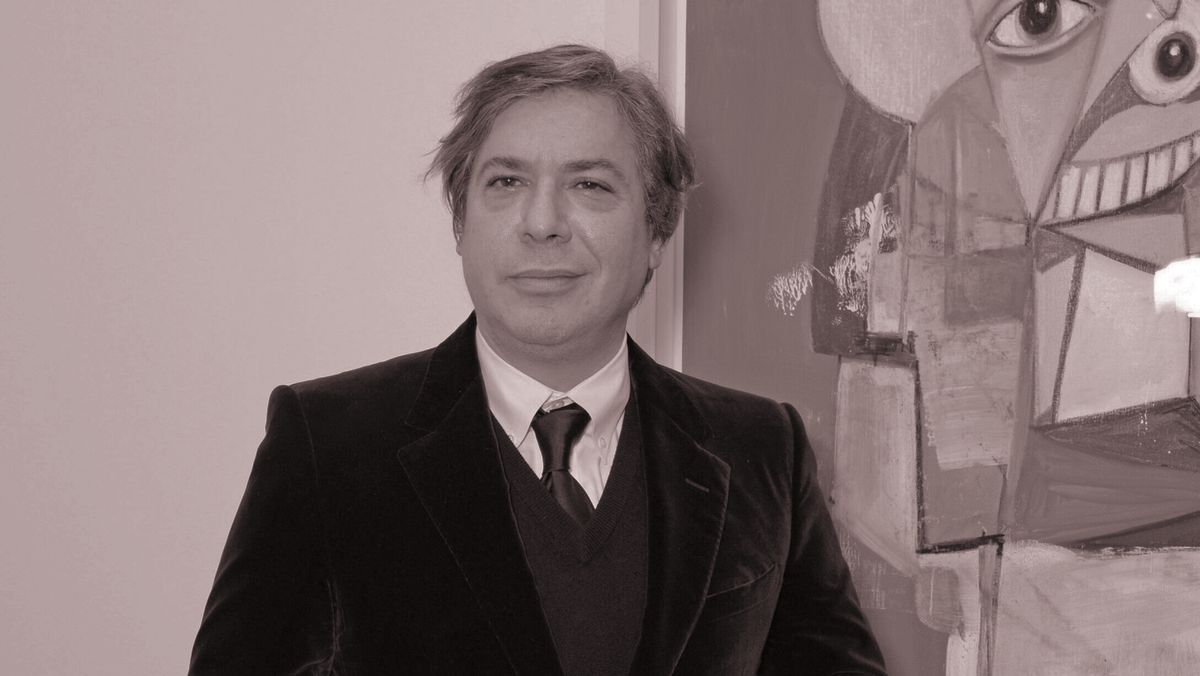
Welcome back to Wall Power. I’m Marion Maneker.
I’m just back from
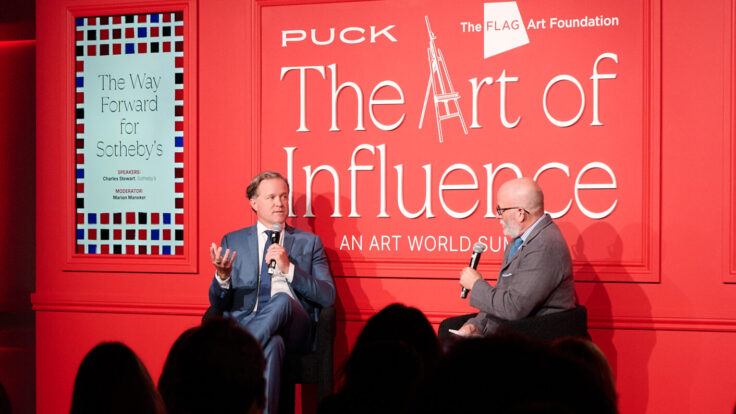
Nantucket—another place where complicated people pretend to lead simple lives. I was there with my Puck buddies, Jon Kelly, William Cohan, and Leigh Ann Caldwell, speaking at the idyllic Westmoor Club. The event was great, and the strong turnout by Westmoor’s members was a sight to behold—Jon and Bill were each three deep with fans and well-wishers.
In many ways, Nantucket is a lot like the art market. It’s
a relatively small place with limited land and a lot of people who want some of it to call their own. Real estate sales for the first half of 2025 were $500 million, up 10 percent from H1 of the previous year. Meanwhile, average prices were down 16 percent, from $4.5 million to $3.7 million, during the same period. The volume of sales, of course, was up 23 percent from the previous year to make up the difference. On Nantucket, as in the art market, we’re seeing strength lower down in the price
spectrum but moderation at the very top.
Tonight we’re going to escape the heat by thinking about October—the auction houses have begun to promote the fall sales to take place around Art Basel Paris. Also, there were some interesting results in the summer auctions that reinforce our contention that there’s a real market below $500,000. There was also a rare auction of M.C. Escher drawings and prints that suggests the number of under-recognized markets out there.
Everything sold, and for prices well above the estimates.
Let’s get started… |
- Phillips’
Modern & Contemporary Art = $2.8 million: Phillips’ mid-July sale in New York had a solid 85 percent sell-through rate of 105 lots and strong performances for works by artists like Helen Frankenthaler, whose late untitled work from 1980 made $229,000, above an estimate (without fees) of $80,000. Also outperforming expectations was Ilya
Bolotowsky’s Complex Movement, from 1947. The painting earned Bolotowsky’s second-highest auction price at just under $140,000, above a modest estimate of $40,000 without fees. Selling at the same level was Kent Monkman’s Recumbent Dandies Observe the Perils of the Games, from 2008, another of the Canadian First Nations artist’s
genre-bending tableaus. Estimated without fees at $80,000, it sold for just under $140,000 to make Monkman’s second-highest price after The Storm, from 2020, which sold last year for just over $380,000.
There were several other upside surprises for artists like Kikuo Saito, Lari Pittman, Soumya Netrabile, and
Warlimpirrnga Tjapaltjarri, an Aboriginal artist represented by Salon 94. Even though those sales were all in the mid-five figures, they are continuing evidence of the strong bidding at this price level. - Christie’s First Open = $7.8 million: At Christie’s, there was even more to talk about: 83 percent of the 305 lots offered found buyers for a total sale of $7.8 million. The top lot was an untitled Elaine de Kooning
painting from 1956 that was estimated at a mere $15,000 without fees, which bidders drove up to a selling price with fees of $352,800. An untitled Keith Haring
work on paper from 1983 was estimated at $80,000 but sold for $277,000. An Alexander Calder gouache
from 1972, Black Tree, Blue Moon, was estimated at $50,000 but sold for $214,000. Alex Katz’s 1992 dual portrait, Kym and Peter, was estimated at $60,000 but sold for a little more than $200,000.
Some interesting under-the-radar artists also had significant price moves.
Osvaldo Mariscotti’s Curves, from 2019, set a record for the artist at just above $150,000. That’s the third record price achieved at auction for the American artist, raised in Italy, who has mostly sold outside of the mainstream art world. Two works by Friedel
Dzubas, a minor color-field painter perpetually on the cusp of a market revival, were sold for prices well above the estimates. Graal, from 1980, was estimated at $60,000 without fees but sold for nearly $190,000 to make his eighth-highest price at auction. Meanwhile, Redland, from
1964, was estimated at $25,000 but sold for $88,000. There were also very good prices for a range of artists like Giorgio Cavallon, Arnaldo Pomodoro, and Mary Abbott.
The recently deceased Joel Shapiro’s untitled sculpture from 1986-7
was estimated at $80,000 and sold for just over $200,000. A Sean Scully painting estimated at $40,000 sold for nearly $190,000. Works by Robert Motherwell, Christo, and Yu Nishimura were also snapped up. - Christie’s M.C. Escher sale = $7.8 million: In another case of artists’ markets you know nothing about until there’s a big auction result, Christie’s sold 65 M.C.
Escher prints and drawings for a total nearly six times the estimate, or $7.8 million. The fascinating thing here is that Escher’s work rarely trades at the auction houses. As Richard Lloyd and Lindsay Griffith of the Christie’s print department explained to me, Escher’s work mostly sells privately among a small group of dedicated collectors. The auction house had been waiting for the right opportunity to attract a broader audience for the artist, whose
images received fame from posters and the ideas highlighted in Douglas Hofstadter’s 1979 Pulitzer Prize–winning book about cognition, Gödel, Escher, Bach. In the age of artificial intelligence, Escher’s art would seem to be even more relevant now than it was 45 years ago.
Christie’s opportunity finally arrived when two collections became available for auction. One remains anonymous, but the other came from Robert Owen Lehman Jr.,
who is known as Robin. Now in his late 80s, Robin bought many of his Eschers in 1980. (He’s now selling them to fund his foundation.) The top lot was Reptiles, a pencil drawing on paper dated to 1943, estimated at $100,000. But the piece eventually made
nearly $530,000 with fees. Relativity, another pencil drawing dated to 1953, was offered with a $50,000 estimate but soared to just above $500,000 with fees. Ascending and Descending, from 1960, also had a 10x
result—landing at a little less than $380,000 above the initial estimate without fees of $35,000.
|
Now, here’s the main event… |
|
|
The French art world is checked out for the summer, and its attention has already turned
toward the fall, where Paris has a lineup of exhibitions—from George Condo to Richter—and a new home for the Fondation Cartier in time for October’s Art Basel. |
|
|
The fall art season is already beginning to take shape. Once again, Paris is looking to be a focal point, as
the museums in the city line up high-level exhibitions to coincide with Art Basel Paris. The Fondation Cartier will open in its new home, unveiling the Jean Nouvel–led renovation of a historic Haussmann-era building, across the street from the Louvre, with a show of work from its collection. The Musée d’Art Moderne de Paris, which calls itself MAM to make life easier, has announced a major show of George Condo’s work, created in collaboration
with the artist, as well as a show of Nigerian artist Otobong Nkanga.
Also, the L’Orangerie will follow up last year’s show of Berlin art dealer Heinz Berggruen’s collection with one about Berthe Weill, the nearly forgotten dealer who exhibited the works of Pablo Picasso, Diego Rivera, Henri Matisse, and Amedeo Modigliani, among others. As we told you a few weeks ago, the
Fondation Louis Vuitton will put on a major retrospective of Gerhard Richter’s work. Of course, we will learn about more shows in the museums and galleries as we get closer to the fall.
In the meantime, the auction houses have begun to publicize their Paris offerings in October. Earlier this week, Sotheby’s announced that it will hold a sale of the contents of Rhône Group founder Robert Agostinelli’s London home a few weeks before the fair
begins. The South Kensington house was designed by Jacques Grange and featured a table by Diego Giacometti set against a screen by Christian Bérard, as well as objects designed by Jean-Michel Frank juxtaposed with a painting by Man Ray. Elsewhere in the home, there were lamps by François-Xavier Lalanne beneath images by Bernard Boutet de Monvel. The most expensive lot in the
sale is a Jacopo Tintoretto Concert des Muses, estimated at €300,000, which sat above an Alberto Giacometti lamp in Agostinelli’s house.
The sale also includes Hiroshi Sugimoto’s Sea of Japan, Hokkaido-Su. 305, estimated at €250,000, and Man Ray’s Landscape (A Tree Grows in Brooklyn), estimated at €80,000. The sale takes place on October 6. |
Christie’s announced that it had secured a European collection of approximately 40 works for its October 24
sales in Paris. The highlights of that collection are works by Paul Signac, René Magritte, and Max Ernst.
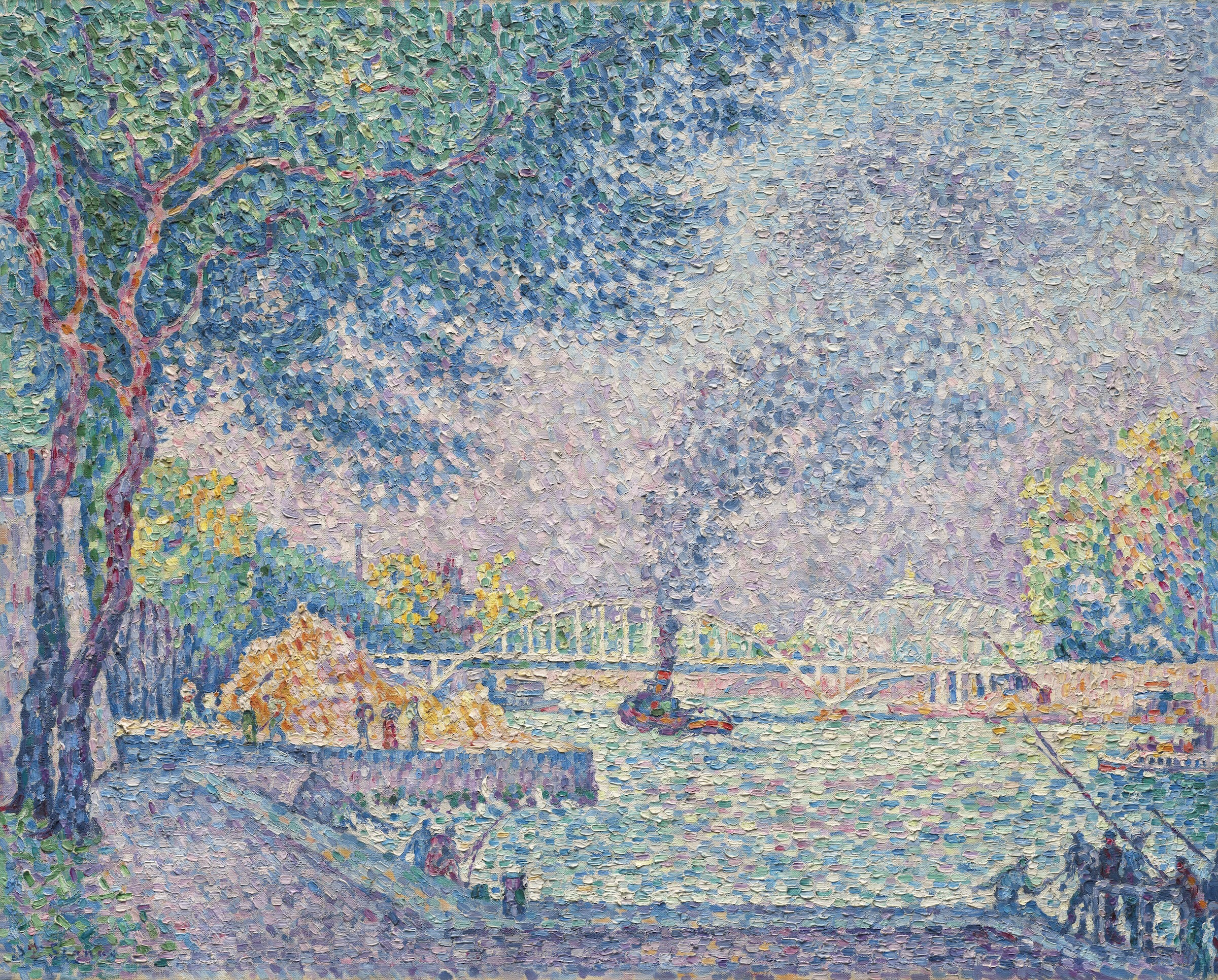
The Signac is La Passerelle Debilly, from 1903, which the artist gave as a gift to fellow pointillist painter Henri-Edmond Cross. The painting, which later passed into the hands of the famous critic Félix Fénéon, has not been on the auction market for seven decades. Signac’s earlier works are
generally valued higher, with the artist’s top auction price coming in at nearly $40 million for an 1891 picture of boats in the morning calm. The highest price for a post-1900 Signac painting was $16 million, achieved in 2019 by a depiction of the harbor in Constantinople. La Passerelle Debilly is estimated at €4 million. |
Paul Signac, La Passerelle Debilly (1903). Photo: Anna Buklovska/Christie’s Images Ltd.
|
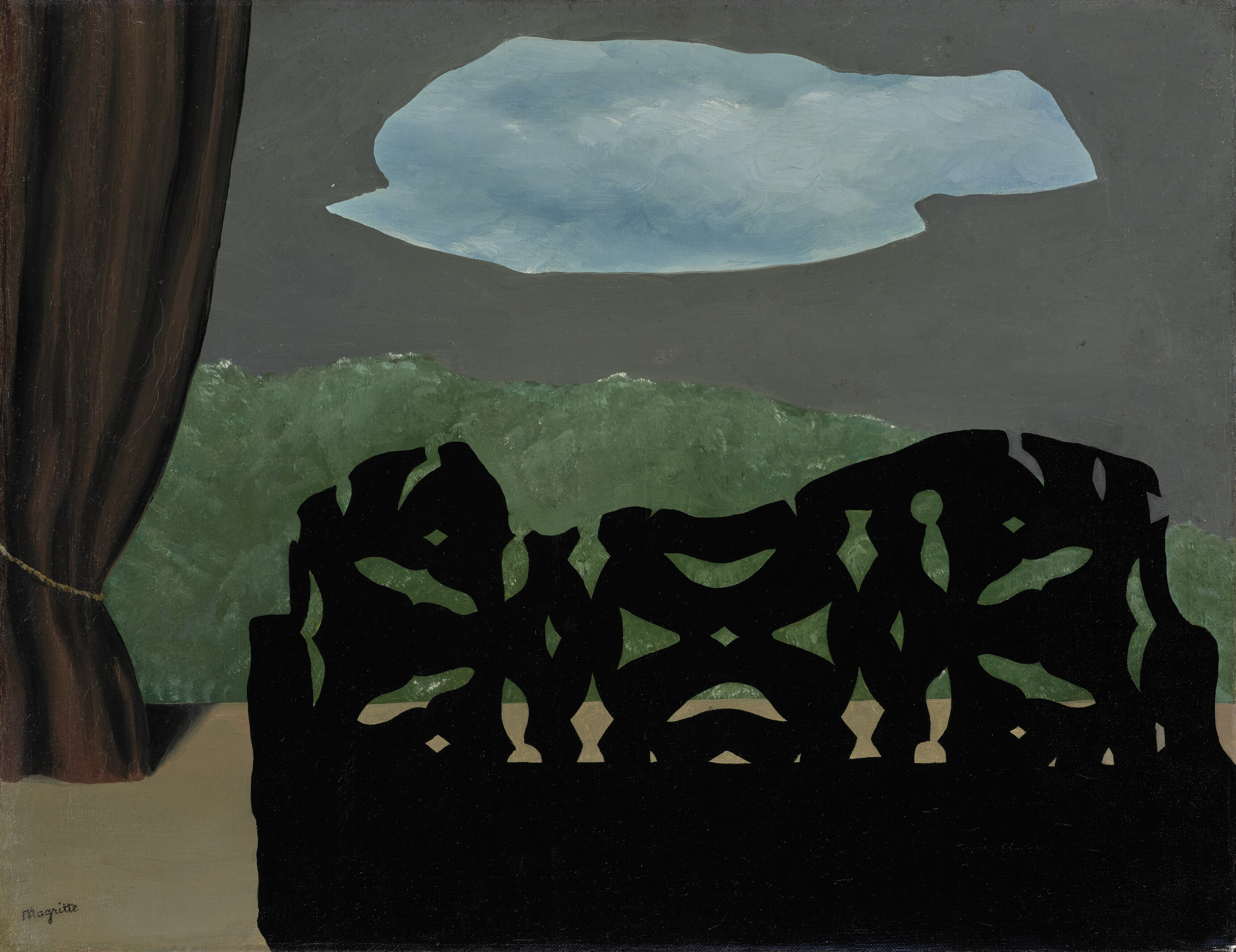
Magritte is represented by Le Ciel passe dans l’air, from 1927, estimated at €1 million. The
painting depicts an interior scene that mixes a rustic bench, a copse of trees, and a stage-set curtain with a blue sky seeming to pierce the artificial setting. The estimate reflects the date of the work—paintings from the late 1920s to early 1930s generally sell in the low million-dollar range—and the size of the picture. It’s around 2 square feet. |
René Magritte, Le Ciel passe dans l’air (1927). Photo: Anna Buklovska/Christie’s Images
Ltd. |
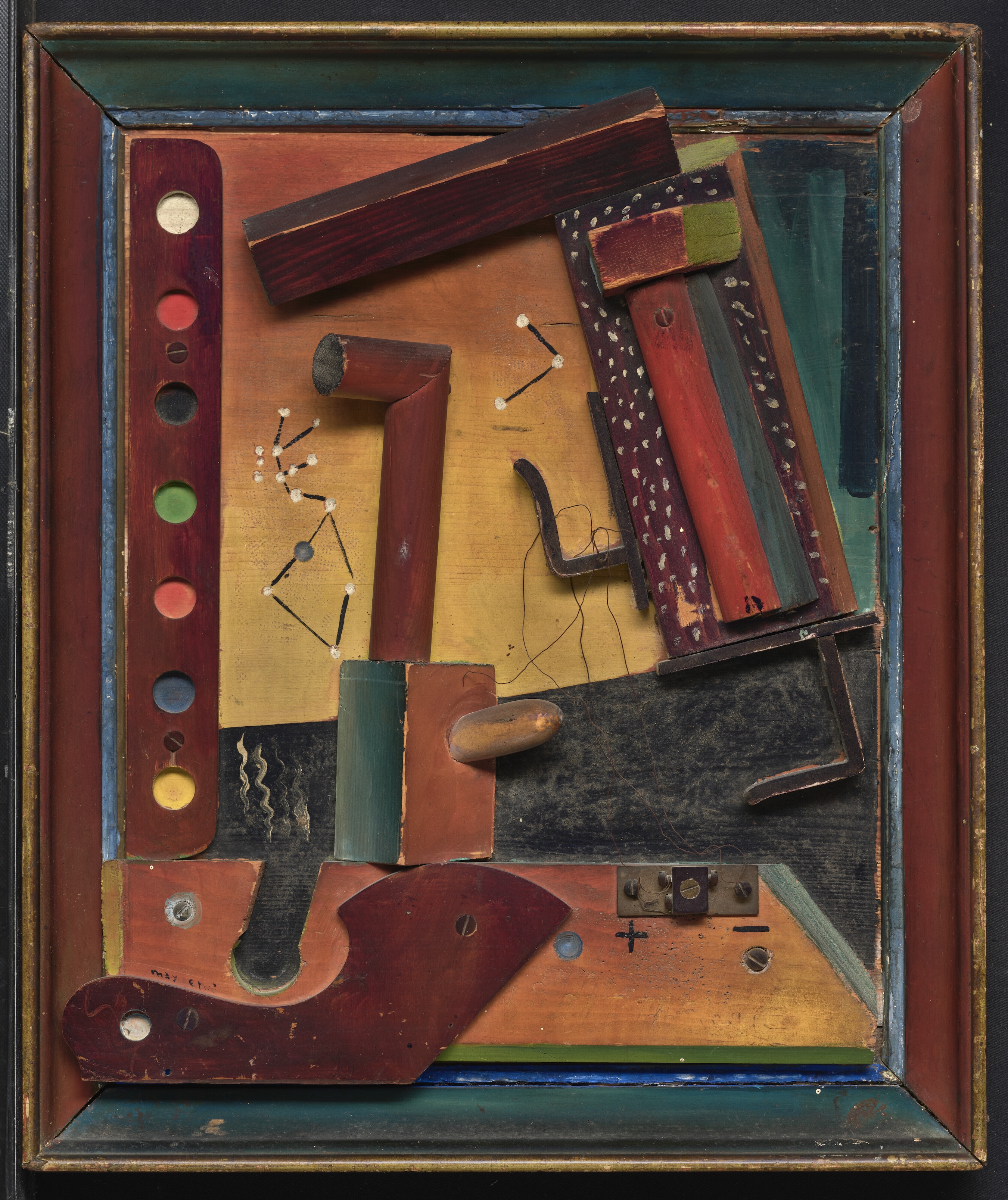
Finally, the auction will include an early Dadaist work by Max Ernst, who joined the movement just after
World War I. The work, Fruit d’une longue expérience, is an assemblage of painted wood that he made in 1919 but gave to the poet Paul Éluard in 1938. Éluard would later sell it to Roland Penrose, who was intimately involved in the surrealist movement and, also, married to photographer Lee Miller. Estimated at €800,000, the painting has been held in the same collection for 50 years. |
Max Ernst, Fruit d’une longue expérience (1919). Photo: Anna Buklovska/Christie’s Images
Ltd. |
Christie’s will have plenty more to announce for the Paris sales in the coming months. But if you’re
interested in Max Ernst and happen to be in San Francisco this summer or fall, Gallery Wendi Norris has assembled a suite of 12 bronze sculptures by Ernst and is exhibiting them in partnership with SHVO, the owners of Transamerica Pyramid Center. Created in 1938 and ’39, the bronzes were cast when Ernst was living with Leonora
Carrington in the town of Saint-Martin-d’Ardèche, to adorn the couple’s house—their place became a meeting spot for the surrealist group in the same period. |
Late last week, The Wall Street Journal
wrote about the Victoria and Albert Museum’s new “open storage” facility, the V&A East Storehouse, which has “the ambience of a junk shop with the backstage area of a provincial auction house or a luxurious version of IKEA,” in the Journal’s words. I can’t wait to go next time I’m in London.
If you don’t follow trends in museums, you probably don’t know that there has been a long-standing movement to get the objects that are not on display into settings where they can at least be seen, even if they’re not presented with the full effect of museum lighting and annotation or a curator’s thoughtful narrative.
V&A East takes that idea and makes it even more accessible. The facility, the Journal writes, “holds 250,000 of the V&A’s 2.8 million objects, as well as
350,000 books and 1,000 archives. Almost everything can be requested for viewing through the world’s first ‘Order an Object’ program.” The whole place sounds like an amusement park for anyone who gets excited about material culture.
And, with that, I’ll leave you to have a great summer weekend.
See you on Sunday,
M |
|
|
Finally, a media podcast about what’s actually happening in the media—not the oversanitized,
legal-and-standards-approved version you read online. Join Dylan Byers, Puck’s veteran media reporter, as he sits down with TV personalities, moguls, pundits, and industry executives for raw, honest, sometimes salacious conversations about the business of media and its biggest egos. New episodes publish every Tuesday and Friday. |
|
|
The industry’s go-to source for unflinching reporting on the trillion-dollar business of artificial intelligence - perhaps the
single most important technology of our time. Ian Krietzberg, the powerhouse journalist behind The Deep View, delivers twice-weekly insights into the latest dealmaking and breakthroughs in A.I., and how the intersecting worlds of finance, entertainment, media, and politics are being transformed in its wake. |
|
|
Need help? Review our FAQ page or contact us for assistance. For brand partnerships, email ads@puck.news. You received this email because you signed up to receive emails from Puck, or as part of your Puck account associated with {{customer.email}}. To stop receiving this newsletter and/or manage all your email preferences, click here. |
Puck is published by Heat Media LLC. 107 Greenwich St, New York, NY 10006 |
|
|
|