Welcome back to Wall Power. I’m Marion Maneker.
After dinner on
Friday night, I was down by the water, where an isolated rain shower was refracting the golden-hour light a mile or two away to create the most intense rainbow I’ve ever seen. I’m not sure what that means, if anything, but I thought I would mention it.
Glenn Adamson is back tonight with another one of his Hot Hand columns, in which he profiles lesser-known designers and artists who are likely to receive more recognition and visibility in the future. (Glenn has an
excellent track record of identifying up-and-coming talent.) Tonight, he singles out Sarah Meyers and Laura Fügmann, who are “making seconds into firsts” with their innovative textile designs.
Up top: Freeman’s auction house in Philadelphia has a major rediscovery in its April 29 sale that’s sure to bring international attention. Also, a mini Vincent van Gogh drawing—a little smaller than a standard sheet of paper—sold in
Paris for 12 times the estimate.
Somebody messaged me on Instagram that I should remind you that your responses to these emails go directly to my inbox. If you think I’ve missed something—or just want to talk something over—feel free to hit reply to contact me directly. You know I’ll see it. If you prefer SMS or WhatsApp, you can reach me on +1.917.825.1391.
Also, if you’re reading this email because it was passed along to you, don’t worry, I won’t turn you in. Just make
your life simpler and subscribe here. Or upgrade to the Inner Circle here, if you’re an art market professional.
Also mentioned in this issue: Josef Šíma, Tristan Tzara, Le Corbusier, Piet Mondrian, Theo van Doesburg,
František Kupka, Robert Delaunay, André Breton, Jean Arp, Robert Ingersoll, Bernard Davis, Hella Jongerius, Ralph Waldo Emerson, Rothko, Robert F. Wilson, and more… |
|
|
|
A MESSAGE FROM OUR SPONSOR |
A MASTERPIECE IN MOTION Unmistakable style. Undeniable attention to detail. Experience composition and craftsmanship at their finest in a Range Rover.
EXPLORE
|
|
|
|
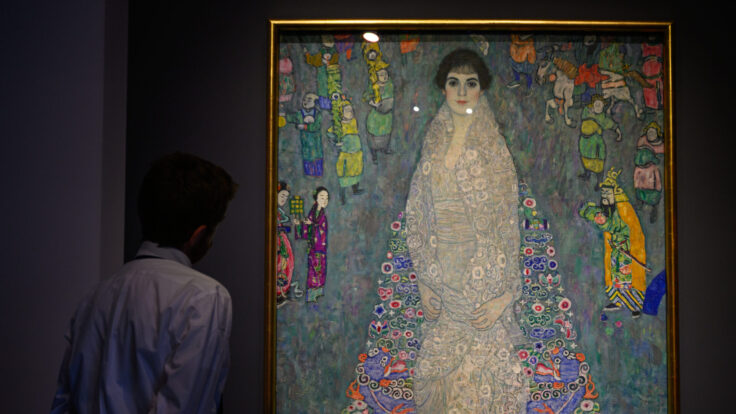
- A lost Czech masterwork: In Freeman’s April 29 sale of modern and impressionist art, there’s a work by Czech surrealist Josef Šíma with a modest-but-realistic $300,000 estimate. The number is rational because Šíma’s auction market has seen real activity lately: Five of his six top prices—ranging from around $385,000 to
almost $865,000—were all achieved in the last five years. Those works, sold primarily in Paris, were made in the 1960s, when the artist was in his 70s.
But the painting on offer at Freeman’s also represents a discovery that’s already caught the attention of collectors around the world—a heretofore unknown second version of the artist’s most admired and historically important painting, Europa, from 1927, which hangs in the Moravian Gallery in Brno. And research shows that this
newly discovered version may actually be the canvas where Šíma worked out his most radical ideas.
Šíma first moved to Paris in the 1920s, and there got engaged in the avant-garde, forging relationships with Tristan Tzara, Le Corbusier, Piet Mondrian, Theo van Doesburg, František Kupka, and Robert Delaunay. In 1927, having been introduced to André Breton through his friend
Jean Arp, he exhibited with the surrealists. That same year, Šíma co-founded the influential journal Le Grand Jeu, started to organize exhibitions, and launched a movement that would advance the goals of dadaism by employing symbolism to achieve some kind of human liberation. He began using the image of an egg as a key symbol in his visual language—it appears as a central element in both versions of Europa.
But why hadn’t anyone known
about the other Europa? Since 1952, it’s been in the family of former Philadelphia Museum of Art trustee Robert Ingersoll, who bought it at a time when Šíma’s reputation had faded, especially in America. The previous owner was Bernard Davis, a Ukrainian émigré collector who had made Philadelphia his home, but clearly returned to Europe often. He, in turn, seems to have bought the work directly from Šíma’s studio not long after it was painted.
- A small van Gogh drawing sells for $1.4 million: In Christie’s Paris sales, a small sheet of paper with a sparse drawing by Vincent van Gogh was offered with a €100,000 estimate. It ended up selling for 12 times that with fees. Multimillion-dollar prices for van Gogh drawings are not uncommon, but this
work is less detailed than many sold for comparable prices. The result is yet another example of the demand for historic works by major artists.
|
|
|
|
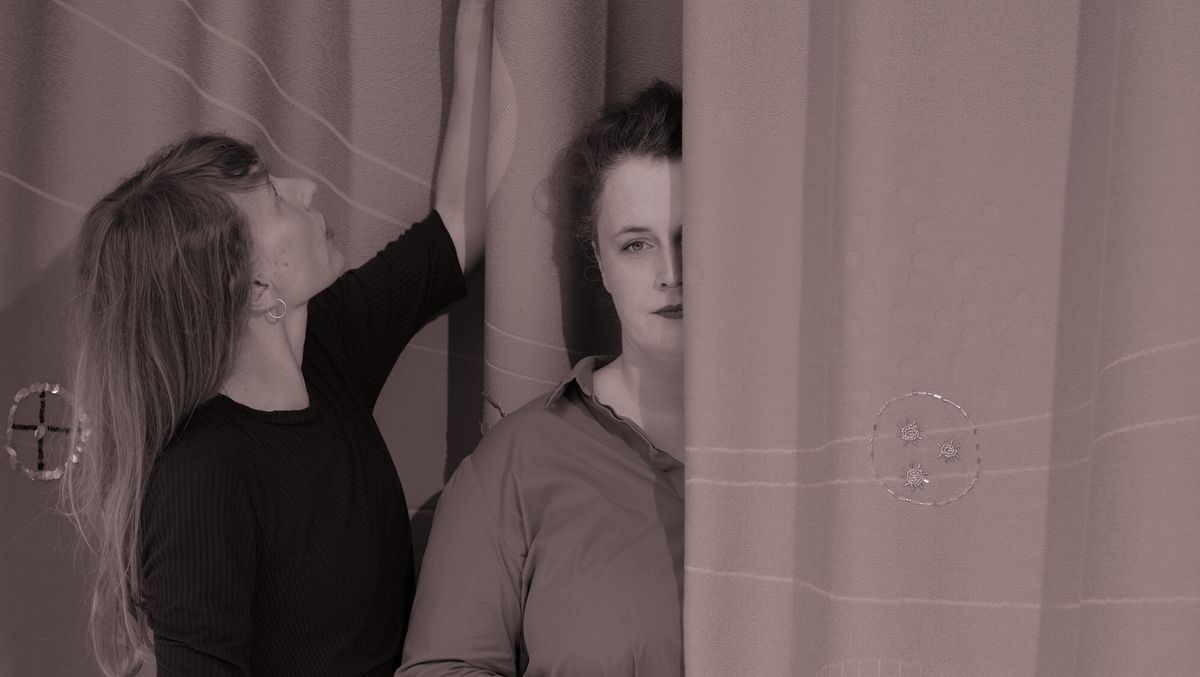
Two young acolytes of the design legend Hella Jongerius operate a studio of their
own, where they’re unleashing colorful gradients in textiles, ceramics, and beyond—and adding an organic element of chance to the predictability of industrial design. |
|
|
|
Recently, I was in Weil am Rhein, Germany, to open a retrospective about Hella
Jongerius, the legendary Dutch designer, at the Vitra Design Museum. Jongerius burst onto the scene in the 1990s with a hands-on experimental approach, and has since become something of a role model to other designers, showing that it’s possible not just to collaborate with companies, but also to push them toward more ecological and ethical solutions. To assist with the installation, she called in her A-team: Sarah Meyers and Laura Fügmann. They’ve
worked with Jongerius for a decade, having joined her studio in Berlin shortly after meeting at the Weissensee art school.
Their collective experience really showed. Walking through the show with the two young designer-makers was both extremely informative and a little awe-inspiring. They had woven many of Jongerius’s experimental textiles, helped construct her cardboard Color Catcher sculptures, and taken part in the studio’s many corporate commissions—including for KLM,
Maharam, Danskina, and Vitra itself. They seemed to know every thread and facet, every story and detail—even more than I did, and I was the show’s curator. |
|
|
|
A MESSAGE FROM OUR SPONSOR |
A MASTERPIECE IN MOTION Unmistakable style. Undeniable attention to detail. Experience composition and craftsmanship at their finest in a Range Rover.
EXPLORE
|
|
|
|
Their work at Jongeriuslab, however, was only a part-time gig. Meyers & Fügmann have also operated
as an independent studio since 2015, with their own fresh take on Jongerius’s guiding philosophy. Across a wide range of disciplines including textiles, ceramics, lighting, and interiors, they have sought to transcend a core principle of industrial design—standardization—and infuse their products with a vibrant unpredictability. |
“Turning
Seconds Into Firsts”
|
Ralph Waldo Emerson famously described consistency as “the hobgoblin of little
minds.” He was writing about metaphysics, but he may as well have been thinking of mass production and its relentless logic of uniformity. When irregularity does, inevitably, occur, items are marked down as “seconds” or simply discarded. This attitude came about for good reasons having to do with productive efficiency and consumer expectation. Universal application, though, has had terrible consequences: tremendous waste within an economic system already making too much stuff as cheaply as
possible; soul-crushing boredom for factory workers, relieved only when they are replaced by machines; and a vast sweep of sameness, as far as the eye can see.
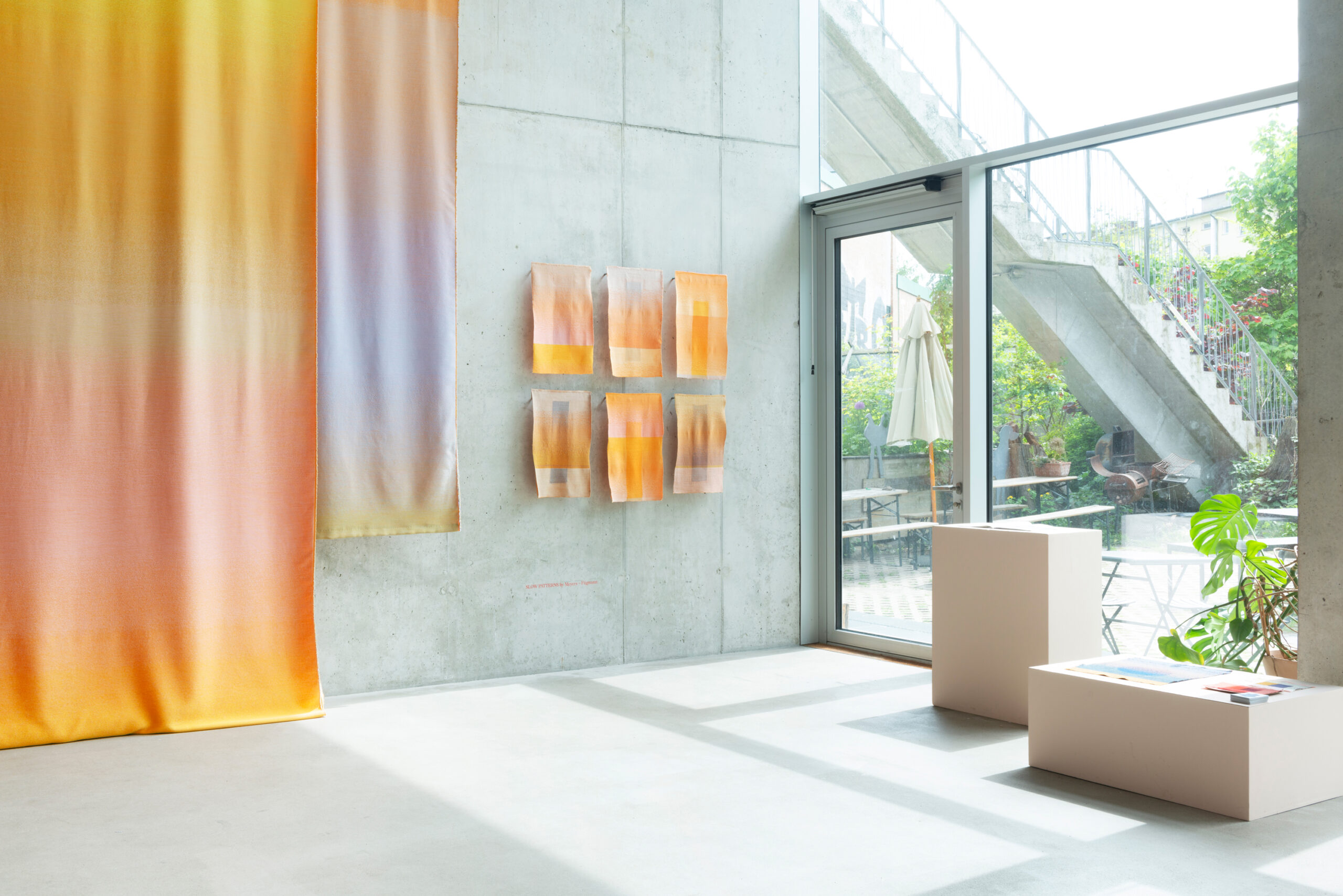
Meyers & Fügmann show us there’s another way. In project after project, they embrace variation as an animating principle, “turning seconds into firsts,” as they put it. A good example is their textile collection Fades Made to Fade, woven from a combination of hand-dyed wool and synthetic yarns. As the cloth is exposed to sunlight,
the organic threads change in hue (some becoming more muted, others getting darker) while the synthetics stay the same. A previously hidden pattern slowly emerges. This is itself an unpredictable process, depending on the combination of dyes and the positioning of textiles. Meyers & Fügmann think of themselves as painting with light; having set out to make more interesting curtains, they say with a laugh, “We have made our own Rothkos.” |
Photo: Marie Rime/Courtesy of Meyers & Fügmann |
The research process for Fades Made to Fade was extensive, not only because of the complex
interactions between the natural and artificial threads, but also because the only way to see the results was to wait. They ended up sending samples to the Arizona desert to speed things up—there’s a testing facility there, mostly serving the auto industry—but they also feel that the natural process has its own beauty, which must be allowed time to unfold.
This same attitude is seen in their cleverly titled Shades, which are lampshades made of translucent porcelain. Each is placed in a
shallow bath of oxide pigment—cobalt for blue, manganese for purple, copper for green—which seeps gradually into the 1-millimeter-thick clay body. This produces a subtle matte composition, which is further transformed when illuminated, as if turning on an indoor sunrise. |
Perhaps the most technically ingenious of Meyers & Fügmann’s experiments thus far is
Couleurs-sur-Sûre, a collection of blankets made of wool from Luxembourg (Meyers’s country of origin; Fügmann is originally from Hanover). The fiber is a byproduct of the meat industry—and because it’s so variable, it has to be hand-sorted before being woven. This is too expensive for commercial textiles, so instead the wool is typically sold at a loss, ending up in China as insulation material. |
|
|
|
Seeking a better destiny for the material, Meyers & Fügmann came up with the ingenious idea of
dyeing the thread after it is already spun and wrapped into a cone—a typical way of preparing thread for the loom. The wool on the outside surface receives a full charge of pigment, while the tightly wound threads on the interior barely register it, even after a long soak. The cones are then fed into the loom, one after another, producing a rhythmic effect as each new color arrives and gradually dissipates.
While their methods are highly craft-intensive, there is also something
compellingly contemporary, even a little futuristic, about Meyers & Fügmann’s designs. The gradients they favor, though always achieved using analog techniques, resemble digital ombré effects. And their cultivation of chance finds a correspondence with possibilities now being unleashed by A.I.
One of their latest textiles for Kvadrat, Scan, directly acknowledges the prospect of a digitally enabled, infinitely variable mass customization. Set to be prominently featured in the upcoming
Salone del Mobile in Milan and Modus Möbel in Berlin, it is a surface treatment of an existing fabric in the Danish manufacturer’s catalogue. Over the heavyweight canvas, they have layered a sequence of colors with silkscreen printing, finishing with a gentle, sideways blast of spray paint.
The result is amazingly atmospheric, as if the northern lights had been somehow woven on a loom. And while the palette has been carefully calibrated, drawing on the systems of the pioneering British
color theorist Robert F. Wilson, it could also be adapted endlessly.
Here and throughout their developing body of work, Meyers & Fügmann are thinking beyond the aesthetic, considering not only how their products look, but the procedures by which they are derived. They are leaders of what’s sometimes called “parametric design,” in which potentially infinite outcomes can be generated within a set of carefully devised constraints. That methodology, too, is borrowed from the
field of computer science, but in their hands it is always expressed through good old-fashioned material intelligence.
If mass production does have a bright future ahead, it’s very likely to involve some degree of customization: That’s a good way to give people not just more of what they want, but also less of what they don’t. To do that well, though, will require artisanal, as well as algorithmic, thinking. Meyers & Fügmann are lighting the way. |
Thanks, Glenn. I’ll be back on Tuesday with more.
M |
|
|
|
Puck founding partner Matt Belloni takes you inside the business of Hollywood, using exclusive reporting and insight
to explain the backstories on everything from Marvel movies to the streaming wars. |
|
|
|
Unique and privileged insight into the private conversations taking place inside boardrooms and corner offices up and
down Wall Street, relayed by best-selling author, journalist, and former M&A senior banker William D. Cohan. |
|
|
|
Need help? Review our FAQ page or contact us for assistance. For brand partnerships, email ads@puck.news. You received this email because you
signed up to receive emails from Puck, or as part of your Puck account associated with {{customer.email}}. To stop receiving this newsletter and/or manage all your email preferences, click here. |
Puck is published by Heat Media LLC. 107 Greenwich St., New York, NY 10006 |
|
|
|
|