Hi, and welcome back to Line Sheet. Halfway there? We are thankful for Jonathan
Ros, who makes sure we all get into the fashion shows with zero problems. I’ll have my final report from Paris on Monday.
Today, though, you’ll find my verdict on Loewe and some interesting things I saw over the past 24 hours. This week, I’ve also been thinking a lot about who gets to write about what. For example, you could argue that it was ballsy of Marisa Meltzer to attempt to capture the essence of a British-French icon in her new
book, It Girl: The Life and Legacy of Jane Birkin. Over lunch at Sotheby’s in Paris celebrating the launch of the book, I spoke with several American and Canadian friends who have built a life here. We discussed the onslaught of Americans moving to Paris, which must be annoying for those who have spent decades trying to integrate. These women were all frustrated by the depictions of the
prototypical “French girl” in the media and marketing—but when it came to Marisa’s biography, they were on board. Sometimes, an outside point of view is the only way to get the truth.
Anyway, I’ve always been interested in the French girl industrial complex, and why it works so… effortlessly on consumers. For today’s main event, Sarah “SShapiro@puck.news”
Shapiro breaks down the economics of the business.
Mentioned in this issue: Jane Birkin, Jean Seberg, Rouje, Morgane Sézalory, Sézane, Marisa Meltzer, Jack McCollough, Lazaro Hernandez, Loewe, Jonathan Anderson, Daniel Roseberry, Schiaparelli,
Kim Bekker, Isabel Marant, and many more… |
|
|
Three Things You Should Know…
|
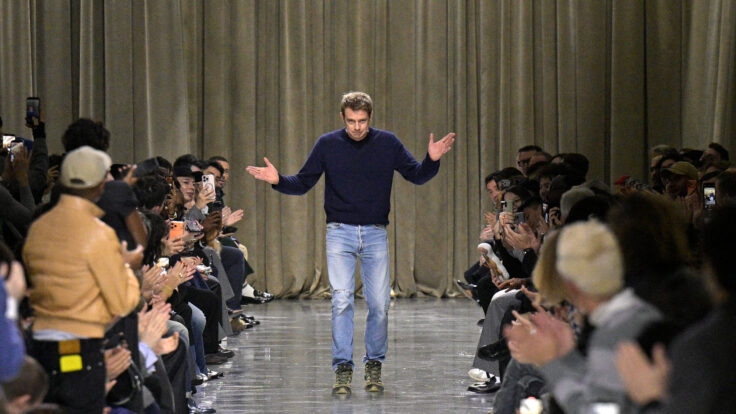
- Bend it like Bekker: Since we’re on the subject of French girls, it feels apropos to note that Isabel Marant’s new creative director, Kim Bekker—whose designs nail Marant’s enduring point of view—is Dutch. Last night at Place Colette, the ground covered in red clay, Bekker—who took a solo bow for the first time, even though Marant is still working in the business—delivered on the promise of the brand, which is poised for another market high.
Succession planning is never easy, but it also doesn’t have to be so dramatic.
- Americans in Paris: Jack McCollough and Lazaro Hernandez have long vied for acceptance in the European market, and after more than 20 years trying to prove they have it, the Proenza Schouler founders got their chance this week with their first Loewe collection. That’s why, in part, their
debut was the most dreaded on the schedule. Over the course of a decade, Jonathan Anderson took the Spanish firm—the second-oldest leather goods house after Hermès, mind you—and brought it into modernity with equal parts humor and reverence. Were Jack and Lazaro up to the task? Their design chops have never been questioned, but plenty of skeptics wondered whether they could compete in the European system with designers who grew up in these houses.
But
Americans relish being underdogs. I started hearing, shortly after their appointment, that the Europeans were impressed by the depth of McCollough and Hernandez’s knowledge, and the steadiness of their self-confidence. And, in the end, their debut was one of the strongest of the season—and, commercially, maybe the most viable. I’ve always had the sense that McCollough and Hernandez felt burdened by the weight of running their own company, that they would rather just design clothes. But
many designers feel this way, and can’t deliver when they’re given the keys to the kingdom. Not these two.
This collection—a slick, tactile interpretation of what modern sportswear should be—was sophisticated, uplifting, and rich-looking. (Jodie Barnes was a good match, styling-wise.) The look-what-we-can-do techniques were also there: handpainted, molded tank dresses; a freaky screen-print dress that hung on the body like a wet towel; etcetera. But the
sportiness of the silhouette, and the colors (teal, primarily red, yellow, blue, black, the perfect green), gave the collection a sense of propulsion. I especially loved the jackets—the hourglass silhouette is what we all want right now—and those little booties fitted with socks, and the new, softer take on the Amazona bag. These were things to buy.
In short, this didn’t feel like Proenza Schouler. It felt like Jack and Lazaro. We all want to move on, and they proved that it’s
possible. - Another American in Paris: I hate show notes; they never make any sense. But Daniel Roseberry’s show notes for Schiaparelli on Thursday night were the best I’ve ever read. They were clearly written by him, as if he were sending a voice note to a friend. They actually explained what he was trying to do. “Why can’t fashion—even everyday fashion—be art?” he wrote.
That question is too
philosophical for me, but Roseberry provided a clear answer anyway. In the past, I’ve bristled at his ready-to-wear proposition for Schiaparelli, the surrealist house where he makes wonderfully fantastical couture gowns and other garments. The ready-to-wear—the normal stuff—always felt a little phony. But not this season. Like his notes, this collection was, in some ways, incredibly straightforward—simple skirt suits, the right flou—but also provocative. (The dresses had cutouts that
read amoeba-like instead of suggestive.) Roseberry seems to have finally struck the balance between art and the everyday.
|
|
|
News and notes on the brands driving the latest incarnation of the never-ending fascination
with French girl style—which, of course, continues to drive big business. |
|
|
For better or worse, so-called French girl style never seems to go out of fashion. Yes, searches on Pinterest
for “classic Parisian style” are up 1,795 percent versus last year, according to the site, and sales have been robust for brands like Sézane, which recently opened its tenth U.S. store, in Brooklyn, and Rouje, whose lone U.S. store is in SoHo. But it’s more trope than trend. The evergreen appeal, of course, is grounded in what it promises: an inside track to the maddeningly elusive, studied-but-carefree dishevelment of a Jane Birkin or Jean Seberg—neither of
whom were actually French, of course. (Searches for “messy French girl” are up 63 percent on Pinterest this year.) Given what’s going on in the States these days, can you blame anyone? |
|
|
While certain brands are decades-old mainstays of this look (Saint James, Saint Laurent), others
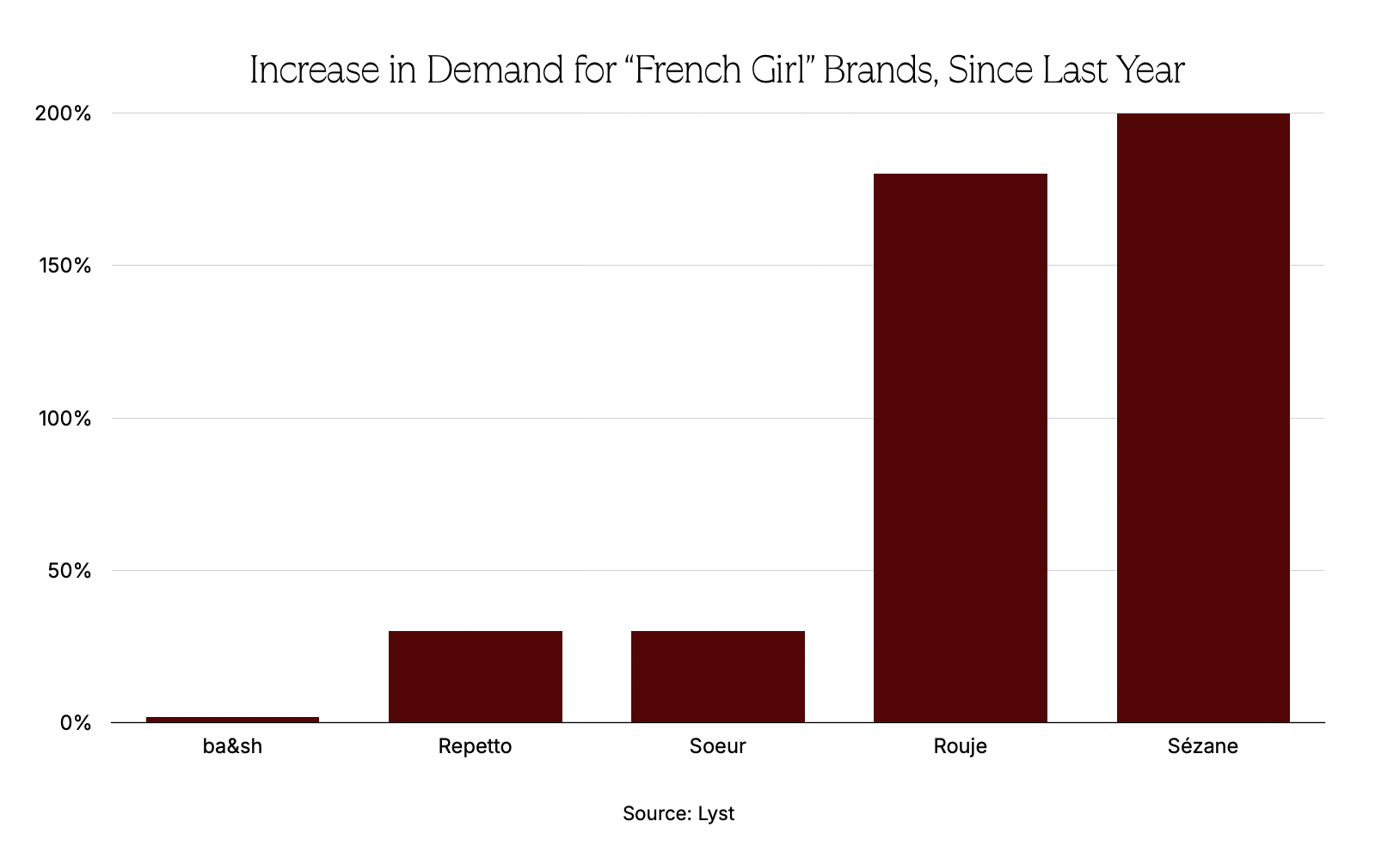
have started to creep into the canon. At Sézane, where lines at their new Williamsburg location have stretched down the block, sales are up 200 percent in the U.S. year over year. After Morgane Sézalory founded the brand in 2013 as a D.T.C. company, they’ve methodically grown their physical presence, and have partnered with entrepreneur-influencers like Alison Roman and Melanie Masarin. Their basics are infused with French details, the materials
feminine and soft, and they’re sold at accessible price points (see: the Emile cardigan for $170, or the Clyde trench coat for $350). Meanwhile, domestic sales for Rouje are up 180 percent over the past year. And Soeur, Polène, Repetto, Rue de Verneuil’s totes, and ba&sh’s boxy gold-buttoned cardigans have also seen various levels of traction. |
Of course, the striped Breton shirt is one of the style’s most enduring staples. The aesthetic is deeply
rooted in French history: It was reportedly created by Léon Legallais, the mayor of Saint-James, a French village in Normandy, in the late 19th century. According to Lyst, demand for Breton-style stripe shirts is up 18 percent over the past year in the U.S. market; the most popular brands selling the style are Boden, La Ligne (I’m hearing their top Breton shirt was
this one in the light blue), Other Stories, and Universal Standard. |
|
|
Then there are the ballet flats, which have filtered into sneaker styles. Over the spring
and summer, the number of sneakers that included “ballerina” or “mary jane” in the description increased 112 percent year over year, according to Edited. Sales of ballet flats in general increased 220 percent over the last three years, and by 43 percent in the U.S. market over the past year, according to Lyst. Some of the most in-demand versions include Alaïa’s velvet rounded toe flats, Soeur’s
Bala (recommended by Garance Doré), The Row’s thin elastic band version, and H&M’s under-$20 pair. Meanwhile, 20 years after their first collaboration, Repetto x Comme des
Garçons just sold out of their black-and-white polka dot take.
Naturally, this all goes beyond clothes. There’s the makeup, of course. I’ve heard that Violette_FR’s top seller is the Bisou Balm in a bright pink-red shade. Meanwhile, Rouje’s
Jeanne, named after its founder, is a popular version in a semi-matte bright red. One insider at Violette_FR explained the value of stocking their products on the shelves of French pharmacies, because of their reputation for prioritizing skin health over heavy makeup. When I asked Jane Birkin biographer
Marisa Meltzer to point me to some French pharmacy staples that might find their way into the tote of a U.S. shopper in Paris, she suggested this La Roche-Posay sunscreen, which she said is the “the best souvenir and a way to engage with French culture.”
I also wondered how Meltzer thought her subject might respond to the proliferation of the style: the heavy bangs,
air-dried hair, crochet minidress, t-shirt and jeans, wicker basket bags, a ballet flat or espadrille, etcetera. “Jane Birkin’s idea of her own style was that she wanted to do her own thing—and that was her style,” she told me. Indeed, perhaps it comes down to being willing and able to embrace the dueling pressures of looking effortless and perfect. And who wouldn’t want to pay to make that easier?
|
The Week in Feedback…
on Dior
|
“F*cking hated Dior, but what do I know?” —A former editor-in-chief (who knows a lot)
“The
Adam Curtis thing is truly legendary…” —A podcaster
“The shoes were really good. Dare I say she saved him a bit? But it’s growing on me overall.” —A C.E.O.-type
“I know that you love him. But this show was so problematic. I wanted to like it, but it’s impossible.” —A C.M.O. |
See you this weekend,
Lauren
P.S.: We use affiliate links because we are a business. We
may make a couple bucks off them. |
|
|
Puck fashion correspondent Lauren Sherman and a rotating cast of industry insiders take you deep behind the scenes of this
multitrillion-dollar biz, from creative director switcheroos to M&A drama, D.T.C. downfalls, and magazine mishaps. Fashion People is an extension of Line Sheet, Lauren’s private email for Puck, where she tracks what’s happening beyond the press releases in fashion, beauty, and media. New episodes publish every Tuesday and Friday. |
|
|
Puck’s daily art market email, anchored by industry expert Marion Maneker, offers unparalleled access to the mega-auctions and
galleries, elite buyers and sellers, and the power players who run this opaque world. Wall Power also features Julie Brener Davich, a veteran of Christie’s and Sotheby’s, who provides unique insights into how the business really works. |
|
|
Need help? Review our FAQ page or contact us for assistance. For brand partnerships, email ads@puck.news. You received this email because you signed up to receive emails from Puck, or as part of your Puck account associated with {{customer.email}}. To stop receiving this newsletter and/or manage all your email preferences, click here. |
Puck is published by Heat Media LLC. 107 Greenwich St, New York, NY 10006 |
|
|
|





_01K6P692XZWDRNMH99TJ1QC7QN.png)