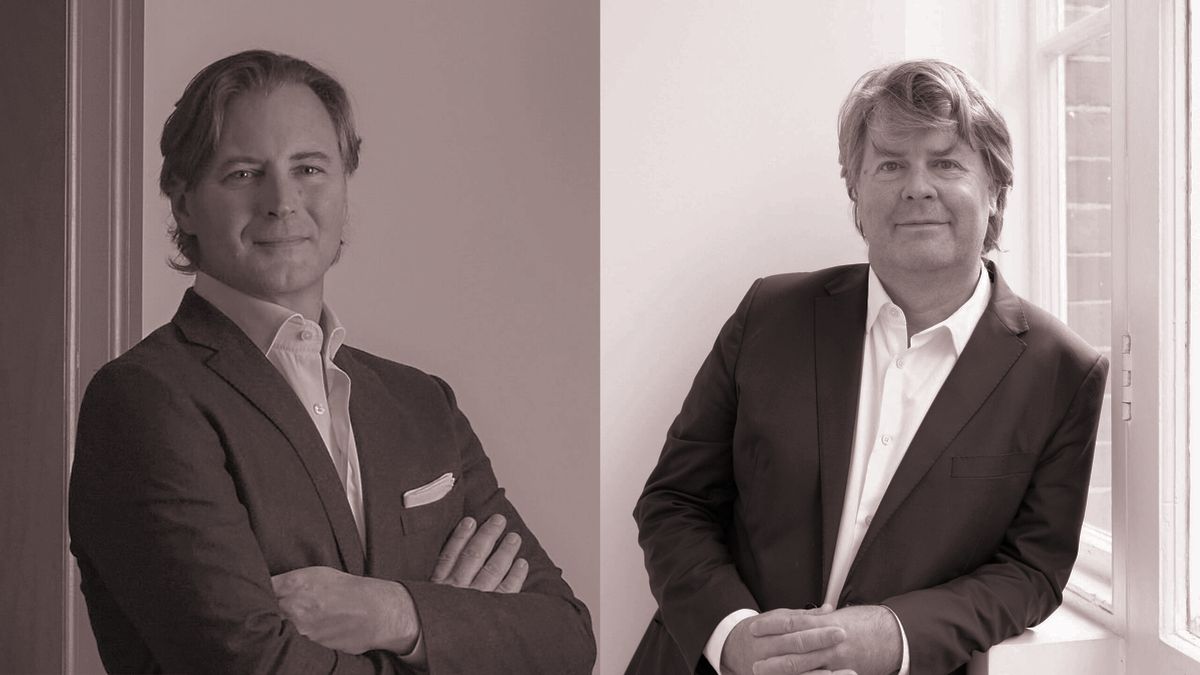
Welcome back to Wall Power. I’m Marion
Maneker.
Tonight, Julie previews Magritte and Les Lalanne: In the Mind’s Garden, a new show at Di Donna Galleries that opens on October 8. It’s the first, if you can believe it, exploration of thematic connections between three important surrealist artists of different generations. Julie also checks in on Phillips’ Geneva jewelry sale and stops by
Claudia Keep’s gallery show.
But first…
|
-
Remembering Milton Esterow: Milton Esterow, the onetime owner of ARTnews, died on Friday at the age of 97. The magazine, which Esterow purchased from Newsweek in 1972 after a career as a reporter at The New York Times, won a National Magazine Award under his leadership. (He sold it in 2014.) Esterow was an important mentor to a generation of art journalists, including our own Julie Davich. But he was also a major art world figure in his own
right, covering the Nazi looting of art during World War II and the seemingly endless campaign to restitute lost works. (My partner William Cohan, who has covered several important restitution cases, contributes more on Esterow in the endnote to today’s newsletter.)
|
|
|
A MESSAGE FROM OUR SPONSOR
|
Greatness isn't achieved in an instant. It's tested until there is no question — only performance.
|
|
|
 |
Julie Brener Davich |
|
- A Geneva jewels
auction: The highlights for the November jewelry sales in Geneva are trickling in. We’ve already written about the $20 million 9.51-carat pear-shaped Mellon Blue diamond on offer at Christie’s, and Sotheby’s has a 4.5-carat oval mixed-cut Fancy Vivid Blue
diamond, estimated at CHF4.5 million. Now, Phillips has entered the conversation. Their Geneva Jewels Auction: V is led by a 6.95-carat Fancy Vivid Purplish Pink cushion modified brilliant-cut diamond, from an unknown mine, with an unpublished estimate in excess of $9 million.Those characteristics make it quite special. Only
about 0.1 percent of all diamonds mined are naturally pink, and those larger than one carat are rarer still. In fact, the two most expensive diamonds ever sold are Fancy Vivid Pinks—a 59.6-carat for $71.2 million in 2017 and an 11.15-carat for $57.7 million in 2022, both at Sotheby’s Hong Kong.
Another highlight of Phillips’ sale is an 18.09-carat step-cut unheated Kashmir sapphire, estimated at $2.2 million. Kashmir sapphires, which were mined primarily in the late 19th and early 20th
centuries, are among the most sought-after gems in the world. Just this past May, the 35.09-carat cushion-cut “Regent Sapphire” set the world auction record for the highest price per carat for a sapphire when it sold for $9.5 million at Christie’s Hong Kong.
Phillips is also selling a selection of Belle Epoque jewels that once belonged to Gladys Moore Vanderbilt, who died in 1965, leaving four daughters and 11 grandchildren. (Her sister was Gertrude Vanderbilt
Whitney, founder of the Whitney Museum.) She’s probably most associated with her family’s summer home, The Breakers, in Newport, Rhode Island. The selection is led by an intricate diamond and 42.68-carat Kashmir sapphire Tiffany & Co. brooch, estimated at $1 million.
- Bright light, big city: Yesterday afternoon, I joined painter Claudia Keep’s walkthrough of her almost sold out show on the Lower East Side to see what all the
fuss was about. Last year, The Cut had called the 30-year-old artist “one to watch,” while Artforum described her current show at March Gallery as a “must see.” A collector friend of mine concurred, encouraging me to check out “a great young painter.”It’s worth popping in if you’re in the neighborhood. Keep is known for her diminutive oils-on-panel depicting moments at once intimate and universal, “and when objective reality becomes abstract,” she said. In this third
solo show at March Gallery, she focuses on the daily rhythms of living in New York that hurtle city dwellers between quiet moments, like an unmade bed and Central Park blanketed in snow, to the visually assaulting, like the inside of a magazine shop. “It’s not just about what the city looks like but how it feels to exist here,” she said, citing Jacob Lawrence’s and Georgia O’Keeffe’s city paintings as influences.
Many of her paintings are studies of
light—a spotlight shining on a solo pianist in a dark theater, the moon twinkling on water at night, and skyscapes at various times of the day, from morning sun breaking through the clouds to a rainbow sunset. For this show, she experimented with expanding the width of her paintings, but not the height, depicting the New York City skyline at 1-foot-by-10-foot scale. The paintings range from $8,000 to $50,000 depending on size; 12 of the 14 on view at March have already found buyers.
|
|
|
And now for the main event…
|
|
|
A new show pairing Magritte and Les Lalanne puts the surrealist master
in conversation with two spiritual successors—capitalizing on the heat surrounding both of their markets and challenging the boundaries of surrealism, itself.
|
|
|
Last week, I ambled over to the Upper East Side for a sneak peek at a revelatory new
exhibition at Di Donna Galleries that groups three stars in the increasingly hot surrealism category: René Magritte, the Belgian painter born in the final years of the 19th century, and husband-and-wife sculptors Claude and François-Xavier Lalanne, who arrived on the scene a generation later. It’s a clever juxtaposition, given the art-historical lineage binding the artists across time. The very first work in the
show is a 1974 bronze bust of gallerist Alexander Iolas, who has been credited with bringing surrealism to America and famously worked with both Magritte and Les Lalanne. “He was the connective tissue of their sensibilities and the uniqueness of their language,” Emmanuel Di Donna told me.
There have been other group exhibitions featuring artists from Iolas’s roster— Max Ernst, Dorothea Tanning, Giorgio de
Chirico, etcetera—but there has never been an exhibition dedicated to just Magritte and Les Lalanne until this one, which Di Donna has staged in collaboration with Ben Brown Fine Arts. Wandering through the show, In the Mind’s Garden, which officially opens on Wednesday, the wisdom of the combination seems obvious: Magritte is the top seller in classic surrealism, racking up
sales north of $1 billion at auction since 2018. Meanwhile, Les Lalanne are the two top sellers in contemporary surrealism, with combined auction sales of more than $700 million in the same period. “This show was exactly what the market wanted,” said Ben Brown.
|
|
|
A MESSAGE FROM OUR SPONSOR
|
Greatness isn't achieved in an instant. It's tested until there is no question — only performance.
|
|
|
The potential upside is greater for Les Lalanne, who are still gaining stature as
sculptors versus functional designers, than for Magritte, who is already in the rarefied stratosphere of artists whose work has sold for more than $100 million. “The Lalannes are still dismissed in some sectors of the more judgmental art world as overly commercial,” said the collector and dealer Leo Rogath. “I don’t agree—and the market clearly disagrees as you can see from the prices. I presume part of the idea is to continue to give the Lalannes the gravitas they
deserve, putting the work in context with an artist at the highest level of recognition and institutional support.”
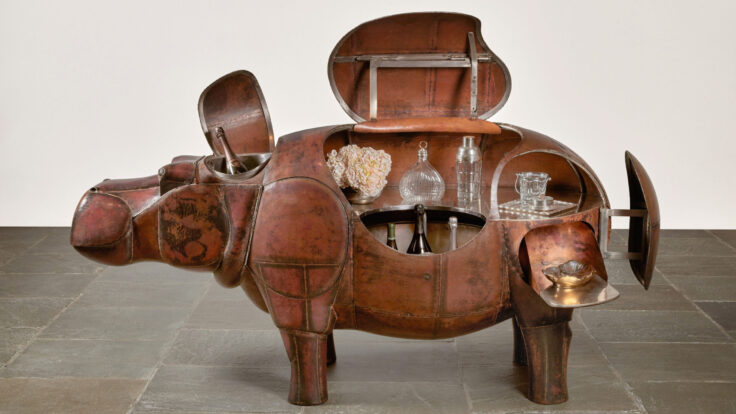
For collectors, In the Mind’s Garden provides access to a wide selection from Les Lalanne’s oeuvres, including pieces that are particularly rare. The show features one of only three of François-Xavier’s cerulean blue hippo bathtubs, for example, and one of only two of his grasshopper-shaped wine cabinets (the other is at Windsor Palace). For Di Donna, the show is a
chance to contextualize Magritte with Les Lalanne, two of the most in-demand artists in the category at the moment.
It’s also a validating moment for Brown, who told me he viewed the show as an opportunity to present Les Lalanne works in-depth to the U.S. market. Brown, a longtime dealer for the two sculptors, stuck by them during the early 2000s, when their work was a much tougher sell. In his first-ever show of their work in London, he couldn’t sell one of François-Xavier’s bronze hippo
bars for $200,000; a couple of years ago, one came up at Christie’s and made $6.2 million. Brown’s more current exhibitions of Les Lalanne work, including Planète Lalanne in a Venetian palazzo during last year’s biennale, comprise mostly pieces from his own collection that he’s held on to since their market’s more difficult days. A quarter-century on, it’s safe to say the gamble paid off.
|
It’s not known if Magritte and Les Lalanne ever met in their lifetimes—the French duo
didn’t start working with Iolas until 1964; Magritte died just three years later—but the couple certainly knew of the older artist’s work through the gallerist. Which is why, despite the generational gap, Di Donna said, “They were always in the same conversation,” addressing themes of “transformation, amalgamation and fragmentation.” Moreover, he pointed out, surrealism is “the only movement still alive” of the major artistic movements of the 20th century. Its enduring appeal can be attributed
in part to artists like Les Lalanne, who are among the torch bearers who have brought the genre into the present day.
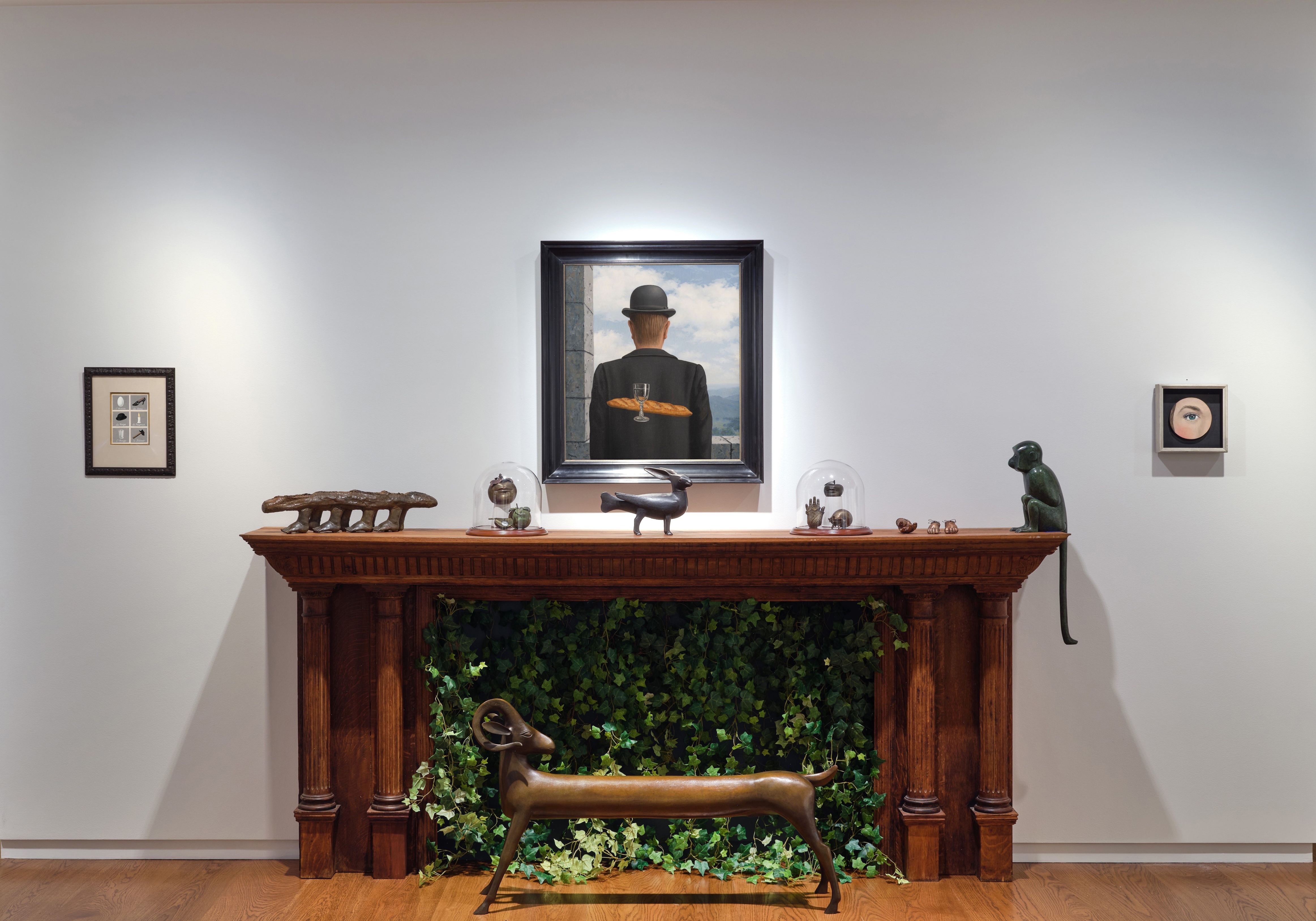
That reality is clear in the way the show organizes its 71 nature-themed works, 26 by Magritte and 45 from Les Lalanne. There are the obvious pairings, like Magritte’s painting of a bowler-hatted man with a floating baguette— L’Ami intime, from 1958, which made
$43 million at Christie’s last year—hanging above Claude’s bronze, caterpillar-like baguette with feet, Pain Pieds, conceived in 1991 and cast in 2006. Then, of course, there are all the apples. A gouache of Magritte’s iconic masked duo of the fruit, from 1966, hangs near several of Claude’s life-size bronze apples and above the 4-foot-tall Pomme de Ben—named for, yes, Ben Brown—conceived in 2007 and cast in 2013. In one of the rare collaborations between husband and wife, a
monkey sits on the oversize fruit’s stem in a humorous play on scale.
|
Installation view of Magritte and Les Lalanne: In the Mind's Garden at
Di Donna Galleries. Photo: Pauline Shapiro/Courtesy Di Donna Galleries, New York. René Magritte: © 2025 C. Herscovici, Brussels Artists Rights Society (ARS), New York. François-Xavier and Claude Lalanne: © 2025 Artists Rights Society (ARS), New York/ADAGP, Paris.
|
Another parallel explored in the show is how both Magritte and Claude Lalanne frequently
tackled the subject of nature overpowering man. One of Magritte’s best-known examples of this theme is a bronze tree stump with the roots overtaking an axe, Les Travaux d’Alexandre, from 1967, named for Iolas. It is displayed near Claude’s 1994 bronze sculpture La Dormeuse, depicting a head lying on its side with branches of leaves instead of hair. Other pairings focus on the figure. Claude’s bronze casts of fragmented body parts overgrown with flora hang on the wall next to
Magritte’s 1939 female nude, Le miroir universel—which, in a similar vein, depicts the top of the body as a stone statue blending with the sky and the bottom half as flesh. The painting last sold at Sotheby’s in 2023 for $9.9 million from the collection of Liu Yiqian and Wang Wei, who had
purchased it eight years prior for two-thirds that price.
|
|
|
All three artists challenge our ways of looking at the world, sometimes quite
literally, by using novel framing devices, like François-Xavier’s outdoor animal sculptures with rectangular cutouts revealing the vista beyond. As he once said, “If we place a sculpture in a landscape, it’s absolutely necessary that its presence be better than its absence.” The current exhibition has two different size versions of his bronze Poisson Paysage from 2007 and 2010. Magritte used similar framing devices in his compositions, and there are multiple examples in the show, even
including one with a fish, La Recherche de la vérité (The Search for Truth), from 1962-63.
“Everyone agrees that Magritte is a genius,” a U.S.-based collector told me, “but I suspect that this exhibition will accelerate the reassessment of Les Lalanne as visionary artists.” By positioning the duo’s functional pieces, like the hippo bathtub and grasshopper wine cabinet, alongside masterpieces by Magritte, Di Donna and Brown are challenging their categorization as part of the
design canon. “Les Lalanne are the spiritual inheritors of the surrealist movement,” Brown told me. “They are all about creating worlds.”
|
As mentioned above, I asked my colleague Bill Cohan to weigh in on Milton Esterow’s
life and legacy. So let me turn it over to him…
My friend Milt Esterow, the longtime owner and editor of ARTnews, died over the weekend at age 97. He lived a long and blessed life. I don’t know all the details of Milt’s near-century on the planet, but I know that he wrote about art for The New York Times for a long time before he decided to buy, and run, ARTnews, eventually selling it in 2014.
I first met Milt in 2007 after the publication of my
first book, The Last Tycoons, a history of the investment bank Lazard, where I’d worked between 1989 and 1995. As part of the reporting, I spent a lot of time interviewing the Lazard patriarch, Michel David-Weill. Michel and I talked often about his astounding art collection, and he gave me a tour of the parts of the collection that he kept at his Fifth Avenue apartment. Michel, whom ARTnews had named one the world’s 200 top collectors, had spent many years
recovering the collection of his father, Pierre, which was seized by Nazis during World War II, boxed up, and stored in a salt mine. Not only did Michel reassemble the collection, but he added new pieces of his own.
In any event, I proposed to Milt that I write a piece about Michel and his amazing art collection for ARTnews. We met in his cramped garment district office, near Keens Steakhouse, where Milt would take me for lunch at the far corner table reserved
for regulars. I can’t remember why he wasn’t keen on a piece about Michel’s art collection, but he was keen on me writing for ARTnews, which I did for the next seven years, until he sold the magazine.
In particular, he wanted me to write about art restitution—the complex process by which art stolen by the Nazis during World War II is returned to the Jewish families from whom it was taken. This led to many long investigative pieces about the famous collection of
Schiele works stolen from Fritz Grünbaum, the Austrian cabaret performer, before he was exterminated, and the legal battles his heirs waged against a Swiss gallery owner who laundered the paintings after the war. Under Milt’s direction, I wrote pieces about the questionable provenance of a number of artworks in the collection of the Museum of Modern Art. I wrote extensively about the ongoing international art restitution protocols designed by Stuart
Eizenstat, the esteemed attorney. Thanks to Milt, I also wrote pieces about the questionable authenticity of a number of Degas sculptures being sold, to this day, in the unregulated art market. Several of my articles for ARTnews won Silurian awards. And many of them also pissed off powerful people in the art market who didn’t appreciate a nosy reporter. But no matter what controversies these stories surfaced, Milt always had my back, and we prevailed.
He
kept writing about art, for The New York Times and for Airmail—I introduced Milt to Graydon—well into his 90s. He always eagerly shared his pieces with me, and vice versa. He was a truly great, hugely knowledgeable man who will be sorely missed. It was a privilege to have known him.
|
That’s all for today. We’ll see you back here on Tuesday.
M
|
|
|
The ultimate fashion industry bible, offering incisive reportage on all aspects of the business and its biggest
players. Anchored by preeminent fashion journalist Lauren Sherman, Line Sheet also features veteran reporter Rachel Strugatz, who delivers unparalleled intel on what’s happening in the beauty industry, and Sarah Shapiro, a longtime retail strategist who writes about e-commerce, brick-and-mortar, D.T.C., and more.
|
|
|
Finally, a media podcast about what’s actually happening in the media—not the oversanitized,
legal-and-standards-approved version you read online. Join Dylan Byers, Puck’s veteran media reporter, as he sits down with TV personalities, moguls, pundits, and industry executives for raw, honest, sometimes salacious conversations about the business of media and its biggest egos. New episodes publish every Tuesday and Friday.
|
|
|
Need help? Review our FAQ page or contact us for assistance. For brand partnerships, email ads@puck.news.
You received this email because you signed up to receive emails from Puck, or as part of your Puck account associated with {{customer.email}}. To stop receiving this newsletter and/or manage all your email preferences, click here.
|
Puck is published by Heat Media LLC. 107 Greenwich St, New York, NY 10006
|
|
|
|