Welcome back to Wall Power, coming to you from the Isle of Skye, where I’m taking a
few days of vacation before I start the marathon of gallery, museum, and auction exhibitions in London and Paris in the coming weeks. I’m Marion Maneker.
Tonight, I’ve got the story of a mysterious Edvard Munch print that emerged from an American family, but turned out to be a key discovery in understanding the origins and evolution of one of the Norwegian artist’s most famous images.
But first… |
-
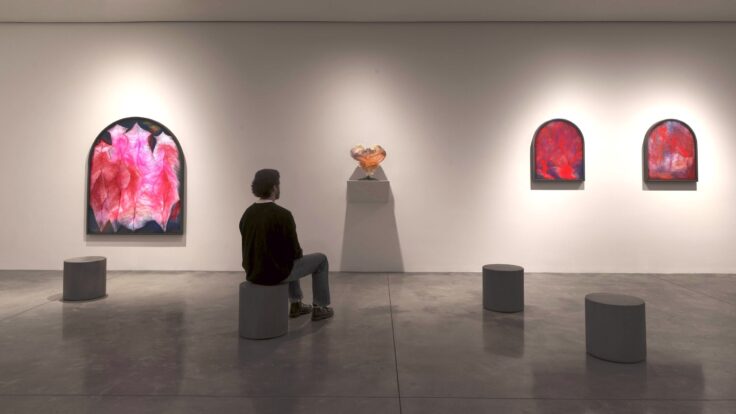
Sea View’s new view: Sara Lee Hantman’s Sea View gallery, which has been in a “concept space” designed by artist Jorge Pardo for L.A. MOCA since 2022, is moving to Hollywood’s gallery district. On October 10, the gallery will open a 2,500-square-foot space at 1300 N. Orange Drive, not far from Lisson, Jeffrey Deitch, Sebastian Gladstone, and others. The new space’s inaugural exhibition will be the first solo show by Indian artist Amitesh
Shrivastava. Hantman also announced that she will exhibit for the first time at Frieze Los Angeles in 2026.
|
|
|
A MESSAGE FROM OUR SPONSOR |
|
|
- Sotheby’s unveils Magritte for Paris: Sotheby’s announced late last week that it will be offering a 1934 René Magritte painting of his wife and muse, Georgette Berger, La Magie Noire, in the Paris Surrealism and Its Legacy sale on October 24. The family of Claude Spaak, an important patron of Magritte’s during his early years, acquired the painting in 1935, and it’s estimated at €5 million.
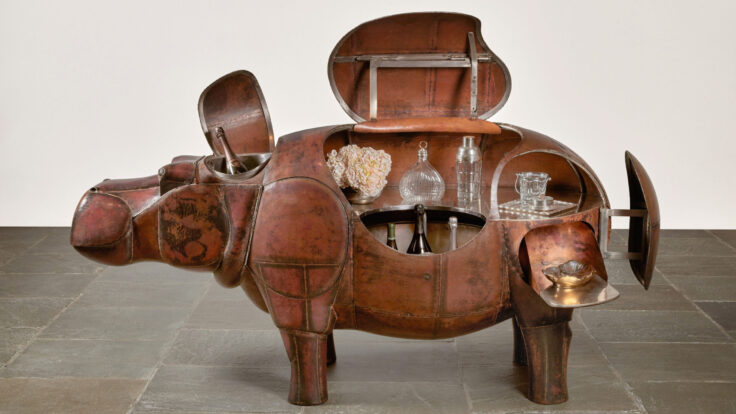
- More Lalanne in the Schlumberger collection at Sotheby’s: Sotheby’s has also announced it will be selling the collection of Anne Schlumberger this autumn. The collection contains a Claude Monet View of Rouen, which is estimated at $3 million and will sell in the modern evening auction. But the bulk of the value is in works by Claude and François-Xavier Lalanne that will be sold on December 10
in New York during the design sales. The top lot there is a copper hippopotamus bar that is estimated at more than $7 million.
|
Now, let’s get to the main event… |
|
|
How one family discovered they owned a key work by Edvard Munch that
was too valuable to sell—and how a clever print specialist solved the problem. |
|
|
During a routine consignment a few years ago, Richard Lloyd,
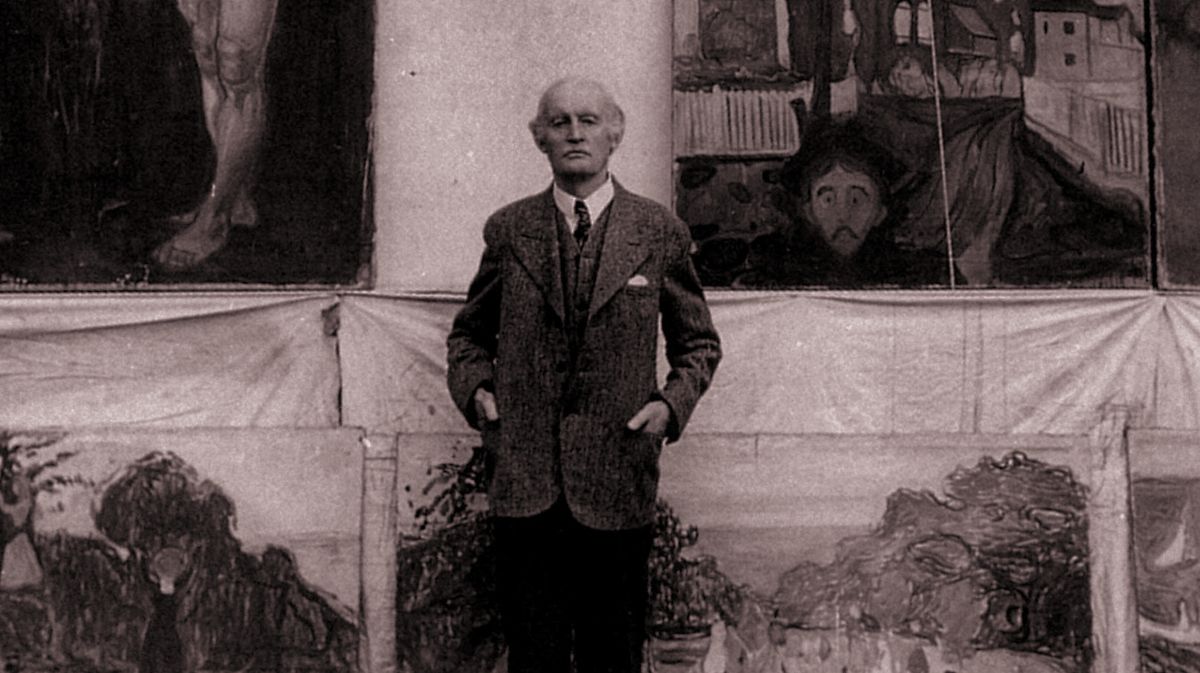
Christie’s international head of prints and multiples, discovered something he’d never seen before and couldn’t make sense of—a print of a familiar Edvard Munch work that, though signed, did not seem to correspond to any of its other known states. The quest to solve the mystery wound up taking Lloyd to Oslo, the Norwegian artist’s home until his death in 1944, where he marked an important discovery and returned with a different print, from the Munch Museum, versions of which
have sold for more than $1 million.
When I arrived at Rockefeller Center to see his acquisition a few weeks ago, Lloyd whisked me upstairs to the viewing rooms reserved for clients, where he opened a large portfolio containing an example of Munch’s Vampire II, a multicolored print that combines lithography and woodcuts. You’ll likely know the image, in which a woman is
hunched over a man, who has buried his face in her lap as she kisses his neck in a tender way—whether out of love, consolation, or condolence, it’s hard to parse. That’s what makes it memorable. That’s what makes it art.
The woman has long red hair, parted in the middle, which cascades down either side of her face and over the back of the man’s head. Munch first made the image as a painting called Love and Pain, but it was the artist’s friend, the critic Stanislaw
Przybyszewski, who connected its supernatural flavor to the male anxieties of the time, seeing in the red-haired woman “a biting vampire’s face,” as he wrote. Munch adopted the Vampire title, which he thought made the painting seem more literary—it evoked the emotionally vampiric characters of writers like Henrik Ibsen, and the literal vampires in Bram Stoker’s novel of the same era. |
|
|
A MESSAGE FROM OUR SPONSOR |
|
|
The artist made six versions of the Vampire painting; his lithographs of the
same image were known as Vampire II, with many but not all of them featuring the same flaming red hair. Munch was more interested in technical innovations in lithography than in keeping track of the editions, so he didn’t always number them. In the print Lloyd showed me, the lithograph of the two figures is surrounded by woodcut fields of blue and green that show the heavy carving marks and wood grain. The layering gives the image a kind of depth and perspective that one doesn’t usually
get from prints.
The editioned work carries a $150,000 estimate, but that number seems low, given the print’s quality, pristine condition, and provenance—it’s rare to have access to a piece that comes directly from the artist via his own museum. And though the image’s many variations greatly affect the price, this one has the key factor of the striking orange-red hair. In 2010, a version sold at Sotheby’s for $1.2 million; another, darker one, perhaps in worse condition, sold at
Christie’s for $875,000 in 2023, as part of the Sam Josefowitz collection. But the estimate on the work Lloyd showed me likely reflects the sale price of a similar version, which shares the dark blue and green woodcuts surrounding the main lithograph, and sold for nearly $165,000 in 2022. |
Lloyd had come by the print in a roundabout way, starting with the consignment of a
different, black-and-white Vampire II lithograph from two siblings whose grandfather had served as a diplomat in Oslo. That one was believed to have been a gift from Norwegian Crown Princess Märtha, who fled to the U.S. in 1940 after the Nazis invaded her country. The consignors’ mother had received it as a 16th birthday present. She died in 2022, leaving it to her two children equally. They could not decide who would keep the artwork, so they consigned it to
Christie’s.
Lloyd described the siblings’ inheritance as being in “ropey” condition. But there was something odd about it that confounded him, notwithstanding the aid of Christie’s extensive Munch-related library. The black-and-white print had Munch’s signature, but it was heavily inked, and it differed from the known versions of the print. Confused—and doubtful that there would be an unrecorded version of a print by an artist as well-documented and researched as Munch—Lloyd consulted a
few dealers he considered more knowledgeable than himself. The dealers shrugged it off.
There was always the chance the work was a forgery, but, as Lloyd wrote me after we met, “the age and condition of the print was very convincing, and it didn’t raise any of the red flags associated with any deliberate attempt to deceive.” Finally, in March 2023, Lloyd contacted the Munch Museum in Oslo—the world’s largest repository of the artist’s works, including 23,000 sketches, paintings, and
personal artifacts donated by the artist himself. Among them were the lithographic stones that were used to make the Vampire II print. Based on Lloyd’s high-resolution images and other details he sent, the museum ultimately confirmed his improbable hunch. He had in his possession a state—a print made before Munch, a known tinkerer, had done more work on the lithographic stone he used to create the image—that was previously unknown. |
|
|
That was enough for Lloyd to fly to Oslo to meet with the museum’s scholars,
including its former director, who came in just to see what Lloyd had brought. “They brought out the lithographic stone from which it was printed, as well as all their impressions, and concluded that this was an earlier state than they’d seen before,” Lloyd told me. And it turned out the stone they’d thought was used to make the first “state” of the Vampire II images was actually the source of the second state. The siblings had helped the Munch Museum make an important discovery.
|
Academic importance isn’t the same as market value. The siblings had something from
which the museum would benefit a great deal, but they were also hoping to see some value to themselves, so a donation wasn’t very likely. But there Lloyd had another improbable thought. Decades before, he’d been told what he thought was something of an urban myth among market folks—“that the museum has a small number of duplicate impressions that they can use to trade for things they don’t have.” If so, he could strike a deal with the museum for everyone’s benefit.
It turned out the myth
was true, although Lloyd told me that discovering the siblings’ print was genuine was only the start of a long process. The museum first had to get outside opinions on the work’s commercial value, he said, then find an impression of similar value to trade for it, then “go through official, formal channels,” since the Munch Museum is owned by the City of Oslo. That process consumed the last two years, which is how we got to me looking at a pristine print, barely removed from Munch’s own hands,
that will be sold at Christie’s on October 24.
The siblings are happy, the Munch Museum is happy, and Lloyd is chuffed. When the dealers whom Lloyd had previously consulted learned what he’d actually found, they tried to make an offer on the print. So it was with no small pleasure that Lloyd was able to tell them that he had resolved the situation, to everyone’s benefit. |
That’s enough for tonight. More in the Inner Circle tomorrow on the recent sales in New
York and Hong Kong. Upgrade if you want to get in on that conversation.
Until then, I’ll be trying out my new Fair Isle sweater on a long walk.
M |
|
|
The ultimate fashion industry bible, offering incisive reportage on all aspects of the business and its biggest
players. Anchored by preeminent fashion journalist Lauren Sherman, Line Sheet also features veteran reporter Rachel Strugatz, who delivers unparalleled intel on what’s happening in the beauty industry, and Sarah Shapiro, a longtime retail strategist who writes about e-commerce, brick-and-mortar, D.T.C., and more. |
|
|
Finally, a media podcast about what’s actually happening in the media—not the oversanitized,
legal-and-standards-approved version you read online. Join Dylan Byers, Puck’s veteran media reporter, as he sits down with TV personalities, moguls, pundits, and industry executives for raw, honest, sometimes salacious conversations about the business of media and its biggest egos. New episodes publish every Tuesday and Friday. |
|
|
Need help? Review our FAQ page or contact us for assistance. For brand partnerships, email ads@puck.news. You received this email because you signed up to receive emails from Puck, or as part of your Puck account associated with {{customer.email}}. To stop receiving this newsletter and/or manage all your email preferences, click here. |
Puck is published by Heat Media LLC. 107 Greenwich St, New York, NY 10006
|
|
|
|