 |
|
Welcome back to Wall Power. I’m Marion Maneker, and I approve this message.
The art market has been caught in a state of near paralysis ever since the historic, record-obliterating $1.6 billion sale of Paul Allen’s collection in November 2022. Buyers and sellers are behaving like deer caught in the headlights, hopelessly transfixed by the Allen sale as it recedes into the past. The art market, after all, is nothing if not backward looking.
I cannot tell you when we will see such huge auction tallies again, but I do know how it will happen. That’s not because I have second sight. It’s because the art market behaves like every other market: It regains momentum by turning attention toward a different group of artists, with what appear to be comparably cheaper price points. This “new” crop of artists seem undervalued—for now—but buyers have a strong thesis for why they will become much more valuable in the future.
This week, Sotheby’s and Christie’s both announced works by three different artists—all women—who fit the mold. These lots could be the key to restoring excitement and conviction in the art market.
More on all that, below the fold. But first…
|
|
|
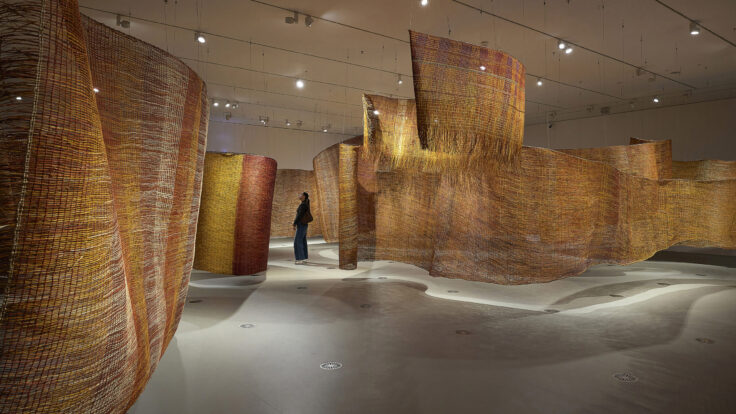
- Veni, Vidi, Venice: The art world divided into two types last week: those who went to Venice and those who are smart. It’s fashionable to bemoan having to attend an art crush event, but Venice—sometimes called the art world Olympics because of its reliance on national sponsorship, although it’s really more of an art world World Cup (some nations are stronger than others)—has not solved the problem of what it means to have a biennial in the age of social media. Instead, it has become increasingly like other city-based, art world events with an emphasis on marketing, sales, and tourism. One theory about why the Biennale was moved from its traditional June opening to April is that it extends the tourist traffic toward early spring. Venice’s famously fragile tourist infrastructure doesn’t get overloaded, and the city benefits from additional hotel and restaurant spending. And boy does the art crowd spend on parties, dinners, and swanky digs.
With that in mind, here’s a brief list of what’s reached us here in the hinterlands: There hasn’t been a lot of love for the main curated show, Foreigners Everywhere. But Adriano Pedrosa, artistic director of the Sao Paulo Museum of Art and this year’s Biennale, has put an emphasis on indigenous art from around the world—including Pacita Abad, an American artist born in the Philippines, who has a retrospective that just opened at MoMA PS1 in New York. Abad’s largely unknown body of work draws from indigenous craft techniques she learned as she traveled the world with her husband, a development economist.
Lauren Halsey, an artist from South Central Los Angeles, is also making a splash in the curated show. Among the nationally sponsored shows, Archie Moore’s Australian pavilion won the Golden Lion for his exploration of his own indigenous lineage going back “2400 generations.” François Pinault, the owner of Kering, CAA, and Christie’s, is also the owner of multiple private museum spaces in Paris and Venice that mount meticulously curated shows. In Venice this week, Pinault’s spaces host French artist Pierre Huyghe, who got a rave write-up from Jason Farago in the Times. For public museum exhibitions, the Gallerie dell’Accademia has a show of Willem de Kooning’s work loosely organized around his two trips to Italy 10 years apart. During one, he learned to cast bronze sculptures.
- What’s holding Helen back?: Last weekend, the Journal published a long-ish story on the bumptious board of the Helen Frankenthaler Foundation. The thrust of the story is that dysfunction has prevented the foundation from pulling off a major retrospective that would revive the artist’s public perception. The story makes the assumption that a retrospective has an immediate market effect. Sometimes they do; sometimes they don’t. Mark Rothko, for example, doesn’t seem to have benefited much from his recent major museum show in Paris, although there was one banger of a private sale, which was said to be almost $200 million. Yet that painting had already traded in the nine-figure range a decade earlier.
The story also makes another assumption that is worth examining: The Journal’s Kelly Crow compares Frankenthaler’s prices to Joan Mitchell’s and finds them lagging. But these two artists are not really comparable. Frankenthaler is widely credited with developing the staining technique that launched the Washington Color School painters Morris Louis and Kenneth Noland. Top prices for Louis and Noland lie on either side of the $5 million mark. Frankenthaler has solidly performed at that level for the past four years and above: She has a record price of $7.8 million, set in 2020.
In the end, it does look like Frankenthaler will be getting her 100th anniversary show. The star of that show will be Mountains and Sea, from 1952, her seminal work that hangs in the National Gallery. It turns out the foundation still owns it. If sold, it could trade for a huge price; Crow suggests $30 million. But that would probably happen on the private market, if at all.
|
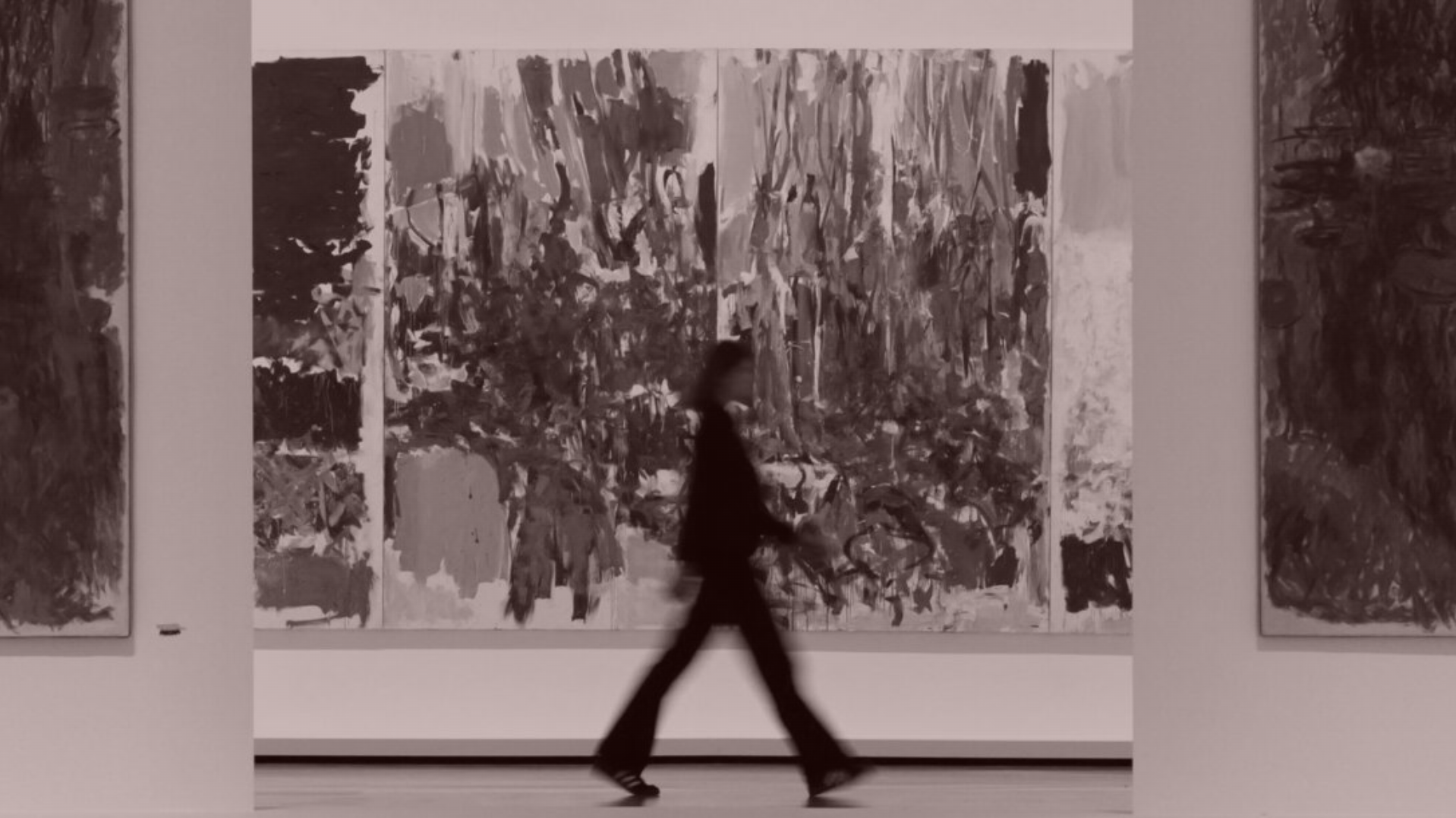 |
| Three Women |
| A stagnant May auction season in New York just got a major jolt via six works by O’Keeffe, Carrington, and Mitchell, with combined low estimates of nearly $60 million. |
|
|
|
| As the May auction season looms in New York, many estates have chosen to avoid it altogether, still fearful that buyers are not yet in the mood to spend even though the economy remains strong. And yet, those humdrum expectations were jolted last week via six works of art by three female artists, with combined low estimates of nearly $60 million. An important flower painting from the 1920s by Georgia O’Keeffe at Christie’s; a prime work by Leonora Carrington, the British-born Surrealist who spent most of her life resident in Mexico; as well as a suite of four works by the Abstract Expressionist Joan Mitchell have all the potential to generate a new narrative 18 months since the market peaked. |
|

|
|
Georgia O'Keeffe, Red Poppy (1928), estimated at $10 million
|
|
|
| Christie’s eschewed the usual press release for Georgia O’Keeffe’s Red Poppy, from 1928, preferring to tease the work on Instagram. “To me,” said Emily Kaplan, who co-heads the 20th Century Evening Sale, “Instagram is the biggest reveal.”
And it is a big announcement. The painting is estimated at $10 million, but nine of the top 15 auction prices for O’Keeffe were paid for her botanical paintings. Close-up depictions of flowers in bloom predominate among those works. Jimson Weed/White Flower No. 1, from 1932, set the record price for any work by a female artist at auction, a decade ago, when it made $44 million. White Rose With Larkspur No. 1 (1927) made $26 million in the Paul Allen sale eight years later. And Black Iris IV (1936), also one of Allen’s works, showed the depth of demand for O’Keeffe’s flowers when it made $21 million last May.
There are no sure things in the art market. Right now, an O’Keeffe flower painting comes pretty close, though. This one is being offered by a savvy collector who has been following the market and knows how the game is played. The $10 million estimate is, frankly, bait. With those recent sales, the seller is surely aiming higher—-though one of the quirks of the O’Keeffe market is that her work doesn’t get high estimates. The biggest estimate ever placed on an O’Keeffe was only $12 million. (Remember, if the estimate is $10 million, the seller doesn’t get to change their mind if only one bidder hits $10 million and gets it.) But there’s a reason for the low entry point.
Estimates at this level will bring out the traditional collectors of American paintings who might not spend $20+ million but can be counted on to take a flier at $10 million. (Hope is endemic to an auction.) If Christie’s brings in additional bidders from institutions or postwar and contemporary collectors looking for value further back in the 20th century, that could move the price upward toward $20 million. From there, it has potential to attract rich Asian buyers who would want to see that a high price is justified by other bids before going all in.
O’Keeffe is now too valuable to sell in the American art auctions. In her place a work by her sister, Ida Ten Eyck O’Keeffe, sold at Christie’s for nine times its estimate, or $302,400, as the opening lot in an American art auction at Christie’s on Thursday. (You’re not the only one who didn’t know O’Keeffe had a sister who painted.) So O’Keeffe is now promoted to 20th Century Evening Sales and treated like the global artist she really is.
What justifies this price? O’Keeffe only made six of these vivid poppy paintings. Half of those were small scale. This one is a decent three feet tall. The other two examples around this size are already in museums. And this is the last one she made of the series. (Collectors seem to go for firsts and lasts.) As Kaplan put it, it’s a painting with “no asterisks.” |
|
|
|
|
|
|
|
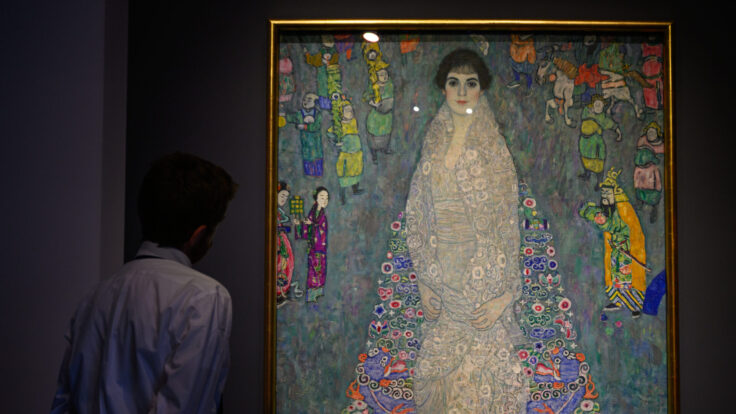
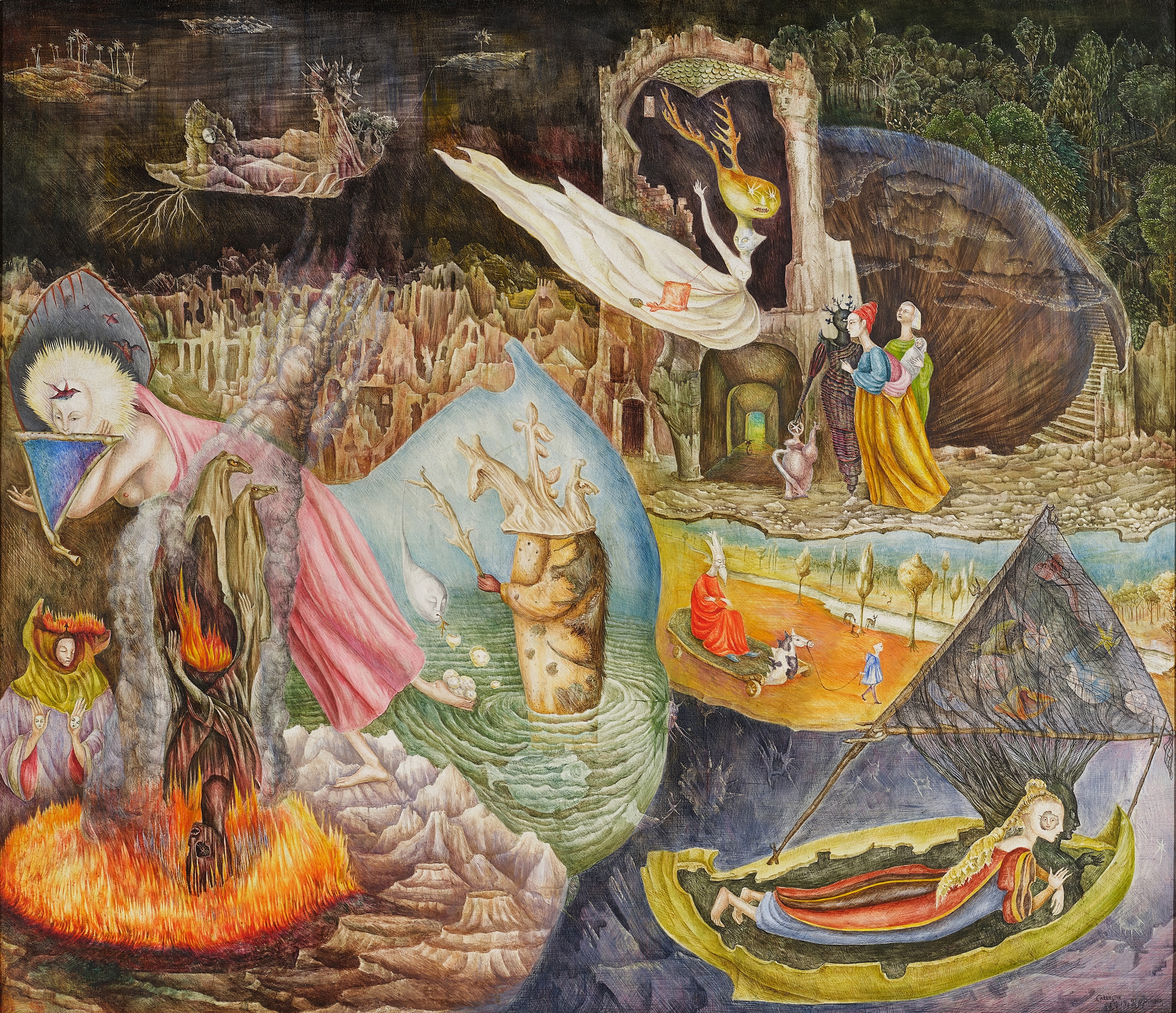
Leonora Carrington, Les Distractions de Dagobert (1945), estimated at $12 million
|
|
|
| O’Keeffe made the transition from American to 20th Century artist. Sotheby’s is hoping to do the same for a group of Latin American Surrealists including Alice Rahon, Remedios Varo, and Leonora Carrington. Sotheby’s will offer Carrington’s Les Distractions de Dagobert, from 1945, with a $12 million estimate this May. That number is almost four times Carrington’s previous auction record of $3.25 million for a very different sort of work. A more comparable work was sold in 2014 for $2.6 million. And this painting on offer was bought in 1995 for only $475,000. Adjusted for inflation, that would still be just under $1 million. That means this Carrington will go from $1 million to at least $12 million over almost 30 years.
Asking four times the highest publicly recorded price isn’t unprecedented. “This has been done before with Frida Kahlo,” noted Anna Di Stasi, head of Latin American art at Sotheby’s. In 2021, Sotheby’s put a $30 million estimate on a Kahlo self-portrait when the highest previous price paid for a Kahlo had been a mere $8 million. In the end, a buyer paid $34.8 million to take the Kahlo home. This is usually a sign that Sotheby’s has sussed out the buyers—and maybe even has used its vast wingspan to locate a few that private dealers wouldn’t know about—and feels confident in its pricing.
There’s a good chance Sotheby’s is shopping what it calls an “irrevocable bid,” or a third-party guarantee from a buyer, like a museum, that knows they want the picture. Di Stasi said some institutional buyers have already paid $9 million-$10 million in the private market for works by female Surrealists. Naturally, Sotheby’s hopes a museum or one of its benefactors will put a slightly higher floor under the Carrington auction. Private dealers, who track the paintings, make the case that interest has been growing in these artists for decades. In 2011, LACMA put on In Wonderland, a show that caused people to take notice. Attendance was unexpectedly high, said dealer Wendi Norris, who helped arrange a number of the loans.
In 2019, Norris held a pop-up show of Carrington’s work in New York that had 6,000 visitors in three weeks. That same year, New York’s Di Donna Gallery focused more broadly on the Mexican Surrealists while featuring the work Sotheby’s will sell in May alongside Kahlo’s self-portraits and works by Varo. Two years later, the Metropolitan Museum in New York put on Surrealism Beyond Borders, a show that emphasized the international breadth of the movement, with prominent space devoted to Mexican artists as well as Carrington herself.
Last spring, Norris held a special preview of her Remedios Varo show for Glenn Lowry, the director of the Museum of Modern Art, who flew 20 members of his board and curatorial team to San Francisco to see it. Norris helped build this market by connecting curators to scholars, mounting shows, and sharing information—especially about the pricing of private deals—with collectors attracted to these artists. “I have a growing and increasingly diverse collector base—including accomplished female collectors, tech collectors, millennials, and buyers from Asia and Europe,” Norris said. “Just yesterday we sold a Carrington to a new tech client in Europe and last week we placed two Carringtons with a young, savvy fashion designer.”
Last year was also when The Art Institute of Chicago also held an important show of Varo’s work. In the past, Varo’s market had reached higher prices than Carrington’s, but Di Stasi hopes to see that change with this sale. “I think this will be the moment where that will stop being the case,” Di Stasi said, “and she will become known as her equal or superior in terms of prices.”
If Sotheby’s can post a final price for Carrington in the high teens or low 20s, with fees, that should bring more work by the more prolific Carrington to market, fueling the kind of frequency that cements a reputation among buyers and builds more demand. |
|
|
|
|
|
|
|
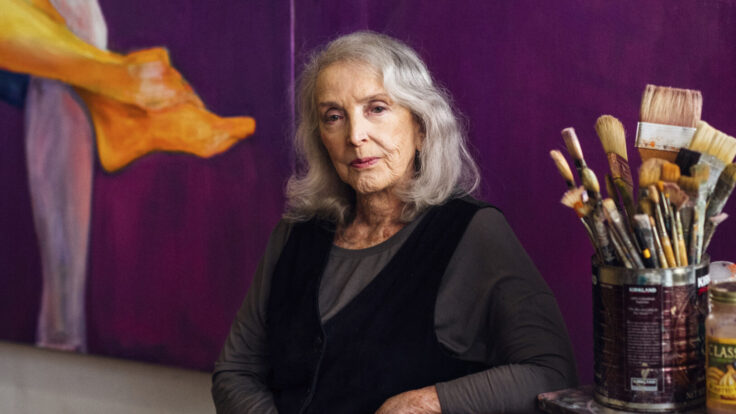
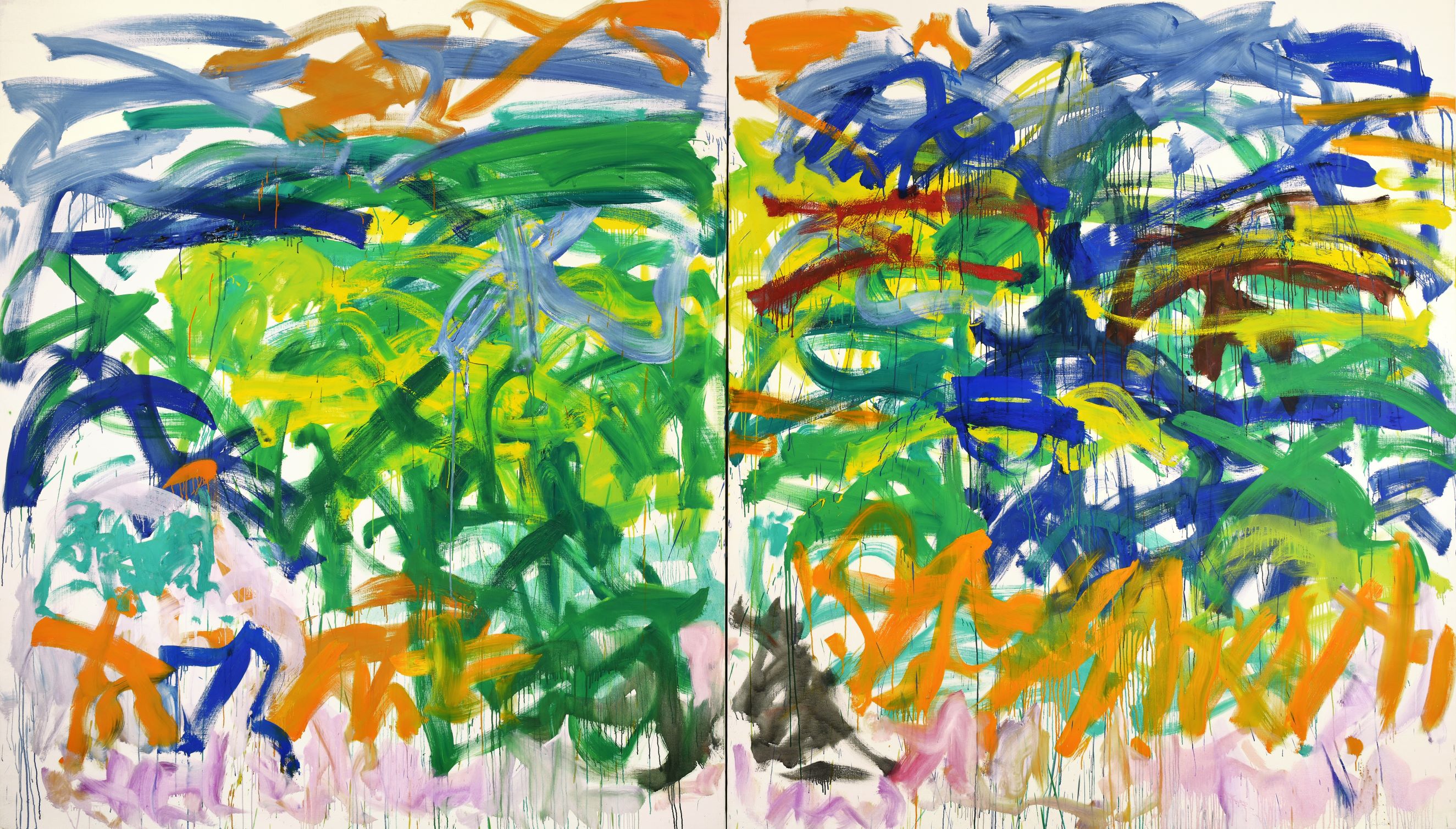
Joan Mitchell, Ground (1989), estimated at $12 million
|
|
|
| Next to Jean-Michel Basquiat, Joan Mitchell will be one of the bigger presences on the market this season. Sotheby’s just announced the sale of four works by one collector with a combined estimate of $36 million, and word in the marketplace is that Christie’s will have another two Mitchells priced around $10 million.
It’s not an accident that both houses will have Mitchells priced near the top of her previous range. In November, Christie’s and Sotheby’s each had a major work by the painter from different periods of her production. One was an untitled work from 1959 that was priced at $25 million and sold for $29 million; the other was Sunflowers, from 1990, that had been a gift from the artist to her dealer, John Cheim. That painting made $27.9 million, over a $20 million estimate. Those sales came after the culmination of her three-city retrospective that migrated from SFMoMA to the Baltimore Museum of Art to the Fondation Louis Vuitton in Paris. That last stop also had a show comparing Mitchell’s abstracts to some of Monet’s late waterlily paintings that are often considered important precursors to Abstract Expressionism.
That retrospective raised the public’s recognition of Mitchell’s career. It also exposed collectors to facets of her work and periods they might not have understood or appreciated. This was especially true for the late period of Mitchell’s output, during the late 1980s until 1990. Without the retrospective, Cheim’s Sunflower might never have been in contention for a record price. Sotheby’s consignment contains Ground, from 1989, which is estimated at $12 million. These late works, which Sotheby’s David Galperin compares to the once undervalued and misunderstood late works of Picasso and de Kooning, have a “freer brush, wider scale, and the whole field of vision opens up.” There’s also an untitled work from c. 1973 that is estimated at $1 million; another untitled work from her prime period in around 1955 priced at $8 million; and Noon, from c. 1969, priced at $15 million.
Even though the broader market is facing pricing pressure, these works are not being offered at come-hither prices. “No other artist,” Galperin said, “do we get more requests for.” And one of the head fakes of having so many Mitchells available in one season is that it may lull buyers into thinking there’s more supply out there than really exists. “I hope that doesn’t give people the wrong impression,” said Saara Pritchard, a former auction house specialist who is one of the recognized experts in mid-century female artists. “There are not a lot of works out there of this caliber, and they are not easy to find.”
The previous record for a Mitchell was set six years ago by the sale of Blueberry (1969), which made $16.6 million. Note that Noon is estimated at just below the all-in price for Blueberry in 2018. (Estimates are for hammer prices, not what the buyer pays with auction house fees.) Two years before, Noon had sold to the collector, who is now consigning for almost $9.8 million. Noon is taller than Blueberry, it’s nearly eight and a half feet tall, which limits who can buy it. You have to hang the thing somewhere, and not everyone has 10-foot ceilings, preferably much taller. (This is what art advisors do, by the way. They think through all of these kinds of headaches for their clients. I know you love it, but where are you going to put it?)
Art market math says Noon is comparable to Blueberry, plus a boost for inflation and Mitchell’s reputation upgrade. Does that make it another $20 million painting? Yeah, sure. In a different market moment, the estimate for Noon would have been more aggressive, maybe as high as $20 million. Right now, the auction houses are looking to keep estimates down so as not to scare off the punters.
If Noon were the only Mitchell on the market this season, there’s good reason to believe much of the momentum would be channeled into that one work. The result could set a new record price. It already did that once in 2016. That would be a $30 million painting. But we’re going to have at least six Mitchells competing for the attention of bidders. Does that split the bidders among the six works? There are collectors who are looking for Mitchells only from the 1950s, or ones only from the late period or even from the late 60s. There are also buyers who just want a Mitchell and might bid on multiple works until they get one they want.
Recent history gives us plenty of examples when flooding the market with material from one artist inflamed the market’s animal spirits. There was the Donald Judd foundation sale in 2006, or when eight of Gerhard Richter’s large abstract paintings were sold in one night at Sotheby’s in November of 2011, or when Christie’s sold 22 works by Richard Diebenkorn in May of 2018. When there’s demand, supply gets absorbed. But there have also been a number of counter examples, especially recently, where a cache of de Kooning paintings from the estate or a pile of Ed Ruscha works rocked up in the marketplace all at once. Don’t get me wrong, the art sold. But the markets were weighed down by the sales.
That leaves someone like Pritchard conflicted. She believes in Mitchell’s market long-term and is gratified by the progress that’s been achieved so far. But she hopes that progress is not derailed by this mass sale. “Perhaps,” said Pritchard, an art advisor who can’t help but see the possibilities of the situation, “it means opportunities for savvy buyers.” |
|
|
|
| FOUR STORIES WE’RE TALKING ABOUT |
 |
|
 |
|
 |
| Skoll & Crossbones |
| An inside account of the shuttering of Participant Media. |
| MATTHEW BELLONI |
|
 |
| Minkoff Moves |
| The skinny on Rebecca Minkoff’s Real Housewives revival. |
| LAUREN SHERMAN |
|
|
|
|
|
 |
|
|
|
Need help? Review our FAQs
page or contact
us for assistance. For brand partnerships, email ads@puck.news.
|
|
You received this email because you signed up to receive emails from Puck, or as part of your Puck account associated with . To stop receiving this newsletter and/or manage all your email preferences, click here.
|
|
Puck is published by Heat Media LLC. 227 W 17th St New York, NY 10011.
|
|
|
|