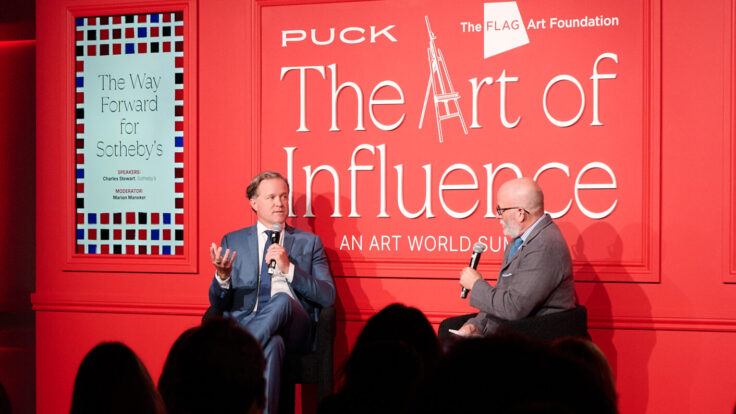
Welcome back to Wall Power. I’m Marion Maneker.
Tonight we’re
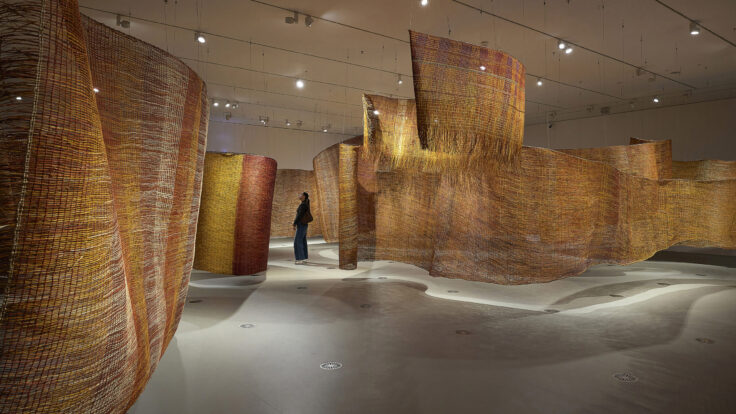
going to talk about Australian artist Emily Kam Kngwarray. If you look at her art, now on view at the Tate Modern in a major retrospective, you’ll think you’re observing the work of someone familiar with Sol LeWitt, Helen Frankenthaler, Pacita Abad, or even the late spot paintings of Damien Hirst. But Kngwarray’s art has absolutely nothing to do with the abstract painting tradition that developed out of European
modernism. Instead, it is adapted from one of the oldest forms of visual culture: the symbols and storytelling of the Aboriginal Australians. It’s a fascinating story.
Also, does anyone want to come to the Independent Art Fair starting on September 4 at Casa Cipriani in the Battery Maritime Building in New York? I’ll be hosting two panels on Friday afternoon. I’ve got some free tickets to share. Just email Fritz@puck.news
if you want to come.
|
|
|
A MESSAGE FROM OUR SPONSOR
|
ALWAYS CONTEMPORARY
With a bold silhouette that conveys movement even at standstill, the Range
Rover Sport is striking from every angle.
EXPLORE
|
|
|
 |
Julie Brener Davich |
|
- Peak NBA card
auction: A 2007-08 Dual Logoman Autograph card at Heritage Auctions, featuring Michael Jordan and Kobe Bryant, has beat the world record price for a basketball card. While the live auction won’t be
held for another eight days, proxy bidding had already reached $5.05 million, or $6.16 million with Heritage’s 22 percent buyer’s premium, as of Friday afternoon. The previous record for a basketball card is $5.9 million, set in 2021 for a 2009-10 Panini National Treasures Steph Curry Rookie Logoman Autograph card, which was sold in a private transaction to an investment fund. (The auction record of $3.1 million was set by a 2018 Panini National Treasures Luka
Dončić Rookie Patch Logoman Autograph card, in 2022.)The Jordan-Bryant card is, of course, one-of-one. Upper Deck only produced Dual Logoman Autograph cards between 2004 and 2009, and while several player pairings were created in multiples, this is the only card featuring M.J. and Kobe, the two greatest shooting guards of all time (send all complaints to Puck’s sports correspondent, John Ourand). The condition rating is just 6 out of 10, but condition matters
less to collectors for unique cards like this one. To increase value, Upper Deck started adding NBA logo patches from gameworn jerseys and signatures to cards in the early 2000s, and this card includes both.
The early bidding is still a long way from the world record for any sports trading card, set in 2022 by a 1952 Topps Mickey Mantle card in mint condition, which made $12.6 million. Heritage’s Mike Provenzale estimates that 70 percent of the
sports memorabilia that the house sells is baseball-related, and 70 percent of that is Yankees-related. Next week, they’re offering a signed 1960 Mantle gameworn jersey that’s estimated to
bring at least $4 million, with proxy bidding already at $1.98 million with fees.
|
|
|
Christie’s
Ole Faarup Collection
|
Peter Doig, Country Rock (1998-99). Photo: Courtesy of Christie’s
|
Christie’s announced that it will feature the collection of Ole Faarup
during the Frieze week sales in London this October. Beginning October 15, the house will sell 140 works with a combined estimate of £16 million ($22 million). The top works in the late Danish businessman’s collection are two paintings by Peter Doig. Ski Jacket, from 1994, is estimated at £6 million ($8.1million), and Country Rock, from 1998-99, is estimated at £7 million ($9.5 million). A different version of Country Rock sold for nearly $14.5 million
in 2014, but was resold at auction eight years later for just above $9.5 million. Another work, House of Pictures, from 2000, also traded down from just over $9.1 million in 2018 to just above $7.5 million in 2023.
The collection, which Faarup amassed over five decades, also contains works by Chris Ofili, Jean-Michel Basquiat, Mamma Andersson, Ewa Juszkiewicz, Hernan Bas, and Neo
Rauch. Proceeds from the sale will benefit the collector’s eponymous foundation.
Now for the main event…
|
|
|
After decades of well-meaning but market-dampening regulations,
Australian Aboriginal artists like Emily Kam Kngwarray are finding their true value. It just so happens that we’re in the middle of an Indigenous art boomlet that may portend another frenzy of interest.
|
|
|
Aboriginal art is so fascinating, in part, because it evokes the expressive abstract
painting of modernism. And yet, the essence of the work is ancient and remote: It is, after all, an expression of one of the world’s oldest continuous cultures, with an iconography that had been in use for tens of thousands of years before it found its way onto canvases in the waning days of the 20th century.
This Indigenous art, which is hard to understand without deep cultural knowledge and easy to dismiss as decoration, has gone through a series of boom-and-bust cycles over the past 30
years. But it just so happens that we’re in the middle of a rising tide of interest in Australian Indigenous art that may portend the growth of a broad and more sustainable market. The Tate Modern in London is currently hosting a show of the work of Emily Kam Kngwarray, one of the best-known Aboriginal artists and certainly the one with the highest
values on the international art market.
|
|
|
A MESSAGE FROM OUR SPONSOR
|
ALWAYS CONTEMPORARY
With a bold silhouette that conveys movement even at standstill, the Range
Rover Sport is striking from every angle.
EXPLORE
|
|
|
There’s also a cresting of interest from collectors and galleries—dealer
D’lan Davidson, who worked at Sotheby’s under its pioneering expert Tim Klingender, recently expanded his gallery’s reach from Sydney and Melbourne to New York and London. The actor Steve Martin and the venture capitalist L. John Wilkerson possess what are recognized as some of the highest-quality works produced by Aboriginal artists, and they’re working on a digital portal to their collections. Martin’s leans more contemporary,
while Wilkerson’s is mainly focused on works made when Aboriginal artists first started committing their symbols to canvas in the early 1970s, and their joint project will help others understand these artists and their paradoxical work.
|
For much of the wider world, the first introduction to Australian Indigenous culture
came through Bruce Chatwin’s bestselling book Songlines, published in 1987. The work was based upon trips that Chatwin made to the Australian outback in 1983 and ’84, accompanying a railroad surveyor who was trying to plot a path between the sacred lands of the Indigenous peoples who lived there. Yes, as late as the 1980s, Australians of European descent and Indigenous peoples were still sometimes encountering each other for the very first time. Through his brief time
spent with these nomads, Chatwin became fascinated with their “songlines,” which fused an individual’s story with a deep connection to the land, the surrounding community, and their ancestors.
Chatwin, who had risen through the ranks at Sotheby’s to become the head of both the antiquities and impressionist art departments before leaving to become a travel writer, thought that the ancient practices of Australia’s Indigenous offered a clue to the origins of language, as well as a direct
link to humanity’s prehistory and an atavistic shared unconscious. He may have had some extravagant, even fanciful ideas, but his interest in the Aboriginal people—and their art—was not unique. A decade before Chatwin arrived, Australians had begun to make efforts to record the culture of the Aboriginal people, whose land they had enclosed for 50 years.
By the 1970s, the inherited visual vocabulary of Indigenous religious and social practices had already started to migrate from sand and
body painting onto substrates that could be preserved and sold. The first Aboriginal artists were primarily men, using their cultural knowledge and authority to create paintings that shared a lineage with Chatwin’s songlines. In 1971-72, Aboriginal men had begun to paint ceremonial patterns on found objects and construction materials. These images were formally structured and strictly regulated by elders. In a culture that used the term “secret men’s business” without irony, Aboriginal women
were forbidden to paint until 1996—at least officially.
But many took up the practice before the cultural laws were loosened. In her Utopia women’s camp in the 1970s, Kngwarray was part of an effort to teach Aboriginal women skills that might provide them with income, one of which was batik, a textile dyeing technique. Despite skepticism from the authorities—batik had no direct bearing on their culture—Kngwarray and her peers took to the process with enthusiasm, drawing from a rich
tradition of ceremony as well as a connection to their environment and their own cosmology. After 10 years of making batiks, Kngwarray started painting, making some 3,000 works in the last eight years of her life, or nearly one a day.
Born in 1910, Kngwarray’s life experience tracks the Aboriginal peoples’ encounter with the modern world—and indeed, she died at the age of 86, in the same year that the authorities lifted restrictions on female painting. The burst of creative output at the
end of her life can be seen as a race to record her embattled but extremely ancient and durable culture.
|
|
|
“The men painted more formally, structured around ceremony,” Davidson, the Australian
dealer, told me over a WhatsApp call the other night. “There is a formula to them. Women are more evocative and emotional.” In general, the work of male Indigenous artists has been more highly valued by the market, Davidson explained—except in the case of Kngwarray. “Emily,” he said, “is valued far more than other Indigenous artists.”
|
Even during her lifetime, Kngwarray stood out among Aboriginal artists. “The market has
really rallied around her from the beginning,” Davidson said. “Everything she painted was sold. The demand around her was huge. During her life, her paintings were selling at auction for record prices.” In 2008, according to Davidson, who then worked at Sotheby’s, a Kngwarray painting was sold to an Australian collector for $1.3 million just before the global financial crisis. Davidson says he just resold it to the National Gallery of Australia for $1.65 million. But that is the rare work of an
Aboriginal artist to have held its value. Davidson told me it is still possible to buy important works for as little as $20,000–$30,000.
The market for Aboriginal art has been bedeviled by two different types of speculation. As interest in Australian Indigenous art exploded in the late 1990s and early 2000s, a number of unscrupulous dealers flocked to the Outback stations to commission work by native artists, who were often exploited. As a result, provenance and fair practices have
become a dividing line in the market for Aboriginal artworks like Kngwarray’s.
|
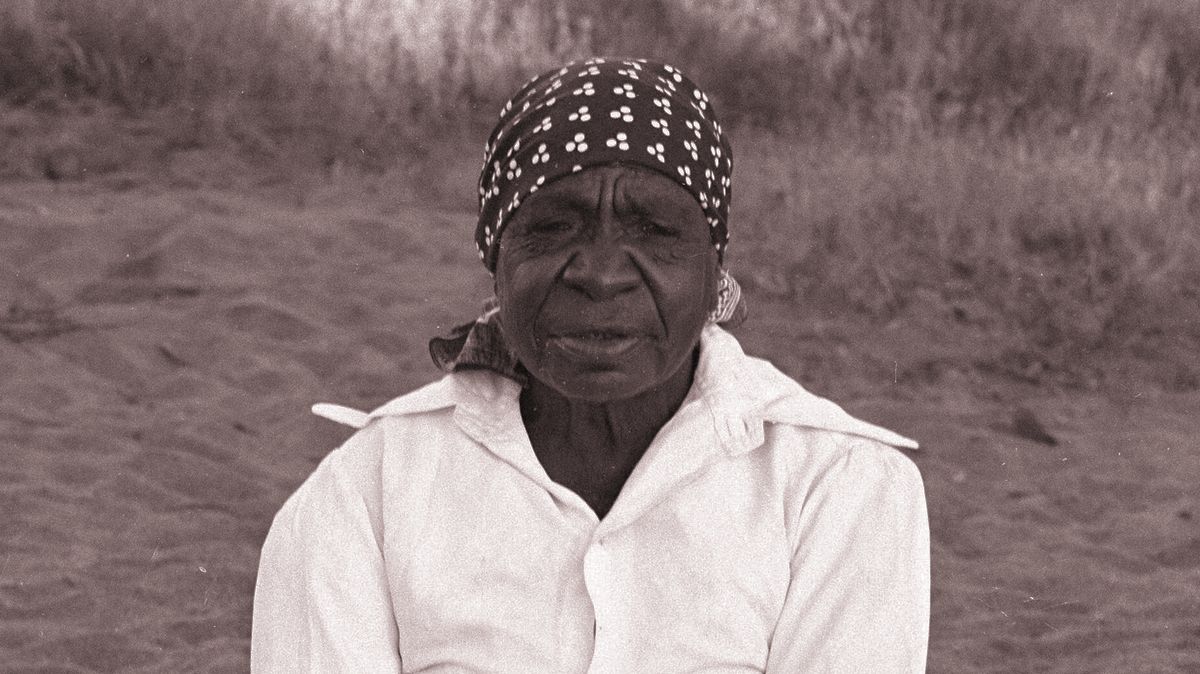
Installation view of Emily Kam Kngwarray at Tate Modern (2025). Photo: Kathleen
Arundell/Courtesy of Emily Kam Kngwarray Copyright Agency and Tate
|
The Kngwarray work now considered legitimate originates through two different dealers,
Rodney Gooch and Janet and Donald Holt. “Outside of those two lines of provenance,” Davidson said, “it’s a two-speed economy”—Kngwarray’s works with recognized provenance have seen their prices rise over time, while works she made for quick cash through carpetbaggers have not.
Davidson says his business took off in recent years once he started setting aside a portion of his profits to return to the communities where the art is made. To
him, this is an indication that the market is shunning exploitative works. “Collectors who try to take shortcuts usually get their fingers burnt,” he warned.
That’s not the only challenge the Aboriginal art market has faced. First, Australia instituted a resale royalty for Aboriginal art in 2010, but the record-keeping burden caused many to shy away from trading in these works. Self-managed retirement funds, which were allowed to invest in collectibles including Aboriginal art, had
also contributed greatly to demand for the paintings—until the introduction of new restrictions on such investments in 2011 abruptly ended that demand. Also, cultural-property export laws, designed to restrict the international sale of historical artifacts, limited the export of artworks made to generate income for native communities. All these different constraints combined to kill the international market for Aboriginal art for much of the 2010s. It was only in 2019, when the export laws
changed, that the market began to stir again.
At that point, Davidson said, “It was like a tap was turned on.” He’s been developing a market in New York. And he partnered with Pace in London to put on a selling exhibition, in tandem with the Kngwarray retrospective, where he managed to sell seven paintings, one for $1.5 million. Pace, too, has brought some contemporary art collectors to the table by showing Kngwarray’s works at fairs like Frieze and Art Basel in Miami and Basel. They also
made significant sales from the London show. And Pace isn’t the only gallery getting in on the action: Salon 94 and Karma galleries have both represented Aboriginal artists.
Meanwhile, Pace has been educating the market as to the stylistic breadth of Kngwarray’s work. On their website, curator Anne Brody underscored how unlikely it was
that Kngwarray would emerge from a remote batik project through two landmark art projects and become “an art world superstar.” But she also recognized that Kngwarray’s fame was no accident. “Kngwarray had what it took and the desire to get there,” she wrote, “a big personality, huge talent, great energy, and the culturally deep authority to make the journey.”
|
Perhaps you saw The New York Times’s
announcement yesterday that St. Patrick’s Cathedral on Fifth Avenue will unveil a new, large-scale mural in the entry vestibule by painter Adam Cvijanovic. The work will depict immigrants but also commemorate a religious event close to retiring Cardinal Timothy Dolan’s heart. Did you
notice that Dolan made a conscious choice to employ a realist artist to make this statement about immigration and its unique role in New York life? Six artists made proposals. But Dolan and his advisors were keen to work with Cvijanovic: “The rest of them were a little too Picasso-like,” Dolan told the Times. “I wanted something that people could look at and see the Holy Apparition at Knock, and not that you’d have to be on LSD to figure it out.”
That’s it for
today. I’m taking next week off, but you’ll be in good hands.
M
|
|
|
The ultimate fashion industry bible, offering incisive reportage on all aspects of the business and its biggest
players. Anchored by preeminent fashion journalist Lauren Sherman, Line Sheet also features veteran reporter Rachel Strugatz, who delivers unparalleled intel on what’s happening in the beauty industry, and Sarah Shapiro, a longtime retail strategist who writes about e-commerce, brick-and-mortar, D.T.C., and more.
|
|
|
Finally, a media podcast about what’s actually happening in the media—not the oversanitized,
legal-and-standards-approved version you read online. Join Dylan Byers, Puck’s veteran media reporter, as he sits down with TV personalities, moguls, pundits, and industry executives for raw, honest, sometimes salacious conversations about the business of media and its biggest egos. New episodes publish every Tuesday and Friday.
|
|
|
Need help? Review our FAQ page or contact us for assistance. For brand partnerships, email ads@puck.news.
You received this email because you signed up to receive emails from Puck, or as part of your Puck account associated with {{customer.email}}. To stop receiving this newsletter and/or manage all your email preferences, click here.
|
Puck is published by Heat Media LLC. 107 Greenwich St, New York, NY 10006
|
|
|
|





_01K2QK3E1MVSEQ7EE8VKAMYNFV.jpg "Peter Doig, Country Rock (1998-99). Photo: Courtesy of Christie’s")
_01K2QMND7YWEZJSNQN329MTHPG.jpg "Installation view of Emily Kam Kngwarray at Tate Modern (2025). Photo: Kathleen Arundell/Courtesy of Emily Kam Kngwarray Copyright Agency and Tate")