Welcome back to Wall Power, my four-times-a-week private email covering all things art and the
market for what we now call “cultural property”—the historic objects that connect us to cultures past and present. I’m Marion Maneker.
Tonight, Julie Davich takes us through the fascinating history of Fabergé eggs as Christie’s gets ready to sell one of these rare objects—created for the Russian royal family and a few other aristocrats—with an estimate of £20 million. Sotheby’s, too, has some Fabergé items from American aristocrats Bing
and Kathryn Crosby. Julie has the details below the fold.
|
|
|
A MESSAGE FROM OUR SPONSOR
|
The first steps towards a masterpiece starts with a dream. The all-electric BMW i7 – the evolution of brilliance.
Learn more at
BMWUSA.com
|
|
|
 |
Julie Brener Davich |
|
- Christie’s Royal Blue
sapphire for auction: The star of Christie’s Hong Kong sale this week is a sapphire-and-diamond necklace that the auction house has dubbed the Royal Blue—not because it has royal provenance, but because it’s set with 16 rare cushion-shaped Kashmir royal blue sapphires totaling 104.61 carats. Estimated at HK$100 million ($13 million), it’s the most valuable jewel
to be offered at auction in Asia this year.
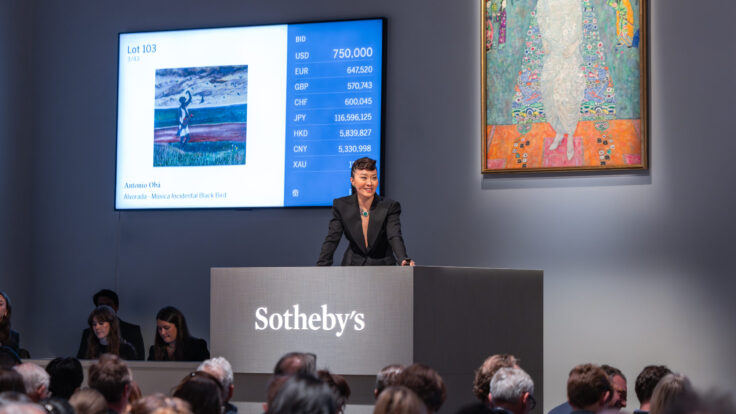
- Speaking of necklaces: I couldn’t take my eyes off auctioneer Phyllis Kao’s necklace at Sotheby’s contemporary art evening auction on Tuesday. So I looked into it for you: It’s a 1980s David Webb design featuring a 38-carat carved emerald, as well as rubies and cabochon sapphires—for sale, of course, at Sotheby’s salon in New York.
- If
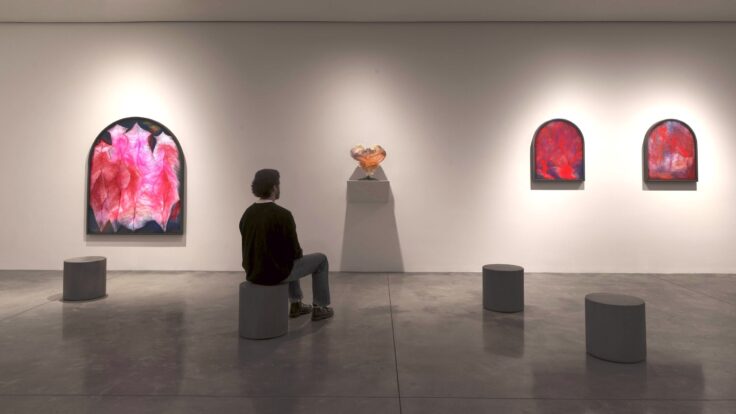
you’re in London…: There’s one week left to view German artist Ernst Gamperl’s first solo exhibition in London, which currently fills the first floor of Sarah Myerscough’s light-filled gallery in Mayfair. Gamperl, a master craftsman, makes oversize
vessels from turned wood, like oak, maple, or ash, with fine striations. (Two examples on view at Myerscough’s booth at PAD London were priced at €35,400 and €79,800.) Each piece takes months to carve, hollow, dry, and treat in order to achieve the perfectly imperfect look he’s going for. On the second floor is a selection of
leather sculptures by Frances Pinnock. Made to look like vessels at human scale, each contains a whimsical world unto itself. One has a little ladder and another has a tiny door, as if inhabited by fairies or wood nymphs.The gallery space, which I visited during Frieze in London last month, is itself worth
the trip. Formerly an abandoned Victorian schoolhouse, the building was offered with a peculiar zoning regulation: The tenant had to have an educational mission. Myerscough had been interested in launching an educational component anyway, and the basement of the renovated three-story building is now home to the Crafted Arts Foundation.
|
|
|
Now, let’s get to the main event…
|
|
|
Fabergé’s renowned Imperial Winter Egg returns to auction next week at Christie’s in London
with a staggering £20 million estimate.
|
|
|
Back in 1994, Christie’s specialist Alexis de Tiesenhausen found himself traveling the world
with the extremely fragile, 5.5-inch-tall Fabergé Imperial Winter Egg in his carry-on luggage. The Fabergé Imperial Eggs—so called because the Russian imperial family commissioned them from the House of Fabergé jewelry firm between 1885 and 1916—are rare, with only 52 known to have existed. Tiesenhausen was toting the Imperial Winter Egg around and showing it to potential bidders. That meant putting the egg, which Emperor Nicholas II had commissioned as an Easter gift for his
mother in 1913, through airport x-ray machines and presenting it to customs officials—tasks he tried to do discreetly, not always with success.
|
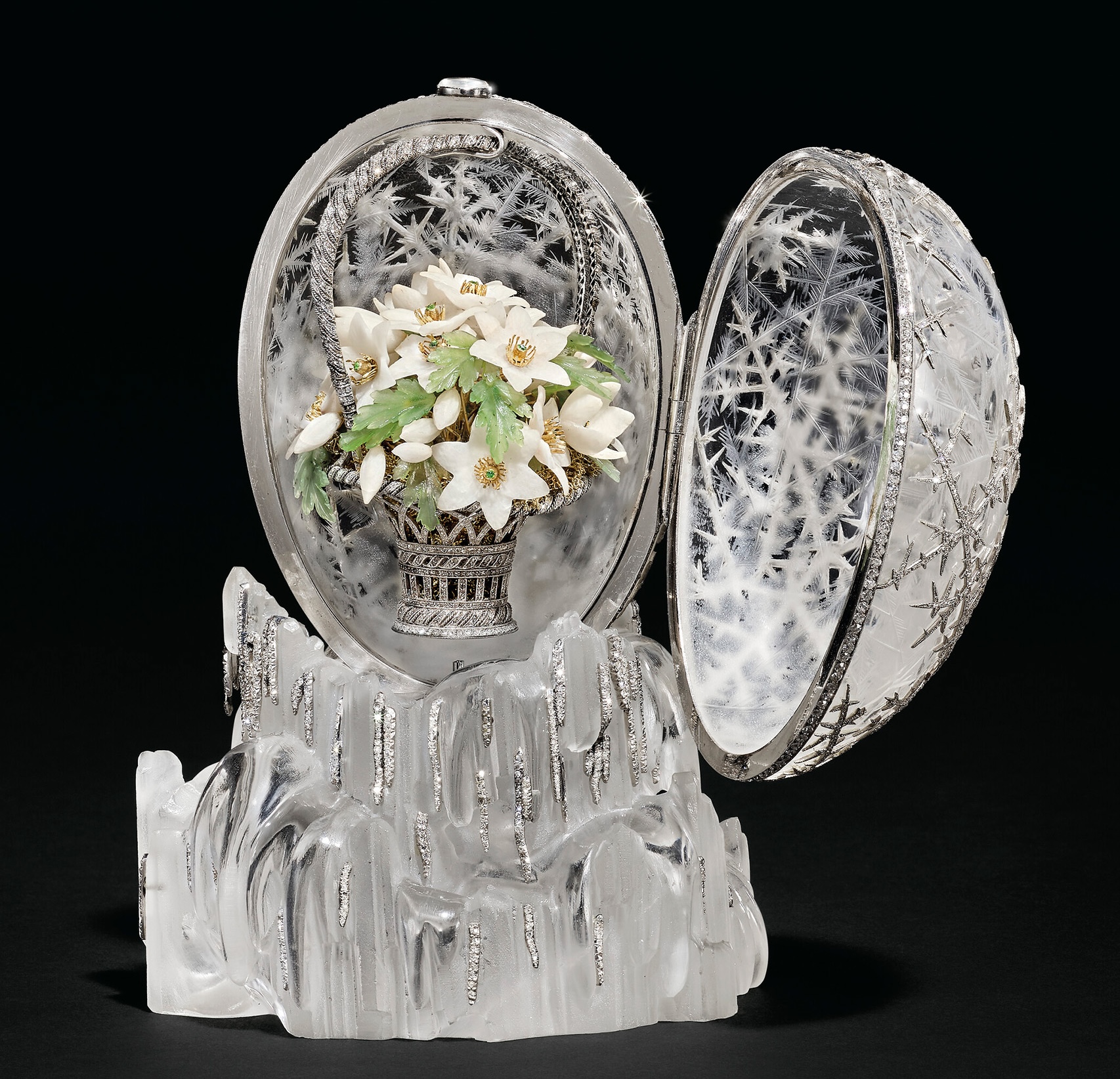
The Winter Egg by Fabergé, from a Princely Collection, Christie’s in London. Photo: Courtesy of
Christie’s
|
Tiesenhausen’s mission completed, Christie’s
sold the Winter Egg for $5.6 million that November, setting a record for Fabergé. Eight years later, in 2002, Christie’s sold it again, for a new record of $9.6 million, to Qatari Prince Saud bin Muhammed Al-Thani. Next week in London, Christie’s is putting the Winter Egg up for sale once more, at an unpublished estimate of £20 million, along with 47 other
Fabergé works being billed as from a “Princely Collection.” (A Christie’s spokesperson said they don’t comment on clients.)
|
|
|
A MESSAGE FROM OUR SPONSOR
|
The first steps towards a masterpiece starts with a dream. The all-electric BMW i7 – the evolution of brilliance.
Learn more at
BMWUSA.com
|
|
|
If the Winter Egg achieves its £20 million estimate, it will beat the record set by the most valuable Fabergé
egg to ever sell at auction, the Rothschild Egg, commissioned by French socialite Charlotte Béatrice de Rothschild in 1902 and sold by Christie’s in 2007 for £9 million ($18.6 million). The pink guilloché moiré enamel egg, with a round clockface and cockerel automaton inside that pops up every hour, sits atop a matching pink enamel and gold
plinth. The winning bidder was Russian businessman Alexander Ivanov, who donated it in 2014 to the Russian government; it’s now on view at the Hermitage Museum in St. Petersburg.
Christie’s “Princely Collection” auction is not the only sale of Fabergé works coming up. On December 18 in New York, Sotheby’s will auction the Kathryn and Bing Crosby
collection, which features several Fabergé items, led by an 8-inch-tall aventurine quartz model of a lion at an unpublished estimate of $300,000. The Crosbys acquired it at Sotheby’s Paris in the early ’90s. There is also a diminutive sapphire mouse, estimated at $50,000, and various other objets de vertu estimated
between $12,000 and $30,000.
|
The Fabergé Imperial Easter Eggs are some of the most storied objects in art history, with many of them
having vanished in the aftermath of the Russian Revolution and fictional versions turning up as convenient plot devices in heist movies (Ocean’s Twelve) and crime series (Peaky Blinders). Each egg is not only intricately ornate on the outside, but also features a surprise inside. One egg sits atop a miniature Kremlin; another fits a tiny carriage. The 1913 Winter Egg coming to auction this week is carved from rock crystal, as if made of ice, with a frostlike pattern on the egg
and diamonds in snowflake motifs; inside, a small diamond-encrusted trelliswork basket is filled with white quartz anemones, representing spring.
Russian Tsar Alexander III commissioned the first 10 Imperial Fabergé eggs as Easter gifts for his wife. His son and successor, Nicholas II, took up the tradition, commissioning two each year for his wife and mother. That tradition ended, of course, with the Russian Revolution in 1917; indeed, the last two eggs were never
finished. Outside the imperial family, Fabergé made several eggs commissioned by wealthy patrons, including the aforementioned Rothschild, Russian industrialist Alexander Kelch, American socialite Consuelo Vanderbilt, and Swedish oil baron Emanuel Nobel.
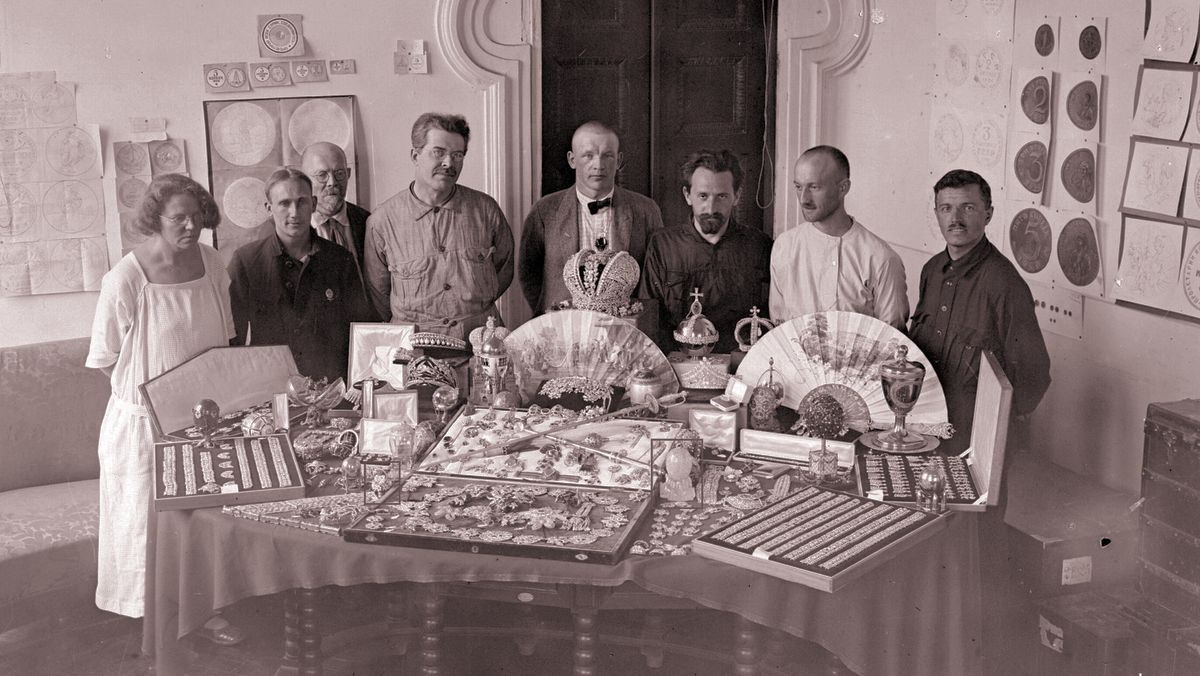
As for the present-day whereabouts of the 52 Imperial Eggs, Russian businessman Viktor Vekselberg bought nine from Sotheby’s in
2004— preempting a planned auction of the Malcolm Forbes collection—which he displays in his Fabergé Museum in St. Petersburg. Ten are still in the Kremlin Armory, where they were taken after the Bolsheviks ransacked the imperial palaces. (Back in the 1980s, Forbes famously set out to have
more Fabergé eggs in his collection than the Soviets. He ended up with 12.) Under Stalin, several left the country; oilman and art patron Armand Hammer, who was close with Lenin, bought 10 or so. Others ended up with Emanuel Snowman of London’s Wartski gallery, still one of the world’s leading Fabergé dealers. In the U.S., the
Virginia Museum of Fine Arts has five in its permanent collection. The Third Imperial Egg, from 1887, was supposedly discovered at a flea market in the American Midwest. That egg, which is relatively small and plain compared to the others, was
sold privately in 2014 by Wartski for the rumored (yet highly improbable) sum of $33 million. There’s also a lot of what’s known as “Fauxbergé” out there.
|
The 2002 buyer of the Winter Egg, Sheikh Al-Thani, was one of the world’s most active art collectors during
his tenure as Qatar’s minister of culture from 1997 to 2005, spending an estimated $1.5 billion to fill the country's art collections. He later ended up owing millions of dollars to the auction houses, and consigned his Patek Philippe “Graves” pocketwatch to Sotheby’s; it sold the day after he died, in 2014, for a record CHF23.2 million
($24.1 million).
|
|
|
The House of Fabergé likewise
followed a path of decline—including a stint owned by Unilever, which slapped the name on a line of cleaning products. A British investment firm relaunched Fabergé in 2009 as a luxury jewelry brand and brought on two descendants of the family, Sarah and Tatiana Fabergé, to advise. Earlier this year,
Russian venture capitalist Sergei Mosunov bought the company, no doubt chuffed by the global attention the Winter Egg is bringing to the brand just as he’s trying to resurrect it.
After the eggs, the most sought-after Fabergé items are hardstone figures of Russian peasants, merchants, noblemen, and soldiers, created between 1908 and 1916. The
second-highest-estimated lot in Christie’s upcoming auction is a 1916 figurine of a house painter, on offer for £1.5 million ($1.9 million). The color variations in the stones are expertly employed to look like paint stains on the figure’s shirt and brushes. The blue paint in his bucket is made from lapis lazuli. The 5.75-inch-tall figure first came to auction at
Christie’s in 2003 from the collection of Emanuel Nobel, where it sold for £845,250 ($1.4 million). The world auction record for one of these figures is $6 million, set in 2013 at Stair Galleries. Commissioned by Nicholas II, that figure depicts the bodyguard of his wife, the last empress of Russia, Alexandra Feodorovna. It’s the
long-lost companion to the figure of his mother’s bodyguard, which is on view at Pavlovsk Palace outside St. Petersburg.
Can the current market absorb so much high-priced Fabergé? And who would the potential buyers be? “The market has been less buoyant for the past five to seven years,” Tiesenhausen told me. “But this has always been a discreet market. Nobody is talking.”
|
Thanks, Julie. It’s a holiday week in the United States, but Wall Power never sleeps. So we’ll see you all on
Tuesday.
M
|
|
|
The ultimate fashion industry bible, offering incisive reportage on all aspects of the business and its biggest players.
Anchored by preeminent fashion journalist Lauren Sherman, Line Sheet also features veteran reporter Rachel Strugatz, who delivers unparalleled intel on what’s happening in the beauty industry, and Sarah Shapiro, a longtime retail strategist who writes about e-commerce, brick-and-mortar, D.T.C., and more.
|
|
|
Finally, a media podcast about what’s actually happening in the media—not the oversanitized, legal-and-standards-approved
version you read online. Join Dylan Byers, Puck’s veteran media reporter, and Julia Alexander, a longtime media analyst, as they sit down with TV personalities, moguls, pundits, and industry executives for raw, honest, sometimes salacious conversations about the business of media and its biggest egos. New episodes publish every Tuesday and Friday.
|
|
|
Need help? Review our
FAQ page or contact us for assistance. For brand partnerships, email ads@puck.news.
You received this email because you signed up to receive emails from Puck, or as part of your Puck account associated with {{customer.email}}. To stop receiving this newsletter and/or manage all your email preferences, click here.
|
Puck is published by Heat Media LLC. 107 Greenwich St., New York, NY 10006
|
|
|
|