Welcome back to Wall Power. I’m Marion Maneker.
It’s a double
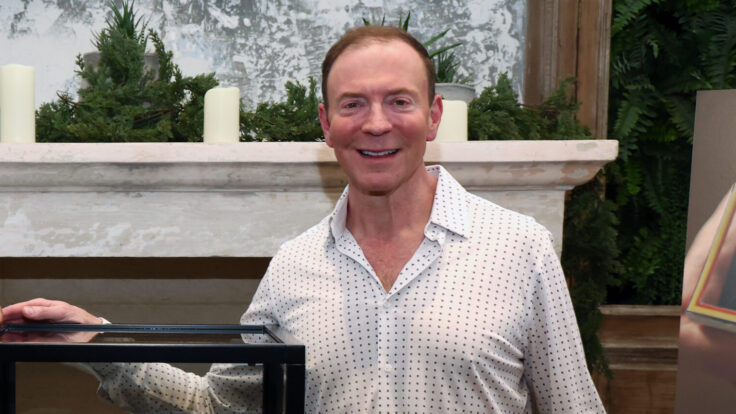
header, sports fans. The new restaurant at the Breuer Building—named Marcel, after Breuer himself—opened yesterday. Tonight, I’ll take you through the back of the house to meet Robin Alesch, one-half of the Roman and Williams team that designed the restaurant as part of a joint venture with Sotheby’s. Also, the new owners of Artsy/Artnet—should we be calling it Artsynet?—have finally restructured the company. I spoke with Artsy C.E.O. Jeff
Yin, who now leads the combined entity, about the changes. Up top, those Monets unseen for decades sold well, and Sotheby’s opened its books for bondholders.
Mentioned in this issue: Robin and Stephen Alesch, Patrick Drahi, Jeff Yin, Warner LeRoy, Joan Mitchell, Helen Frankenthaler, Andrew Wolff,
Hans Neuendorf, Andrew Russeth, Claude Monet, and many more… |
|
|
|
A MESSAGE FROM OUR SPONSOR |
A MASTERPIECE IN MOTION Unmistakable style. Undeniable attention to detail. Experience composition and craftsmanship at their finest in a Range Rover.
EXPLORE
|
|
|
|
-
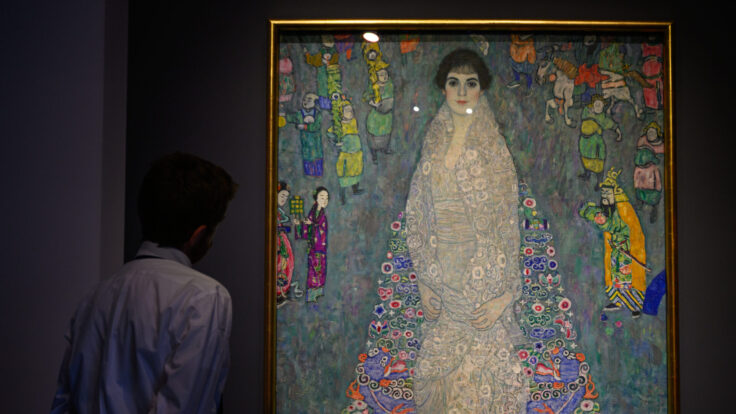
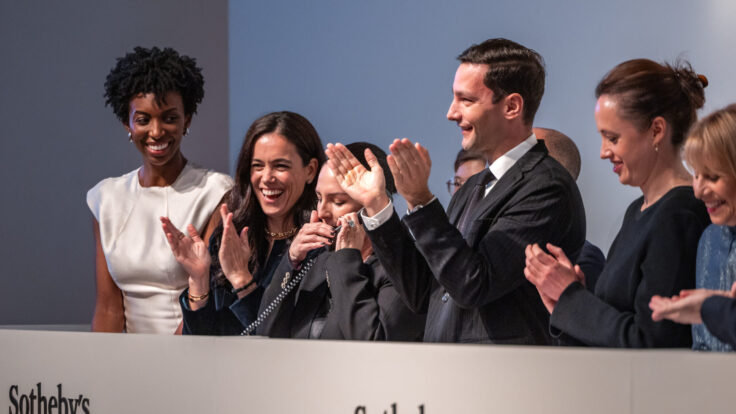
Monet takes Paris: Those two Claude Monet works did quite well in Paris yesterday at Sotheby’s. Vétheuil, effet du matin, from 1901, sold for $11.8 million, solidly above the estimate of nearly $7 million. It last traded hands in 1972. The riverscape Les Îles
de Port-Villez, from 1883, was estimated at around $3.5 million and sold for just under $7.5 million. That work entered the consignor’s family collection in 1954.
- Sotheby’s shows a $53M profit: In a quick volte-face, Sotheby’s main auction
business showed a $53 million profit last year, up from a $190 million loss in 2024, per the Financial Times. (These numbers don’t include related businesses like Sotheby’s S.F.S. art-lending arm.) In a separate piece, the FT opined that the $53 million “would translate, all else being equal, into the consolidated group barely breaking even,” and added that the last time the company made a pretax profit was in 2020, “unhelpful ahead of a $765 million debt maturity in
2027.”
Of course, the FT also revisited its revelation that Sotheby’s was offering 7 percent interest to consignors who keep their money with the auction house for extended periods after a sale. That report has caused a lot of consternation in the art-trading community, whose participants now worry that Sotheby’s finances are shakier than they thought. But one smart lawyer I spoke to reminded worried clients that Abu Dhabi’s sovereign wealth fund owns a large equity stake in the
auction house—therefore, any threat to unsecured creditors will likely be headed off by an opportunistic acquisition from a Gulf entity. As long as the market appropriately values the prestige of the Sotheby’s brand, Patrick Drahi can borrow money from his own clients without any real risk.
|
And now for something a little different… |
Marcel the
Shell:
A Restaurant Emerges at the Breuer
|
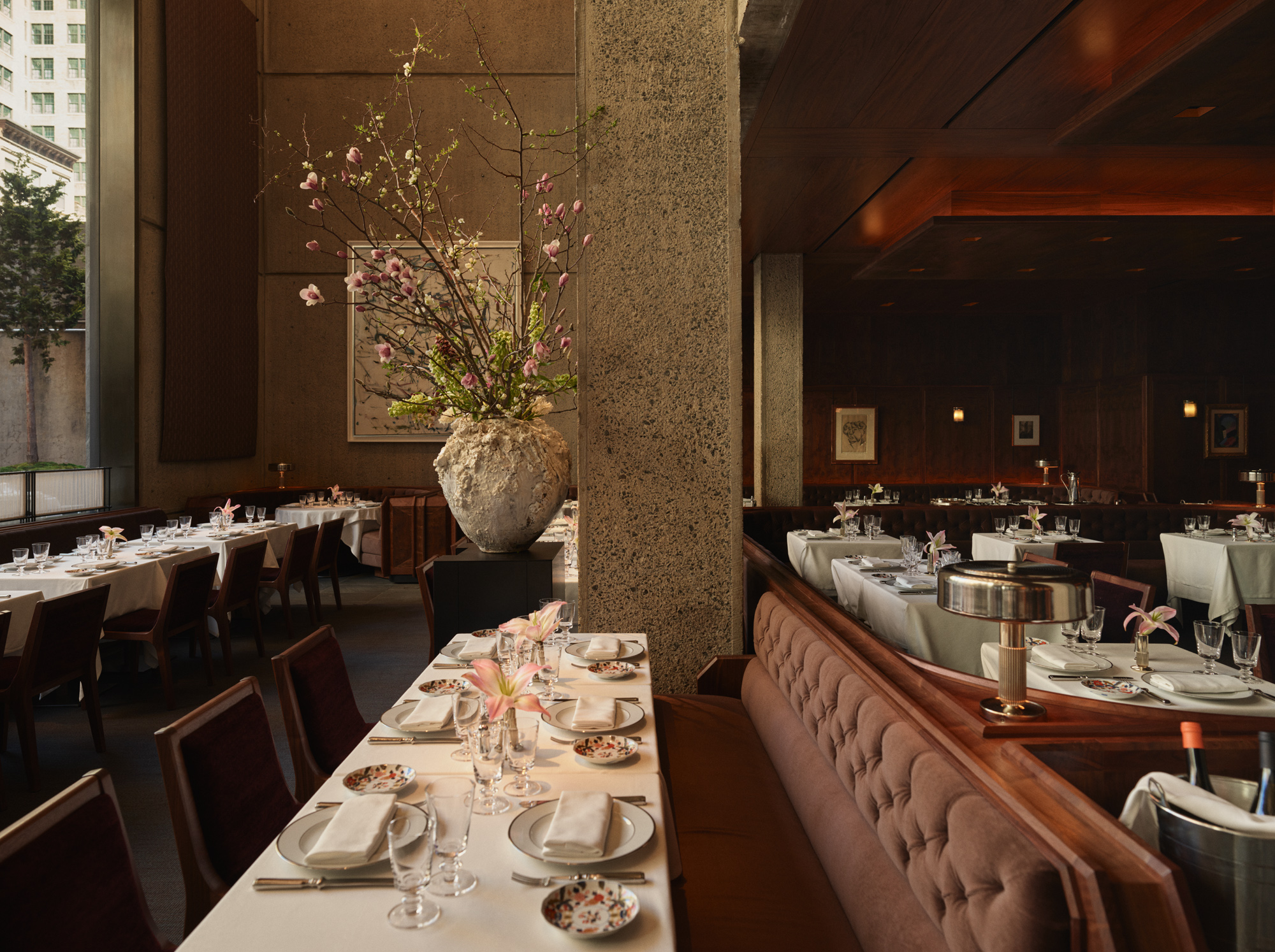
A couple of weeks ago, I was sitting at a plush banquet in the new Sotheby’s restaurant, Marcel,
speaking to proprietor Robin Alesch as the project barreled toward last night’s opening. Alesch was explaining how she grew up a classic New York City kid, the only child of cosmopolitan parents who took her to the city’s great restaurants like the Russian Tea Room and Tavern on the Green. “We went to the Four Seasons and Windows on the World,” she reminisced. “But I don’t think we ever made it to Maxwell’s Plum.”
That’s a good thing. Warner LeRoy’s
famous singles-scene restaurant was ground zero of the 1970s sexual revolution, probably not the best place for a teenager. But that scene evolved into an era of restaurants-as-theater, a place to see and be seen—the kind of drama that became a theme in Alesch’s design career. She met her husband, Stephen, when the two worked as set designers on movies. Through their firm, Roman and Williams, they eventually designed some of New York’s most talked-about restaurants, including
the Boom Boom Room at The Standard and Le Coucou. That relationship led to their opening La Mercerie in the design store they launched in SoHo in 2017.
Around the same time, Roman and Williams got the opportunity to design the revamped British galleries at the Met, where they helped the curators flip the emphasis from “royal patronage to the creativity, entrepreneurship, and consumer culture that shaped four centuries of British decorative arts,” according to their website. They did that
with dark-colored walls and beautifully lit bronze-and-glass vitrines that bring to mind the TIE fighters from Star Wars or the final scenes of 2001: A Space Odyssey. You’ll see those same Goppion vitrines at Marcel, where Alesch employs a trick she learned from the Met’s curators: putting smaller objects into large vitrines to emphasize their importance. Of course, there are a number of other vitrines in the restaurant to jump-start Sotheby’s luxury retailing
efforts.
While we were talking, Alesch pointed to a line of stone pillars in the double-height atrium. “That’s the landmark line,” she said. Inside that line and under the lobby, the Alesches had a free hand expanding the number of seats, creating an open kitchen, and decorating. But even without landmark constraints, they drew cues from the Breuer Building’s own design language: A stone-wood-and-bronze staircase leads to an elegant wood-paneled room that feels like a seamless extension
of the landmarked lobby above. The staircase also provides a star-turn moment—this is restaurant-as-theater—for diners to be seen as they enter and survey the patrons seated below. |
|
|
|
A MESSAGE FROM OUR SPONSOR |
A MASTERPIECE IN MOTION Unmistakable style. Undeniable attention to detail. Experience composition and craftsmanship at their finest in a Range Rover.
EXPLORE
|
|
|
|
If you hope to make a dramatic entrance, you’ll have to compete with the art. The restaurant
displays some massive paintings from Sotheby’s well-stocked private sales inventory, with works by Joan Mitchell and Helen Frankenthaler dominating the space. The displays are possible because of a series of holes in the concrete walls that Robin discovered while researching Breuer’s intentions for the space. It turned out they were not vestiges of the casting process that many architects fetishize, but receptacles for pins that allow Marcel to hang art on the
landmark’s walls. |
Photo: Rich Stapleton/Courtesy of Sotheby’s |
Marcel is a joint venture between Sotheby’s and Roman and Williams—part of a quiet strategic
initiative in which Sotheby’s tries to monetize more of its real estate footprint through hospitality. There’s even a job listing for a director of strategic finance, a role that, among other things, involves real estate development and management, hospitality and brand licensing, and growing “event space revenue at our flagship locations.” But what Sotheby’s needs more than
anything is someone with merchandising and hospitality experience to lead the way.
Now, let’s get to what happened at Artnet this week… |
|
|
|
The combination of Artsy and Artnet has placed Jeff Yin in charge of a combined
art-market platform with new potential—an A.I.-powered auction database, merged gallery networks, and a slimmed-down newsroom. Can his vision survive contact with reality? |
|
|
|
On Wednesday, Artsy and Artnet announced that the two companies would merge under the leadership of
Artsy’s C.E.O., Jeff Yin. On Thursday, Yin restructured the business: pulling Artnet’s sales arm into Artsy, closing its Berlin office, and laying off a number of writers and editors from Artnet’s news division. Though the merger announcement declared that the two companies would retain their distinct brands, it looked at first like Yin was acquiring Artnet and dismantling important signature pieces of the operation—that Artsy had “won,” in the words of a surprised observer I
spoke with.
It’s been just about a year since former Goldman Sachs partner Andrew Wolff broke the Neuendorf family’s control over Artnet. Six months ago, Hans Neuendorf’s son quit as Artnet’s C.E.O. on the eve of the annual general meeting intended to take the company private. In many ways, the departure was fitting: Years of chronic underinvestment, high costs, and poor strategy had left Artnet in a tight corner. Its
three-legged business—the auction database that transformed the art industry through price transparency, a network of gallery listings very similar to Artsy’s, and the news division—was stagnant with no obvious source of growth.
During the six months that Artnet was without a C.E.O., I’m told that Wolff met with every employee and learned what they did. At the same time, he had the complicated task of taking a German company and combining it with an American entity. (Technically, this
week’s merger involved the two U.S. divisions—the U.K. subsidiaries are still owned by a parent company, and the German office is no longer needed.) |
|
|
|
When I spoke to Yin yesterday afternoon, he explained that he’d merged the back offices for
efficiency; Artnet’s brokerage group, for instance, will work across both brands. He cannot, however, get the same efficiency from the gallery services that each brand provides—there’s little overlap in the galleries that use Artsy and Artnet to promote themselves and their inventories—so Yin is keeping both groups running, since the traffic that goes to each platform will remain separate.
It was Artnet’s news division that saw the biggest number of departures—I don’t have an exact
figure. A concerned publicist I spoke to cited a tearful now-former Artnet writer whom they’d just been on the phone with, who told her that the editor-in-chief, two writers based in Asia, and one in Germany who also co-hosts the company’s podcast were among those defenestrated. I wasn’t entirely surprised: Artnet’s news division was a hamster wheel of effort that consumed every dollar of the company’s luxury ad revenue, creating a conundrum that the Neuendorfs never seemed able to resolve.
Many—including a former Artnet employee who contacted me when the layoffs first started—simply assumed that Artsy was showing its dominance over Artnet by cutting into the latter’s most visible operation. |
Yin doesn’t see it that way. A careful manager, he’s been controlling expenses at Artsy for years,
including by purpose-building its content division “to provide discovery and inspiration at the top of the purchase funnel,” in his words. In contrast, he said, Artnet had been “chasing impression quantity over quality.” His goal in cutting the division back was not to eliminate Artnet News, but to prune it back to its healthiest parts as a foundation for growth in today’s multichannel mediaverse. He called the remaining team, led by the able and talented Andrew Russeth, “very
dialed-in,” and declared his intention to “invest in this product.”
In particular, Yin wants to invest in audio and better video—if they’re going to have a podcast, he said, “I want it to be the best podcast.” It may sound funny to many that he’s firing an experienced staff while simultaneously declaring his intention to build the company’s media presence. But he’s not wrong that web traffic has been dying, and that the Neuendorfs overinvested in the wrong types of media while skimping on
Artnet’s claim to fame, which was the auction price database.
On that front, Yin reiterated the strategy that I had previously heard from Wolff: Artsynet’s new leaders believe they can combine Artnet’s auction database with primary market learnings from the gallery networks and behavioral data from both websites. Then, using A.I. tools, they hope to surface valuable information for users, most likely sellers. It’s an appealing vision. But as with the self-driving car revolution, there’s a
lot that has to happen, and many hidden pitfalls. Right now, Artsy is using A.I. only in its internal “tooling,” as Yin puts it. (I’m told that Artnet had an unfortunate foray into using A.I. to gather data last year, so there’s a lot of work to be done there, too.)
Yin’s vision also provides some insight into why Artnet News has been so heavily scaled back. For Artsynet to thrive, it needs users who will generate data that is valuable to the platform—not readers who are valuable to
advertisers. And even though a main goal for the company is to “capitalize on all of this rich data,” the immediate challenge is to stanch the losses and put the combined company on an even keel. It’s too bad a lot of people had to lose their jobs for the company to do that. |
Thank you for staying through both games tonight. I hope you have a fun weekend planned. If not,
try to get some rest. The art world is about to head into overdrive. Brace yourselves.
In the meantime, the great Glenn Adamson is back on Sunday with another Hot Hand.
See you then,
M |
|
|
|
Puck founding partner Matt Belloni takes you inside the business of Hollywood, using exclusive reporting and insight
to explain the backstories on everything from Marvel movies to the streaming wars. |
|
|
|
Puck’s daily political newsletter from Washington on what’s really happening in this town, from the White House to
the Pentagon to Capitol Hill, K Street, and the campaign trail. |
|
|
|
Need help? Review our FAQ page or contact us for assistance. For brand partnerships, email ads@puck.news. You received this email because you
signed up to receive emails from Puck, or as part of your Puck account associated with {{customer.email}}. To stop receiving this newsletter and/or manage all your email preferences, click here. |
Puck is published by Heat Media LLC. 107 Greenwich St., New York, NY 10006 |
|
|
|
|