Welcome back to Wall Power. I’m Marion Maneker.
Things have
started back up in the gallery world, so tonight I’m going to take you on a brief tour of some of the new shows that have opened here in New York. Marguerite Humeau’s scintille is at White Cube on Madison Avenue; Richard Pousette-Dart’s
Geometry of Summer is at Pace in Chelsea; and David Zwirner Gallery has two shows of great work from legendary artists. We’ll discuss William Eggleston: The Last Dyes and Dan Flavin: Grids.
If you’re not yet a Puck subscriber, you really ought to join
here to access all of the great coverage from my
colleagues, especially the essential political news we’re going to need in the next few weeks and months. And, as always, if you’ve got something you want to share with me, you can always reach me by replying to this email, sending one to Marion@puck.news, or texting +1.917.825.1391.
Also mentioned in this issue: Franka Haiderer, Anthea Peers, Manny
Davidson, Valentino Garavani, Giancarlo Giammetti, Richard Prince, David Hockney, Jean-Michel Basquiat, Philip Leider, Marc Chagall, Antonello da Messina, Charles Duncan, Guy Stricherz, Irene Malli, and many more...
And here we go… |
-
Franka Haiderer goes back to Christie’s: Earlier this week, Christie’s announced that Franka Haiderer would become the managing director for the house’s EMEA department, reporting to Anthea Peers in London. Haiderer had previously spent a dozen years at Sotheby’s, where she was the chairman for Germany and a business-getter for Europe more broadly. She recently worked on Sotheby’s Manny Davidson
consignment.
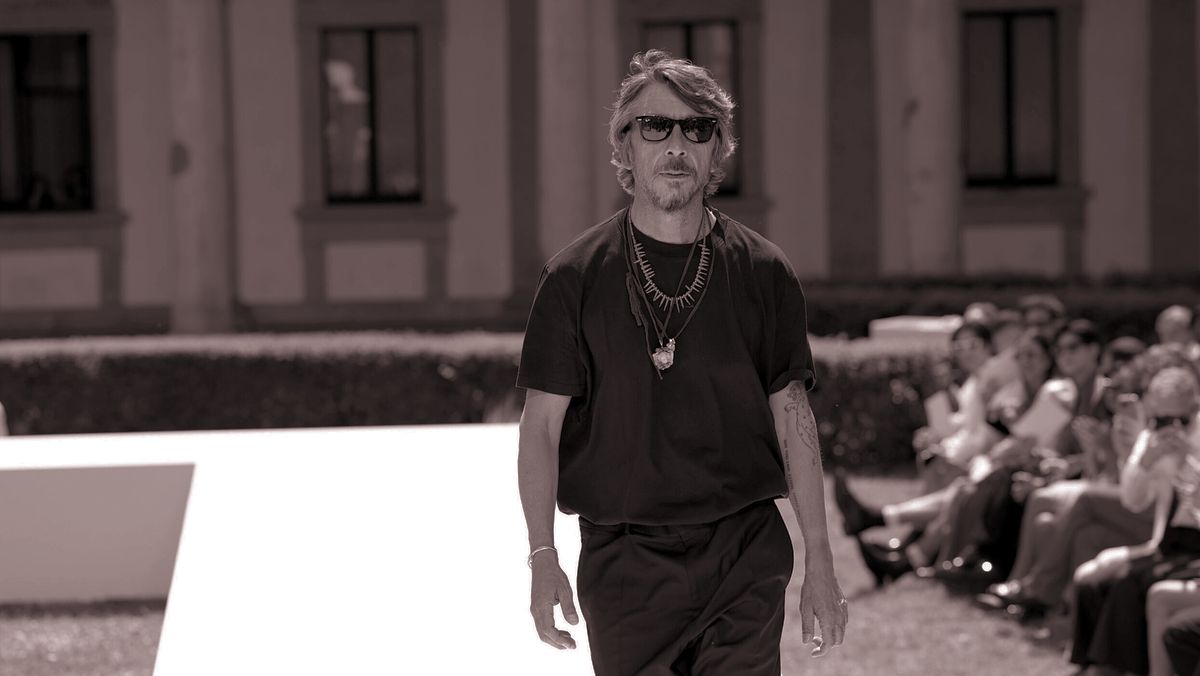
- Valentino Garavani dies at 93: By now, you’ve heard the news that Valentino Garavani has died. In addition to his long-standing cultural relevance as a fashion designer and member of the international social swirl, Garavani and his business partner,
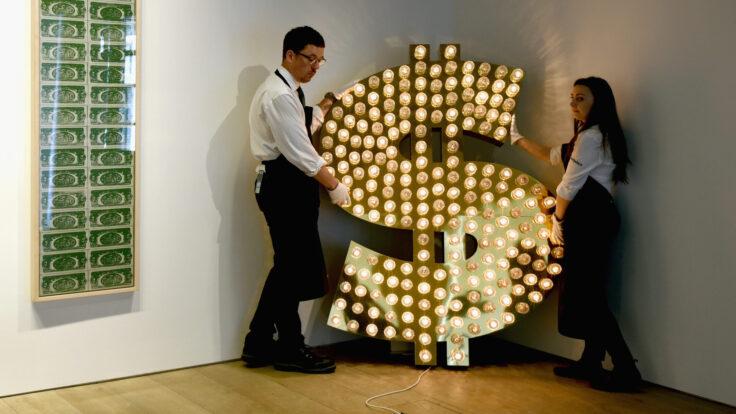
Giancarlo Giammetti, were major collectors who helped move the market over the last 25 years. When Valentino bought at auction, he often bid from the first few rows. In 2008, he purchased Richard Prince’s Overseas Nurse, from 2002, for almost $8.5 million—a record for the artist at the time. The next year, he bought David Hockney’s California Art Collector, from 1964, for nearly $5.5 million.
Then there were the works by
Jean-Michel Basquiat. In 2021, Giammetti sold In This Case, from 1983, for $93 million, which kicked off the current Basquiat market. In 2023, Valentino sold El Gran Espectaculo (The Nile), from 1983, for $67 million. In 2024, there was talk about the private sale of his Baptismal, from
1982, which appeared in the Fondation Louis Vuitton show in 2018 and was said to have sold for $130 million or so. It turns out Valentino was a tastemaker in art, too.
What’s left? It’s hard to know. Some of the recent sales were made to fund Garavani and Giammetti’s foundation, and Garavani’s estate planning seems to have been fairly thorough. Nevertheless, the market is currently sniffing out supply, so I’m sure the appropriate calls are being made this week. - Artforum founding editor Philip Leider dies at 96: Artforum announced on its site yesterday that Philip Leider—the magazine’s founding editor-in-chief, who sought “to separate the art world from the world of commerce”—died on January 11 at the age of 96. According to Artforum’s obituary, he
was an early ardent supporter of Andy Warhol on one hand and land art on the other. Leider helped launch the magazine from San Francisco and then stayed with it as it moved to Los Angeles and then New York. He left Artforum at its peak in 1971 to teach art history, first in California and later in Israel.
- Don’t worry about the Metropolitan Opera’s Chagalls: If you saw The New York Times’s alarmist
story suggesting the Metropolitan Opera’s Marc Chagall murals are for sale, don’t take the bait. The Times is yanking your leg. Even though the murals are valued at $55 million, the opera is just offering to “sell” them to someone who would agree to keep them in place and get a plaque in return. That’s one pricey
plaque.
|
Sotheby’s
$10 Million Antonello
|
Antonello da Messina, Ecce Homo (1460-65). Photo: Courtesy of
Sotheby’s |
Antonello da Messina—the 15th century painter who is thought to have brought oil
painting to Venice, where he worked alongside Giovanni Bellini and Piero della Francesca—is a key figure in Renaissance art. He first encountered Northern Renaissance painting while in Naples, where those works were fashionable, and there’s some suggestion that he was in contact with an important follower of van Eyck. Once Antonello returned to Messina, he began painting in the Netherlandish style, with greater attention to detail and gradations
of light within his subjects; he also brought with him the Northern style of portraiture, showing subjects’ relaxed features in full face or three-quarter view, rather than in profile.
There are very few surviving works by Antonello—Sotheby’s estimates around 40—and virtually all are in museums. So when a two-sided panel
came to market depicting Christ with a crown of thorns (Ecce Homo) and Saint Jerome in the desert, believed to have been painted between 1460 and 1465, the auction house decided to put a $10 million estimate on the guaranteed work. It will share center stage in the first Old Masters sale to be held in the Breuer Building on Madison Avenue, from February 4-6, alongside Rembrandt’s drawing of a lion from The Leiden Collection.
Now, the main event…
|
|
|
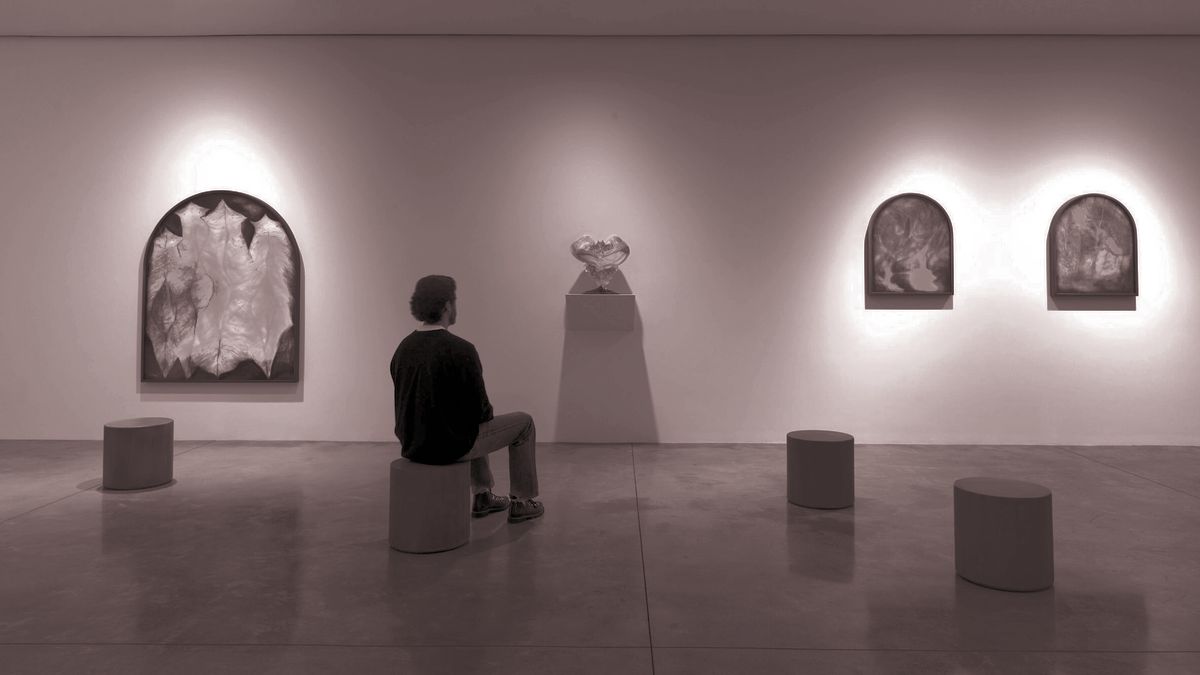
Fresh from their holiday hibernation, New York galleries are once again buzzing
with crowded openings and legendary works from the likes of Humeau, Pousette-Dart, Eggleston, and Flavin. |
|
|
This year got off to a tough start in the art world. A not-insignificant number of people got
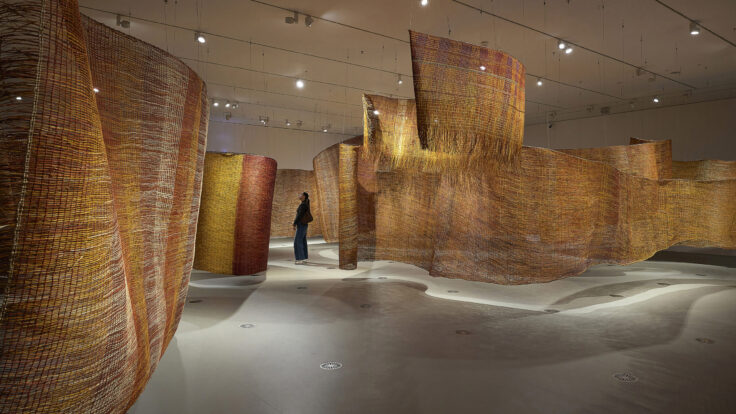
trapped in the Caribbean after the Maduro extraction created a cascade of missed flights, leaving some industry swells stuck in paradise a bit longer than planned. The inconvenience should have been little cause for panic—after all, the art world always takes a while to get back up and running in January—but with a round of openings late last week, there is now a surprising amount of art to see around town, including the debut at White Cube of surrealist-inspired French artist
Marguerite Humeau; a show of the late work of fellow abstract expressionist Richard Pousette-Dart at Pace; a show of William Eggleston’s dye transfer prints at David Zwirner; as well as a great installation of Dan Flavin’s beautiful light sculptures, or “grids.” These are just a handful of an entire menu of options to entertain yourself here in New York, should the president make good on his saber-rattling over Greenland and
shut down the airspace over the Atlantic. |
My first encounter with Humeau’s work—and the enthusiasm for it among the collecting class—occurred
more than a year ago, when I visited Howard Rachofsky, the influential Dallas collector. Last year, Rachofsky featured a “room-filling installation” of one of Humeau’s “mythological ecosystems,” which had drawn attention at the Venice Biennale in 2022. At White Cube, the 40-year-old artist has taken the single-themed installation conceit one
step further by treating the entire two-story exhibition space as a single expression of the work she made in response to a trip to West Papua in New Guinea. There, she explored a cave filled with stalactites, stalagmites, and translucent fauna thriving far from the light, as well as bats.
Humeau’s art takes a story or experience—a trip to a bat cave in the South Pacific, for instance—and turns it into both a fictional world and a metaphor for our own experiences. She’s a contemporary
surrealist in the sense that she is interested in emotions and ideas that cannot be reached through reasoning. She’s also willing to imagine a parallel dreamworld filled with fictional creatures inspired by real ones. You don’t have to be a psychologist to read the dark cave as a metaphor for the human psyche, but what makes Humeau’s work appealing is that her trip through the unconscious isn’t filled with terrors. |
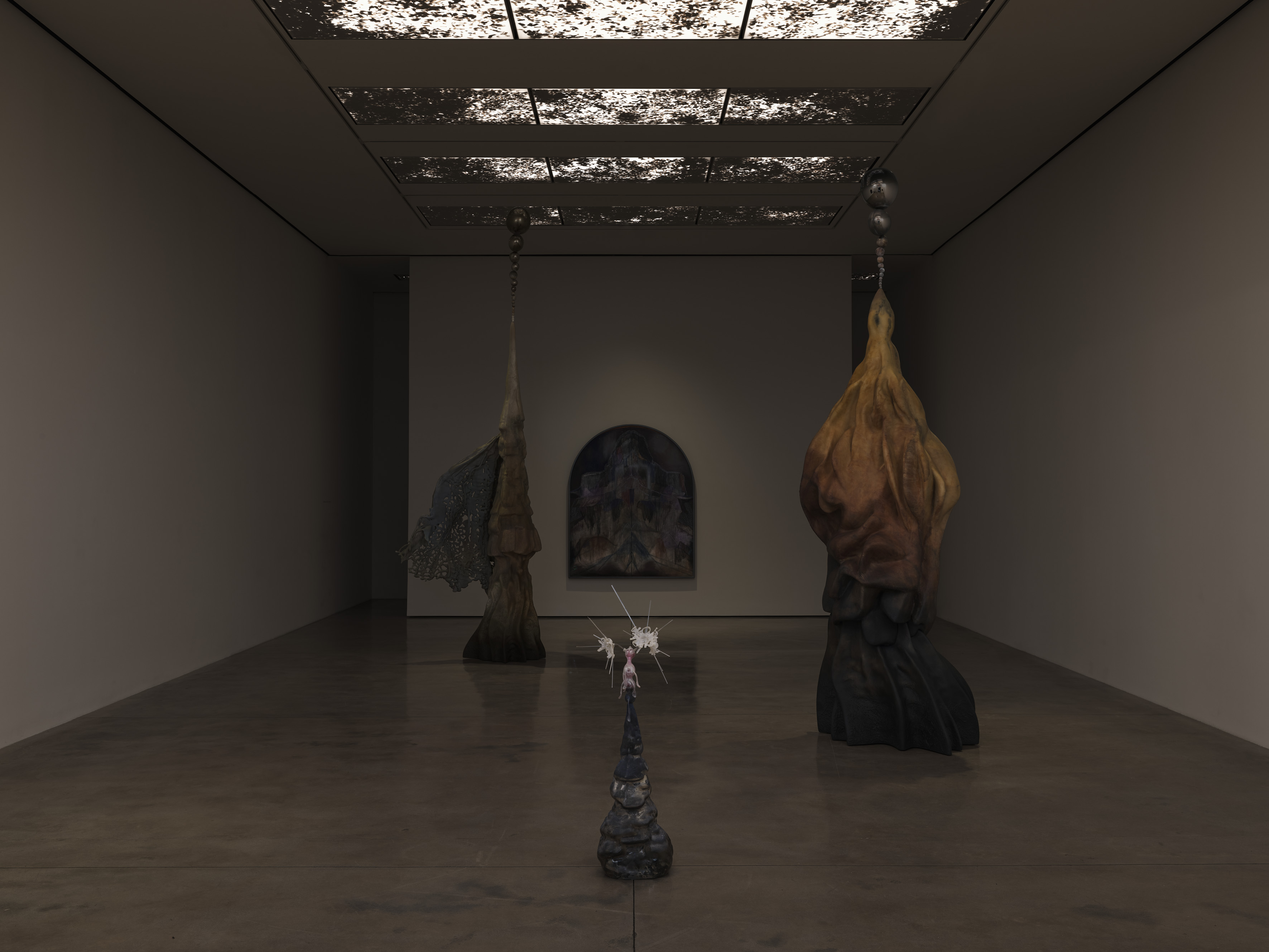
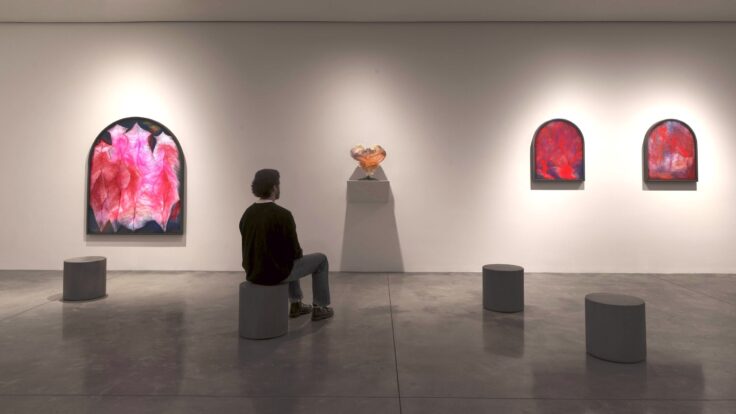
Marguerite Humeau, scintille at White Cube, New York. Photo: Frankie Tyska/Courtesy of
White Cube |
The show begins on the ground floor with several sculptures that recall stalactites, the stone
centurions guarding the inner chambers of the cave, surrounded by dark charcoal works on paper in archlike frames. The message is that we’re plunged into darkness with only these hulking sculptures to orient us. Then, upstairs, a more colorful and luminescent world opens up as Humeau creates more works on paper depicting the translucent creatures that inhabit the underwater level of her dark cave. Mounted on small plinths all throughout the upper gallery are sculptures inspired by the bats of
the West Papua cave and made from “color-shifting casta glass,” which, the artist said, changes color with different levels of moisture. Offhandedly explaining that bats are “great pollinators,” Humeau postulates through her bat sculptures the idea that “the purest act of love is to become what you pollinate.” Thus, many of her bat forms merge with imagined fruits, tapping into a fundamental surrealist trope of transformation. |
Emerging from Humeau’s cave, I made my way across Central Park and down the West Side to see Pace’s
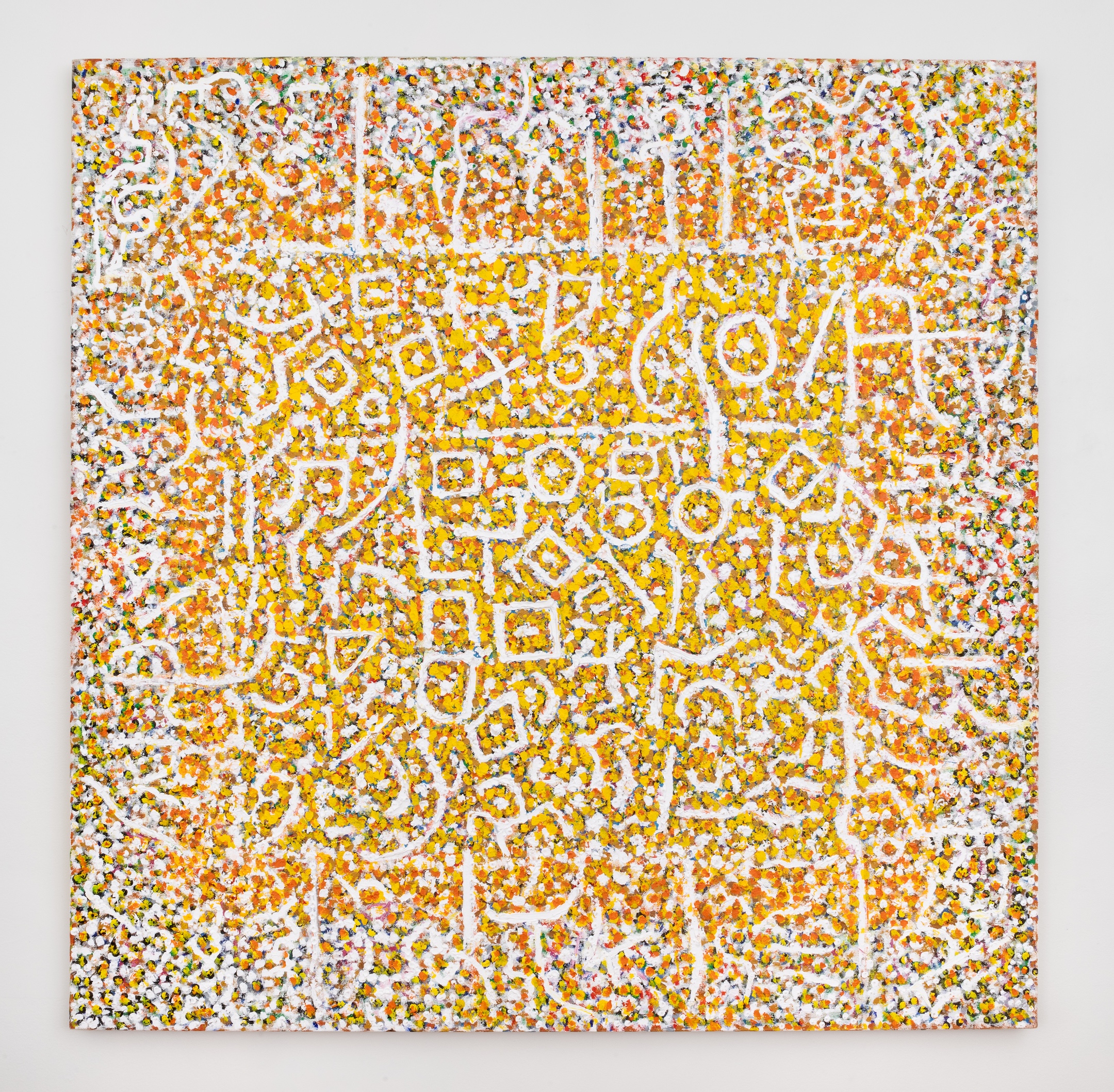
show of Richard Pousette-Dart’s late work. Perhaps Humeau’s surrealism was too much on my mind, but as I walked through the exhibition I was reminded that some of the paintings on display in Richard Pousette-Dart: Geometry of Summer were reminiscent of works by Jackson Pollock and Adolph Gottlieb in the Philadelphia Museum of Art’s great surrealism centennial show, Dreamworld. This was especially true of Golden Door, a work from 1989-90 that is, in many ways, the star of the show. (I toured the show with an art advisor who quickly inquired about the work’s asking price but was told it was already on reserve at more than $700,000.) Alpha Forming, from 1992, and Illumination Square, from 1983, were filled with similar shapes and patterns. |
Richard Pousette-Dart, Golden Door (1989-90). Photo: The Richard Pousette-Dart
Foundation/ARS |
Pousette-Dart was a contemporary of the abstract expressionists, but he was not really one of them.
First of all, he didn’t drink, which left him out of much of the brawling and contentiousness. Secondly, although Pollock, Gottlieb, Willem de Kooning, Mark Rothko, and others from that period had wrestled with surrealism throughout the ’30s and ’40s, Pousette-Dart came from another tradition. His father had been an artist, and his intellectual interests were more homegrown than the European yearning of the ab-ex guys. Pousette-Dart was more of a
transcendentalist, explained Charles Duncan, who runs the artist’s foundation. His daughter, Joanna, an artist in her own right, and his son, Jon, who led the 1970s Pousette-Dart Band, were on hand for the press preview. Pousette-Dart’s abstract work doesn’t really need a deep intellectual framework to be appealing.
Pace has been representing the artist’s estate for a dozen years. In 2022, the gallery
showed work from the 1950s—layered, impastoed canvases that are as intricate as Persian carpets. Much of that detail is muted in these works, which can be too easily described as simply depictions of circles, squares, and ovals that the artist called “stadia.” But the layers remain, resulting in art that is far more engaging than its
surface simplicity might initially suggest. |
A few blocks south, David Zwirner’s complex of Chelsea galleries is showing works
by photographer William Eggleston and minimalist pioneer Dan Flavin. The Eggleston show’s title, The Last Dyes, refers to a series of dye transfer color prints made from Eggleston’s photographs by a master printer using some of the last existing materials made for the process. Dye transfer printing was once a mainstay of commercial work, creating vivid color images for magazines and newspapers. But the technology waned in relevance and became an esoteric option for photographers. Once
Kodak started phasing it out in the 1990s, master printers Guy Stricherz and Irene Malli began stockpiling the dyes, paper, and matrix film used in the process. (They walk you through it in this video.)
Dozens of people showed up for a gallery talk that preceded last Thursday’s opening. Most were young enough to have never seen or experienced
the dense saturation of dye transfer printing. Eggleston’s photography, which did so much to make color photography an art form, reaches its apogee in these prints. Subtle, moody images glow with a range of colors—look here, here,
and here—while others heighten the implicit narrative drama of these photographs. But as impressive as the results of the dye transfer process are, Eggleston’s arresting images are still what makes this work so appealing. He even makes a cameo in the reflection of a car’s bumper. |
Color also plays a pivotal role in the Flavin show, a block away. This series of works, which
employs Flavin’s signature fluorescent lamps, began in 1976 and grew out of his cornered squares. The grids feature equal numbers of horizontal fixtures facing the viewer, with vertical lamps shining into the corners to create two layers of light. Then there’s the interaction of color: Flavin variously uses pink, yellow, green, blue, and red in these light sculptures. The works come in different sizes and are mounted at different heights within the corners. Like Pousette-Dart’s, Flavin’s
works appear quite straightforward, even soothing at first—a tonic from the chaos and stresses of everyday life—but they are also arresting in the intensity and unfamiliarity of the color bath they create.
I plan to go back to the Flavin show anytime I’m in the neighborhood over the next few weeks. It feels like a refuge to me, and with
Trump ratcheting up his “end of days” scenarios to avoid the consequences of his own behavior, I’m thinking we’re all going to need as much peace of mind as we can possibly get. |
That will have to do for today. I’ll be back tomorrow in the Inner Circle with the Hot 50 for 2025,
based on data from ARTDAI. If you’re not already a member, now would be a good time to upgrade.
M |
|
|
Puck founding partner Matt Belloni takes you inside the business of Hollywood, using exclusive reporting and insight
to explain the backstories on everything from Marvel movies to the streaming wars. |
|
|
The ultimate fashion industry bible, offering incisive reportage on all aspects of the business and its biggest
players. Anchored by preeminent fashion journalist Lauren Sherman, Line Sheet also features veteran reporter Rachel Strugatz, who delivers unparalleled intel on what’s happening in the beauty industry, and Sarah Shapiro, a longtime retail strategist who writes about e-commerce, brick-and-mortar, D.T.C., and more. |
|
|
Need help? Review our FAQ page or contact us for assistance. For brand partnerships, email ads@puck.news. You received this email because you
signed up to receive emails from Puck, or as part of your Puck account associated with {{customer.email}}. To stop receiving this newsletter and/or manage all your email preferences, click here. |
Puck is published by Heat Media LLC. 107 Greenwich St., New York, NY 10006 |
|
|
|