|
Welcome back to Wall Power. I’m Marion Maneker.
Art Basel is still going on, but we’re turning our attention to next week’s sales in London. It’s no secret that Christie’s and Phillips have leaned into the art market downshift and reduced the June sales in London to midseason events. Nevertheless, there are some very interesting lots on offer. And Sotheby’s has assembled some big-ticket items from around the world to put on a mixed evening sale with some surprises. More on that below.
|
|
|
|
A MESSAGE FROM OUR SPONSOR
|
The first steps towards a masterpiece starts with a dream. The all-electric BMW i7 – the evolution of brilliance. Learn more at
BMWUSA.com
|
|
|
 |
Julie Brener Davich |
|
Christie’s Jewelry Sale Record
|
|
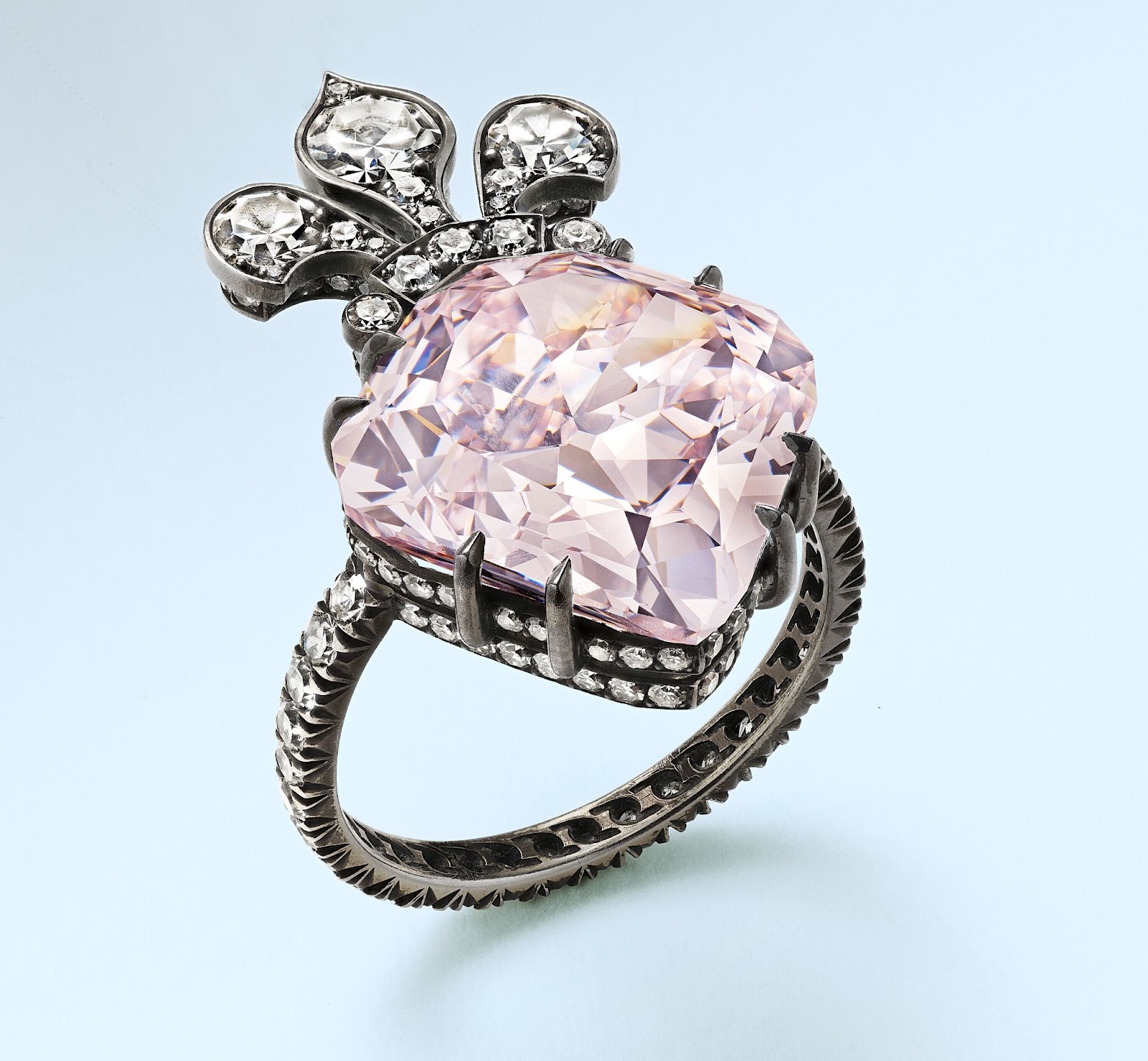
The Marie-Thérèse Pink, a historic JAR colored diamond ring. Photo: Christie’s Images Ltd.
|
|
Considered to be among the most stylish monarchs in history, Marie Antoinette was known for her obsession with fashion, and her garments and jewelry are still influential 250 years later. They’re also still setting records. Her 10-carat pink diamond, reset by jewelry designer Joel Arthur Rosenthal’s JAR, sold at Christie’s earlier this week for $14 million against an estimate of $5 million. It was the top lot of Christie’s Magnificent Jewels sale, which made a combined $87.7 million—the highest total ever for a various-owners jewelry sale at Christie’s in the Americas. Too bad Christie’s felt the need to get third-party backers on so many top lots and give away some of their upside.
Three Mughal masterpieces with royal provenance achieved a total of $14.8 million, against an aggregate estimate of $5 million. The group was led by the carved emerald necklace that sold for $6.2 million, followed by the multi-gem and emerald necklace for $5.6 million, and the three-strand spinel and natural pearl necklace for $3 million. The 392-carat Blue Belle sapphire achieved $11.3 million against an estimate of $8 million, but that’s far less than the $17.3 million it sold for in 2014. Buyers in the current market are responding to jewels associated with names—either of the maker, a previous owner, or, best of all, both.
Anne H. Bass, the socialite who died in 2020, had a strong showing as well. The 29 lots from her collection totaled $8.8 million against an estimate of $3.4 million. Her 11 pieces of custom JAR jewelry made $4.5 million, against a combined estimate of $970,000, led by a necklace of briolette emeralds and sapphire beads, which pulled in $1.5 million against an estimate of $200,000. But buyers also went for classics, like the Van Cleef & Arpels diamond cluster earrings, each with a 12-carat pear-shaped pendant, that sold for $2 million against an estimate of $1.2 million. The concurrent online sale of various contents of Bass’s New York apartment, including other jewelry, made $4 million, led by a steel wire necklace by Alexander Calder that made $441,000, and a Gustav Klimt drawing that sold for $378,000—almost 10 times its estimate of $40,000.
Estimated at $2.9 million, the collection of Lucille Coleman ended up making $7.4 million across 28 lots. The nine Van Cleef & Arpels “mystery-set” jewels tripled their combined presale estimate to make $4.7 million, led by the ruby and diamond flower brooch that made $1.56 million against its estimate of $600,000.
|
|
|
|
Now on to the main event…
|
|
|
|
While it’s tempting to look at last week’s Art Basel and the upcoming London fair as quiet and unremarkable, you’d be missing the deal flow humming just below the surface. The top of the market isn’t completely frozen—it’s just more discreet, and there’s plenty of exceptional work changing hands.
|
|
|
|
What’s the old line about acting? There are no small roles, only small actors? That came to mind while I was deep in the catalogues for London’s June auctions, which take place next week. There are no small auctions, only small lots. These June sales were once a major event on the art world calendar as buyers transited from Switzerland to London on a regular European buying jaunt. We’re told there were few Americans and Asians in Basel this week. Whether that’s a measure of the fair’s success in bringing galleries to three continents, or a comment on the global funk that’s been limiting the art market, no one seems to know.
We do know that Art Basel produced few sales over the $10 million mark earlier this week. And even though nothing in next week’s London sales is estimated above £6 million, there could still be one or two eight-digit outcomes, if stars align. But don’t jump to the conclusion that the top of the market is completely frozen—it’s just more discreet. Most eight-figure sales are taking place privately now, far from the overheard commentary of an art fair hall or an auction room. I know of a $100 million Basquiat purchased privately in the past few months—and I’ve heard of collectors getting unsolicited offers for their paintings at the $25 million mark. Some folks are spending real money.
|
|
|
|
A MESSAGE FROM OUR SPONSOR
|
The first steps towards a masterpiece starts with a dream. The all-electric BMW i7 – the
evolution of brilliance. Learn more at
BMWUSA.com
|
|
|
|
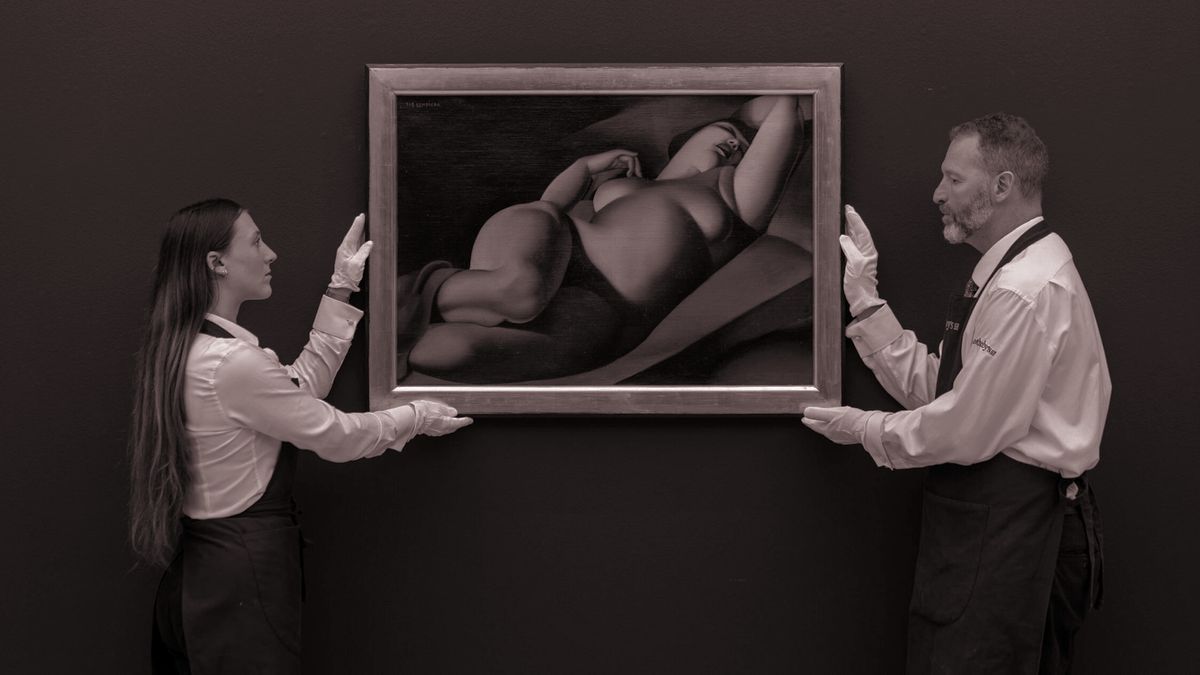
And there are still plenty of works worth taking seriously in London. Sotheby’s has assembled an evening sale of 52 lots—a healthy number—of which 11 are estimated at £2 million or above. At the top of the spectrum is the Tamara de Lempicka that you might have seen in an earlier newsletter. It is estimated at £6 million, but significant works by Lempicka have begun to sell for prices above $15 million. The paintings that sell at this new price level tend to be the artist’s society portraits from the 1920s. Those works were previously collected by a generation of late 20th century Hollywood tastemakers, including Madonna, Jack Nicholson, and Barbra Streisand, and fashion designers like Wolfgang Joop.
Sotheby’s La Belle Rafaëla, from 1927, isn’t a glamour work like those, but a classic female nude done in a chiaroscuro style. It’s also relatively small. But the painting has been in the same collection for 30 years, well before the market began to appreciate Lempicka’s work as art rather than as an expression of the distinctive art deco style. This sale will be an interesting gauge of how firmly her work has entered the canon.
|
The other work with a £6 million estimate is Pablo Picasso’s Nu assis dans un fauteuil, from 1964-65, which is a painting of Jacqueline Roque, the last of the artist’s wives whom he married when he was 80. This small work, once owned by dealer Jeffrey Loria, is backed by an irrevocable bid. The only constraint on its price is its
intimate, almost 2-foot-square size.
On the opposite end of the spectrum in terms of size and, perhaps, cultural relevance is Jenny Saville’s massive nude Juncture, from 1994. According to ARTDAI’s database, the 10-foot-tall painting was bought at auction in 2009 for $650,000 and again in 2019 for $7.1 million. It has since been shown at the Aldrich Museum in Connecticut, the Yale Center for British Art, the National Portrait Gallery in London, and New York’s Lévy Gorvy Dayan, as part of a show of paintings of backsides cheekily titled Rear View. The painting hung dramatically at the top of the former Wildenstein Mansion’s dramatic staircase. It really had wall power, as we say.
I’m told Juncture is being sold by the owner of a recently opened private museum in Venice. The work has no financial armature, most likely because the seller knows the artist’s work holds its value. Gagosian Gallery represents Saville, and previous works bought and resold within the past decade have traded with small advances in price, even as the wider market stayed flat. That suggests Saville is a good store of value. More than that, the seller seems to be trying to take advantage of the intense interest in Saville provoked by today’s opening of her major show at the National Portrait Gallery in London, which is receiving nothing but rave reviews.
|
|
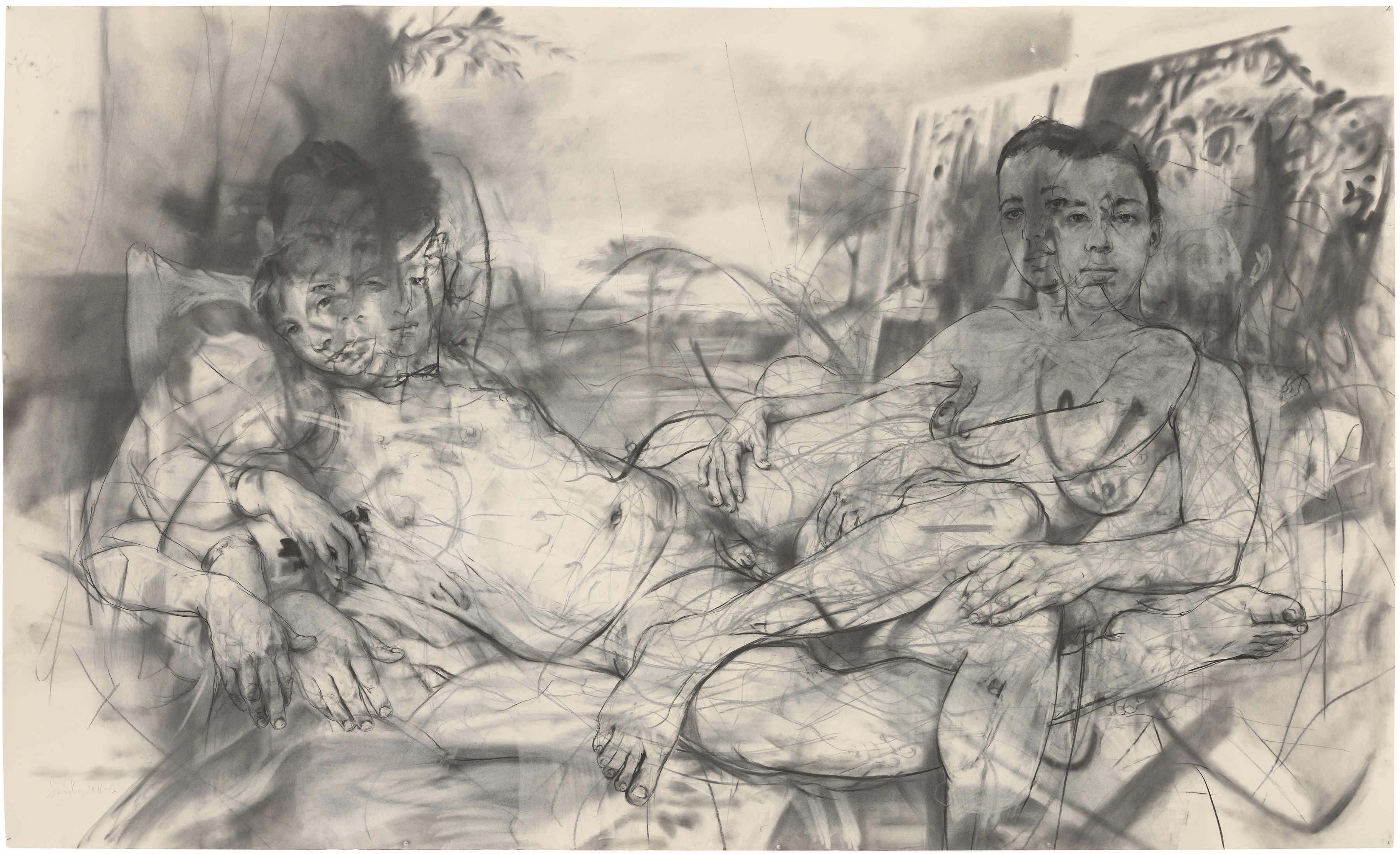
Jenny Saville, Mirror (2011-12). Photo: Courtesy of Sotheby’s
|
Sotheby’s also has a very large—more than 8 feet wide and 5 feet tall—charcoal drawing by Saville, Mirror, from 2011-12. There’s recently been a lot of interest at auction for Saville’s images made with charcoal. Two sold this year for prices above $1 million. One was on paper, and made $1.2 million; the other was a work on canvas, and made $1.8 million. This larger charcoal work is estimated at £800,000, which would mean a selling price equal to the $1.2 million work on paper that is only half the size.
Sotheby’s Helena Newman and Tom Eddison told me that the Saville drawing is another example of how big-ticket, image-driven collectors are getting more comfortable owning works on paper, which have historically been seen as less valuable than canvas. They both pointed out that the Saville charcoal was hanging in a gallery alongside the Picasso, a Schiele, and another work on paper by Basquiat. Some of you will remember that two decades ago, Basquiat collectors started showing an interest in late Picasso works—in which the master had begun to paint in a more expressionist way than he had previously—reclaiming them from the disparaging judgment of critics from the late ’60s and ’70s. Sotheby’s late Picasso is a bit early to be considered expressionist, like Basquiat, but works on paper by Basquiat have recently seen a significant jump in prices. Sotheby’s sold one for $16 million last month. In London, they have Untitled (Indian Head), from 1981, estimated at £4 million, and Untitled (NY CZAR), from 1988, estimated at £500,000.
If you’re looking for a painting on canvas by Basquiat—and many seem to be—Phillips has MP, from 1984, estimated at £3.5 million and backed by a third party. One of two paintings of Michael Patterson, a clubgoer whom Basquiat met at the ’80s New York hotspot Area, it sold for $1.7 million in 2011, on its third try at auction. (It had previously been offered for sale twice, also more than a decade ago, only to be bought in.) Now, due to the guarantee, it will sell for at least twice that purchase price. All of that is a reminder that the artworks never change; the attitude and interests of collectors do, which is why we shouldn’t make too much of the fact that artworks sometimes fail at auction.
|
|
There are some interesting lots in Sotheby’s sale at the lower price points, but before we get to those, it’s worth pointing out that Sotheby’s has a consignment of sculptures from Australia that include works like Dame Barbara Hepworth’s Vertical Forms, from 1965, estimated at £2 million, and Henry Moore’s Reclining Mother and Child from 1961, estimated at £3.5 million. The Hepworth estimate is quite strong considering similar works have sold for prices slightly below £2 million all in. Another cast from the same edition of the Moore work was sold in 2009, during the height of the global financial crisis, for $3.5 million. That makes the £3.5 million estimate either very attractive or indicative of waning demand for the artist. There’s also a Vilhelm Hammershøi painting, Sunshine in the Drawing Room II, from 1903, estimated at £3 million, that has been in the same family for more than a century. Hammershøi’s work is highly prized by museums. And this estimate reflects that: Even selling at the low estimate, the work would be among the Danish painter’s top five prices once the fees kick in.
|
|
|
|
Other things to pay attention to in Sotheby’s sale are six more lots from the
Roy Lichtenstein estate. Two of them, the painting Purist Still Life with Pitcher, from 1975, estimated at £2.5 million, and Seductive Girl (Study), from 1996, have irrevocable bids. Based on May’s results, these works should continue Sotheby’s streak of success with Lichtenstein’s estate.
Two last lots to look at: Sotheby’s is selling a print of Man Ray’s Noire et Blanche, taken in 1926 and printed before 1935, with an estimate of $1.5 million. Other prints of the images have sold for $4 million in 2022 and $3.1 million in 2017. The sale comes in advance of the Met’s major Man Ray show, debuting in September of this year.
|
|
Elizabeth Peyton, Liam & Noel (1996). Photo: Courtesy of Sotheby’s
|
|
There’s also an Elizabeth Peyton painting of Liam and Noel Gallagher, from 1996, estimated at £1.5 million and backed by an irrevocable bid. The Oasis duo is kicking off their reunion tour in Cardiff two weeks from today. Other images that Peyton painted of Liam Gallagher have sold for $1.7 million, three years ago, and $1.6 million, just last month. Classic figures from the music world tend to be among the Peyton subjects that collectors pay the most for. Kurt Cobain, Sid Vicious, and David Bowie all made prices over $2 million.
|
|
Just because the sales at Phillips and Christie’s are of lower value doesn’t mean they’re of lesser interest. Both houses have paintings by Lynette Yiadom-Boakye, each estimated around £500,000, and the market for her work remains solid but well priced. That means results tend to look less impressive than the steady sales would, and should, indicate.
Meanwhile, Christie’s, Sotheby’s, and Bonhams all have David Hockney iPad drawings that have been printed in very large formats of nearly 8 feet by 6 feet, estimated around £250,000. In addition, Sotheby’s has a separate private selling exhibition of Hockney pieces that include three more of these works. The market for Hockney editions remains strong, and the estimates are consistent, but the results for these large-format iPad drawings can be quite variable.
All three houses have a painting by Yu Nishimura, who was recently picked up by David Zwirner. Sotheby’s and Phillips each have a painting by Joseph Yaeger, another artist with continuing demand despite the slowdown in the market for recently made art.
One lot to keep an eye on is Christie’s Victor Man painting, The Chandler, from 2013, estimated at £300,000. Another version of the painting sold for a little more than $500,000 last year, the artist’s second-highest price at auction. Man made five works in the initial series in 2013, and has returned to the image of a seated figure holding a decapitated head—evoking both Virginia Woolf’s novel Orlando and medieval imagery of saints—three more times since, with one painted as recently as two years ago.
There are more hidden gems in the sale, including works by William Monk, Kai Althoff, Marlow Moss, and many others. But I’ve already gone on too long about these “minor” midseason sales. Remember: There are no small auctions, only small lots.
|
It’s been a while since I’ve beat up on The New York Times’s coverage of the art market. I know you’ve missed it. To recap, my complaint is that the Times allows the editor overseeing the coverage to phone it in, permitting journalistic no-no’s, like the overuse of any one source, the use of sources who seem to lack bona fides (extra points if you can combine the transgression into a single source), and allowing writers to fit facts to predetermined biases. The latest example is this report from Art Basel, published yesterday. For starters, the headline misidentifies the fair as contemporary art’s most important fair—the original Art Basel’s importance lies in its ability to gather the most-valuable works, which tend to be from the 20th century, which is hardly contemporary. The article is long on tendentious facts, and short on thoughtful analysis or reporting.
Let’s be clear: It is very hard to know how an art fair should be covered. It’s like Heraclitus’s river. You’re never stepping into the same art fair twice—not year to year, or even day to day. And I have a lot of sympathy for a reporter who’s sent to an art fair and told to come back with a compelling piece. Little is available to the naked eye, and no one you speak to can be trusted, as they all have their own (often competing) agendas.
One final thing: As Art Basel expands to five fairs, it is only natural and inevitable that the original fair will have to change in response. There’s no gotcha there, even if the Times wants to pretend there is.
Rant over. Let’s all gather back here on Sunday.
M
|
|
|
|
The ultimate fashion industry bible, offering incisive reportage on all aspects of the business and its biggest players. Anchored by preeminent fashion journalist Lauren Sherman, Line Sheet also features veteran reporter Rachel Strugatz, who delivers unparalleled intel on what’s happening in the beauty industry, and Sarah Shapiro, a longtime retail strategist who writes about e-commerce, brick-and-mortar, D.T.C., and more.
|
|
|
Need help? Review our FAQ page or contact us for assistance. For brand partnerships, email ads@puck.news.
You received this email because you signed up to receive emails from Puck, or as part of your Puck account associated with . To stop receiving this newsletter and/or manage all your email preferences, click here.
|
|
Puck is published by Heat Media LLC. 107 Greenwich St, New York, NY 10006
|
|
|
|





,%20est%20%C2%A31.5-2%20million_01JY7F3G9K82B2MCMQRR0RF08Y.jpg "Elizabeth Peyton, Liam & Noel (1996). Photo: Courtesy of Sotheby’s")