|
Good evening, and welcome back to Wall Power. I’m Marion Maneker.
Tonight, I’m looking at what’s happening in Los Angeles from the perspective of artists and art collectors. These last few days have been horrendous to watch from afar; and, while the art is hardly the first priority for anyone, there are some heartbreaking and illuminating stories filtering in from the evacuation zones.
But first…
|
- Did someone just buy a $130 million Basquiat?: The art world is filled with collector-dealers who speculate on the work of a few artists. One of them is John Sayegh-Belchatowski, a French dealer who actively trades in contemporary artists such as Christopher Wool, Keith Haring, and Jean-Michel Basquiat. So it was serious business earlier this week when he
posted on Instagram that a Basquiat painting—an 8-foot-square work from 1982 which Sayegh-Belchatowski referred to as “Baptismal”—had been sold privately to an American collector for $130 million. After all, with so many big sales moving to the private market, it helps to be reminded that there are buyers active at the very top.
It turns out, Sayegh-Belchatowski was a bit late to the news. The work, owned by 92-year-old fashion eminence Valentino Garavani, sold some time last year, probably in the late summer. Sayegh-Belchatowski likely got wind of it recently and is hoping the news will help him sell a few of his own Basquiats that are languishing in inventory. He had bought Basquiat’s Pollo Frito in 2018 on an irrevocable bid for $25.7 million; he sold it to Masterworks, who fractionalized it in 2023 at a $36.7 million valuation. (Sayegh-Belchatowski did not respond to requests for comment.)Basquiat’s Baptism (1982), which matches the image on Instagram, is among the top 10 works for the artist’s connoisseurs, according to one middleman who pointed to the heavy layers of paint and the image of a Black man with upstretched arms. The figure in Baptism, which evokes Basquiat’s initiation into the art world, would prove to be the model for the well-known and highly valued boxers and warriors that populate his major later works. Meanwhile, I’ve had various dealers who work at that level tell me that the price might have been lower than $130 million, but still above $100 million. (One person close-ish to the deal insists that it was slightly more than the quoted $130 million figure, but not much.) And there’s some suggestion that there was competition for the deal, which, if true, would be good news for the market.
When art sales at this price point are revealed, everyone’s thoughts turn to Ken Griffin, who paid over $100 million for Basquiat’s Boy and Dog in a Johnnypump (1982) five years ago. Would the hedge fund billionaire shell out for another Basquiat at a private price above the public record? He certainly seems to have been acquiring major pieces. Last spring, according to Artnet’s Kenny Schachter, Griffin bought Yusaku Maezawa’s Untitled (Head), also from 1982, for $200 million, almost double the record $110 million auction price the piece made in 2017. So while it’s possible Griffin ended up with Baptism, I’m not convinced. Especially after he asked Christie’s to calculate his rebate for providing a third-party guarantee before he made his final bid on the $121 million Magritte last November.
- The ’24 art market by the numbers: On Wednesday, Puck’s Inner Circle subscribers were given exclusive access to my piece on the latest proprietary data in the auction business, which is far more complex than the public (and private) narratives. If you want a more nuanced understanding of the activity in the various price bands of the market, I suggest you upgrade to the Inner Circle.
|
|
Now, here is Julie with a quick look at a show that opened yesterday…
|
|
|
 |
Julie Davich |
|
Gallery Hopping With Julie: Barkley L. Hendricks
|
|
Barkley Hendricks, Untitled (1981)
|
The Frick’s show of portraits by Barkley L. Hendricks, back in the fall of 2023, seemed to flood every art fan’s Instagram feed. It was, after all, a watershed moment for Hendricks—a Black contemporary artist with a Yale M.F.A. who had died six years prior at the age of 72. Hendricks’ large-scale, full-length oil portraits of his Black friends and acquaintances are, in some ways, a precursor to Kehinde Wiley’s insertion of Black subjects into historic compositions, thereby entering them into a canon from which they had been largely absent.
The market for these portraits has exploded since Hendricks’ death, with the top 15 prices for his works at auction all achieved in recent years. Yocks, a 1975 double-portrait, was sold three times in six years: first, in 2017, for $940,000; two years later, for $3.7 million; and for $8.4 million after it was included in the Frick exhibition catalogue in 2023. In 2020, one of his works was rumored to have sold on the private market for $14 million.
Very few of these grand portraits are left on the market. Hendricks’ former gallerist Jack Shainman, who represents the estate, just opened an exhibition of the artist’s varied works at his West 20th Street location. (The show includes works on paper, photographs, landscapes, and basketball-themed pieces.) Shainman does have one full-length, partially nude, untitled Hendricks self-portrait from 1981 for sale. Hendricks demonstrates his sense of humor in the painting by depicting himself in an Elizabethan lace collar, cyclops sunglasses, and antlers.
The show’s title, The Space Is the Place, refers to Sun Ra’s Afrofuturist performance piece from the 1970s that was eventually turned into a film. The exhibition has a spiritual bent, with many of the works on paper containing images of moons or solar eclipses. The largest painting, an untitled 5-by-8-foot work, shows nine glowing basketballs as phases of the moon. “It’s a good time for escapism,” explained curator Elisabeth Sann.
|
|
|
|
Los Angeles is burning. And one theme of the fires, which are forcing residents to choose between their possessions, is that art is interwoven into our lives. Among the various efforts in the gradual rebuilding, art insurance executives are beginning to grasp the work ahead of them.
|
|
|
|
Yesterday, as I listened to my Puck partners Dylan Byers and Peter Hamby on The Powers That Be, discussing the unreality of the wildfires ripping through Los Angeles, I was struck by a particularly poignant detail. Dylan and Peter, both longtime Angelenos, were trading stories of disbelief, while analyzing the tragic events through the lens of politics and local media, the latter of which is often underappreciated until a disaster reminds us that it is essential.
Dylan relayed the story of a local NBC News crew that paused in the midst of its reporting to prevent a distraught homeowner from risking his life by dragging a few possessions out of the fire. “This guy went to his house on his bike,” Dylan recalled, “and tried to grab some paintings.” The man was determined to carry some very large artworks to safety on two wheels, and the reporter interviewing him offered to take his paintings. As Dylan pointed out, the news crew understood that the resident and his art had a better chance of surviving if the paintings went in the back of their news van and the resident rode out of the fire unencumbered.
However valuable the paintings may or may not have been is beside the point. When people only have seconds to decide what’s most important to them, they don’t reach for a calculator. When I asked Dylan about the
story, he added that he, too, had evacuated his home with his wife. And when they left, one of the few things they took with them was a painting, made by a close friend and given to them as a wedding gift. Monetary value isn’t, or shouldn’t be, the first thing you consider about a work of art.
By Wednesday night, most of the art world had learned from Instagram that former Los Angeles Museum of Contemporary Art curator Paul Schimmel had lost his Altadena home of 35 years to the Eaton fire. Given his long tenure, Schimmel’s house would have, of course, contained art with both sentimental and historical value. Dealer John Cheim also lost his home in Malibu. Cheim had sold some of his most valuable art from his New York apartment at Sotheby’s last year, but surely his Malibu house, too, held meaningful and valuable objects. Paul McCarthy, Christina Quarles, Ruby Neri, Analia Saban, and a number of other prominent artists also lost their homes or were evacuated. It’s not clear if their studios were damaged.
In each of these cases, the lost art will represent as much an emotional dislocation—like the man retrieving his paintings with a bicycle—as it will inflict a monetary or even cultural loss. Collectors may or may not have good insurance, but no amount of money can conjure unique works back from the ashes. As I listened to the podcast, I thought immediately of a friend, a former Los Angeles resident, who had recently posted an Instagram video of one of his paintings being installed in the house he rented in the hills above Burbank. Fortunately, it turned out the video was out of date and the collector had moved out of the rental some time ago.
|
Still, Los Angeles is home to numerous high-value art collections, and the fires are burning where wealthier people tend to live. The biggest collections may be in places that are safe from the flames, but there’s always the chance that an unassuming house contains extraordinary works that, even if not valuable today, could one day be recognized as the work of an overlooked genius. It will take a long time before we’re able to assess what we’ve lost.
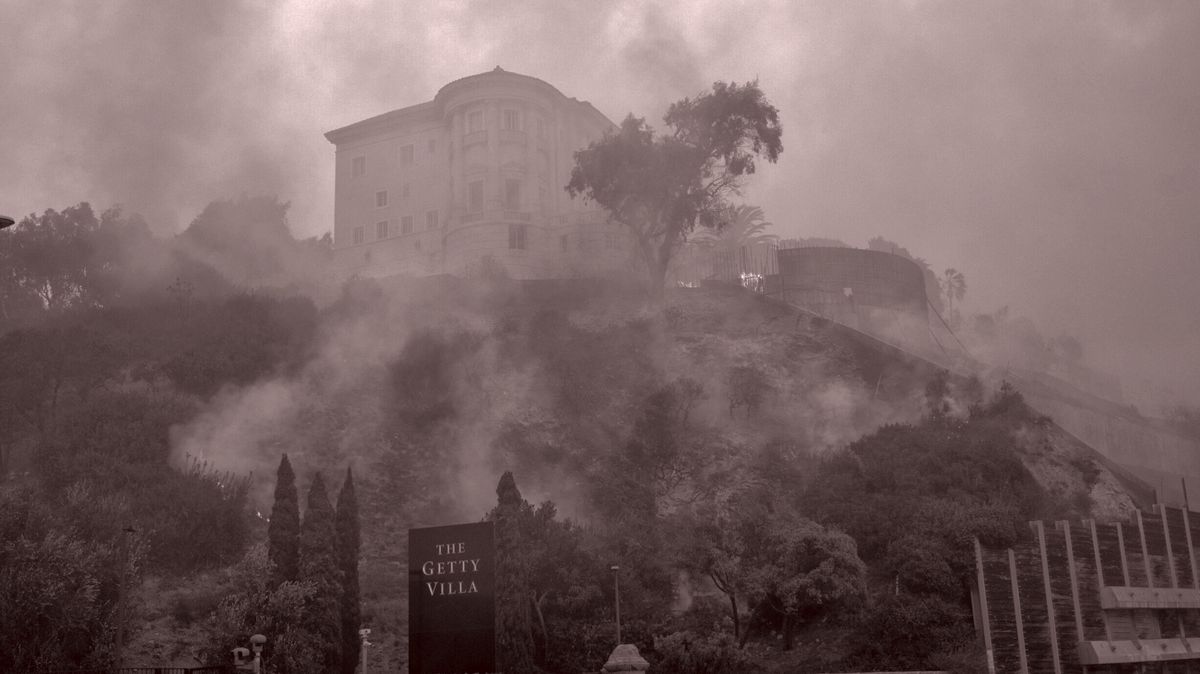
On Tuesday, when the Pacific Palisades fires started licking at the outskirts of the Getty Villa, which sits perched atop a bluff overlooking the Pacific, we had our first inkling of what might come later. According to the Los Angeles Times timeline, employees had less than two hours between the fire first being spotted and flames reaching the villa. The museum benefitted from having the foresight, planning, and gardening staff to aggressively clear brush on the property and cut back vegetation that could burn ahead of the dry season. Failing that, the museum has systems to mitigate fire hazard, including double walls, and ways to manage internal air circulation and seal off galleries from the smoke.
There are other measures that owners of high-value art can take to prevent fires, including filling rooms with nitrogen, which effectively smothers fire. But few homes have such sophisticated systems—especially since replacing a room’s oxygen also suffocates anyone trapped inside.
|
Los Angeles was in the midst of an insurance crisis before the fires even began, and underwriters were reducing their risk exposure throughout 2024. Beginning Wednesday, I started calling people in the art insurance, storage, and even shipping industries. One executive from a major art insurance firm based in London told me the extent of the lost art would be hard to evaluate because the information wasn’t “granular” yet. Besides, with the fires still raging, the adjusters haven't been able to get access to the properties to make assessments. Another art infrastructure executive told me that several private art collections have been lost, but it’s not clear what value the works might have had.
The good news, according to the executive, was that several evacuations took place in time. I also spoke to Caroline Page-Katz, the president and C.O.O. of Uovo, a Brooklyn-based art storage company with extensive facilities in Los Angeles, who told me Uovo began contacting their L.A. clients on Tuesday, the day the fires began. Although “the frequency has ebbed and flowed as the situation unfolds,” Page-Katz said, they are now fielding about five to 10 times the normal storage and transit requests. “In the beginning, requests were primarily coming in from the evacuation zones and adjacent areas,” she explained. “As the days go by, we are fielding numerous ‘wait and see’ requests in addition to those who are taking precautions even if they are not in the immediate vicinity. For clients in evacuation zones, we have coordinated safe zones to pick up property”—extra measures to make it easier for clients to bring their works to them for storage.
It will take years for Los Angeles to recover from these fires. Our hearts go out to everyone who lost something, but especially to those who lost everything. Please donate here so we can help.
|
About two years ago, art world group texts went wild over a rather tone-deaf and self-important job posting by an “art world family” looking for an “executive assistant.” The details of the job, which appeared alongside other entry-level employment opportunities on the New York Foundation for the Arts website, involved a grab bag of domestic chores—as though someone overwhelmed with adulthood had thrown up their hands and decided to hire someone to fix their life for them. “The ideal candidate,” the posting read, “must be dedicated to a simple goal: make life easier for the couple in every way possible.” At the time, The New York Times picked up the tale as fodder for its Styles section, and yesterday, the paper returned to the subject—in full Streisand effect mode—to explain that Sarah Hoover and her husband, artist Tom Sachs, were most definitely and absolutely not the anonymous main characters in the previous article. “Ms. Hoover, in an interview for this article,” the Times wrote, “said she did not post the ad.”
But in the new article, which was pegged to Hoover’s postpartum depression memoir, The Motherload, the couple do just about everything they can to present themselves as exactly the type of people who’d post such an ad. “Ms. Hoover has particular tastes,” the Times writes. “She rarely watches television. She reads widely, but almost exclusively books by women. … She also recounts how Mr. Sachs has rewarded her shamelessness. … Ms. Hoover knows that ‘The Motherload’ offers less than flattering glimpses of herself. She’s also aware that it may make her husband ‘sound bad,’ she said. But she has found power in opening up about the turmoil, angst and mess swirling around in her outwardly pretty life.”
See you Sunday, guys.
M
|
|
|
|
Puck founding partner Matt Belloni takes you inside the business of Hollywood, using exclusive reporting and insight to explain the backstories on everything from Marvel movies to the streaming wars.
|
|
|
|
The ultimate fashion industry bible, offering incisive reportage on all aspects of the business and its biggest players. Anchored by preeminent fashion journalist Lauren Sherman, Line Sheet also features veteran reporter Rachel Strugatz, who delivers unparalleled intel on what’s happening in the beauty industry, and Sarah Shapiro, a longtime retail strategist who writes about e-commerce, brick-and-mortar, D.T.C., and more.
|
|
|
Need help? Review our FAQ page or contact us for assistance. For brand partnerships, email ads@puck.news.
You received this email because you signed up to receive emails from Puck, or as part of your Puck account associated with . To stop receiving this newsletter and/or manage all your email preferences, click here.
|
|
Puck is published by Heat Media LLC. 107 Greenwich St, New York, NY 10006
|
|
|
|


.001_01JH968KA7TBWZJN51YGXYKZ9T.png "Barkley Hendricks, Untitled (1981)")