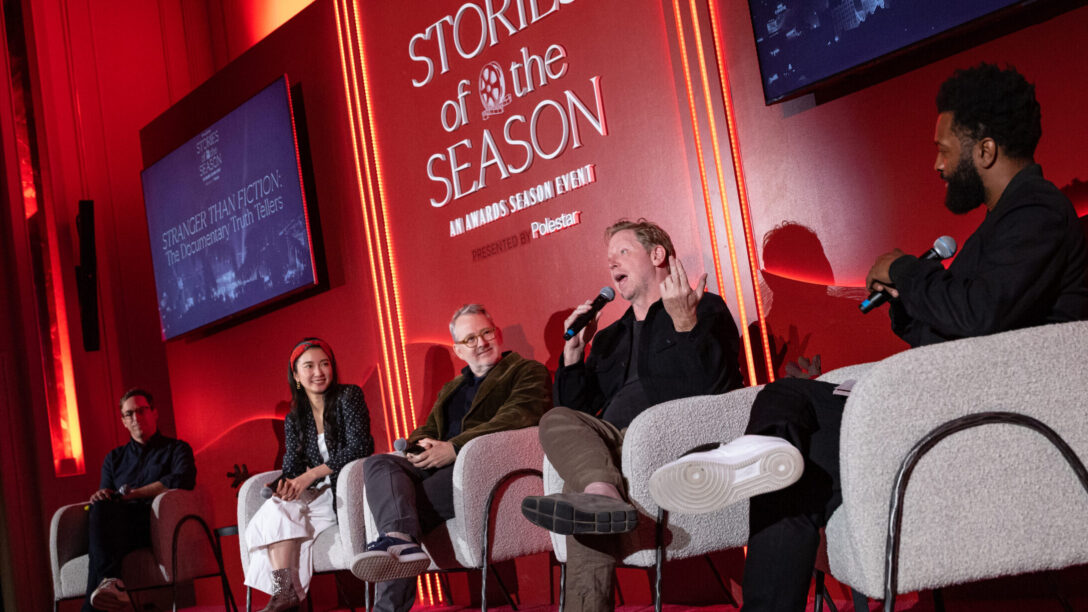
Candid reflections from a quartet of the year’s most compelling documentary filmmakers—Josh Greenbaum (Will & Harper), Morgan Neville (Piece by Piece), Matt Tyrnauer (Carville: Winning Is Everything, Stupid), and Shiori Ito (Black Box Diaries)—about their remarkable projects.
Josh Greenbaum, Shiori Ito, Morgan Neville, and Matt Tyrnauer on stage with Puck’s Baratunde Thurston.
Photo: Puck
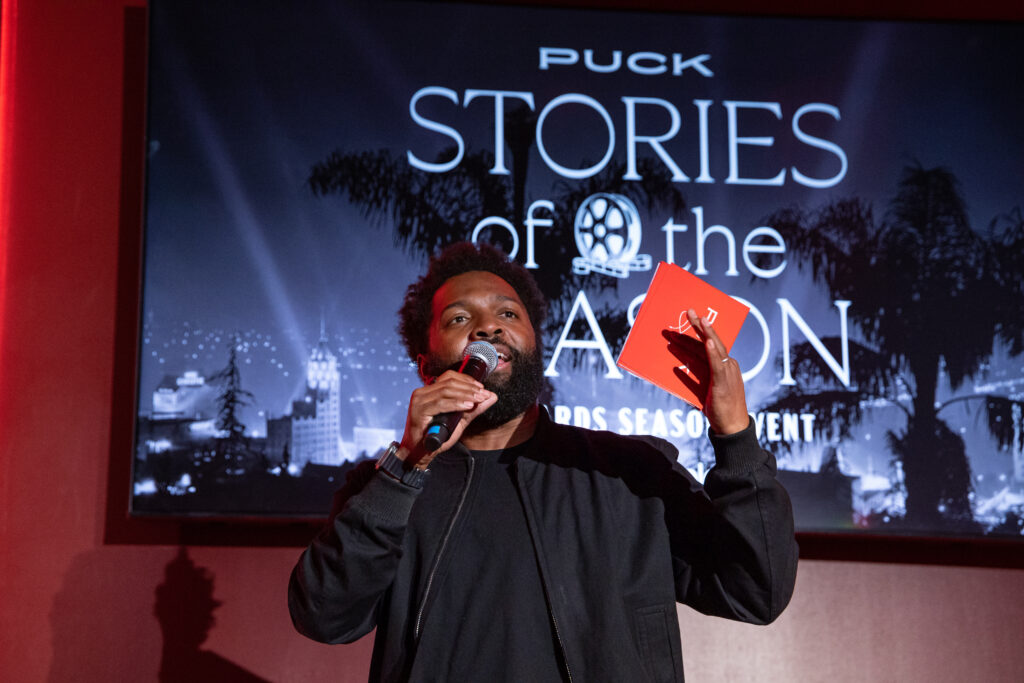
In this second of four panel conversations that comprised Puck’s inaugural Stories of the Season event in Los Angeles, our very own BaratundeThurston took the stage to interview a quartet of the year’s most compelling documentary filmmakers: Josh Greenbaum (Will & Harper), Morgan Neville (Piece by Piece), Matt Tyrnauer (Carville: Winning Is Everything, Stupid), and Shiori Ito (Black Box Diaries). Their brisk and candid conversation took place in front of an intimate crowd of awards season voters and Hollywood luminaries, and touched on everything from the surprising lessons they learned while making these extraordinary films, to the personal catharsis and moments of revelation that happened along the way. This conversation was supported by Mayer Brown.
The following Q&A has been lightly edited for length and clarity.
Baratunde Thurston: All of the stories that each of you helped tell are really powerful, so thank you for that service. Can you dig a little beneath the surface and share the one thing you really want people to know about or take away from your stories?
Matt Tyrnauer: Carville: Winning Is Everything, Stupid is a film about politics, and it’s about someone who’s 80 years old, who’s an icon and a living legend, and the person who reinvented the art of political consulting and taught Democrats how to win again in the early ’90s—a lesson that we probably could learn from again today. There was an idea that Carville had at the outset—and I don’t take direction from my subjects, but I thought this was a good idea—he wanted me to make a new generation of people understand that politics is a worthy pursuit. What I wanted to come through was the joie de vivre of James Carville, and his lust for the game and the way he played it. And the subtitle emerged as, Winning Is Everything, Stupid, because if you don’t win, to quote him, you ain’t gonna get your shit done.
Morgan Neville: Piece by Piece is a film about Pharrell Williams and his journey. But it’s not about what he did, it’s about how to be a creative person in the world. As a creative person, making this film became my therapy—addressing these questions about hanging on to your uniqueness in a world that’s trying to put you in a tube, and everything that Pharrell grappled with. What I’ve been happiest about is the creative people watching the film and saying, Oh, this film was for me and spoke to me. The film, fundamentally, whether or not you know anything about Pharrell, is a story of how you navigate being different in the world, particularly as a creative person.
Shiori Ito: Black Box Diaries is about me investigating my own rape case as a journalist. I had to cross the line as a journalist to make this film, because, as you know, the idea of journalism is to not be partial to anything. It was hard and very harsh; I had everyday exposure and therapy sessions. But now that I made this film, I really can tell everyone, If you have a trauma, make a film, because it really helps. I just want to encourage people and whoever watches it that you can also tell your story.
Josh Greenbaum: I’m a big believer in the expression that laughter is the shortest distance between two people, and Will & Harper is a story about two friends who connected through laughter. It’s also a look at America, a look at transition, and a look at the relationship between Will and Harper. Over the past week or two, I’m sure we’re all reeling in different ways—our incoming president spent over $215 million on anti-trans ads. To me, the only way to combat hate is with love and empathy, and so we need more stories. We need to take over the narrative, because when our leaders fail to set a moral compass, we have to do it.
So our film tells the story of two people involved in a very personal situation that seems political, but is actually incredibly intimate and personal—my hope is that it will spread that love and empathy and the message of compassion that we’re going to desperately need for the next four years.
Photo: Puck
Unexpected Twists
Sticking with you Josh, my deep takeaway from your story is that it’s a friendship story. Yes, it’s about trans issues, acceptance, and Americana—but it’s really about this relationship [between Will and Harper]. Did you know that going in, or is that something that emerged during the process?
Greenbaum: I think it was a bit of both. When we were starting the road trip, the question Harper asked was, I love this country, but does it love me back? She used to do these cross-country road trips all the time, and she wasn’t sure if she could continue to do them since she transitioned. Will had the idea of accompanying her on her first road trip and taking the timeto figure out what her transition meant for their friendship.
I don’t know that we can come away with a definitive answer of what America thinks about trans people, but what we discovered time and time again is that it’s hard to hate up close once we see each other eye-to-eye, which we’re not doing a lot of nowadays. Much of what Will is learning in our film is how to be a better friend and how to be a better ally. And so much of that is just showing up, sitting down, and listening. I hope we can all take away from the film that we need to reconnect and refine each other’s humanity.
Photo: Puck
Shiori, your film rocked me in many ways. With a little bit of distance from the time the film was locked, what has the impact been on your assailant, the system of accountability you were pushing to improve, and how you’ve seen yourself as the main character?
Ito: It’s been a challenge. We still haven’t been able to find any distributor or theater. It’s still a really taboo topic. So just being here, being able to start screening our film outside of Japan, it means a lot. I think it’s really hard to talk about this issue. So for me, this was my way to speak from the outside, and hopefully, we’ll reach back to Japan. The important thing is that I could feel that I had the power to tell my own story. And I really feel empowered by being able to do so, and I want to encourage others to do the same.
Morgan, tell me more about the choice of Lego animation and what else it allowed you to do.
Neville: I’ve made documentaries for a long time, but what animation allows you to do is not only see what you see with your eye, but to see what you see with your mind’s eye. Pharrell grew up in the projects in Virginia Beach, and he was conscious about wanting to show that place could be difficult, but it could also be magical. Being able to see Virginia Beach through his eyes was one of many things that animation allowed us to do. It allowed us to time travel, to go to outer space—but really it was about being able to represent his creative process and the creative process visually.
One of the great discoveries at the beginning was that Pharrell has synesthesia, so he sees color when he hears sound. That instantly became this idea that we could see sound throughout the film. It’s interesting that the documentary sensibility is exactly the opposite of the animation sensibility. In animation, the director gets to decide everything; in documentary, you don’t get to control anything.
Matt, I spent some time with James Carville when I did a live election night broadcast with Brian Williams, and I felt like I knew him because I saw your film; he was exactly the way he was portrayed in that film. What do you think went into that?
Tyrnauer: James is James. There are just certain characters who are just always themselves. And he was a joy to make a film about because there’s no pretense and he’s completely comfortable with a crew around. He’s very comfortable in his own skin. He made my job a little easier because of that. The trouble with this film was that he inserted himself into the 2024 election cycle in a very unexpected way—but we managed to track the cycle with Carville, and you see a master at work in real time.
Didn't get an email? Check your spam folder and confirm the spelling of your email, and try again. If you continue to have trouble, reach out to fritz@puck.news.
Didn't get an email? Check your spam folder and confirm the spelling of your email, and try again. If you continue to have trouble, reach out to fritz@puck.news.
Member Exclusive
Get access to this story
Create a free account to preview Puck’s full offering, including exclusive articles, private emails from authors, and more.