
Join Puck to listen to this article
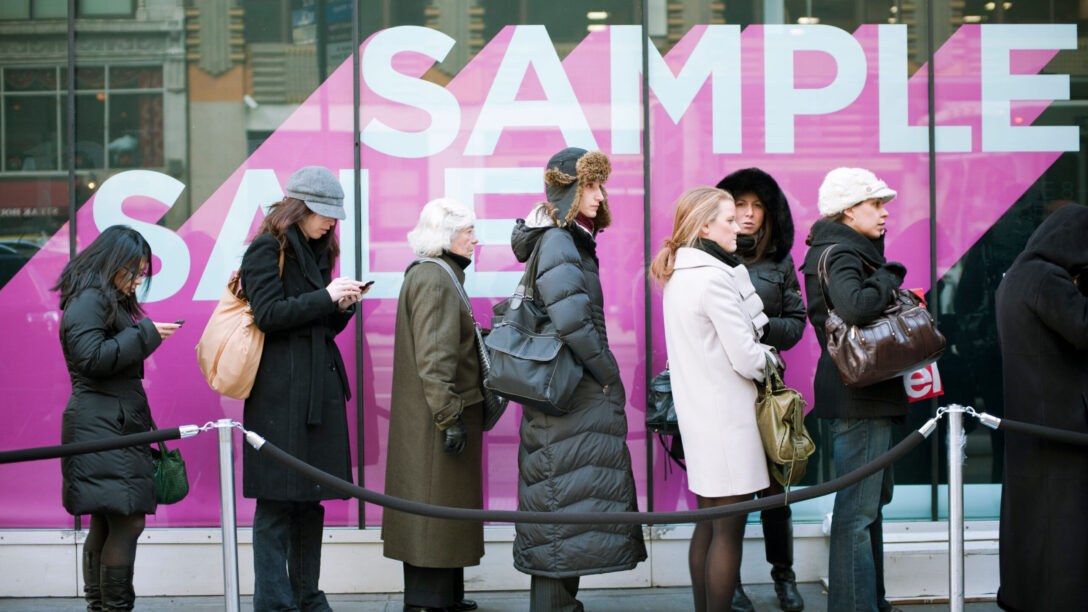
This week, hundreds of New Yorkers waited in a line that wrapped around 18th Street for the chance to buy $1,200 jackets, marked down from $4,950, at The Row’s annual fall sample sale. Later, on TikTok and Instagram, shoppers posted hauls that might have been equivalent in value to an annual entry-level salary before the markdown.
Of course, none of these shoppers was in any kind of financial distress—even the wealthy and wealthy-adjacent tend to enjoy a good deal. And yet, there’s no doubt we’re living through an unusual economic moment: U.S. retail spending is holding strong, but luxury is under pressure amid persistent price inflation, which is driving consumers toward resale channels.
Anything can look recessionary if you squint hard enough. But the reality is more nuanced: Consumer spending on retail and apparel isn’t declining, it’s decelerating. Most Americans aren’t broke, they’re just changing how and where they shop. At Rent the Runway, active subscribers grew 13.4 percent year over year in Q2—after all, you can rent a Proenza Schouler White Label jacket for one month for $89, splash it on your Instagram feed, return it, and achieve the same status boost you used to get from buying the piece for $795. Meanwhile, at The RealReal, where a Chanel jacket can live five lives in three years, consignor inventory was up 22 percent year over year in Q2. Meanwhile the number of active buyers increased to 1 million, up 6 percent, and average order volume rose to $581 from $538 in Q2 2024.
That’s not to say that the TikTokers tracking recession indicators through Depop prices, unadorned nails, grown-out roots, and miniskirts aren’t onto something. Consumer sentiment continues to drop—the latest survey out of the University of Michigan, released this morning, shows that confidence in the economic climate is at its lowest point since the almost-recession in 2022. But data from Klarna shows that delinquency rates continue to fall even as more people are using buy-now, pay-later services.
Instead, consumers are changing their relationship with clothes—becoming more discerning about what is worth full price, and what they actually need in their closet. When affluent shoppers are Marie Kondo-ing their Hermès Picotin and The Row handbags while strategically using credit card points for vacations and B.N.P.L. services for a new Prada leather jacket, we’re not witnessing a typical financial dip.
Empires of Excess
This psychological shift is happening amid a perfect storm of retail confusion—tariff uncertainty, credit tightening (as my colleague Bill Cohan has detailed), consumer fatigue, etcetera. As a result, it can be hard for brands to diagnose whether customers have pulled back on spending due to tightening budgets, exhaustion, price confusion, or simply sobering up from decades of overconsumption. To some retail executives, the slowdown feels like a personal affront—they built their careers on the premise that consumers could be nudged, gamified, or algorithmically manipulated into perpetual motion. Now, those same consumers are treating marketing like spam and algorithms like noise.
Meanwhile, the real and imagined impact of Trump’s tariffs has roiled the retail prediction market. Back in June, for example, Morgan Stanley forecast that spending growth for this year would slow to 3.7 percent, from 5.7 percent in 2024, after a surge in pre-tariff purchases was followed by a pullback. Shipments from Shein, the Chinese fast-fashion e-commerce giant, were down around 8 percent in September versus a year prior, according to Bloomberg, one of its worst monthly performances over the past three years. Meanwhile, brands are raising prices—jackets and outerwear are 24 percent more expensive this year, according to AlixPartners—despite the president’s demands that retailers accept lower margins. The average price for a dress is up 20 percent, and bags are 15 percent more expensive than last year.
Retailers can’t tell if their problems are cyclical, structural, or self-inflicted. That uncertainty can be dangerous, because they don’t know what problem to fix and might be tinkering in the wrong area. For now, they’re mostly acting as though the problem is cyclical—that sentiment will rebound, and volume will follow. But what if the real story is structural? This isn’t a temporary chill in spending; it’s a cultural repricing of consumption itself. If the last decade was defined by abundance—cheap capital, infinite content, two-day shipping—the next may be defined by calibration. Retailers are no longer competing for attention, but for justification. Every purchase—especially that $90 white tee—must now defend its existence. That’s a scary proposition for anyone who built their empire on excess.