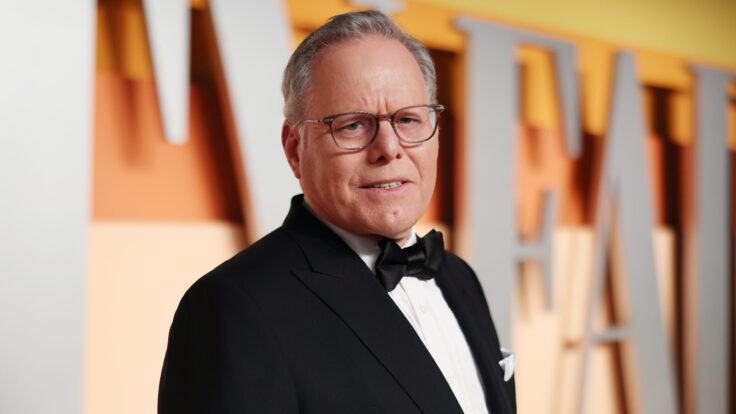
Welcome to Dry Powder. I’m Bill Cohan, here in the Northeast, where it seems to have rained every 20 minutes since April, and where Dry Powder’s prevailing person of interest, David Zaslav, remains a source of constant fascination.
You have to admit it: Zaz has a way with debt. He gave birth to Warner Bros. Discovery on $55 billion of it, anointing himself a media macher in the process, and has been surprisingly adept at paying it down. Now, as he spins off his declining cable assets, he’s making a highly unusual tender offer, and using debt as a cudgel of sorts, coercing his bondholders to buy it back, or get stuck holding the bag. As I note below, if he can pull it off—and he seems to be pulling it off—it’s a maneuver we may see again and again.
Meanwhile, amid warfare in the Middle East and that Liberation Day pause ending, Trump signaled some positive news for Dry Powder’s other favorite protagonist, Shari Redstone. “ Ellison’s great,” Trump told reporters this afternoon. “He’ll do a great job with it.” Presumably, the president was referring to David Ellison, who has been trying to get his hands on Redstone’s Paramount for the better part of a year, with a final deal extension looming. Have the Trump-Redstone mediation talks advanced? Is the F.C.C. ready to give the merger a greenlight? As the president said regarding our potential bombing of Iran nuclear sites, “nobody knows what I am going to do.”
📝 P.S.: We’re always kicking the tires around here to figure out how to optimize your Puck experience. If you have a couple minutes, here’s a brief survey for our readers.
Okay, let’s get started…
|
- A billion-dollar Bitcoin buy: Microstrategy, Michael Saylor’s publicly traded Bitcoin repository that occasionally moonlights as an enterprise software company, continues its phenomenal ride in the stock market. (Saylor has now shortened the name of the company, Sean Parker–style, to just Strategy.) On June 16, Strategy announced that it had bought another 10,100 Bitcoin for an aggregate purchase price of $1.051 billion—or around $104,080 per Bitcoin, slightly less than where they’re trading these days. As of June 15, Strategy owned 592,100 Bitcoin, for which the company had paid nearly $42 billion at an average purchase price of $70,666 per coin. The market value of Saylor’s stash is nearly $62 billion, giving Strategy a Bitcoin gain of $20 billion.The market value of Strategy is even higher: $103 billion, while the company’s enterprise value, including debt and preferred stock, is $115 billion. The stock price is up 23 percent this year, and 145 percent over the past 12 months, far outpacing the equity markets, and companies such as Tesla (up 71 percent), Meta (up 40 percent), and Apple (down 9 percent).Along with BlackRock’s Bitcoin ETF fund, investing in Strategy is probably the easiest way to speculate on the price of Bitcoin these days. But I can’t help but wonder if Saylor himself is increasingly becoming the market for Bitcoin. After all, the currency supply is permanently capped at 21 million Bitcoin. So with a committed buyer like Saylor always in the market buying, buying, buying—that activity continues to drive up the price. Saylor, who I’m convinced is some sort of genius, doesn’t see it this way, of course. He continues to argue that Bitcoin, which didn’t exist prior to 2008, remains a bargain. He has predicted the price of a single Bitcoin will reach $13 million by 2045, giving the Bitcoin asset class a total value of $280 trillion—which, if that happened, would make it the most valuable commodity on Earth. A big if.
- Trump phones it in: On Monday, the 10th anniversary of Trump’s fateful descent down the escalator, Eric Trump was everywhere in right-wing media pushing Trump Mobile—the new family business cum marketing ploy to get people to fork over $47.45 a month (get it? Trump is both the 47th and 45th president) for wireless phone services. Trump Mobile is what’s known in the industry as an M.V.N.O., or mobile virtual network operator—i.e., a cellular service provider that leases access to the network infrastructure of, say, AT&T or Verizon. Naturally, Trump Mobile will be more expensive on a monthly basis than other M.V.N.O.s, such as Mint Mobile ($30 a month) and Boost Mobile ($25 a month). The $499 phone itself, dubbed the T1, is gold-colored, and will purportedly begin shipping later this summer. It features the American flag and the slogan “Make America Great Again.”
Eric implied on Monday that the T1 will be made in the United States, keeping with his father’s Made in America push. But there was a rather glaring caveat. “Eventually all the phones can be built in the United States of America,” he told Fox Business supplicant Maria Bartiromo (emphasis mine). In other words, the phones may not be made here anytime soon. The consensus seems to be that while the phones will eventually be assembled in Alabama, Florida, and California, many of the components, no surprise, will be manufactured overseas, mainly in China. But that wasn’t stopping Eric. “We have to bring manufacturing back here,” he continued. “And so our ethos is, Built for Americans, by Americans. Do it cheaper, do it better.”Eric also boasted that the Trump Mobile call center will be in St. Louis, not Bangladesh. “I think we’re going to shake up the space in a very big way,” he told Maria. He then fully descended into buzzword-laden gobbledygook. “Obviously, real estate has always been our bread and butter, but when you take the technology world between, the social platforms, you know, the actual hard devices, which is really what Trump Mobile is, you know, and then kind of the true retail banking, CeFi, DeFi in a world of cryptocurrency—which is no question where the world is going—I really believe we’re going to have one of the great, kind of, tech platforms as part of the Trump Organization of any company in the world, and I couldn't be more proud of Trump Mobile.” The apple really doesn’t fall far from the tree.
|
|
And now, more on our friend Zaz…
|
|
|
|
David Zaslav leveraged his way to media moguldom, then diligently paid down $21 billion of debt in three years, and is now making an unusual debt tender offer as part of the process of spinning out WBD’s linear TV assets. Is the offer really too good to refuse, or is it a coercive maneuver that leaves bondholders with little choice?
|
|
|
|
These days, everyone and their dog seems to have an opinion on the soon-to-be-concluding Warner Bros. Discovery experiment. Should the deal have been consummated in the first place? Was its $55 billion in debt the original sin? Will the recently announced split get everyone to the promised land? In the meantime, however, there is some clarity on the initial phase of the separation plan—the highly unusual tender offer for a big chunk of the company’s still-outstanding $37 billion of debt: It’s proving to be an unqualified success.
As of last Friday, WBD’s bondholders had pretty much agreed to tender their bonds back to the company for a variety of premia, depending on the bond. As part of the successful consent solicitation, they’ve also agreed to allow the company to be split in two, and both new entities to issue as much secured debt as they want. As Fraser Woodford, the WBD executive vice president who has managed the process for the company, told me, “We made an offer that we thought was fair, that we thought was appropriate—and I think, ultimately, bondholders agreed.”
The preliminary results, as of June 13, bear that out. As you recall, Zaz & Co. arranged for a $17.5 billion bridge loan from JPMorgan Chase, some $14.6 billion of which is being used to buy back a meaningful portion of WBD’s outstanding debt—much of which is long-dated and low interest, since it was issued during the Fed’s 13-year period of quantitative easing. Now that the Fed has raised rates, much of that debt is trading at a discount.
The idea behind the somewhat coercive tender offer is to allow WBD to capture that discount by offering bondholders a premium to where the debt is trading, but at a price often well below par, or 100 cents on the dollar. According to Woodford, WBD hopes to capture around $3.4 billion of the discount before it closes the tender offer toward the end of the quarter. That’s an impressive bit of corporate finance jujitsu.
WBD sliced its offer into six pieces, grouping various maturities, coupons, and types of bonds together, and making above-market offers for them, some with consent fees, some without. Over the past week, Woodford has spoken to many of WBD’s bondholders, both on the phone and in two in-person meetings with groups of 30 bondholders at Barclays on Seventh Avenue. During those conversations, Woodford no doubt made clear what could happen if bondholders didn’t accept—a path that would probably be materially worse for both bondholders and the company. But so far, a majority of bondholders in each tranche—and in most cases, a substantial majority—voted to tender their bonds to the company, and to consent to the changes in the provisions governing the bonds. On the low end, 58 percent of the holders of a $225 million issue of senior notes, due 2042 with a 4.95 percent coupon, tendered. (There was no consent fee offered to this group.) On the high end, nearly 99 percent of the holders of a $7 billion issue of senior notes, due 2052 with a 5.14 percent coupon, tendered—and split more than $10 million of consent fees.
|
|
WBD could have created a structure without seeking any consents, which would have left all the debt with the declining Global Networks company. Also, as part of the tender, WBD offered a junior secured position to holders of unsecured bonds. The company didn’t have to do that, either. WBD could have not made the tender offer at all, of course, and instead just gone into the market and bought the bonds back at prices below what it’s offering in the tender. At one point last week, the D.C. law firm Akin Gump tried to organize the bondholders in order to negotiate better terms with WBD, but the effort fizzled. One bondholder joked—or at least I think it was a joke—that the bond offers were “coercive” because they were “so fair” that he didn’t have any choice but to accept. “This was the best outcome for everyone,” Woodford told me. “We paid for certainty.”
There are some other interesting wrinkles. After the tender offer closes, the outstanding debt that did not tender, or that was not bought in, will likely trade down. If that happens, since the bridge loan is for about $3 billion more than what WBD will likely end up putting toward the tender offer, it will be able to use that money to buy back more of its debt at an even deeper discount. Time will tell, but it’s another interesting coda to this first phase of the split.
WBD will next refinance the JPMorgan Chase bridge loan with new debt. While it’s true that the new debt will be issued at higher interest rates than the debt the company bought back, there will be less of it—probably around $30 billion, as opposed to $34 billion now. WBD also got approval from bondholders for an unusual “non-boycott” provision that prevents them from colluding to force the company to pay higher interest rates, or to secure better terms when it refinances the bridge loan. That won’t happen now, if it could ever have happened. (How do bond investors around the globe band together sufficiently to force an issuer to pay up?)
When all is said and done—after the fees are paid to the investment bankers and the lawyers—I assume the tender offer will result in a cleaner balance sheet for WBD, and an income statement with less interest expense. WBD’s equity investors seemed to agree, with the stock up around 6 percent so far this week.
|
|
Still to be determined, of course, is how much of the $30 billion of remaining debt post-tender will be apportioned to each of the split companies, Global Networks and Streaming & Studios. As I’ve reported, I suspect that the bulk—around $25 billion—will stay with Global Networks, which is expected to have around $6 billion of adjusted EBITDA in 2026, more than enough to service that level of debt. The remaining debt will go with S&S, which the company projects will have around $3 billion to $4 billion of adjusted EBITDA in the coming years.
WBD C.F.O. Gunnar Wiedenfels, who is slated to become the C.E.O. of Global Networks, has pretty much confirmed that allocation, without getting into specifics. “It’s too early to talk about a target capital structure,” Gunnar said last week on a conference call with Wall Street analysts, adding that “it’s safe to assume that the majority of the debt is going to live with Global Networks, and a smaller portion—but a not-insignificant portion—on Streaming & Studios.”
This lack of clarity has left some analysts peeved. “We view this statement as both ridiculous and extremely problematic,” analysts at CreditSights wrote in a June 9 research report. “Without this information, it is impossible to accurately assess the credit profile, and by extension appropriate trading level, for WBD’s bonds.”
I chatted recently with Joshua Kramer, a special situations analyst at CreditSights and one of the authors of two reports about WBD’s tender offer. He essentially told me that WBD made its bondholders an offer they couldn’t refuse. “This was an exit, consent, discount-capture, covenant-stripping deal, which we see in the distressed universe,” he said. “But done to an investment-grade company—that is not the way things normally work. There’s nothing that stops any company in the world from going out and doing a deal like this, except for—and I know you worked in the industry—the short memory of the debt market.”
Joshua wasn’t sure who conceptualized the tender offer, whether it was someone at WBD, or someone at JPMorgan Chase or Evercore, its two financial advisors on the split. “But it’s a great structural win,” he said. He agreed that the WBD tender offer was “coercive” and added, “It’s the difference between a carrot-only exchange offer, and a carrot-and-a-stick exchange offer. To show up with this kind of stick in an investment-grade, crossover-type company is new.” Unwittingly or not, WBD may have created a whole new strategy for using a tender offer to capture the trading discount in bonds on the BBB cliff.
|
|
Finally, we’ve also gotten some clarity on the new contracts for Zaz and Gunnar, who will become sister C.E.O.s. For Zaz, the WBD board had to decide whether to factor in the recent nonbinding shareholder vote in which a majority voted against his $52 million 2024 pay package, presumably out of pique over the 60 percent decline in the WBD stock since it was first listed in April 2022. I don’t think most people have taken the time to study Zaz’s compensation package, which has been heavily weighted toward paying down debt and increasing the stock price. His annual cash compensation of $3 million is obviously well below the $52 million headline number that gets all the attention. His new deal is also heavily weighted toward getting the stock price moving, as it should be.
Zaz’s employment with S&S now runs to December 2030, according to a Monday filing with the S.E.C., with his annual cash compensation remaining at $3 million. However, his annual cash bonus target has been reduced from $22 million to $6 million, but could be as much as $12 million, depending on the company’s performance. The new contract reduces his annual equity incentive from $23.5 million to $15.5 million in the first year after the S&S spin, and then to $7.5 million in future years.
If he remains at the company for five years, he’ll also receive stock options for some 24 million WBD shares, with a strike price of $10.16, which obviously could be quite valuable if the stock appreciates post-spin. (The option grant is already in the money, with the WBD stock trading at around $10.40, even if it can’t yet be exercised.) Zaz’s new contract also includes a monthly car allowance of $1,400, and “personal” use of the corporate jet for up to 125 hours a year, to be paid for by S&S. (“Personal” use being, for instance, Zaz’s wife joining him on business trips.)
As for Gunnar, his new contract runs until December 2031 (but only if and when he becomes C.E.O. of Global Networks) and will pay him $2.5 million in cash annually, with a maximum annual cash bonus of $17.5 million. He’ll be eligible for another $16 million in annual stock grants, which will vest over time, and conditionally, plus a one-time $15 million equity award post-close.
Now that the debt deal is pretty much wrapped up, and both Zaz and Gunnar have cut their new contracts, all that’s left to contemplate is whether the stock of these two companies will finally levitate, and whether Wall Street’s M&A bankers will be able to cook up some deals for each of Zaz’s S&S and Gunnar’s Global Networks. It’s the gift that keeps on giving.
|
|
|
|
Join Puck’s chief political columnist, John Heilemann, as he roams the corridors of power and influence in America on this twice-weekly interview show, taking you beyond the headlines with the people who shape our culture: icons and up-and-comers, incumbents and insurgents, moguls and machers in the overlapping worlds of politics, entertainment, tech, business, sports, media, and beyond. The conversations are rich and revealing, unrehearsed and unexpected… and reliably impolitic. A Puck-Audacy joint, new episodes drop every Wednesday and Friday.
|
|
|
|
Puck’s daily political newsletter from Washington on what’s really happening in this town, from the White House to the Pentagon to Capitol Hill, K Street, and the campaign trail.
|
|
|
Need help? Review our FAQ page or contact us for assistance. For brand partnerships, email ads@puck.news.
You received this email because you signed up to receive emails from Puck, or as part of your Puck account associated with . To stop receiving this newsletter and/or manage all your email preferences, click here.
|
|
Puck is published by Heat Media LLC. 107 Greenwich St, New York, NY 10006
|
|
|
|