{{ 'now' | timezone: 'America/New_York' | date: '%b %d, %Y' }} |
|
|
Welcome back to Dry Powder, live from Nantucket. I’m Bill Cohan.
In
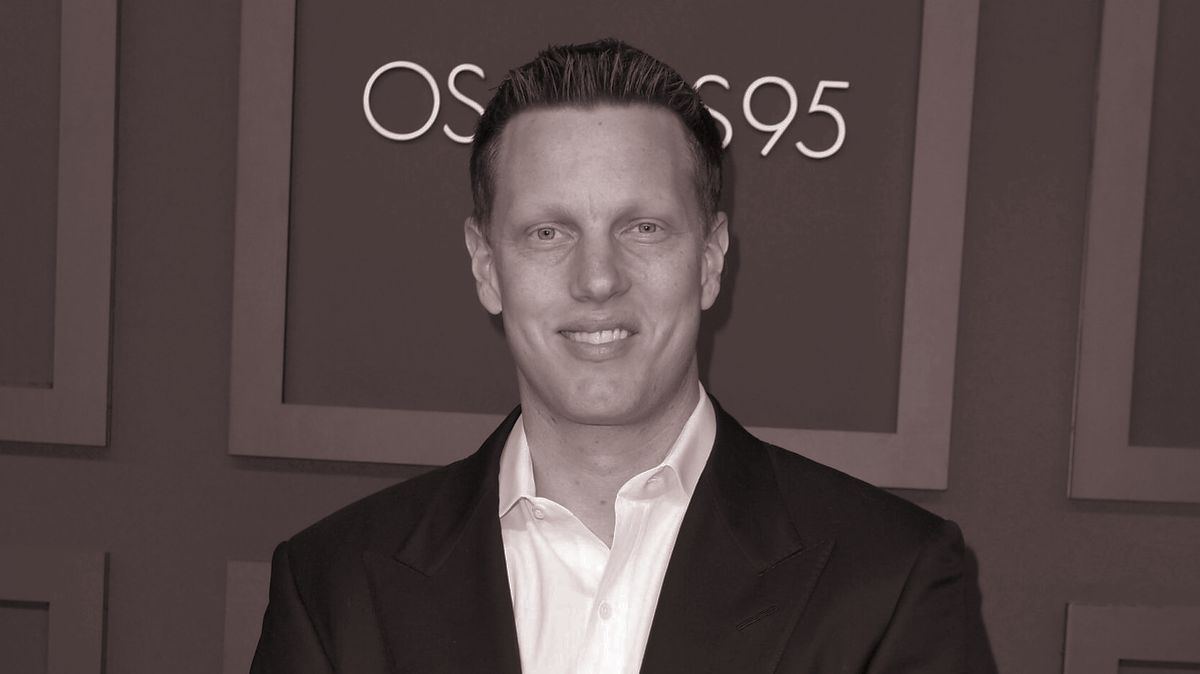
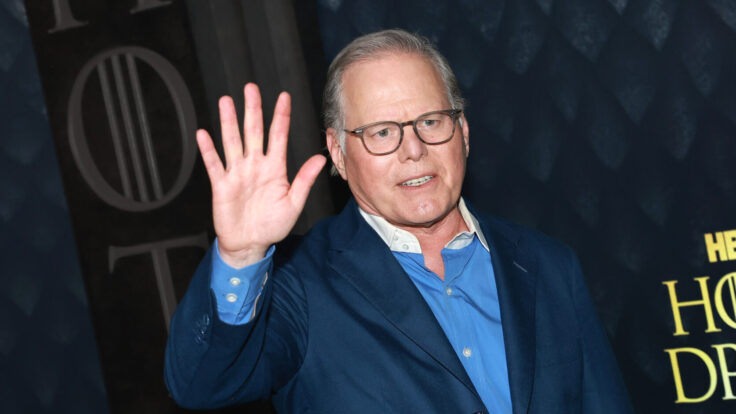
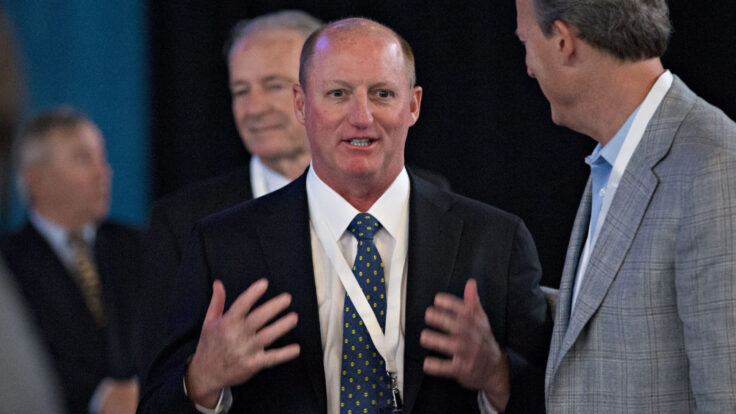
today’s issue, it’s the tale of two Davids. A few days into his deleveraged recap journey, David Ellison is reciting his gospel about somehow pivoting Paramount from a legacy mishmash of media assets into a veritable tech player—all as the arbs exit the stock. Meanwhile, David Zaslav’s green shoots at WBD remain obscured by the spooky and accelerated demise of its cash-generating cable assets. Is this the natural course of things, or simply a holding pattern
until the company splits next year and Gunnar Wiedenfels is left holding the bag?
But first… |
- A
retro private equity play?: Not many people are aware of Section 1202 of the Internal Revenue Code, which gives investors in small businesses a potential 100 percent capital gains tax exclusion under certain conditions. (It’s been around since 1993 and amended many times since, but was further “enhanced” by the Big Beautiful Bill.) The federal capital gains avoidance applies to the greater of $10 million of gain or 10x the taxpayer’s basis in the stock. To qualify for the exclusion, the
company must be a C corporation and have had assets of less than $50 million at the time of the investment and immediately after stock is issued to investors. The stock also must be primary shares of the company—not secondary offerings acquired from existing shareholders—and be held for five years.
Service-oriented businesses, such as law, financial services, or consulting firms, do not qualify for this benefit. But tech, retail, and even manufacturing businesses would qualify
for the exemption. It’s probably no surprise that I keep hearing about some smaller LBO shops actively seeking out smaller manufacturing businesses to buy, and to hold for at least five years, before selling in order to qualify for the exemption. Who knew? - A reminder from the I.P.O. market…: You remember the Newsmax I.P.O. that I wrote
about in April? The company, controlled by Chris Ruddy and Thomas Peterffy, went public in March at $10 a share and then promptly soared to $83.51 on its first day of trading, up a ridiculous 735 percent. (More than Figma!) The next day, the stock moved up to $233 a share, up 2,230 percent in two days.
Obviously, this could not be sustained. And it hasn’t been. The stock now trades at around $11.50 a share, barely above its I.P.O. price, and down
86 percent since it went public. So that’s kind of crazy, but not surprising, and yet another example of how toppy the market has become.
|
And now on to the main event… |
|
|
News and notes on the viability of David Ellison and Gerry Cardinale’s Paramount promises,
plus Zaz’s stock conundrum. |
|
|
This week’s financial news was dominated, of course, by the changing of the guard at Paramount Global after
the Ellisons and RedBird Capital struck their $8 billion recapitalization deal with the company, and its largest shareholder, National Amusements Inc. The $16 million ransom payment was made to Trump, regulatory approval was granted, and now the Redstones are finally gone, ending a nearly 40-year run at the company and its predecessors. I think that’s probably good news all around. The family patriarch, Sumner Redstone, wasn’t compos mentis long enough to see what his daughter, Shari, did to the
company before he died in 2020, age 97. And I suspect Shari and her family are breathing a serious sigh of relief now that the deal is closed.
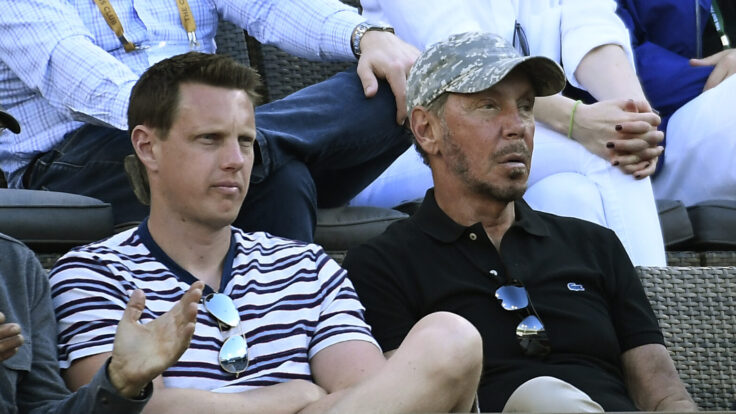
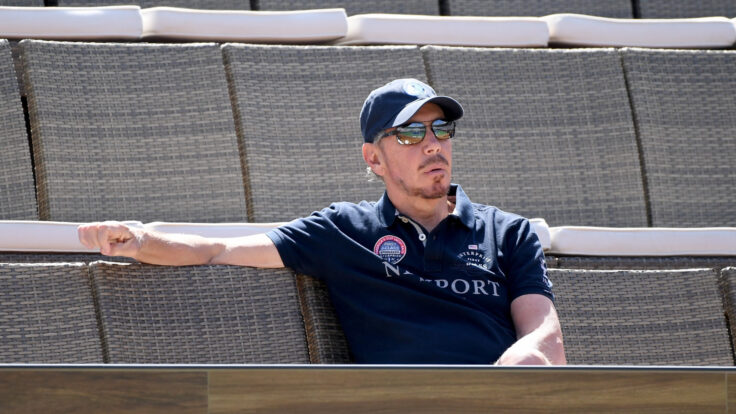
The Redstone heirs get their $2.4 billion in cash, some $300 million of which will be used to pay off a loan to Larry Ellison, while another $250 million or so will be used to pay off the quickly accreting preferred stock investment that is owed to Shari’s investment banker, Byron Trott, and his firm BDT & MSD Partners. It’s probably a good thing
that Sumner isn’t around to witness, first-hand, the value destruction here, but whatever the after-tax proceeds are of that $1.85 billion cash infusion will probably be more than enough for Shari and her kids to continue to live in the style to which they have become accustomed.
Anyway, the recapitalized company, now known as “Paramount, a Skydance Corporation,” has debuted on the Nasdaq under the new ticker symbol PSKY (get it?). It’s hard to predict how the stock will trade, but the
new company has got more equity, and less debt, than it did before, plus a new management team, and David Ellison’s Skydance Media merged in. Big cuts are coming, we’re told, as well as new investments designed to optimize Paramount’s tech stack.
There aren’t many examples in the market of a deleveraged recap—a situation in which there is a change of control and debt reduction, but the company remains publicly traded. It could all go to zero, or it could trade up and into the
$40-per-share range, as the Ellisons are undoubtedly hoping. At the moment, the stock is sitting around $10.60 a share, down about 10 percent since the deal closed on Thursday, but that’s probably more due to the arbitrageurs selling out and less a sign that the deal is going to sour.
I suspect investors are in serious wait-and-see mode. Can David Ellison and corporate president Jeff Shell—who will each earn annual salaries of $3.5 million, plus annual bonuses and stock grants that vest
over five years—slow the declines in PSKY’s linear assets? Can they grow the profitability of Paramount+, which only recently escaped breakeven? Will the $2 billion in promised expense cuts be realized, or even exceeded? Will the Ellisons achieve any of the vaunted technological innovations they’ve been promising, and if so, with those innovations be significant enough to move the EBITDA needle? If Ellison and Shell can deliver, the stock should react positively. Until then, it could be choppy
sailing indeed. (This is not investment advice.) |
Already, though, there appears to be a different feel at the company. Last week, members of the conquering
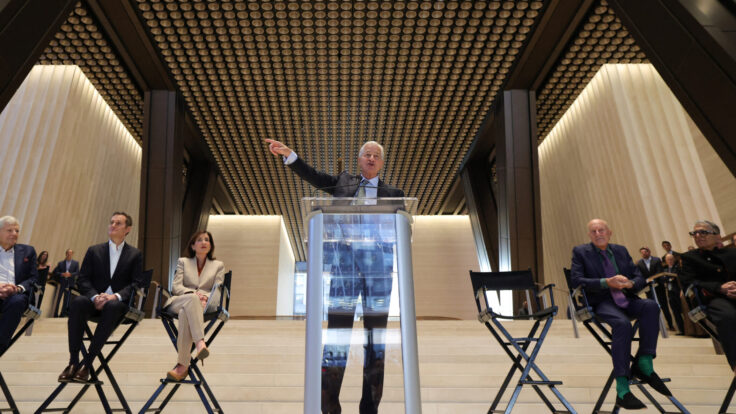
army—David and Jeff, as well as RedBird principal Gerry Cardinale, former Paramount Global fractional C.E.O. George Cheeks, and Andy Gordon, who spun out of RedBird to become the PSKY C.O.O.—sat on a stage at the Paramount building in Times Square in front of a gaggle of about 30 reporters. (I was invited to the event late Wednesday afternoon but couldn’t make it.)
As my partner Matt Belloni
reported, the group did their best to answer questions and convey the company’s new direction. “Unless you can build a tech product that is truly competitive with what’s coming out of Silicon Valley, you can’t compete,” Ellison said, according to a transcript that made the rounds. “And that has been one of the big problems that’s been facing legacy media, is they
don’t actually understand the skill set, and how critical that is, and that it is actually a combination of great content working with tech product, hand in hand. That is how you actually get this business growing and scaling again, and you need both.”
Sounds good, even though I’m not exactly sure what any of that means. In a conversation with CNBC’s Dave Faber on Friday, Ellison elaborated that one obvious technological improvement would be to “converge” the company’s
three streaming businesses, which operate on separate tech stacks on multiple clouds, into “one unified tech stack in one cloud.” Cardinale, the ex-Goldman banker, put it more bluntly. “The most important thing a modern media company today needs to do is stop keeping its head in the sand,” he said. “The world’s not going to come to you, you better go out and grab it.”
Over at Status, Oliver Darcy reported that Ellison
sidestepped some of the more burning questions on the minds of the assembled journalists, such as whether Ellison had in fact made a secret deal with Trump for $20 million in public service announcements, to air on CBS, for topics Trump favors. Darcy reported that Ellison, in effect, wouldn’t answer, declining to “politicize” anything and wanting Paramount
to appeal to everyone. For his part, Darcy asked whether Ellison and his team would commit to leaving 60 Minutes alone. More sidestepping, it seemed, although Ellison did reply that 60 Minutes had been his first stop once the deal closed. “It is literally day one,” Ellison said. “We’re not going to sit up here and say we have every answer today.”
Gerry, again speaking more directly, added, “Don’t buy a news organization, whether broadcast or print, if you want to
influence it.” Cardinale recently bought The Telegraph, in the U.K., from his Jeff Zucker–led affiliate, RedBird IMI. As for whether Ellison was going to buy The Free Press, and thus the “advisory” services of Bari Weiss, he declined to comment on “rumors.”
Of course, that’s hardly the only rumor flying around about Ellison’s M&A ambitions. As my colleague Kim Masters
reported the other week, there’s plenty of chatter in and around Hollywood these days about whether Ellison intends to take a run at Warner Bros., too, if the price is right. After all, Skydance-Paramount is still subscale, and David has essentially unlimited access to capital, via his father. Another industry fantasy, perhaps, but money has a way of creating
its own momentum.
Indeed, I’ve been struck by all the bankers and lawyers involved in the deal, including the likes of Centerview Partners and Cravath, for the Paramount Global special committee; the aforementioned BDT & MSD Partners and Ropes & Gray for National Amusements; LionTree, Rothschild, and Simpson Thacher for Paramount Global; and RedBird, Bank of America, Moelis & Company, and The Raine Group, as well as Latham & Watkins and Sullivan & Cromwell for Skydance, Gerry, and the
investor group. Their payday has been a long time coming.
I am also struck by the composition of the new PSKY board of directors, which seems to offer a big tell regarding the future of Ellison’s deleveraged recap play. This thing seems like a Ferrari, champing at the bit to race. In addition to Ellison, Cardinale, Shell, and Gordon, there is Sherry Lansing, the 81-year-old longtime Hollywood executive and former Paramount chief; John Thornton, a former
C-suite M&A executive at Goldman Sachs who is now an executive at RedBird; Safra Catz, the C.E.O. of Larry Ellison’s Oracle; Barbara Byrne, a former Paramount board member and a former Lehman Brothers banker; Justin Hamill, the chief legal officer at Silver Lake Partners; and Paul Marinelli, the president of Lawrence Investments, Larry Ellison’s investment firm. That seems to me like a board gearing up for some serious
deal-making. We shall see. |
One of those deals being bandied about, of course, would be for WBD’s Streaming & Studio business once it is
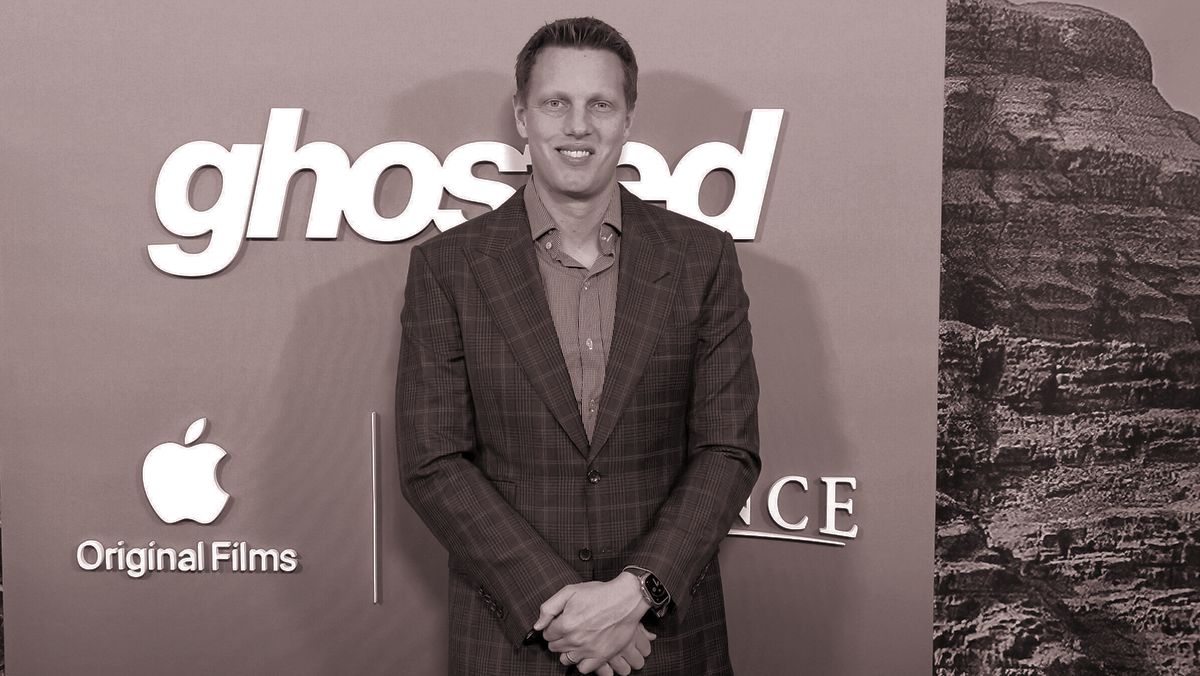
spun out next year. That business will be run by current WBD C.E.O. David Zaslav. Which brings us to WBD’s second-quarter results, also announced on Thursday and promptly buried in the media hoopla around the closing of Skydance-Paramount.
As was pretty much expected, the divisions that will comprise Zaz’s new fiefdom performed well. The big second-quarter winner was the Hollywood studio, which had four films, among them F1 and Sinners,
that together generated more than $2 billion in global revenue. “In fact, Warner Bros. Studios has distributed five films in a row that opened to over $45 million domestically, a first for any studio, and has four of the top 10 global Hollywood movies year-to-date, more than any other studio,” the company said in its letter to shareholders.
The studio’s $6.1 billion in revenue in the first half of 2025, and $1.1 billion of adjusted EBITDA, was up some 195 percent year-over-year.
Adjusted EBITDA for the year would be “at least $2.4 billion,” Zaz predicted, a “substantial step” toward the stated $3 billion goal.
As for streaming, Zaz touted HBO Max’s 142 Emmy nominations across 20 different shows, more than any other platform. The streaming segment added more than 3.4 million subscribers in the second quarter, the vast majority of which were international, and adjusted EBITDA was nearly $300 million; Zaz projected at least $1.3 billion in streaming adjusted EBITDA
for the year.
There was more good news at WBD on debt reduction, thanks to the very successful exchange offer that I have previously covered in depth. At the end of the second quarter, WBD had net debt of $30.7 billion, down
nearly $25 billion since the company’s inception more than three years ago, and a net leverage ratio of 3.3x.
The bad news, no surprise, came from WBD’s linear TV portfolio, which will soon be the bailiwick of C.F.O. Gunnar Wiedenfels. Revenue in linear was $4.8 billion for the quarter, down 9 percent from the 2Q24; adjusted EBITDA was down a whopping 24 percent year over year, to $1.5 billion from $2 billion. In answer to a question from Jessica
Reif Ehrlich, a research analyst at BofA Securities, about the “underappreciated opportunity” at Global Networks, Gunnar tried to put lipstick on the pig. “One big factor here is that people understand that we’re building a group of assets here that is set up to thrive and continue to prosper on a stand-alone basis,” he said. “It won’t mean that we’re going to change the secular trends. But I do believe that there are very significant pockets of growth and
opportunity, and we’ll work really hard over the next half-year here to identify those and get in position to deliver what I think is going to be a business with much more longevity than what the market sees right now.”
Right now, though, the market isn’t seeing it. In fact, the market seems to be ignoring the positive developments in Zaz’s business and focusing only on the negatives in Gunnar’s future portfolio. Since the earnings announcement on Thursday morning, the stock is down more
than 17 percent. Ouch. I asked LightShed Partners analyst Rich Greenfield why he thought the market was reacting this way. “Linear nets down 25 percent [in] EBITDA,” he texted. “AB = A+B.” In other words, linear’s ongoing meltdown is driving the stock these days, and probably will continue to do so until the two businesses are separated. But, as Wolfe Research analyst Peter Supino reminded investors in his August 7 report
about WBD’s earnings, “It’s never what you worry about that gets you.”
I suspect investors will be treading water at both WBD and PSKY until the split occurs at WBD, and some tangible results get put on the board at PSKY, both of which will be 2026 events. In answer to a question from Faber, at CNBC, about how PSKY shareholders should measure the new management’s success, Ellison said, “We need to obviously have significantly grown our studios business, significantly grown our streaming
business, that we’ve effectively restructured the company, and that we’ve really built platforms that are competitive with some of the best that are coming out of Silicon Valley.” Easier said than done. |
|
|
Join Puck’s chief political columnist, John Heilemann, as he roams the corridors of power and influence in America on this
twice-weekly interview show, taking you beyond the headlines with the people who shape our culture: icons and up-and-comers, incumbents and insurgents, moguls and machers in the overlapping worlds of politics, entertainment, tech, business, sports, media, and beyond. The conversations are rich and revealing, unrehearsed and unexpected… and reliably impolitic. A Puck-Audacy joint, new episodes drop every Wednesday and Friday. |
|
|
Puck’s daily political newsletter from Washington on what’s really happening in this town, from the White House to the Pentagon
to Capitol Hill, K Street, and the campaign trail. |
|
|
Need help? Review our FAQ page or contact us for assistance. For brand partnerships, email ads@puck.news. You received this email because you signed up to receive emails from Puck, or as part of your Puck account associated with {{customer.email}}. To stop receiving this newsletter and/or manage all your email preferences, click here. |
Puck is published by Heat Media LLC. 107 Greenwich St, New York, NY 10006 |
|
|
|