 |
 |
|
Happy Wednesday. Welcome back to Dry Powder.
|
|
The resilience of the “carried interest loophole,” stubborn as Lazarus, was the most talked-about bit of Wall Street news this past week. But on the Street itself, the real chatter has concerned the “sudden departure” of Carlyle C.E.O. Kewsong Lee. In the relatively stable land of private equity, “sudden departures” just don’t happen. So I chatted with some insiders to find out the real story…
|
 |
| A Defenestration at the House of Rubenstein |
| Yes, Kyrsten Sinema has extinguished any fears of closing the carried interest loophole. But the real story out of Washington that Wall Street cares about is what went down at Carlyle. So here goes… |
|
|
|
| The big Wall Street news out of Washington over the weekend was not that the people who make money from money—private-equity moguls, hedge-fund managers—once again beat back the latest attempt to close the so-called “carried interest loophole.” That was to be expected, as I predicted last week when some people actually thought that finally it was les jeux sont faits for the loophole (or whatever you want to call it). And, really, the outcome was never in doubt thanks to Kyrsten Sinema, the senator from Arizona, who was well-paid by the money industry for her insistence that the Inflation Reduction Act not contain any provisions related to carried interest.
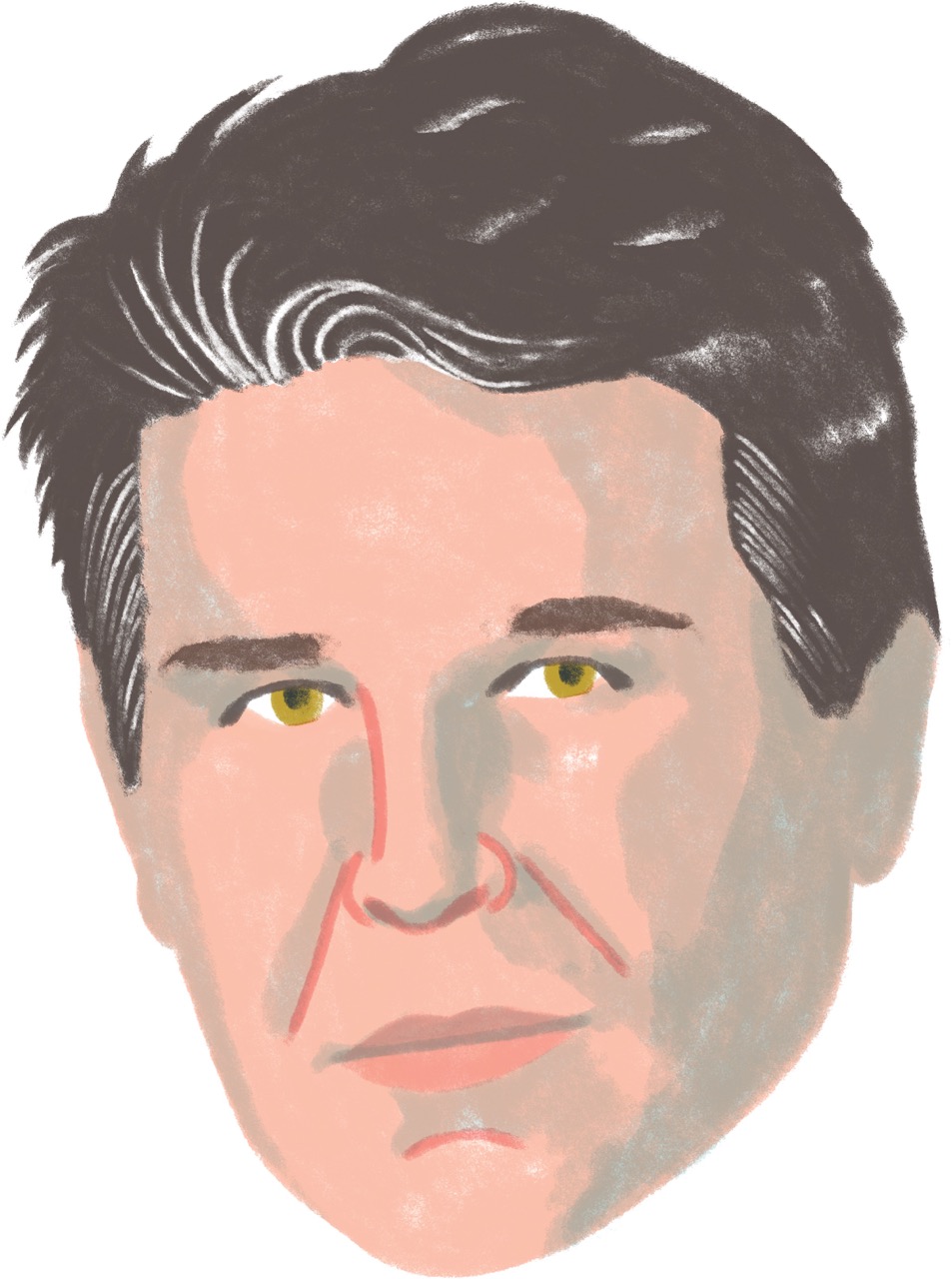
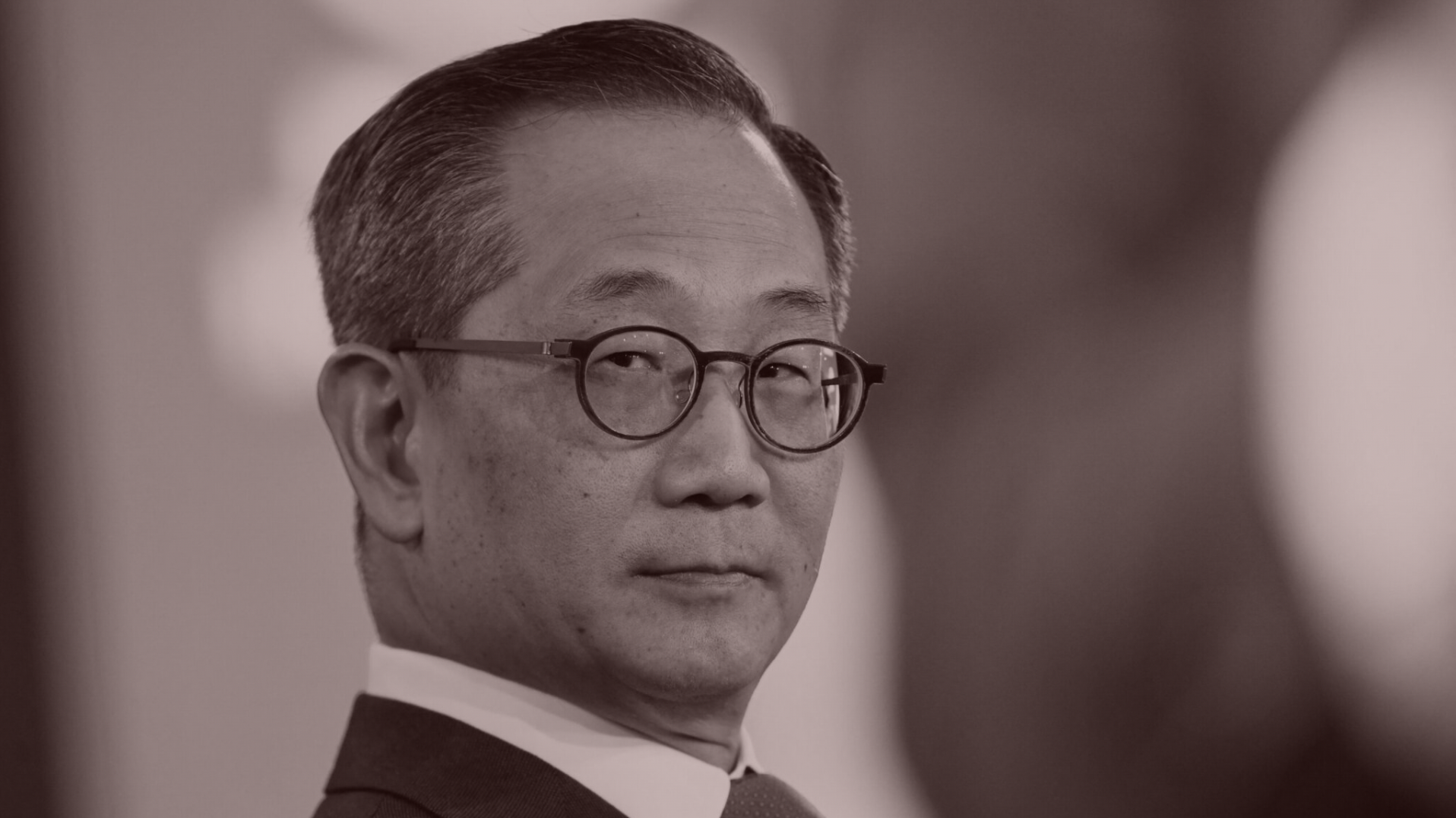
No, the truly stunning news out of Washington, as it pertains to Wall Street anyway, was the “sudden exit” on Sunday night of Kewsong Lee, the C.E.O. of the Carlyle Group, after nearly five years at the helm of the powerful, and publicly traded, private-equity behemoth with $376 billion in assets under management and a market value of $12.8 billion. Carlyle’s stock has fallen some 10 percent since the firm announced Lee’s shock departure. “This is a sudden and unwelcome surprise change, particularly in light of the positive progress that we believe the firm has made during [Lee’s] tenure in terms of accelerating growth, entering new business verticals, and expanding profitability,” Robert Lee, an analyst at Keefe, Bruyette & Woods, told the Financial Times.
In 2017, Lee and Glenn Youngkin, now the unlikely Republican governor of Virginia, were deemed to be the worthy successors of the three co-founders of Carlyle: David Rubenstein, William Conway, and Dan D’Aniello, who remain the firm’s largest shareholders, owning a third of the company, and who serve prominently on the board of directors. Youngkin and Lee didn’t always see eye-to-eye, and Lee became sole C.E.O. of Carlyle after Youngkin announced that he would leave the firm in September 2020. Youngkin ran for office in 2021 and won. Conway, whose 73rd birthday is later this month, is returning as interim C.E.O. (For his part, Rubenstein has become a ubiquitous media presence and has a new book, How To Invest, coming out next month. I’ll be interviewing him about it soon.)
Succession at private equity firms has become a big deal of late as the founders of the largest companies are now reaching retirement. Each of the big firms has tried their hand at succession, of course, with varying degrees of success. Over at The Blackstone Group, the industry leader, co-founder Steve Schwarzman, now 75 years old, has designated the delightful Jon Gray, 52, as his successor. But Schwarzman remains the firm’s C.E.O. and doesn’t seem particularly keen on going anywhere soon. Last October at KKR, the two founders and cousins, Henry Kravis and George Roberts, each 78 years old, named Joe Bae and Scott Nuttall, as the new co-C.E.O.s. (KKR’s stock is down roughly 20 percent since then and now has a market value of $45 billion.)
At Apollo, any sense of orderly transition to the next generation of leadership was badly disrupted by the news of Leon Black’s involvement with Jeffrey Epstein, by the allegations against him lodged by a former paramour, and by the reports of an attempted coup by Josh Harris, one of the three founders. In the end, it was my old friend Marc Rowan, now 59, who got pulled out of semi-retirement to take the reins of the firm in March 2021, 31 years after he co-founded it with Black and Harris. Apollo’s stock, with a market value of around $35 billion, is up around 24 percent since Rowan took the helm of the firm. At TPG, succession has gone comparatively smoothly, with Jon Winkelreid, a former partner and C-suite executive at Goldman Sachs, taking over the sole leadership of the company in May 2021 from founders David Bonderman and Jim Coulter. (TPG is an investor in Puck.)
All of which is to say that abrupt firings of C.E.O.s in the land of private-equity firms is a rare and unusual thing, which is why Lee’s unexpected departure is so shocking and causing ripples of schadenfreude around Wall Street. This is not normal operating procedure at a buttoned-down ship like Carlyle, which has long served as a revolving door for Washington cabinet officials, among them Frank Carlucci, Dick Darman, and the one-and-only James Baker. Former president George H. W. Bush served as a senior advisor to Carlyle after he left office. So, what the happened down there on the Potomac? |
|
|
| My private-equity sources tell me that Lee had become a feared and controversial presence inside the firm and that Conway, among others, decided that the mood needed to change and a greater sense of camaraderie needed to be re-instilled. Like Wall Street generally, private equity can be a sharp-elbowed industry, but I have heard that Lee lost the support of his charges. “He was among the nastiest people I ever met,” shared one longtime private equity executive about Lee without much prompting. (Carlyle’s head of communications, Andrew Kenny, declined to comment on the management changes.)
According to industry insiders, Lee consolidated his power inside Carlyle after Youngkin left to run for governor, and began to diversify the firm into new and different directions. Like many private equity shops, the firm’s bread-and-butter was the traditional leveraged buyout business. To wit, Carlyle recently bought and sold Supreme, the niche millennial streetwear company with a cult-like following, while pocketing a profit of around $500 million on its $500 million investment. But Lee wanted to expand beyond its traditional L.B.O. operations.
During a February 2021 investor day, Lee laid out an ambitious goal of Carlyle raising $130 billion in new capital by 2024, most of which he wanted to go to opportunities outside of the firm’s private-equity business. Carlyle is in the process of raising a new $22 billion equity buyout fund, of which about $15 billion has been raised to date. One of the areas that was of keen interest to Lee was providing private credit, which has become popular among many private equity firms, even though the returns are lower and it is, you know, not exactly private equity. |
| ADVERTISEMENT |
 |
| Over 40 million people use Facebook Privacy Checkup each month
That’s nearly 60 times the population of Washington, D.C.
And that’s just one example of the tools and technologies we’re building to keep our communities safe.
Facebook is taking action to keep its platform safe.
Learn more about our work ahead. |
|
|
| For instance, in March, Carlyle acquired a $15 billion portfolio of collateralized loan obligations from another investment firm for $615 million in cash, plus 4.2 million Carlyle shares and then promptly had to deal with mark-to-market losses from rising interest rates. In April, Carlyle announced that it had raised $4.6 billion for a second credit fund to provide debt financing to private companies and to help other private equity firms do buyouts.
But Lee continued to clash with colleagues, even as he was articulating his bold new vision for the firm. My sources tell me that the complaints about Lee inside the firm grew louder until they reached Conway and the Carlyle board of directors that would soon be deciding his fate. Lee’s contract renewal negotiations provided a catalyst for the change. His five-year contract paid him a salary of $275,000 in 2021 along with a cash bonus of another $5.5 million. He also received a stock award of $36 million in 2021, for total compensation of $42.3 million, according to the Carlyle 2022 proxy statement. (By comparison, Peter Clare, the head of Carlyle’s buyouts group, received total compensation of $76 million in 2022, while Steve Schwarzman, the dean of the industry, received total compensation of $1.1 billion for 2021. His net worth these days is estimated by Bloomberg at $33 billion.)
According to my sources (and also confirmed by reporting by the Financial Times), the relationship between Lee and the Carlyle board members negotiating his new contract broke down irreparably last weekend, prompting the firm to release its sudden announcement that Lee was relinquishing his position as C.E.O., effective immediately, and was also leaving the Carlyle board of directors. Lee sought a new contract that, with incentives, would have given him a payout in the range of $300 million, supposedly in line with his next-generation peers. But the board’s compensation committee—composed of the three founders—did not engage with Lee’s demand, leading to the impasse. Sure, under Lee’s nearly five years in charge, the firm’s assets under management have roughly doubled and its stock is up 56 percent. But Blackstone’s stock rose about 215 percent during the same time and its market value is $122 billion, some ten times that of Carlyle. Alas, this is a rough business and you have to keep up with the Schwarzmans and Kravises.
Although both sides tried to put a good face on this turn of events—“the Board is grateful to Kewsong for everything he has done to position Carlyle for the future,” Conway said as Lee was being booted—I can’t emphasize enough how unusual it is in the land of private equity, especially as the firms have become increasingly institutional, for this kind of dramatic departure of a chosen successor. |
|
|
| Lee will be well compensated to leave Carlyle. According to the firm’s August 8 filing with the Securities and Exchange Commission, Lee and Carlyle signed a “separation agreement” which will provide Lee with the “severance benefits” that were part of his employment contract as well as the immediate vesting of his performance-based stock awards for the years 2018, 2019, and 2020, as measured through the end of this year. He will also receive his carried-interest allocations prior to his appointment as C.E.O. As part of the separation agreement, according to the S.E.C. filing, Lee agreed to release Carlyle from any claims he may have against the firm and agreed that he will comply with “post-employment restrictive covenants.” Naturally, I was hoping to read Lee’s separation agreement, which was agreed to on Sunday. But Kenny, the Caryle spokesman, declined to share it. It’s not clear whether it will have to be filed with the S.E.C..
Meanwhile, Conway has returned on an interim basis and a search firm has been engaged to try to find a new C.E.O. from outside the firm, and perhaps even outside the industry. Candidates from traditional banking circles, such as Robin Vince, the C.E.O. of BNY Mellon, and Charlie Scharf, the C.E.O. of Wells Fargo, are already being mentioned as possible contenders, I am told. |
| ADVERTISEMENT |
 |
|
|
| There are also several possible internal C.E.O. candidates as well, such as Clare, the private-equity head, and Sandra Horbach, a longtime executive at Carlyle and co-head of the firm’s U.S. buyout group who I have known since her days as a partner at Forstmann Little. In the meantime, there will also be an “office of the C.E.O.,” composed of six other Carlyle executives, including Clare, to help Conway run the firm while a new C.E.O is found. Lee will stay until the end of the year as an “advisor” to Carlyle and “to assist with the transition.” The firm’s chief operating officer, Christopher Finn, who was about to retire, also agreed to stick around.
If private equity’s recent victory over the foes trying to end the industry’s long-standing carried-interest perquisite demonstrates anything, it’s that this is one powerful and resilient industry. I’ve often believed that private equity is the world’s greatest (legal) wealth-creation mechanism, a stunning example of financial alchemy, leaving investment banking and hedge funds largely in the dust. The risks are surprisingly muted and the benefits of using other people’s money to do deals are rather extraordinary. So while the news coming out of the Carlyle Group late Sunday night was indeed shocking, Carlyle is not going anywhere. It will be more than fine. I’m sure Kewsong is sad to be leaving, especially so suddenly. But he’s had a great run, and, at 56 years old, he’ll be just fine, too. |
|
|
|
| FOUR STORIES WE'RE TALKING ABOUT |
 |
| A Web3 Scandal |
| Matt and Taylor Lorenz break down Hollywood's place in the Creator Economy. |
| MATTHEW BELLONI |
|
 |
|
 |
|
 |
|
|
|

|
|
|
| You received this message because you signed up to receive emails from Puck
Was this email forwarded to you?
Sign up for Puck here
Sent to
Unsubscribe
Interested in exploring our newsletter offerings?
Manage your preferences
Puck is published by Heat Media LLC
227 W 17th St
New York, NY 10011
For support, just reply to this e-mail
For brand partnerships, email ads@puck.news |
|
|