Happy Wednesday from San Francisco.
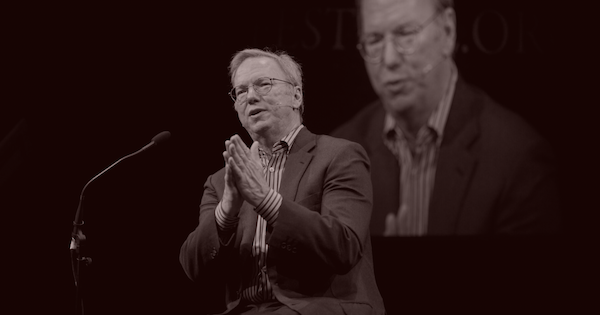
Earlier this week, I caught up with Eric Schmidt, the former Google C.E.O. and Obama pal and adviser. I've always found Schmidt to be a fascinating character. For years, he personified the Silicon Valley-Washington mind-meld (and revolving door) that defined the Obama era. He’s still a major power in Washington, but perhaps somewhat more cynical about the ability of other chief executives to follow his political playbook. Schmidt has always known which way the wind is blowing, and he's right, of course, that 2021 is not 2011.
Thanks again for joining Puck. As a reminder, if you've got a tip on anything in the world of Silicon Valley and politics, feel free to reply to this note. It goes directly to my inbox. Eric Schmidt, the former C.E.O. of Google and Obama pal and adviser, for years personified, if not molded, the Silicon Valley-Washington axis of influence. So I was somewhat taken aback when Schmidt told me from his New York living room this week that he didn’t think there would be another Eric Schmidt after him. “I do think that my activism, ten years ago, is not likely to get repeated,” he said. “The reason is that the C.E.O.s that are now under such control—because of both woke-ism, employee activism, shareholder activism and boards—that this next generation of executives will be much quieter, not just on politics but on global problems.”
Schmidt is indeed something of a throwback: He’s a unique figure in Silicon Valley history, an embodiment of the bonhomie between politicians and the tech sector that defined the halcyon Obama era. He served as the tip of the spear not only for Google’s massive lobbying operation, but also for Silicon Valley’s charm offensive more broadly, cultivating a then-unrivaled network of political allies. The Obama White House, in turn, celebrated the dynamism and optimism of America’s newest mega-cap corporations: You couldn’t walk across the West Wing without tripping over a Google executive there for a meeting. Schmidt, somewhat famously, had a badge that read STAFF at Hillary Clinton’s November 2016 election night party.
Over the intervening years, that symbiosis deteriorated. In 2017, Schmidt left Google, stepping down as the company’s chairman. Since then, Schmidt has tended to two major passion projects. One is his philanthropy, Schmidt Futures, whose new $1 billion Rise program finds impressive teenagers overseas and offers them Rhodes-like scholarships. The other is less hopeful, and more dire: Schmidt’s gnawing concern that the U.S. military-industrial complex is not taking China’s dominance of artificial intelligence research seriously enough. He’s out this week with a new book I’ve read, The Age of AI, co-authored with a 98-year-old Henry Kissinger and computer scientist Daniel Huttenlocher, to paint a picture of what could be a dark future. As Schmidt told me, A.I. will soon be “extraordinarily better at targeting you.”
To his critics, Schmidt remains the consummate influence-peddler, deploying his $25 billion fortune and his decades of relationships to advance his personal interests—which tend to align with Big Tech’s. Among his admirers, he is a patriotic, ruthlessly effective titan who has a rare understanding of the levers of power in the nation’s capital, and, more broadly, the machinations of the real world. What everyone can agree on is that he remains a massively powerful dude, with sweeping influence from San Francisco to Washington and Wall Street. He owns 20 percent of the quant hedge fund D.E. Shaw, where Jeff Bezos got his start; is a major player and fundraiser in Democratic politics; and, as is often overlooked, remains one of Google’s largest individual shareholders.
The question circulating over the last few months among my sources is, to put it bluntly, whether Schmidt still has his old juice. When his name was floated for a new tech task force during the Biden transition, a dozen progressive groups went berserk, asking Biden to keep Schmidt at arm’s length. But Schmidt is, in my view, something of a survivor, with the ability to retain influence no matter who is in office or what titillating personal drama is splattered across Page Six. Just last month, the White House invited Schmidt Futures to sponsor a new fellowship. Several of the aides at his philanthropy, which became a home for some Obama veterans, have made their way into the new administration.
I don’t think Schmidt’s power has really waned so much as the optics have changed. This moment is much less friendly to a tech billionaire reaching his tentacles into the nation’s politics, but Schmidt, as he made clear to me, does not care one iota about the blowback. This age simply requires different tactics for someone like him. And criticism is just the cost of doing business in 2021.
I talked with Schmidt about whether our fear of robot overlords is overblown, whether billionaires like him should focus more on philanthropy or more on taxes, and why he still hasn’t talked with Joe Biden since he became president. Here’s our conversation, edited for length and clarity.
The left seems to freak out anytime your name is mentioned in Washington. Is it different to be Eric Schmidt under a Joe Biden versus Eric Schmidt under a Barack Obama? Do you operate any differently given the optics?
I’ve spent my whole life sort of ignoring the optics, and instead trying to do what I thought was interesting, and doing it with other people, not just by myself. I don’t worry too much about the optics. What I learned is that there are people who are obsessed about how things are looking, and there are people who are obsessed about what happens. I’m obsessed with what happens.
One way to understand it is that in our system today, if you don’t have critics, you aren’t relevant. And for the life of me, I don’t understand why some of these groups do what they do.
Obviously you had a close relationship with the Obama White House. They could be the exact same interactions you have with the Biden White House, but they just read differently today.
This administration is different. The time is different. I am different. That was a unique moment. I don’t think that it’ll be the same. Not only did I not expect it to be the same with Biden, it is not the same with Biden.
How so?
Well, for one thing, it’s a different generation. So for example, the [Office of Science and Technology Policy] is run by Eric Lander, who is my very close friend. But he has different people. He has a different generation. And that’s okay. So what I learned about Washington is it’s both tribal, but it is also generational. And so the way I think of it is, it is now their time. I’ll give you an example of my very close friend Jared Cohen. [He] and I wrote a book together, I was his mentor. He is now, ten years later, doing the things that I did ten years ago. And I thought I shouldn’t be jealous of it. I should be excited about it.
So in that sense, it’s a passing of the torch. And so my view of politics is it’s a passing of a torch and a new model. I’ll give you an example: J. Edgar Hoover, started in the ‘30s and died in office when he was in his 70s. That’s too long. That’s too much power. You don’t want that. And I don’t think any of us want that, and therefore I don’t want it for myself.
When’s the last time you talked with Biden? Have you talked with him since he got into office?
No, but I’ve talked with his staff. And that’s about what I would expect.
If this was 2008, you would have talked with Obama by this point.
Well, with Obama, remember I was a member of his administration. I just want to be clear. I’m not a member of the government. And I’m not a member of Google. So I’m just a private citizen who is a philanthropist. I’m a chairman of the Broad [Institute] and a couple of other things like that. And I’m writing a book. So it wouldn’t necessarily be appropriate for the president to call me to say, “Hi, Eric, how are you? How’s your book going?”
Could you see yourself at any point during the four years going into any formal role?
No, and the reason is it’s better for me to work from the outside.
You’ve always held yourself out as a bipartisan figure. I wonder if January 6 has caused you to rethink your belief that the Republican Party was a worthy bargaining partner. Even during the Trump administration, you did a good job of fostering relationships with Jared Kushner, you went to Trump Tower, you visited the White House at least once. Do you regret any of the bipartisan bonhomie?
I do not. I was actually in the [Trump] White House a number of times. I met with the president a number of times. I met with his staff a number of times. I just don’t think America works if we become fully tribal. Let’s take the extreme version of what you said. Let’s do it as a thought experiment. So let’s assume that the power structure is 50-50 and they are not allowed to talk to each other and they spend all their time shooting missiles at each other internally. How do you make progress on the great problems of the world?
We are all Americans. This gets lost in the narrative of January 6. January 6 was a few thousand people who violated the law. As best as I can tell, they’re all being put in jail. And hopefully this will not happen again. And whether that goes all the way up to the president or not, I don’t know. But it was clearly illegal. And my Republican friends agree that it’s illegal. My Republican friends agree, by the way, that you should get vaccinated. So when you don’t take the media lens, or this sort of broad brush lens, but instead you look at it on an individual basis, I have very good relationships with Democrats and Republicans. And that’s how I get things done.
I know some tech leaders are thinking about the same question—whether the Trump era has irreparably ruptured the need to work with Republicans.
That would be a mistake on their part. But let me answer a little differently. I do think that my activism, ten years ago, is not likely to get repeated.
What do you mean by that?
The reason is that the C.E.O.s that are now under such control—because of both woke-ism, employee activism, shareholder activism, and boards—that this next generation of executives will be much quieter, not just on politics but on global problems. This is just my personal view. And I could be wrong, and maybe there will be a new set of idealistic people that will do it. But if you look at it, the moment you do anything as a C.E.O., you’re immediately criticized by some group of your employees. And so the era of very active C.E.O.s, on things other than the business, is probably gone for a while.
You said back in 2014 that inequality is the number one issue facing democracies. If that’s true, the problem has gotten worse. To what extent do you see philanthropy as a solution, versus a more radical restructuring of the American economy?
Let’s understand the math. The government can give out more money than a charity on any particular problem, because the government can print money and charities can’t. And the government is indeed printing money. It’s printing trillions of dollars, which is well beyond what philanthropists can do. What philanthropists can do is, in addition to funding their pet projects, they can take risks that the traditional funding agencies won’t.
Over the last couple of weeks, there has been a spirited conversation about the taxes paid by billionaires. A critic would say that billionaires still are not paying enough in taxes, and that’s the reason there’s such great inequality.
That is clearly not true. The causation is not true. The premise, which is that billionaires are not paying enough in taxes, is always true. It’s always true that people like me can pay more taxes.
What specifically? If you were helping to oversee the tax regime, what sort of tax increases do you think should go up on wealthy people specifically?
I’m more focused on revenue growth than taxes.
I’ve looked very carefully at this question: could you raise enough money from the rich people to solve the various problems, and the answer is there’s not enough money even among the billionaires. The problem with progressive taxation is you have to be willing to tax the sort of 70 percent up, which is not the billionaires. The top 1 percent doesn’t fill the hole. And so that’s why I’m saying mathematically it’s just not true. I don’t mind taxes—if they’re taxes paid on real transactions, as opposed to just calculated taxes, which is not correct—if it’s real taxable gains and so forth, I don’t mind paying them and I suspect many people like me don’t mind, because they just don’t think about it. It’s just whatever. I’m much more interested in the fact that the government systems are so inefficient in the amount of waste and misappropriation. I would rather come up with other vehicles that are sort of not driven by the political winds. And I don’t know of any—I don’t know the mechanism.
It’s much more interesting to ask a more specific question about philanthropy and taxes. So my philosophy is roughly the following: Largely due to luck and not skill, I am in a situation where I have too much money, and I have to give it away. And that is an opportunity and a burden. And I intend to do it well.
My world is all about people. Everything I’m doing is fundamentally about a person or an idea. Now, as a matter of tax policy, you could say, ‘Okay, Eric’s busy working on people, but let’s also tax him for infrastructure, because he’s not allowed to build the roads.’
One of the philanthropic pursuits of yours that has interested me the most is that you’ve called for a 9/11-style commission to study America’s Covid response. I know you’ve said you’re prepared to go at it alone if you don’t have congressional support and subpoena power. Do you expect to?
We don’t know. We have talked to the political leaders and everyone has said let’s get through this current wave. And then we’ll address the question.
Some rules are: it has to be bipartisan and it has to be credible. I’ve done a bunch of commissions, so I understand how to do commissions well. And we would do it well if we got started on it.
Speaking of which, you’re now turning the A.I. commission you led into a think tank that you fund to push for policy recommendations on A.I. Some people have criticized billionaire philanthropy on the grounds that it gives wealthy people more power than the average person has. Do you think that critique has any merit?
No, because I think that’s how our system works. I start from the premise that I have an opportunity to influence the conversation along the principles that we’re discussing. Because of who I am, I am heavily, shall we say, criticized and inspected on it. I don’t expect a walk in the park. But what I do ask is for a hearing of the ideas. So if you don’t like my ideas, that’s fine. But, please, at least listen to them before you immediately criticize.
You’ve always been an optimist about A.I. Do you still see it as a net positive for society? The concern would be that we would look back on this era and wonder if we’ve made some of the same mistakes with A.I. that were made with social media a decade or two ago.
Fifteen years ago, there was not a narrative that said, by the way, this stuff is going to get misused by governments. It’s going to be used to affect elections. It’s going to be used to target conspiratorial theorists. It’s going to become an aspect in legitimate political discourse.
We collectively missed it, and I missed it. We wrote the book partly to address that. I agree with the premise of your question, and I think I would make it stronger. When we started with the internet, which I’ve been doing my whole life, the collective group had roughly a decentralized view of power, and the benefit of connecting everyone. The decentralized view of power and connecting everyone has occurred, and it has enormous benefits. And I don’t want to go back. But it came with these problems, and these problems are serious. So a reasoned argument would say, don’t throw the baby out with the bathwater—whatever the metaphor is—but understand what you’re doing.
Companies seek to maximize revenue. The best way to maximize revenue in social media is engagement. The best way to maximize engagement is outrage. Now, that’s just true. It’s not false. It doesn’t mean that you can’t address it with regulation or competition or whatever, but it is true. And so if it’s true now, it will be true in ten years when these A.I. systems are extraordinarily better at targeting you.
It seems fair to say you’re still not as scared about A.I. as, say, Elon Musk. Would you call him an alarmist?
Well, I don’t agree with what he said. You’ll notice he hasn’t said much recently. And, at the same time, five years ago, Stephen Hawking was saying the same things. And unfortunately, Stephen Hawking has passed away. So we don’t know his current view. But the two of them assumed that—I’ll use my own words—that the singularity would occur and that after the singularity, we would be subject to the warlords of computers, which I do not believe will happen.
You’ve been a big proponent of Silicon Valley working more closely with the military. At Google and elsewhere, A.I. partnerships with the defense industry have met fierce criticism internally. Do you think any of the ethical concerns are warranted, or is this a case of employee idealism verging on naïveté?
I think the ethical concerns are very legitimate. And I would never want to participate in a system that was misused, especially one that would harm civilians.
I was not allowed by law to participate in the Maven decision so I didn’t. That’s very important to know. And they made a decision that I didn’t agree with. So I would have made a different decision. And for the record, Amazon, Microsoft and many others picked up the ball when Google left Maven—so the product is getting built, and by as best I can tell from the outside, it’s quite successful. So you want to be careful about commenting about the Valley as a whole and specific companies. There’s nothing wrong with Google deciding not to work on Maven and letting the other companies do it. Because it’s a perfectly legitimate business choice.
FOUR STORIES WE'RE TALKING ABOUT 
The indie film industry is notorious inside Hollywood for penny-pinching financiers, lax on-set managers, cheap hires and poor on-sent conditions. MATT BELLONI 
The merger appears reckless, even to those in Trumpworld. As one former senior advisor put it: “It's got as much gas as the Hindenburg.” TINA NGUYEN 
Members of the intelligence community are increasingly convinced that the Russians are behind the terrifying directed-energy attacks on diplomats and spies causing "Havana Syndrome." JULIA IOFFE 
The formative years of David Zaslav's career explain as much about the history of cable as they portend about the future of streaming. WILLIAM D. COHAN 
You received this message because you signed up to receive emails from Puck.
Was this email forwarded to you?
Sent to {{customer.email}}
Puck is published by Heat Media LLC.
For support, just reply to this e-mail. For brand partnerships, email ads@puck.news |


SHARE