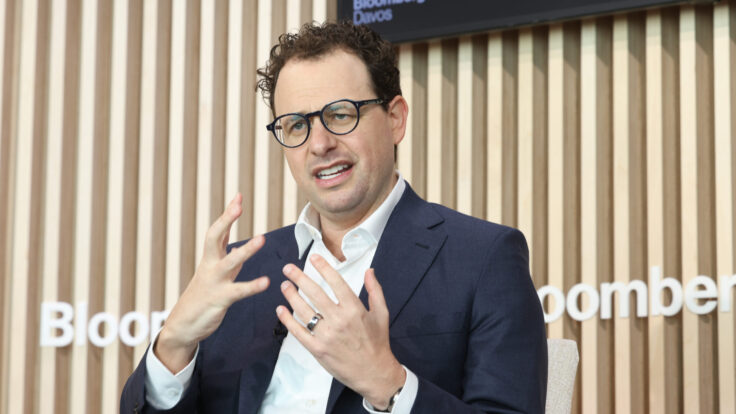
Happy Sunday, and welcome to a special pre-inaugural issue of The Hidden Layer, my new
twice-weekly private email for Puck covering the business of artificial intelligence. I’m Ian Krietzberg.
The first official edition of this newsletter will hit your inbox this Tuesday—click here to make sure you’re on the list—but until then, I wanted to share a bit of my own backstory, my evolving perspective on this trillion-dollar industry, and how
I made my way to Puck. And as a reminder, when you sign up for Puck, you can access every private email from all of our authors. See you on the inside. |
|
|
The rise of A.I., already a trillion-dollar industry, is still badly misunderstood
by the media and warped by its own reality distortion field. At Puck, my goal is to reground the reporting surrounding A.I. with an insider’s view of the business and unbiased understanding of the technology, itself. |
|
|
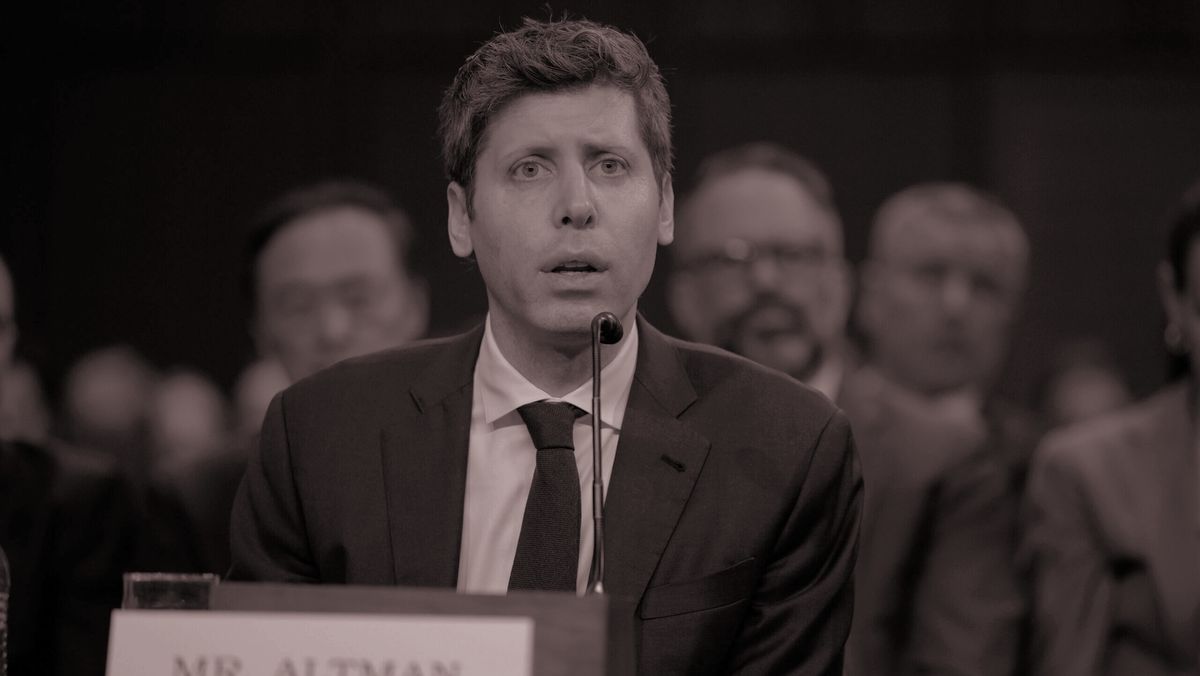
I was a business reporter, in early 2023, when Sam Altman, the C.E.O.
and co-founder of OpenAI, sat before Congress and implored the government to regulate artificial intelligence. Just a few months earlier, OpenAI had quietly released an app called ChatGPT that promised to usher in a new technological revolution, turning Altman into a household name practically overnight.
At the hearing, Altman was agreeable and unassuming, gesturing at a world that would be remade with more productive and fulfilling jobs. He also nodded, darkly, at A.I.’s potential
risks. “I think if this technology goes wrong, it can go quite wrong. And we want to be vocal about that,” he said. “We want to work with the government to prevent that from happening.”
Altman, unlike Elon Musk, his former partner in OpenAI, has always had a chameleonic talent for telling people what they want to hear. And yet the subtext of what Altman was saying was unmistakable. His testimony grabbed the attention of at least two people: Senator Peter
Welch—who said he couldn’t remember a time “when we’ve had companies come before us and plead with us to regulate them”—and me.
I immediately pivoted to reporting on A.I., at that time still an embryonic business, but one that was growing exponentially. My own career took off, too. Less than a year later, I became editor-in-chief of The Deep View, an A.I. industry newsletter, that I grew to nearly half a million readers. Today, I’m excited to be sending my first dispatch as the
A.I. correspondent for Puck, where we’ve just launched The Hidden Layer, a new, twice-weekly email covering the business of artificial intelligence. |
As always, my goal as a reporter has been to sort science fact from science
fiction. The trouble—or fascination—with this field in particular is that much of the critical science is built on significant unknowns that fuel assumptions, educated guesses, and full-on hypotheticals. The two A.I. factions in Silicon Valley that generate the most headlines are the accelerationists, who are racing to create a superintelligence they believe will unleash a technological utopia, and the
doomers, who worry we’re on the precipice of summoning powers we can’t control. Of course, the majority of industry players are operators and opportunists: investors, engineers, academics, and entrepreneurs concerned with more prosaic issues—productivity gains and P&Ls, cost, environmental impacts, grounded risk assessments and regulatory policy, etcetera.
Incredibly, even as A.I. has become an all-consuming obsession in Washington, Hollywood, and on Wall Street, the conversations
surrounding the technology are still painfully imprecise. All the major A.I. companies (OpenAI, Google, Anthropic, Meta, Nvidia, xAI…) and researchers (Geoffrey Hinton, Yann LeCun, Melanie Mitchell, Margaret Mitchell, and Gary Marcus, to name a few) use different benchmarks to compare models and offer competing definitions of what artificial “intelligence” really is. Is intelligence unique to humans? What makes
humans intelligent? Is consciousness or sentience a requirement for intelligence? What is consciousness, anyway?
It doesn’t help that biological intelligence is a poorly defined and vaguely understood concept, at best. Dr. David Cox, a neuroscientist by training who now works as IBM’s V.P. for A.I. models, told me this year that “we could fill encyclopedias with what we don’t know about how natural brains work.” The notion of “artificial intelligence” is probably a
misnomer, too: John McCarthy, an early computer science pioneer, said he coined the term “because we had to do something when we were trying to get money for a summer study in 1956”—he and his co-researchers had originally referred to their work as “automata studies,” which, they discovered, was much less sexy than “A.I.”
Whatever it is, the A.I. we have today has already shattered benchmarks that were once held by some within the field of computer science to be sacred markers of machine intelligence. The chatbots of today, according to some researchers, have arguably passed the Turing test, a 75-year-old proposition that, very simply, aims to determine whether a machine can consistently convince a human that it is, itself, a human. People are already forming close relationships, and even falling in love, with the same chatbots that can’t reliably perform basic math. Maybe we’re just easier to fool than we’d like to think. |
A
Trillion-Dollar Gold Rush
|
In the years since ChatGPT’s fateful launch, I’ve spoken with hundreds of
technologists and academics alike, spanning computer scientists, engineers, psychologists, cognitive scientists, philosophers, investors, inventors, and executives. I’ve read all the research and white papers, studied the industry’s history, and followed every cutting-edge development from new L.L.M.s to entirely different systems and the unique hardware innovations that might unlock future progress. Much has changed since this field became mainstream, but much remains the same. Governments around the world, for one, are now very publicly all in on A.I., as I’ve been reporting for months. Billions of dollars’ worth of investments into the infrastructure that makes A.I. possible have been announced, even as the Trump administration’s adoption of the technology has been haphazardly accelerated, at least in part, by Musk’s time with DOGE. (Indeed, the president’s initial Liberation
Day tariffs appeared to be calculated by ChatGPT.) Just last month, the U.S. Department of Energy made a somewhat stark claim, calling A.I. “the next Manhattan Project.”
As large language models grow larger, more sophisticated, and add hundreds of millions of users, the hardware that makes them tick has been consuming steadily
increasing quantities of energy and raw materials. Both environmental transparency and cost-benefit analyses are essentially nonexistent. There’s no clearer example of the vibe shift than Altman, himself, who began his public-facing career pleading for regulation, and is now promising
a near-term technological utopia and calling for more government assistance (and dollars)
with fewer guardrails. Last month, after striking a deal with Trump to build a large data center in Abu Dhabi, OpenAI secured a $200 million defense contract with the U.S. government. |
At Puck, my ambition is to cover these rapid developments in A.I. by returning
critical thinking to an industry that’s often misunderstood by the media and warped by its own reality distortion field. Reporting on A.I. badly needs to be regrounded with a more expert and unbiased understanding of the technology itself—both its mystery and its limitations. That’s why we’ve named this newsletter The Hidden Layer—a reference to the complex, unseen process that occurs within a neural network between when you prompt a model and it responds. It’s the black box connecting
input and output where deep learning happens and creativity appears to emerge.
The Hidden Layer nods at the opacity and misconceptions surrounding the business of A.I., too. The truth is that large language models remain bound, for now at least, by many of the same constraints as existed in 2022: persistent issues of bias and reliability; an inability of these systems to differentiate truth from falsehood; no obvious path to true human-like intelligence, despite billions
of dollars spent and gigawatts of electricity expended chasing a tipping point that is perpetually right around the corner. Microsoft and Google say about 25 percent of their code is now being generated by A.I.; Meta predicts “most” code will be written by A.I. in 12-18 months. And yet, implementation has been nonlinear. A.I.-based software engineering products remain,
like their more general-purpose counterparts, brittle and difficult to trust. And while Duolingo is now an “A.I.-first” company, others, like Klarna, have backtracked after diving
headfirst into A.I.—a development I’ve been tracking closely.
Of course, I’ll also be covering the genuinely remarkable ways in which A.I. might improve our lives. We’ve seen advancements in A.I.-centric projects designed to enable more advanced weather prediction and rapid wildfire detection; generative A.I.–based programs that are helping kids overcome dyslexia at scale; and promising research into the potential of this technology to aid in the discovery of new molecules, drugs, and
treatments, all while advancing hyper-personalized medical diagnostics.
Can A.I. cure cancer? Well, no, not yet… and probably never, at least in those terms (it’s not really as simple as it sounds). But there’s no question that the biomedical field is now moving faster than ever, as tasks that once took days or weeks are now done in hours. Still, utopia does not lie on the horizon; the context that surrounds each of these applications is rife with moral and ethical complications and
calculations that make even the positive applications difficult to blindly pursue. As with any new technology, how these tools will be used or abused comes down to incentives, regulations, and risk assessment. Igor Jablokov, the A.I. pioneer behind Siri and Alexa, rather creatively summed up the state of the field in 2025 as a force for good or evil. “You’re creating this hammer on the presumption that
Jimmy Carter is going to put it in his hand and he’s going to build Habitat for Humanity for you,” Jablokov said. “Sometimes, you can’t foresee that Ted Bundy is going to be hitting people over the head with it.”
It also requires improving communication and building trust—with the public, with the people building and deploying these systems, and with the systems themselves. When I first began reporting on A.I., I did so out of awe but also fear—because
the better you understand something, the less reason you have to be afraid. (As such, I can tell you quite a bit about the physics behind aviation.) I want to build that trust with you, too. After all, when it comes to A.I., it’s vital that everyone—regardless of their technical expertise—recognize that they have a very real stake in whatever happens next. |
|
|
Join Emmy Award-winning journalist Peter Hamby, along with the team of expert journalists at Puck, as they let you in
on the conversations insiders are having across the four corners of power in America: Wall Street, Washington, Silicon Valley, and Hollywood. Presented in partnership with Audacy, new episodes publish daily, Monday through Friday. |
|
|
A professional-grade rundown on the business of sports from John Ourand, the industry’s preeminent journalist,
covering the leagues, players, agencies, media deals, and the egos fueling it all. |
|
|
|
|
MATTHEW BELLONI, IAN KRIETZBERG & ERIQ GARDNER |
|
|
Need help? Review our FAQ page or contact us for assistance. For brand partnerships, email ads@puck.news. You received this email because you signed up to receive emails from Puck, or as part of your Puck account associated with {{customer.email}}. To stop receiving this newsletter and/or manage all your email preferences, click here. |
Puck is published by Heat Media LLC. 107 Greenwich St, New York, NY 10006 |
|
|
|