 |
 |
|
Welcome back to Dry Powder.
|
|
The tragic suicide of L.B.O. pioneer Thomas H. Lee, last week, has rattled the cloistered world of finance. We may never know why he decided to take his own life, but Tom did leave behind a long, complex legacy to consider. In this issue of Dry Powder, a meditation on a life cut short.
|
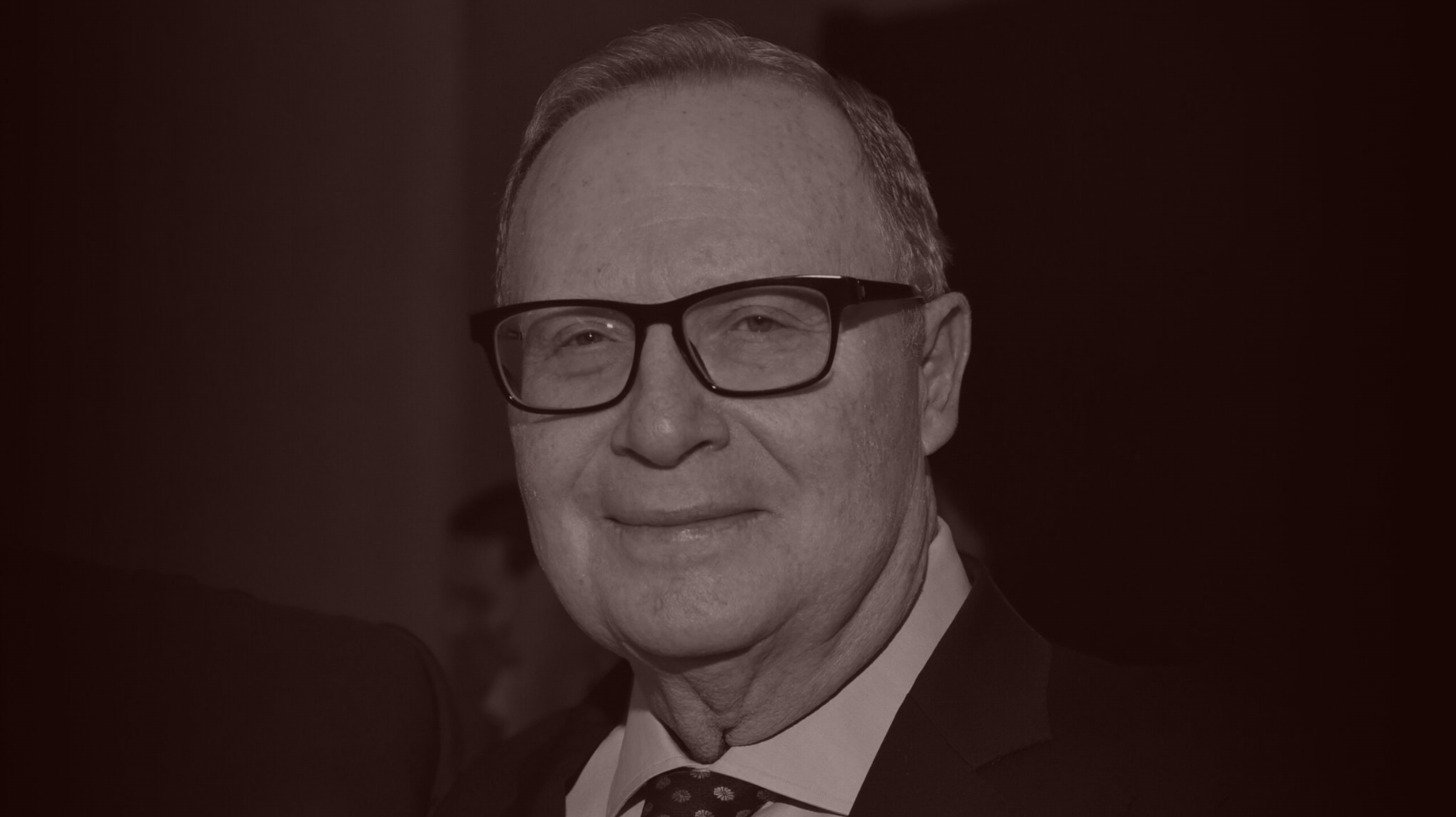 |
| What Was Eating Tom Lee? |
| Ever since the L.B.O. pioneer was found dead from a self-inflicted gunshot wound, Wall Street has been buzzing—trying to figure out why someone who seemed to have it all would take such a drastic action. |
|
|
|
| Given the shocking nature of the sudden death of Thomas H. Lee last week—by suicide, reportedly from a single gunshot wound to the head from a Smith & Wesson revolver—the paeans to the 78-year-old buyout titan have come fast and furious. He was found shortly after 11 a.m. last Thursday morning by his assistant in the bathroom off his sixth-floor private office in the General Motors building on Fifth Avenue, a skyscraper that Donald Trump once owned and that houses such tenants as Estee Lauder, the cosmetics empire, Weil Gotshal, the law firm, and Perella Weinberg, the boutique investment bank. Another buyout pioneer, Forstmann Little & Co., had its office on the 44th floor of the building once upon a time.
Efforts to revive Lee were unsuccessful and he was declared dead at 11:26 a.m. Something like this had never happened before in the clubby world of buyout billionaires. And all of Wall Street has been buzzing in its wake, trying to figure out why someone who seemed to have it all and didn’t appear to have any looming health issues would take such a drastic action.
Mike Sitrick, a spokesman for the family and Lee’s friend, released a statement praising Lee as “one of the pioneers” in creating what we now call the private equity industry, as well as a “devoted husband, father, grandfather, sibling, friend and philanthropist who always put others’ needs before his own.” (He declined to elaborate on the circumstances surrounding Lee’s death.) Scott Sperling, who took over the management of Lee’s first and most successful eponymous Boston-based buyout firm, Thomas H. Lee Partners, after a power struggle in 2006, called Lee “an iconic figure in private equity” who “helped pioneer an industry and mentored generations of young professionals who followed in his footsteps.” His current colleagues at Lee Equity Partners, in New York, described him as “a great partner and wonderful friend whose vision will continue to influence us for many years to come.”
There is no question that Lee and his original partners, Sperling and Tony DiNovi and others, were among the leaders of the early buyout industry. Born in Brooklyn, Lee moved with his family to the Boston area, where he attended the Belmont Hill School and Harvard. After stints at L.F. Rothschild, the investment bank, and Bank of Boston, now part of Bank of America, Lee started his firm in 1974, in Boston, reportedly with a $150,000 loan from his brother, Jon, to acquire companies through the newfangled idea of leveraged buyouts—buying businesses with a maximum amount of borrowed money and a minimum amount of equity. By operating the business well, paying down debt—the interest on which was tax deductible—and increasing EBITDA, the equity value of the company could soar, generating vast riches if things worked well. (Obviously, the equity would be lost if the companies performed poorly and descended into bankruptcy. Yes, there was risk involved. Lee was said to like to gamble, no surprise.) |
|
A MESSAGE FROM OUR SPONSOR
|
 |
| Reasons to Consider a Covered Call Strategy
Seeking to retain equity exposure while mitigating downside risk? The time could be right for covered call strategies. Navigate volatile markets with the Global X Nasdaq 100 Covered Call ETF (QYLD) — it writes call options on the Nasdaq-100 Index, aiming to generate monthly income.
Explore QYLD. |
|
|
| One of the earliest and most successful L.B.O.s was the 1982 acquisition of Gibson Greetings, for $80 million, by Wesray Capital Corporation, a partnership between former Treasury Secretary William Simon and investment banker Ray Chambers. Wesray and the two partners individually put up roughly $1 million of the purchase price and borrowed the rest. A few years later, the two men sold the business, reaping some $70 million in cash, each. The private-equity business has blossomed from there, spawning an industry valued at around $5 trillion or more. Steve Schwarzman, the buyout king, reaped $1.26 billion in compensation in 2022 and has a net worth these days of around $30 billion. On average, Blackstone employees each made around $1 million in 2022.
Lee’s first big hit came in 1985 when he bought Sterling Jewelers for $28 million, only $3 million of which came from Lee’s equity. Two years later, Lee sold Sterling for $210 million, $180 million of which he pocketed. But, of course, it was Lee’s deal for Snapple, in 1992, that made him a legend in the buyout business. His firm paid around $135 million for the company, took Snapple public eight months later, and then flipped it to Quaker Oats two years later for $1.7 billion, with Lee and his partners and investors reaping some $925 million in profit.
That kind of alchemy got Lee noticed on Wall Street. He did deals for the likes of Dunkin Donuts, Ghiradelli Chocolates, Rayovac and The Learning Companies. Lee also bought and sold companies such as American Media, AXIS Capital Holdings Limited, Cott Corporation, Endurance Specialty Insurance, Homeside Lending, Houghton Mifflin, Michael Foods, National Waterworks, Simmons Company, TransWestern Publishing, Tucker Anthony Sutro and Warner Music Group.
He scored another financial bonanza with the acquisition, in 1996, of the credit-reporting company TRW Information Systems and Services, a division of the industrial behemoth TRW. Lee teamed up with Bain Capital, also in Boston, on the deal, agreeing to pay $1.1 billion for the company, in a leveraged buyout. Lee and Bain had bested Great Universal Stores, then the parent company of Burberry, for the TRW business, which they renamed Experian Information Solutions. But Great Universal Stores was not to be denied and just seven weeks later, it bought Experian for $1.7 billion. Yet another legendary payday for Tom Lee. |
|
|
| The firm was as hot as it got, at least for a while. Between 1974 and 2006, the year Lee left the company and moved to New York City to start Lee Equity Partners, Thomas H. Lee & Co. raised something like $22 billion of equity in six institutional funds, and made more than 100 investments with an aggregate purchase price of more than $125 billion. I used to call on the firm when I was a banker and I remember going to see DiNovi and Sperling in Boston on many occasions with pitch books filled with actionable ideas. They were always game for a good idea and made young bankers feel welcomed. I can still remember the day, back in 1997, when a group of us bankers from JPMorgan Chase (when it was still Chase) flew off to Bermuda on the private jet for a day of golf and schmoozing with Tom Lee and his partners, who had flown in on their own private jet. It was Jimmy Lee versus Tom Lee in the subsequent 18-hole match, with Jimmy Lee prevailing.
But the best reason to go for a visit was to see the firm’s incredible offices, overlooking Boston Harbor, with one of the first corporate gymnasiums around. That got people on Wall Street talking. Another banker I know told me he used to go up to Boston and, even though he was pretty junior at the time, Tom Lee would not hesitate about spending time with him directly. “I’d fly up to Boston and I was suddenly in his office,” the banker remembered. “What’s he doing with a thirty-one-year-old green banker? He was far more ebullient and whimsical and impulsive. I think that’s a good word for Tom. He was impulsive in a way that a lot of these guys are not. They’re deliberate. They are purposeful and Tom was often impulsive.”
In early 1993, when he was separated from his first wife, Lee had a brief relationship with a stock broker named Laura Goldman that quickly turned destructive. Goldman later accused Lee of raping her during a visit to his condo at The Breakers, in Palm Beach. (“I was frozen, I panicked,” she once told me about the incident in an interview. “I was like a deer in headlights.”) Goldman eventually began threatening Lee and demanding money from him. She was indicted for extortion, as The New York Times reported, and fled to Israel to avoid prosecution. After eight months, she was extradited back to the United States, where she pleaded guilty in a Boston courtroom and was sentenced to five years of restrictive probation. Lee paid Goldman $150,000 in 1995 and another $15,000 for psychiatric care after she signed an affidavit agreeing that she hadn’t been raped. She emailed me this week that while she agreed that Lee was a pioneer of the L.B.O. industry, she still believes that the sex wasn’t consensual and that he “wasn't the suave Jewish Gordon Gecko described. He was more similar to the Danny DeVito character inWhat’s the Worst That Could Happen?” |
|
|
|
|
| In addition to the bad behavior there were bad deals, too. One of the worst was the ill-fated acquisition of Refco Group, one of the world’s largest futures and commodities exchanges. In June 2004, Lee acquired a “major ownership stake” in Refco, which valued the company at $2.25 billion. In August 2005, Lee took Refco public. Scandal struck two months later, when the company announced that its C.E.O., whom Lee had backed in the buyout, had hidden some $430 million in bad debts from its auditors. A week later, in October 2005, Refco filed for bankruptcy. Lee reportedly lost nearly $1.4 billion on the investment.
And then there were the problems with his partners: one after another of them were ejected from the firm, including the likes of buyout whizzes John Childs and Glenn Hutchins, both of whom started new, successful firms. (Hutchins was one of the founders of the behemoth Silver Lake Partners.) Another group of Thomas H. Lee partners left and founded Berkshire Partners, a highly regarded middle-market buyout firm. Finally, in 2006, Lee himself was defenestrated from the firm he founded. It wasn’t pretty. But he had become very rich, worth an estimated $2 billion or so, and philanthropic. He gave $22 million to Harvard and served on the boards of a variety of tony nonprofits, including Lincoln Center, the Museum of Modern Art, and the Whitney Museum. He was said to have a great eye and a fabulous art collection.
He remarried and moved to New York City and started Lee Equity Partners. In 2008, he raised $1.1 billion for the new fund. But after an early Lee Equity investment in Deb Shops, Inc. came a cropper, he never could regain the stature he had attained earlier in his career. He more or less faded into the background and his name was rarely mentioned in buyout circles. The company’s website lists some 40 employees and 31 deals across business and financial services and healthcare, although there’s not one I’ve ever heard much talk about. (Papa Murphy’s take-n-bake pizza, anyone?) In New York, Lee was far more isolated, removed, and inaccessible than he had been in his earlier days in Boston. He didn’t sit in the same space as his partners. In fact, he had a fancy office separate and apart from them. |
|
|
| A banker friend, who ended up knowing Lee well from East Hampton, where he had a legendary home that he used to host the likes of Bill and Hillary Clinton, and from Palm Beach, where he still had the condo at The Breakers, said that Lee was “childlike in some respects,” noting that he “couldn’t hold onto” his first firm and “struggled to hold onto his second firm.” He said that he thought Lee had “a certain degree of O.D.D. [oppositional defiant disorder]” but added that he “really was brilliant” but “often distracted,” a man who “did things his own way.” He cited as an example the way Lee dressed. He’d conform with suits, as in the pictures in his obituaries, but then did that “kind of Goldfinger look” where he’d “get weird looking with kind of cool glasses.” He added, “There was always something that didn’t quite conform or didn’t fit in about him. He couldn’t always hold it together, but it always seemed just idiosyncratic and charming.”
There was something slightly off. His apartment in New York was on Sutton Place, near the 59th Street bridge, not in the usual mogul land of Park Avenue or Fifth. (OK, it was a triplex, but still.) And he had only a condo in Palm Beach, in the same building as his parents before they died, not a sprawling mansion on the ocean or on the Intercoastal. My banker friend remembered having lunch with him once during the Covid lockdowns at the Racquet Club, on Park Avenue, and Lee had already had a few drinks before lunch and then he had “two or three Martinis” during lunch. After lunch, they went back to Lee’s new office to show it off. Lee didn’t want to wait for his visitor to get approved by security: “So he said to the guard, ‘Hey, look, I’m Tom Lee. This is my office. Can’t we just go up?’ And the guard said ‘I’m sorry, sir, You have to check in with the front desk.’ And Tom pulled out a $50 bill and then a $100 bill and then $200. It was insane. I mean, the guard obviously wasn't going to take it and the front desk was right there. And it was just so bizarre.”
My banker friend saw him again recently in Palm Beach and noticed that Lee had lost what looked like 40 pounds, or more. He looked great. “Well, I’ve stopped drinking,” Lee told him. Lee had taken to walking five miles a day and had given up the alcohol. He would fly people down to Palm Beach on his jet. (His closest friends were said to be Tom and Alice Tisch.) “If you called him and said you needed to see him, he’d say, ‘Come on over,’ no matter what,” the banker said. “But I didn’t get a sense that there was a crowd of close friends. He wasn’t good at intimacy.”
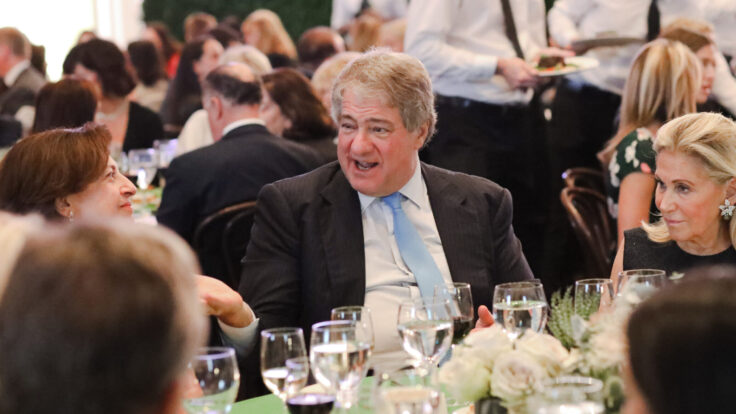
At a ceremony celebrating his life, on Monday, at Alice Tully Hall, his five children spoke, as did his brother, Jon, who had provided his original stake in his buyout business, and five friends, including Harvard admissions dean Bill Fitzsimmons and Hillary Clinton. “Tom was a constant presence,” Clinton told the mourners. “We’ve shared births and weddings and anniversaries, state dinners at the White House, lively parties from New York City to Martha’s Vineyard to the Hamptons during good times and tough ones.” Wynton Marsalis played the trumpet, along with eight other musicians.
What’s clear in the end was that Lee was a complex individual, like many of us, with demons and ghosts and behavior that was self-destructive. But there’s no taking away from him what he accomplished in the world of high finance. “All you can just say is that he was quirky, lovely, childlike, gracious, generous, brilliant,” my banking friend said. “And again, quirky, with undoubtedly, huge despair emanating from some place that was not clear to all of us.” |
|
|
|
| FOUR STORIES WE’RE TALKING ABOUT |
 |
|
 |
|
 |
| The Harris Makeover |
| Karen Finney makes the bull case for Harris’s vice presidency. |
| TARA PALMERI |
|
 |
|
|
|
|
|
 |
|
|
|
Need help? Review our FAQs
page or contact
us for assistance. For brand partnerships, email ads@puck.news.
|
|
|
|
Puck is published by Heat Media LLC. 227 W 17th St New York, NY 10011.
|
|
|
|