Good afternoon, I'm William D. Cohan.
Welcome back to Dry Powder. If you're receiving this private email, it means that you have subscribed to Puck, our new media company covering Washington, Wall Street, Silicon Valley, and Hollywood. Thank you.
As always, you can read my latest work online, at your convenience, or in this email, below. Enjoy, and I'll be back in your inbox on Sunday with more Dry Powder.
SPONSORED BY 

Serious China watchers fear that businesses have underestimated the gravity of Xi’s “regulatory crackdown”—but privately worry that Washington isn’t responding with nearly enough nuance. “It's impossible to decouple,” warns one China expert. “[You] can't afford to not be there.” In a September research report, the mighty Goldman Sachs asked the important question: “Is China Investable?” By this, Goldman wasn’t necessarily thinking about retail investors. Instead, the firm was hypothesizing about the risk tolerance for the companies that it specializes in advising, and raising capital for, around the globe. Should they still feel comfortable doing business in the country?
It’s a question that many on Wall Street are pondering these days. “The known unknowns and the unknown unknowns have increased,” explained one very senior Wall Street executive, echoing the late Donald Rumsfeld’s famous expression. We were speaking soon after the United States, Britain, and Australia agreed to a nuclear submarine deal designed to countermand China’s increasing military presence in the South China Sea (and one that also pissed off France). “That’s sort of a direct acknowledgement that portions of the Western world [believe], ‘You know what, we have to begin to counteract China’s intrusion into Southeast Asia, the Middle East and Africa, put aside Taiwan,’” he continued. (We spoke just before China buzzed Taiwan with some 56 fighter jets during a fraught couple days.)
The problems that companies face in China these days go well beyond whether Evergrande, the Chinese real-estate giant, defaults on its $300 billion in debt. What is more worrisome, those on Wall Street seem to agree, is the “regulatory crackdown,” as one investor put it in the Goldman report, upon which the government of China’s supreme leader, Xi Jinping, has recently embarked. “This isn’t business as usual,” George Magnus, an associate at the China Center at Oxford University, told the Goldman Sachs researchers.
Magnus, who is also the author of Red Flags: Why Xi’s China is in Jeopardy, cited a variety of recent events for his growing concerns. Since Xi was “heralded as a closet reformer” at the 18th National Party Congress, in 2013, he said, “real and market-oriented reform in most areas has ground to a halt.” Recently, there has been the cancellation of the Ant Financial I.P.O. and the post-I.P.O. investigation of Didi, the Chinese ride-sharing company, which has caused its stock to fall nearly 50 percent since it went public in the United States at the end of June. Many have interpreted the post-I.P.O. investigation of Didi as a form of retribution against the company for listing on the New York Stock Exchange. And we’re not even talking about factoring in the fate of the million or so Uyghers that China has been busy disenfranchising. (“We care [about the Uyghers],” the senior Wall Street executive said.)
Chinese regulators have targeted certain sectors of their economy for reform, including internet platforms, education, gaming and real-estate. “In recent months, the Chinese government has embarked upon a regulatory tightening cycle unprecedented in terms of its duration, intensity, and scope,” the Goldman researchers noted. Since February, Chinese stocks have lost more than $1 trillion of value, and now have a total valuation of around $7.5 trillion, down from around $10 trillion a year ago. According to an estimate by Siblis Research, the total value of the publicly traded companies in the U.S. was nearly $47 trillion at the end of June.
Close observers of China, such as Magnus, are worried. In the report, he said Xi’s recent initiatives “reflect a discrete break from the last 20 to 30 years, and—if anything— suggest that China is turning back the clock to a more Marxist-Leninist system of governance with conservative morals that we thought it had left behind a long time ago.” The moves, he suggested, represent a return to the Chinese Communist Party’s “centrality” in the country. “North, south, east, west, the party leads everything,” as Xi once said. Magnus suggested that Xi is at the beginning of “a broad campaign” to bring China’s private sector “to heel” and to reinsert the Party at the “vanguard of leadership” in “all realms of economic, social and political life” and “people and firms need to align their interests with it.”
In the report, Magnus noted that he has dismissed the argument that China’s “regulatory crackdown” is overblown—a refrain generally made by those who point out that it appears to have ensnared merely “frivolous technologies” (such as video gaming, ride-sharing, and streaming services) and spared high-tech innovation, such as artificial intelligence and quantum computing. “I’m not sure that regulating consumer technology won’t be harmful,” he continued in the report. “Things like Apple watches and Xiaomi telephones fulfill a very important role not just as products, but through the processes companies use to produce them, which creates spillovers for technological adoption in areas like retail, wholesaling, and transportation. Jettisoning these technologies understates their significance and risks stifling innovation. So, the regulatory rollout won’t be uniform. But the drift toward more intervention and political control will win out, in the end, because that’s the government’s raison d’etre.”
Xi’s “regulatory crackdown” was particularly “pernicious,” Magnus continued in the report, and has the “hallmark of a crafted plan” to reinforce the power of the Party and to “subjugate” private companies and entrepreneurs in the year-long run-up to the 2022 National Party Congress, when Xi is expected to announce that he is staying in power for a third term, something that hasn’t happened since Mao’s day. In 2018, China removed the two-term limitation for Xi, allowing him to effectively remain president for life if he chooses to do so.
SPONSOR CONTENT Taxing Thoughts
As the current Moderate v. Progressive Democrat drama plays out in D.C., you might wonder how Congress will pay for a $1.5-$3.5 trillion reconciliation package. On September 23, House Speaker Pelosi, Senate Majority Leader Schumer and Treasury Secretary Yellen announced agreement on a “framework” for revenue raisers (i.e., higher taxes). What was missing from this announcement, and has not appeared since, are specifics. What we do have are the reconciliation bill tax provisions passed by the House Ways & Means Committee in mid-September with significant tax code changes, including higher individual and corporate tax rates and limited deductions. Equally important are missing items: repeal of the 2017 Tax Cuts and Jobs Act limit on SALT deductions and, for Wall Street, “MODA” championed by Senate Finance Committee Chair Wyden. The fate of these proposals and the “winners” will be known when agreement is reached between Democratic factions. Explore the tax proposals. 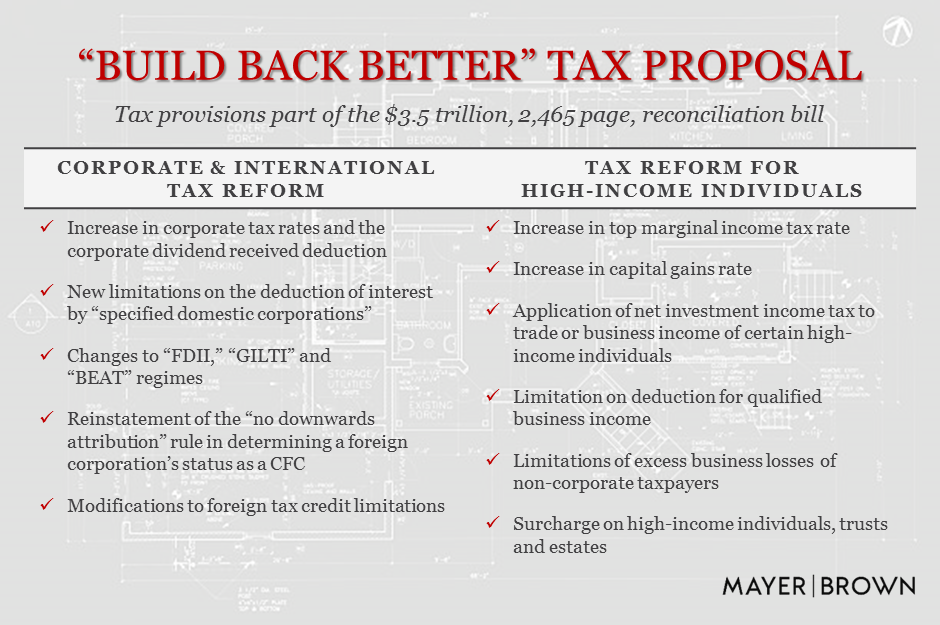
After reading this report, I called a few serious China watchers on Wall Street to get their read on the evolving situation. One of them, a longtime China expert and respected Wall Street player, said that Xi’s recent moves were largely an “evolution” of the president’s concept of capitalism, reflecting his “huge concern” about growing wealth inequality in the country. “He’s pressing on it very hard,” this person said of Xi, adding that the Xi government had a role in creating the wealth disparity, but of course could not take the blame for it. “He’s going to blame business,” he continued. That’s why there’s been the crackdowns on video game manufacturers—there’s a fear that the Chinese obsession with video games “could wipe out a generation,” he said—and on the education companies that prepare Chinese students for the college entrance exam. “You take a test and then either go to college, or you don’t, and your life just totally changes,” he continued.
The senior Wall Street executive agreed that wealth inequality has become a huge problem in China, just as it is in the United States. “It doesn’t matter whether you’re a democracy or a dictatorship,” he told me. “Inequality is the leading cause of death of a regime, a democratic regime or authoritarian regimes. I think [the Chinese are] worried about that.”
The longtime China expert worried that policy makers in Washington aren’t taking a nuanced enough approach when dealing with the Chinese and Xi’s reforms. “The only area where Democrats and Republicans are united is on anti-China,” he said. But he sees little point debating the China hawks in Washington, especially when he agrees with the majority of the critiques. The real question, he says, is “what do you want to do?”
He fears that U.S. policy makers will take steps to punish China that will also punish a number of important American companies. U.S. agriculture companies and consumer-products companies may be fine, because China needs food and consumer goods, and there are few, if any, vital technology concerns embedded in them. “It’s easy,” he said, “It’s non-controversial.” (Unless, of course, the consumer products company is Nike.) Instead, he cites companies like Intel, which makes computer chips, and Honeywell, which makes, among many other things, sophisticated landing gear and avionics for jets. He worries that if, say, Honeywell isn’t allowed to sell those high-tech parts to China—as China continues to roll out its new Comac C919 commercial jet production—that other non-American companies will get that contract, hurting the U.S. economy and U.S. employment.
“The rest of the world is not going to decouple from China economically, not going to come close to doing that,” he continued. “And that’s not just Asia, but the Europeans—bigtime. And so if we do this, and we don’t participate in supply chains, we don’t set global standards, we isolate ourselves. And if we sequester too much of our technology, we really hurt ourselves. We have to be smart. We have to have a high fence and a small yard.”
He also cited the questionable decision by the New York Stock Exchange to delist important Chinese companies, such as China Mobile, because they sell some products and services to the Chinese military. “Everybody does something with the military, right?” he said, speaking candidly. He fears a bad precedent is being set, and that the Chinese will find a way to retaliate against American companies: “Why would any good Chinese company want to list here and put themselves through the process?”
SPONSOR CONTENT 
Then there is Wall Street and China. “We can’t decouple on finance,” the China expert argued. China, after all, is our largest foreign creditor, and if they were to start to dump their U.S. Treasury securities onto the market, and just bring the country’s ownership in line with the ownership of other central banks, it would be “much harder for us to run our macroeconomic policy and for the Fed to manage interest rates.” Wall Street has to continue to figure out ways to work with China and Chinese companies, either through joint-ventures or by getting the permission of the Chinese government to operate more independently, as Goldman Sachs was able to do in December 2020.
“The Chinese are such an important part of global capital flows,” he continued. “And with money moving at the speed of light, to the extent there’s a disturbance or a financial crisis in China, of course, it will impact us in our markets, just like what happened in the U.S. [in 2008]. And it’s impossible to decouple.”
As a result, he noted, every U.S. company operating in China today is trying to figure out what Xi’s moves mean and how they will navigate around them. He tries to imagine what, say, the C.E.O. of Honeywell must be thinking: “The market is so big, and is apt to be big for a long time and growing quicker than that of other big markets. It’s so vital to the global supply chain, I can’t afford to not be there. [But] how can I afford to be there in a size given that I could get cut off by the Chinese or by the U.S.? I don’t know what the policy is. So it’s a very difficult decision.”
The senior Wall Street banker agreed with this analysis. He’s doing it at his own bank and he’s sure his competitors are, too. There’s concern about Xi’s “regulatory crackdown” and if a potential Evergrande credit default would spread to adjacent industries or to the broader supply chain. “How do you get comfortable actually putting a balance sheet in China?” he wondered. “I think it makes it a riskier proposition.” But, he said, “I guarantee that every bank around the world is stress-testing their Chinese exposures right now.”
FOUR STORIES WE'RE TALKING ABOUT 
The expectation is that most people—particularly those not attached to marquee TV creator clients or the coveted books and sports departments—will be cut loose in the transition. MATTHEW BELLONI 
Political journalists find themselves trying to cover a legislative process that is arcane, aggravating, and painfully normal. JULIA IOFFE 
Emerson Collective was an early investor in the portentously named digital media company—and among the first to raise red flags. THEODORE SCHLEIFER 
If you want to understand the conundrum of the financial markets these days, all you have to do is look at the insanity in junk bonds. WILLIAM D. COHAN 
You received this message because you signed up to receive emails from Puck.
Was this email forwarded to you?
Sent to {{customer.email}}
Puck is published by Heat Media LLC.
For support, just reply to this e-mail. For brand partnerships, email ads@puck.news |


SHARE