 |
|
I’m Bill Cohan, welcome back to Dry Powder.
|
|
It’s increasingly evident that, on Wall Street, the bigwigs are bracing themselves for four more years of Donald Trump, whose bloviating, chaotic manner is anathema to a financial class that values, above all things, predictability in government. In today’s issue, how the Dimons and Ackmans of the world are hedging their bets on Biden.
But first, a few notes from my partner Eriq Gardner, with the latest legal news making the rounds on Wall Street…
- S.B.F. sentencing math: The next chapter in the seemingly endless Sam Bankman-Fried legal saga is the matter of his sentencing, now that the disgraced crypto wunderkind has been soundly convicted of fraud. This week, his legal cavalry, led by Trumpworld lawyer Marc Mukasey (a former federal prosecutor and onetime partner of Rudy Giuliani), boldly proposed a mere six-year stint behind bars in his sentencing memorandum. Mukasey’s appeal centers on the anticipated full reimbursement of FTX customer funds, based largely on S.B.F.’s seemingly prescient investment in the company Anthropic A.I.
The intricacies of federal sentencing guidelines play a crucial role here. Bankman-Fried faces a baseline sentence of six years, with Judge Lewis Kaplan weighing recommended enhancements running the gamut from the sophistication of the crime to whether there was obstruction of justice, such as S.B.F. lying on the witness stand. But the biggest potential multiplier surrounds victim losses, initially estimated to be a staggering $10 billion. That astronomical sum could balloon his prison term by a gut-wrenching three decades, which is why S.B.F. and his lawyers are now pointing to a rebound in FTX’s crypto assets, plus a savvy investment in Anthropic A.I., that could be used for reimbursements.
Of course, there’s a plot twist. This argument is made possible by a seismic legal development two years back, wherein the 3rd U.S. Circuit Court of Appeals (encompassing New Jersey, Pennsylvania, and Delaware) decided to flip the longstanding precedent that sentencing guidelines should factor in intended, not just actual, financial harm. According to their new ruling, only losses actually suffered should influence sentencing enhancements. (Cue the flurry of white-collar criminals angling for leniency...) Given the apparent circuit split, it’s only a matter of time before SCOTUS steps in to settle the matter.
- A Trump liquidity holdup: Over the past week, Donald Trump’s lawyers have been locked in a frantic legal battle: As Bill has noted, Trump’s multibillion-dollar stake in Truth Social—which is poised to go public through a SPAC merger—might be his best asset to pledge as collateral while seeking appellate review of his nearly half-billion dollars in civil fines.
However, a fresh legal saga has erupted. Former Apprentice candidates Andy Litinsky and Wes Moss, who say Trump Media is their brainchild, have filed a chancery complaint. They allege that the board’s ratification of a billion new shares has meaningfully diluted their own stake, a violation of their services agreement. What makes this situation urgent is not only an impending shareholder vote on the merger, which is scheduled for March 22, but also by the revelation that Trump has reached an agreement with Digital World Acquisition Corp., the SPAC, which permits him to transfer his stock post-merger to his family, a trust, or other affiliates.
This arrangement sets the stage for an imminent liquidity event. Attorneys for Litinsky and Moss say this is “particularly alarming given the over $500 million in civil judgments Trump owes judgment creditors” and may “explain his last-minute stock grab.” On Monday, a Delaware vice chancellor granted a motion to expedite and gave Trump until Wednesday to respond. A hearing is slated for this weekend. —Eriq Gardner
|
| And now on to the main event… |
|
|
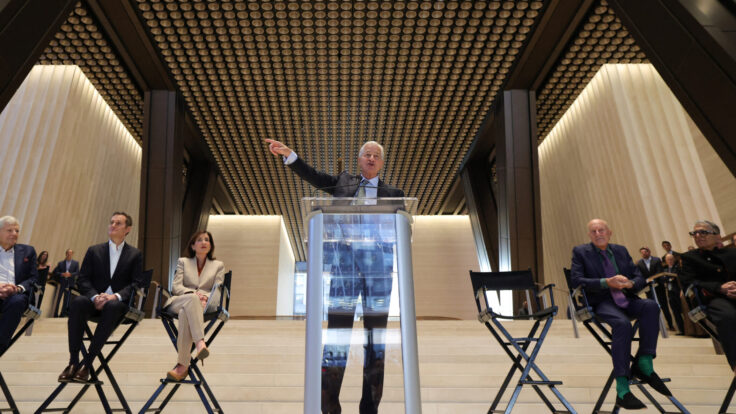
| Shortly after Jamie Dimon made his stunning comments about Donald Trump at Davos—praising the indicted former president as “kind of right” about a lot of things—my phone blew up with soliloquies from Wall Street’s liberal in-crowd. The callers wanted to know what the hell had just happened. Had Jamie lost the plot? Had he forgotten the chaos of Trump’s four years in office? More importantly, was he positioning himself and JPMorgan Chase for what he must be figuring will be a Trump victory in November? Since when had Jamie become so craven?
After all, Jamie has long appeared to be what passes for a Democrat on Wall Street, where the top brass often support Republicans while the rank-and-file usually vote for Democrats. Jamie, it seemed, was both top brass and a Democrat, a rare breed that includes Larry Fink, at BlackRock; David Solomon, at Goldman; Tom Nides, newly installed as a vice chairman at Blackstone; and Blair Effron, at Centerview Partners. Although he has taken to calling himself “barely a Democrat” these days, Jamie has been mentioned as a possible Treasury secretary in Democratic administrations.
That probably won’t be happening anytime soon, especially after his comments in Davos. Nor can I imagine him ever working for Trump, no matter what Trump might offer him. But with six weeks’ worth of perspective, I can almost fathom that Jamie was trying to walk a fine line with his comments: at once trying to be conciliatory toward both Biden and Trump and, more important, to be respectful of Trump’s supporters, all 70 million of them or so (at least in 2020), who may or may not be customers of his bank and who, of course, are our fellow Americans.
Welcome to Wall Street’s political hijinx, circa 2024, where it’s increasingly obvious that the bigwigs have started to hedge their bets in case Trump actually wins a second term, when of course they would much prefer that he retreat to Mar-a-Lago for good, and fade away like other ex-presidents. I’m not feeling a bunch of love and enthusiasm for the incumbent, mind you, but I do get the sense that on Wall Street, there is general agreement that four more years of Biden would be far preferable to another four years of Trump, with all his bloviating and chaos. Wall Street likes predictability and calm, not high-beta behavior, at least in Washington.
“I’m more optimistic now than I’ve been since pre-Covid,” shared one of my faithful sources, a senior Wall Street executive. “I think the economy is very solid. I think Biden is going to win by a larger margin than in 2020. I think the Democrats are going to take the House and lose the Senate. So you’re going to have a divided government, which people on Wall Street love [because it ensures predictability]. And you’ll have Grandpa Applesauce-for-Brains for four years.” When you have an economy this good, and a Republican candidate who’s “so noxious to independent voters,” he continued, “I don’t see the math of where [Trump] gets the 270 [electoral college votes]. And the polls reflect how the economy was six months ago, so I don’t even think it’s going to be close.”
Nevertheless, when leaders like Dimon are hedging on national TV, you can bet the fear is real on Wall Street that Trump can win, despite everything, including the near-triple-digit indictment count, the civil judgments, and the more than half a billion dollars in fines that could bankrupt him. The current Real Clear Politics average of polls has Trump leading Biden by 2.2 percent, and while there is a sense on Wall Street that the race will tighten up as we head into the fall, it could clearly go either way, which has many scratching their heads, wondering how and why Trump has even a chance to win. “Part of it is coming to grips with who we really are,” one former Wall Street C.E.O. and longtime Democrat texted me the other day. “Who comprises America? What we stand for. What are our values and principles? Feels like a very selfish time for people being about themselves and no longer [about] a collective or greater good.” |
|
|
| Jamie, at least, was clearly trying to be diplomatic when he said that he wished Democrats “would think a little more carefully when they talk about MAGA,” or when he said Trump was “kind of right about NATO, kind of right about immigration” and “right about some of China.” The gist of his remarks—after referring to his annual summer bus trip through rural America, in and around Spokane, Boise, and Bozeman—was that Americans are “hungry to grow” everywhere, not just in Silicon Valley, and that Biden’s “negative talk about MAGA” was disrespectful of his fellow citizens.
Bill Ackman, the outspoken hedge fund manager, and another seemingly reliable Democrat, is clearly hedging his bets, too. During his marathon podcast with Lex Fridman last month, Ackman said that Trump—whom he at first hoped might approach the presidency like a businessman—was ultimately “a very imperfect” president who “contributed to the extreme amount of divisiveness in our country.” Yes, obviously. But like many of his peers, Bill expressed his deepening frustration and even contempt for Biden, too. “It’s embarrassing for the country, having him as a presidential candidate, let alone as the president of the country,” he said. “It’s crazy. And it’s just going to get worse and worse. The worst part of his legacy is his ego, that prevents him from stepping aside. And that’s it. It’s his ego. And it is so wrong, and so bad. And so embarrassing.”
Ackman, of course, is not representative of the typical Democratic voter. He has supported the long-shot primary challenger Dean Phillips, previously supported Vivek Ramaswamy, and not so long ago urged me to join him in pushing for a Jamie Dimon candidacy. But he is an avatar of a certain category of left-leaning, ultra-wealthy financiers who donated to Democrats in past cycles but say they’re “done” with Biden. Ackman told Fridman that he had just returned from a few days in London, where people were asking him how Biden could possibly be president again. He said he believes that while being a C.E.O. is a “full-contact sport,” being president of the United States “is like some combination of wrestling, marathon running, and being a triathlete. You’ve got to be in serious physical shape, and at the top of your game to represent this country, and he is a far cry from that. And it’s just getting worse.” (At that point, he was still hoping Phillips would emerge as a credible alternative to Biden, but that has not happened, not even close.)
“It’s really bad for America, and I’m upset with him and upset with his family,” Ackman continued. “This is the time where the people closest to you have to put their arms around you and say, ‘You know, Dad, you know, honey, you’ve done your thing, this is going to be your legacy, and it’s not going to be a good one.’ Great leaders should also know when to step down. One of the best tests of a leader is succession planning. This is a massive failure of succession planning.”
As confounding as these very public and high-profile Democratic Wall Streeters are by turns denouncing Biden and finding nice things to say about Trump is the fact that by any objective measure, the Biden presidency has been remarkably successful. Unemployment is at historical lows. The economy is growing faster than the economy of any other industrialized country. Inflation is coming down, although food prices remain stubbornly high. The stock markets are at all-time highs—an unimaginable reality some 18 months ago. Violent crime is at 50-year lows. Yet people are grumpy and stubbornly refuse to give Biden credit for what he has accomplished both legislatively and economically. He has also restored, to some degree, our standing in the world.
And yet, most of the recent polls—whether one can possibly believe them or not—have Trump leading nationally as well as in the key battleground states. That probably helps explain both Dimon’s hedge and Ackman’s condemnation. “It’s hard to believe that half this country could support a person so devoid of values, ethics, and a true desire to serve this country,” the ex-Wall Street C.E.O. texted, about Trump. “But we have to take it head-on.” He is hoping and praying that at least one half of Congress is controlled by the Democrats to put some brakes on Trump during his second term. And everyone I know continues to wonder: How the hell did we get here?
The disbelief is palpable. Last summer, no less than David Rubenstein, one of the billionaire co-founders of The Carlyle Group (and the new principal owner of the Baltimore Orioles), put forth the modest proposal, during a talk in Nantucket, that Biden should pardon Trump for his sins in exchange for an agreement that Trump would not run for president—and that Biden wouldn’t run either. The idea went nowhere, of course. But it is indicative of the centrist megadonor journey through the five stages of grief.
More recently, some Wall Street C.E.O. types have continued to hold out hope that one or both of Biden or Trump will drop out or experience health-related issues that would cause them to abdicate, opening the door to a brokered convention, where a donor-class white knight such as J.B. Pritzker, Glenn Youngkin, Gavin Newsom, or Nikki Haley might parachute in. Such is the depth of fever dreams on Wall Street these days when it comes to the upcoming election. |
|
|
|
| FOUR STORIES WE’RE TALKING ABOUT |
|
|
|
|
|
 |
|
|
|
Need help? Review our FAQs
page or contact
us for assistance. For brand partnerships, email ads@puck.news.
|
|
You received this email because you signed up to receive emails from Puck, or as part of your Puck account associated with . To stop receiving this newsletter and/or manage all your email preferences, click here.
|
|
Puck is published by Heat Media LLC. 227 W 17th St New York, NY 10011.
|
|
|
|