 |
|
Welcome back to The Best & The Brightest. I’m Tara Palmeri.
🎙️ As always, don’t miss the latest episode of my podcast, Somebody’s Gotta Win, where this week I deconstructed the “Nikki Haley insurance policy” theory and pondered her long game with South Carolina political guru Terry Sullivan.
In tonight’s edition, I dig into how high-dollar Republican donors are starting to rationalize returning to Trump’s bosom. Much like his radicalized small-dollar donors, they are starting to relate to Trump’s alleged victimhood thanks to his whopping $355 million fine for manipulating his assets—a crime they can finally understand.
But first, Teddy has an incredible story on legendary venture capitalist Marc Andreessen’s push into Washington…
|
| Marc Andreessen Eats Washington |
|
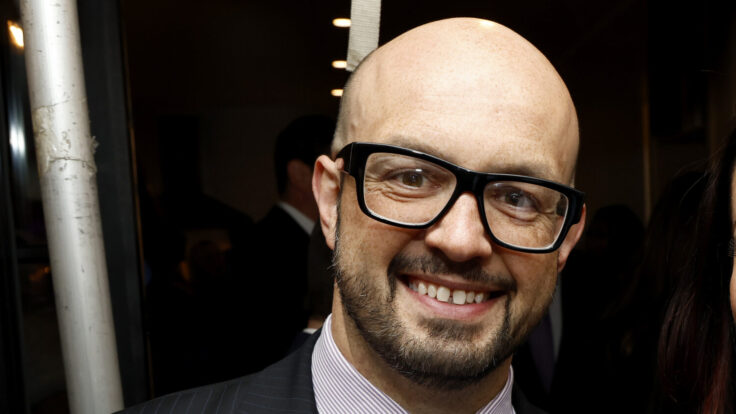
| Late last month, Marc Andreessen was holding court in the Waldorf, the site of the former Trump hotel in downtown D.C., showing off one of his new initiatives in town, “American Dynamism”—his firm’s investment thesis for backing startups in patriotic fields like manufacturing and defense tech. As the speaking list suggested, Andreessen hasn’t lost his ability to pull: sprinkled about were Governor Wes Moore, F.B.I. director Christopher Wray, and G.O.P. senators including Bill Cassidy and Todd Young. Later that evening, Andreessen Horowitz held one of those classic D.C. wine-and-dines at the National Portrait Gallery, which they rented out in all its grandeur. (Yes, there was a Playbook SPOTTED mention.) The firm’s partners weren’t SPOTTED when they hit the Hill a few days later to take private meetings with senators, however.
Andreessen, one of the men who helped invent the modern internet, used to hate Washington. In private conversations with friends—or the conservative rabble-rousers who flood him with ideas for memes—he has often expressed skepticism about the town’s value and its denizens. The man who once helped Al Gore design his website exuded the sense that he was done with these bozos, particularly after the Trump surprise of 2016 left the voracious reader looking inward for answers—a sort of self-conscious reflection and awakening that he has called a “spirit walk.”
Anyway, that was then. These days, Andreessen is back, consumed by ideological fervor and more active in politics than he has been in decades, according to about two dozen friends, politicos, and influencers who have interacted with him over the years. His firm has quietly hired high-powered Republican and Democratic consulting firms to help them navigate Washington while hosting fundraiser after fundraiser at its Sand Hill offices for crypto-friendly candidates, setting up new political-action committees, and preparing to spend its founders’ fortunes to boost…
Click here to read more…
And now here’s Abby Livingston’s report from The Hill… |
| Hogan, Slotkin & A Senate Fundraising Update |
|
With Super Tuesday (and the first round of congressional primaries) less than two weeks away, it’s remarkable how fluid the Senate map remains this late in the cycle. As such, here’s where things stand in two of the most compelling Senate races:
- Maryland Senate: Now that Maryland Democrats have settled into the new reality that Larry Hogan has single-handedly put retiring Ben Cardin’s Senate seat in play, the consensus I’m hearing is that state Dems aren’t overly worried. Yes, they’re taking Hogan seriously: The former governor is a rare Republican who could win statewide in Maryland. But most of my conversations this week indicated that Democrats think Maryland is only capable of electing a Republican to state office—not the federal level, where abortion will be a top issue.
That doesn’t mean Democrats believe this will be a walk in the park. Hogan and his Republican allies could run up the tab on this one in the fall, costing Democrats more money when they’re already spread thin playing defense all over the map. When I pressed Democrats on whether Hogan’s entrance might impact their May primary, my sense was that everyone’s fairly settled in their camps on this race. Angela Alsobrooks, Steny Hoyer’s favored candidate, has $3 million in cash on hand. Her top Democratic rival, alcohol magnate/House Democrat David Trone, filed an absolutely stunning campaign finance report that showed he can probably keep up with any Republican spending thrown at him, should he become the nominee: One of the top self-funding candidates ever, he’s already loaned his campaign $23 million, with almost $14 million already out the door.
- Michigan: When it comes to fundraising in the Michigan Senate race, there’s Elissa Slotkin and everyone else. The House Democrat ended last year sitting on $6 million for what is expected to be a brawler of a race this fall. And that came after she’d already spent $5.7 million to win the retiring Debbie Stabenow’s seat. But beyond Slotkin, an interesting race is shaping up on the Republican side. While former House Republican Mike Rogers lags behind her with just under $1 million in cash on hand, he is the unquestioned Washington establishment favorite in the Republican primary: He’s picked up campaign checks from around 35 current and former House members and senators. Nearly every single member of the Senate G.O.P. leadership donated to Rogers, including N.R.S.C. chairman Steve Daines. So did John Boehner.
That was not the case for another ex-House Republican running for the party’s nod, Peter Meijer. After he voted to impeach Donald Trump after the insurrection, Meijer has had a tortured relationship with both his party and Trump. None of his former colleagues are rallying behind this campaign, but the grocery store chain heir bolstered his fundraising with self-funding. He launched his campaign late in the quarter, and reported only $389,000 in cash on hand. Ahead of his December launch, Meijer personally paid for an $86,000 poll, so he did not enter this race blindly. As for Hill Harper, the TV actor who’s running against Slotkin for the Democratic nod, it’s been a struggle to keep up. He had only $154,000 in cash on hand, and only a handful of Hollywood types rallied to his cause, most notably Tennis Channel C.E.O. Ken Solomon and producer Frank Marshall.
|
 |
| Trump’s Donor Love Language |
| Fascinatingly, Trump’s $355 million financial penalty (plus interest) has some among the donor crowd warming to the presumptive nominee. Are they just being reflexively opportunistic, or genuinely sympathetic to the financial plight of a fellow billionaire? |
|
|
|
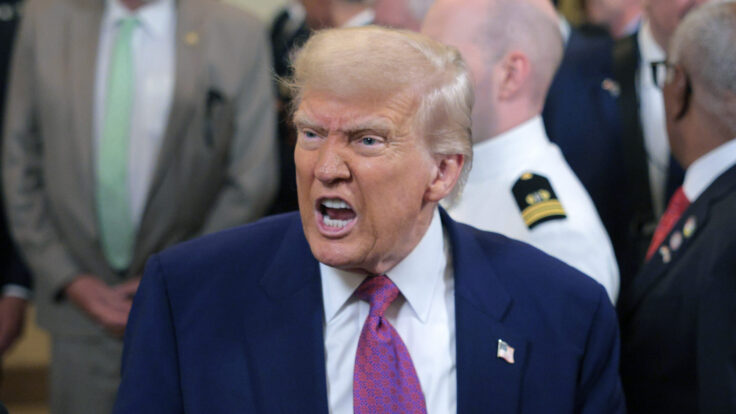
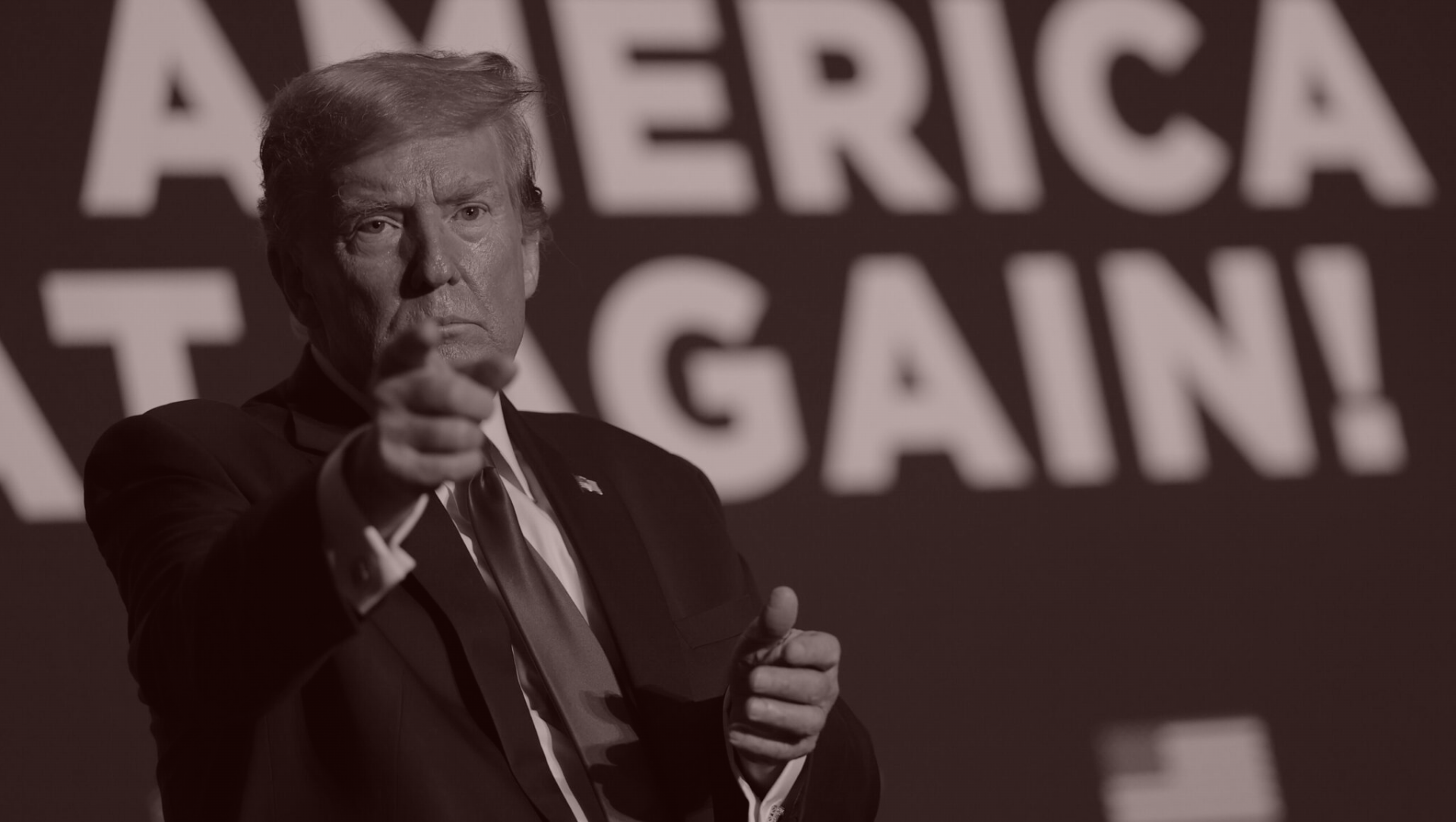
| Among the sharpest of Donald Trump’s political gifts has always been his ability to exploit victimhood, real or perceived, but especially his own. And indeed, Trump has a legitimate claim to being at least among the most prosecuted men in America: twice impeached, indicted on 91 felony charges, found liable for sexual abuse and defamation, and facing the potential dissolution of his business empire. This litany of alleged misdeeds is among the reasons that his presidential campaign currently has just $30 million in the bank—about half of Joe Biden’s cash on hand. Around this time last cycle, Trump had $229 million in his campaign war chest and Biden had just $70 million.
Over the last week, however, the mood toward Trump and his legal obligations appears to have shifted in the Republican donor universe, or at least pivoted slightly. On Friday, of course, a judge in New York found the former president liable for conspiring to manipulate his net worth and ordered him to pay some $355 million in penalties, plus interest. In another era, a stunning financial judgment might have compelled party elders to second-guess the wisdom of his nomination. But, as with his first criminal indictment in New York (and then the indictment in Miami… and in Georgia… and in Washington, D.C.), Republicans are rallying to his cause.
And this time, interestingly, it’s business owners, megadonors, and even some Never-Trump institutionalists who are offering, or at least rationalizing, their support. After the judgment dropped, interestingly., one G.O.P. bundler told me that he was hearing a common, if unusual, request from donors: “We don’t want to give Trump money, but is there a way we can give money to his legal defense?” this person told me, relaying the conversations.
Yes, of course, the timing is convenient. Perhaps the donor migration is really just a reflection of Trump’s polling, and the grudging acceptance that he will be the Republican nominee. Many of these donors are the same Republicans who previously supported Ron DeSantis or Nikki Haley and are now seeking a justification for slipping back into Trump’s good graces before the window of opportunity closes. But others are genuinely aggrieved that Trump is facing consequences for what they perceive as a largely victimless crime—unlike refusing to hand over classified documents, or assaulting E. Jean Carroll and then defaming her, or trying to stop the certification of the 2020 election. So what if he hyperbolically inflated the value of his assets and reaped the benefits from the dumb money crowd?
Tax code manipulation, after all, is a love language among the .001 percent, and this appears to be a “witch hunt” that some wealthy Republicans can countenance. Indeed, Deutsche Bank itself testified that they made $40 million in interest off Trump’s inflated assets. (“There are no traditional victims, as in anyone suffering out-of-pocket loss,” noted CNN senior legal analyst Elie Honig, a former federal prosecutor in the Southern District of New York. “The only purported victims, the banks, were repaid with interest.” New York State disagreed.)
“We’re appalled and frightened. It’s pick the target, and then prosecute. It’s like Russia,” said one major DeSantis donor. This person hastened to add that he still won’t support Trump, himself, but is hearing a softening among his peer set. “It’s just really anti-business,” added former DeSantis donor Dan Eberhart, who recently made the switch to team Trump. “It softened up several potential donors that I know. As the legal cases ripen, you’re going to see more donors drawn to defend Trump. A lot of donors own their own businesses, and they are putting themselves in Trump’s shoes.”
Another top G.O.P. donor, who was holding out for Glenn Youngkin and still refuses to donate directly to Trump, said that his fellow Youngkinites are beginning to form justifications for why it’s likely worth donating to the presumptive Republican nominee. “Non-Trump Republicans are capitalists. This is a direct attack on capitalists,” the donor said. “If you were probably going to [donate to Trump] anyway, then this comes across as a justification to yourself and your family members that we have to do this because we’re defending the rule of law. Sure, it’s on the margins, it’s a significant subset of people who were probably going to go [with Trump] anyway, but it’s another arrow in the quiver.” |
|
|
| Of course, there are a fair amount of mental gymnastics exercises required to get riled up over Trump’s alleged persecution at the hands of New York Attorney General Letitia James. Yes, James campaigned for her office on investigating him. On the other hand, Trump is campaigning on the pledge to act like a “dictator” on Day One of his presidency and turn the Justice Department on his political enemies, and appears eager to let Putin annex Ukraine.
But the rhetorical shift among Trump-skeptical G.O.P. donors has been noticeable, and pronounced. At a Bloomberg event last month, Citadel’s Ken Griffin, a major Haley donor, dubbed Trump a “martyr” on account of his more than seven-dozen felony charges. “His name’s being removed from ballots,” Griffin said. “It’s hard not to feel some level of just like, this is just wrong. This is just unfair. And frankly, as a voter, I want my vote to determine who is the president and not some clever legal maneuvers by somebody on the opposing side of the aisle.”
Alas, many donors have come to accept that footing Trump’s legal bills is simply the cost of helping him win the election. But the slow pace of fundraising and Trump’s attorney fees have taken a toll. No wonder Trump’s team is desperate to launch a Joint Victory Fund with the R.N.C. so that they can accept checks of more than $800,000—or that they hope replace ousted R.N.C. chair Ronna McDaniel with Trump’s daughter-in-law, Lara Trump, and his campaign manager, Chris LaCivita as C.O.O., so that he can officially tap the party slush fund. |
|
|
| Trump, for his part, doesn’t seem overtly distracted by all this—perhaps the starkest difference between this campaign and his highly spontaneous and reactive previous runs. I’ve heard from multiple people who saw Trump last weekend, after the judgment dropped, that he’s angry but hopeful that he will win on appeal as the case moves through the various New York courts. “He’s pissed off because it’s so outrageous,” said one person who saw him. “But other than that, he’s made it clear: If he starts losing in the polls, not in court, then you have a problem.”
Another person who spoke to Trump recently said, “He’s angry about the whole legal thing, but he has an amazing ability to compartmentalize.” As for the Carroll case, I’m told Trump “wasn’t so upset about the accusation, but rather that she was able to use the system to con him out of money. He’s not used to losing to settlements like that.”
In the meantime, those close to him spend their time spinning the idea that court cases are earned-media opportunities, even if it means he has to arrange his campaign around his court schedule. And while donors may be sympathetic to Trump’s business woes—especially the indignity of a state-appointed monitor at the Trump Org, or possibly having to put up one of his properties as collateral—those who have known him forever see this latest legal challenge as another self-inflicted, ego-driven error, just like the defamation case and the obstruction of justice case.
But, alas, it also plays into his greatest political strength: grievance politics. In Trump’s own mental map, it would seem, he’s just the victim of another witch hunt, and one aimed at one of the most primal parts of his identity: his wealth. “There is some psychological part of this. Questioning his assets and how rich he is just gets inside of his head,” said a longtime adviser. “His perception of his wealth is an important part of his makeup. When you keep insisting how rich you are, people will question if you are really rich. People who are really rich never talk about it, but he wouldn’t stop; he said it was part of his shtick.” |
|
|
|
| FOUR STORIES WE’RE TALKING ABOUT |
 |
|
 |
| Blue Munich |
| An insider’s dispatch from the annual security conference. |
| JULIA IOFFE |
|
 |
| Trump’s Liquidity |
| Can Trump actually fork over half a billion in legal penalties? |
| WILLIAM D. COHAN |
|
 |
|
|
|

|
 |
|
|
|
Need help? Review our FAQs
page or contact
us for assistance. For brand partnerships, email ads@puck.news.
|
|
You received this email because you signed up to receive emails from Puck, or as part of your Puck account associated with . To stop receiving this newsletter and/or manage all your email preferences, click here.
|
|
Puck is published by Heat Media LLC. 227 W 17th St New York, NY 10011.
|
|
|
|