|
Hello, and welcome back to The Best & The Brightest. I’m Leigh Ann Caldwell, on a plane to Los Angeles for the Milken Institute Global Conference. On Tuesday, I’ll be speaking on a panel about “The Future of a Free Press.” My partners Julia Ioffe and Dylan Byers will be there, too, so if you see us, please stop and say hello.
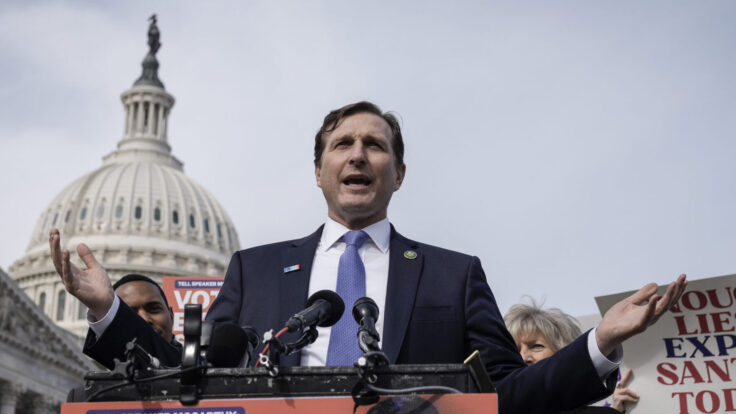
Today, news and notes on an extraordinarily consequential moment for House Speaker Mike Johnson, who is working to usher the entirety of President Trump’s legislative agenda through his slim majority in a single bill. He’s overcome challenges to his leadership and his agenda multiple times before, but this could be his biggest test yet.
But first…
|
- The failed science of budget cuts: As we saw on Friday, President Trump released his aspirational budget of $163 billion in domestic spending cuts—a 22.6 percent reduction—while increasing the Defense Department budget by the same dollar amount. The White House claims that the cuts are necessary to put the country on a path to a balanced budget. But, of course, when the cuts are offset by comparable defense and security funding, it’s not a reduction in spending—just a reallocation of resources and priorities.The administration’s wishful budget makes clear that it expects the states to shoulder much of the cost of social programs, especially for K-12 education, where the president proposed $4.5 billion worth of cuts. It’s one thing to move oversight of education to the states; it’s another thing to ask them to pay for it, too. If Congress also asks the states to bear more Medicaid or food assistance costs, which is under consideration as part of the tax and spending cuts bill, it’s hard to imagine states being able to cover the check.
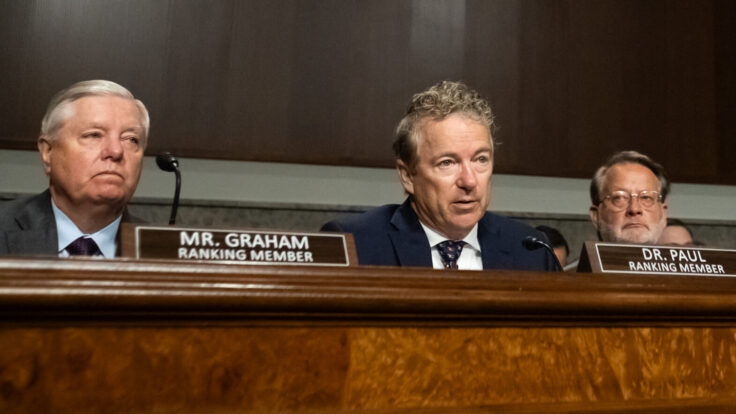
But Trump’s budget—like all presidents’ budgets—will never pass. Republican Sen. Susan Collins, the chair of the Senate Appropriations Committee, has already panned it. Even a forthcoming, relatively modest $9 billion recissions package—a measure to claw back some government funding already allocated—could face problems. Sen. Rand Paul, who has been pushing the administration to send Congress a rescissions package of cuts, including DOGE cuts, told me it would be “a trial” to see if Republicans will actually approve reductions in spending. “Why are they only sending $9 billion over? I don’t know,” Paul said. “I think they had said initially they were going to do it in multiple tranches. Maybe they think this is the easiest $9 billion. They don’t want to lose the case and see if they can get the $9 billion, but we’ll see.” Congress tried it before—in Trump’s first term—but failed to pass a $15 billion recissions package, and the administration gave up.
|
|
|
|
A MESSAGE FROM OUR SPONSOR
|
|
Medicaid helps keep more than 30 million children healthy, covering regular checkups and more.
|
|
|
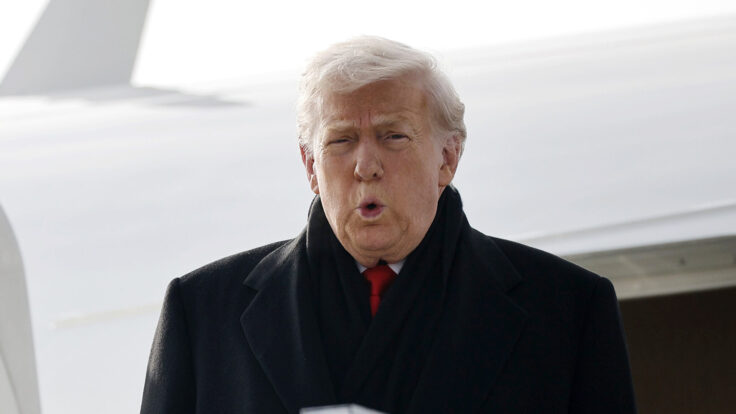
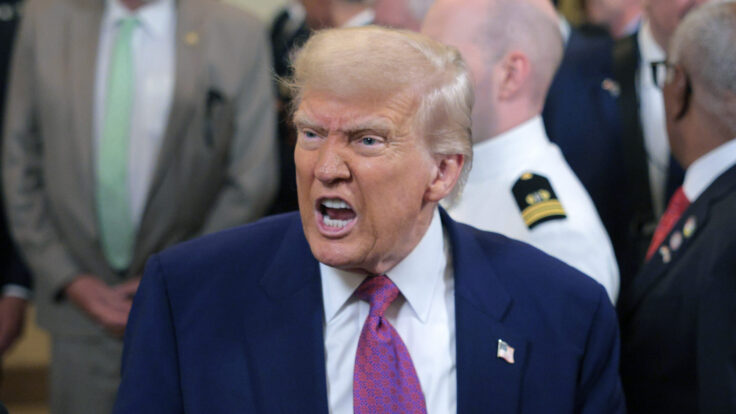
- Constitutionally clueless: Trump feigned ignorance on all matters constitutional in an interview this morning with NBC News’s Kristen Welker. When asked if anyone can be denied due process, a guarantee provided in the Fifth Amendment (including for noncitizens), Trump said, “I don’t know.” Asked if he has to “uphold the Constitution,” he said, “I don’t know.” When asked if he’ll run for a third term, despite the Constitution prohibiting it, he replied, “I don’t know if that’s constitutional.” Trump also said a couple other things of note. For one, he was particularly evasive about running for a third term, saying it’s “not something I’m looking to do.” On the state of the economy, he said, “I think the good parts are the Trump economy and the bad parts are the Biden economy.” And he didn’t reject using the U.S. military to take over Greenland. “I don’t rule it out,” Trump said. “We need Greenland very badly. Greenland is a very small amount of people, which we’ll take care of, and we’ll cherish them, and all of that. But we need that for international security.”
|
|
|
|
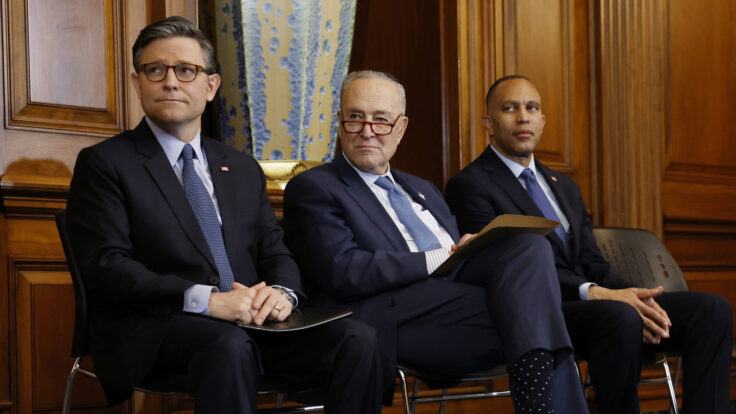
One hundred days into Trump’s term, the speaker faces his greatest test yet: passing the president’s “big, beautiful bill” through a fractured and mutinous conference. “Rarely have the stakes been higher; rarely have the margins been narrower,” said one of his closest confidants. “And rarely has the difference of opinion of where we need to go in the House been starker.”
|
|
|
|
Mike Johnson has notched his share of victories in his 18 months as speaker of the House, not least of which is that he still has the job—which few thought would be possible given the Republican Party’s nanoscopic majority. Along the way, he’s angered colleagues, faced multiple threats to his leadership, and struggled to wrangle the votes for his January speaker election. And yet, Johnson survives—a high-wire act that some Republicans attribute to his being quite good at the job, while others complain he couldn’t do it without the rest of his leadership team, and especially not without the provisional support of Donald Trump.
Johnson is currently facing down his biggest test yet: passing the entirety of Trump’s legislative agenda in one massive, “beautiful” bill. If Johnson can’t corral his party behind the measure, it would constitute a massive failure with potentially disastrous political consequences. Republicans would have no major legislative accomplishment to tout; many Americans’ taxes would go up; and his members would lose faith in him. Perhaps most importantly, Johnson’s usefulness to the transactionally minded Trump would immediately come into doubt. “Rarely have the stakes been higher; rarely have the margins been narrower, and rarely has the difference of opinion of where we need to go in the House been starker,” Rep. Dusty Johnson, one of Johnson’s closest confidants, told me.
Ushering this massive tax and spending cuts bill through the House is proving to be a messy, rancorous process. The three committees tasked with crafting most of the $5 trillion tax cut, and potential $1.5 trillion in spending cuts, have delayed their committee work a week due to the severity of disagreements among Republicans on everything from Medicaid cuts and a higher cap for state and local tax deductions, to the repeal of Inflation Reduction Act tax credits, low-income food assistance programs, and more. “The delay is not a good sign,” one House member told me. “It isn’t a four-alarm fire, but it clearly is an unwelcome development.”
|
|
|
|
A MESSAGE FROM OUR SPONSOR
|
|
Medicaid helps keep more than 30 million children healthy, covering emergency room visits and more.
|
|
|
|
Given the current political makeup of the House, divisiveness was all but guaranteed: Hardline conservatives want massive spending cuts; centrists are fighting to protect Medicaid and other constituent benefits; and blue state Republicans are fighting to increase the SALT cap. Meanwhile, Trump is pushing for additional tax cuts on tips and Social Security benefits that he promised on the campaign trail. And it’s up to Speaker Johnson to figure it all out.
Johnson’s defenders praise him as a survivor—someone with immeasurable patience to deal with the very complicated, sometimes bitter dynamics within the conference. He is thoughtful, kind, and well-liked. And he listens, they say. He’s constantly on the phone with many of his members and with Trump. “Never underestimate Speaker Johnson,” Rep. Mario Díaz-Balart told reporters before being whisked away to vote. I tracked down the Florida Democrat and asked him why he has so much confidence in Johnson. “Well,
it keeps happening time and time again,” he told me. “He gets it done. He gets the votes.”
But while some of Johnson’s colleagues laud his patience, others say they’re perpetually frustrated by his inability, or unwillingness, to make decisions. He’s seen as a dawdler, dragging on negotiations for far too long with little progress. “Have I been in meetings where it seems like nothing gets resolved? Yes,” one member said. To wit: I’m told the negotiations over the SALT deduction are stalled over theoretical new cap numbers because Johnson hasn’t narrowed the possibilities, or been clear about the options. “He does not have the luxury of making bold decisions that irritate two-thirds of the conference,” Rep. Dusty Johnson told me in Johnson’s defense.
|
A Minimum Viable Tax Bill
|
|
Johnson is meeting the challenge bruised from the past 18 months. His job was threatened, not for the first time, when he worked with Democrats to get military aid to Ukraine, and again when he turned to Democratic votes to pass government funding bills. He relied on short-term bills to fund the government despite promising to reform the appropriations process. And he made a mess out of the House Intelligence Committee by removing well-respected members—including its chairman, Rep. Mike Turner—and replacing them with MAGA ideologues, undermining the comity and reputation for seriousness that the committee has generally enjoyed.
Moreover, as one House Republican aide put it, Johnson deposited political chits that were in no way needed. Putting MAGA-friendly members on Intel didn’t earn him much support but lost some respect. While Trump withdrew Rep. Elise Stefanik’s nomination to be United Nations ambassador to ostensibly strengthen Johnson’s slim majority, the speaker is again dawdling. He has yet to put her back on the Intel committee, which he promised to do—angering Stefanik and jeopardizing a key ally.
Johnson is known to be meticulous, perhaps to a fault. He still approves, and sometimes writes, his own press releases. Unlike his predecessors, he doesn’t have a well-known group of trusted friends and confidants, relying instead on his own counsel, his faith, and his wife, Kelly. One person close to the speaker countered that there are about 10 House members—including Dusty Johnson, Pat Fallon, and fellow Louisianan Steve Scalise—who have unfettered access to Johnson, but few people know who they all are.
|
|
|
That mystery has arguably become a problem for Johnson. Previous speakers would deputize their kitchen cabinet to liaise with members—who knew, for example, that if they told Rep. Patrick McHenry about an issue, it would get back to then-Speaker Kevin McCarthy. “He’s not growing the circle in the ways that previous speakers have,” one senior Republican aide said of Johnson, whose hesitation to delegate keeps him bogged down.
But there’s no mystery about the source of Johnson’s staying power, such as it is. In November 2023, two weeks after he became speaker, and before any primary votes had been cast, Johnson firmly endorsed Trump for president, saying he’s “all in”—a contrast from the recently deposed McCarthy, who didn’t offer his (tepid) support until two months later. Johnson understood, one of his allies said, that he needed to build his relationship with Trump, and that there could never be any daylight between the two. Johnson has enthusiastically defended the president on every front, including the president’s expansion of presidential powers at the expense of his own legislative body’s.
For Johnson personally, it’s paid off. In January, when his speaker election was in doubt, Trump got on the phone to flip two holdouts. Rep. Chip Roy released a statement saying he voted for Johnson only because of his “support and respect” for Trump. When Johnson didn’t have the votes to fund the government in March, Trump again picked up the phone and coaxed—and scolded—the holdouts. The president and the speaker corralled all but one Republican into voting in favor of a six-month extension of government funding that continued much of President Biden’s budget—something many said they’d never do. Now that the tax and spending cuts bill is running into trouble, Trump is again calling members, Republicans tell me, to remind them that it’s his agenda that they need to get behind.
It’s likely that Johnson will be able to get Trump’s tax and spending package through Congress—Republicans are insisting that failure is not an option—but the question is, in what form? Will it include Trump’s wishlist of the elimination of taxes on tipped employees or Social Security recipients, a full repeal of Biden’s renewable energy tax credits, and no benefit cuts to Medicaid? Or will it be a slimmed-down, minimum viable product version of the bill, with just a few billion dollars in spending cuts (an amount the more realistic Senate allowed in their budget instructions)?
I’m told that a pared-down bill is being discussed in small group conversations and text chains, but that no one is seriously considering it… yet. “Everything’s on the table, honestly, just because of the mood [of the conference],” Tennessee Rep. Tim Burchett told me. “It’s going to ultimately play out to Trump’s urgency that he puts on this—whether he wants it done like this, or wants it done like that.”
|
|
|
|
Join Emmy Award-winning journalist Peter Hamby, along with the team of expert journalists at Puck, as they let you in on the conversations insiders are having across the four corners of power in America: Wall Street, Washington, Silicon Valley, and Hollywood. Presented in partnership with Audacy, new episodes publish daily, Monday through Friday.
|
|
|
|
Ace media reporter Dylan Byers brings readers into the C-suite as he chronicles the biggest stories in the industry: the future of cable news in the streaming era, the transformation of legacy publishers, the tech giants remaking the market, and all the egos involved.
|
|
|
Need help? Review our FAQ page or contact us for assistance. For brand partnerships, email ads@puck.news.
You received this email because you signed up to receive emails from Puck, or as part of your Puck account associated with . To stop receiving this newsletter and/or manage all your email preferences,
click here.
|
|
Puck is published by Heat Media LLC. 107 Greenwich St, New York, NY 10006
|
|
|
|