{{ 'now' | timezone: 'America/New_York' | date: '%b %d, %Y' }} |
|
|
Hello and welcome back to The Best & The Brightest. I’m Leigh Ann
Caldwell, celebrating my one-year anniversary at Puck! Thank you for joining me on this ride—and, if you haven’t already, make sure to sign up here. We’ve broken major news, illuminated how the redistricting wars backfired, profiled the Ezra Klein
handwringing on the Hill, deciphered the MAGA demographic crisis, chronicled the ups and
downs of Chuck Schumer’s Senate, revealed the president’s mixed messages on A.I., exposed Texas’s Jeff Roe rift, and much, much more.
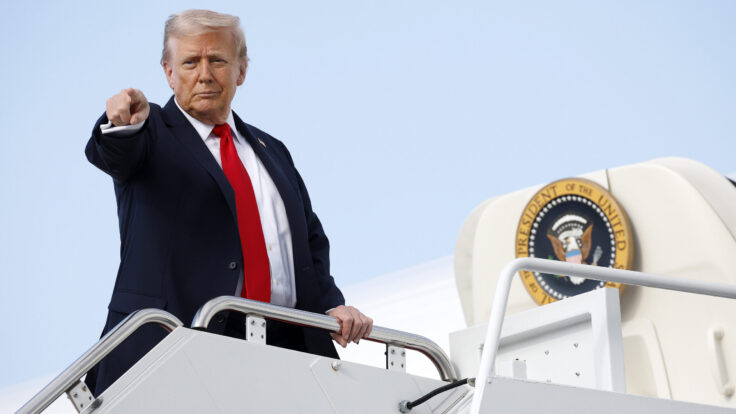
Meanwhile, in Davos, Donald Trump dropped his
threat of new tariffs on Europe after claiming to have reached the “framework of a future deal with respect to Greenland,” causing markets to rebound into the end of the day. Of course, the president continues to fixate on the Arctic’s great “piece of ice,” as he referred to Greenland this morning, when he wasn’t calling it “Iceland” by mistake. But he has apparently backed off the possibility of seizing the Danish territory by force—a relief for the many Republicans on Capitol Hill who have
been quietly irritated by his all-consuming focus on Greenland.
In fact, as I report tonight, Republican members have privately discussed the likelihood that Trump would be impeached if he invaded Greenland, and they have communicated their concerns to the White House and worry that the president’s obsession with territorial expansion could put the House majority in jeopardy.
Also mentioned in this issue: Hakeem Jeffries, Britt
Jacovich, Michael McCaul, Don Bacon, Henry Cuellar, Brian Mast, Mike Rogers, Mark Carney, Xi, Putin, Maduro, Jerome Powell, Warren Davidson, and many more…
Let’s get started… |
-
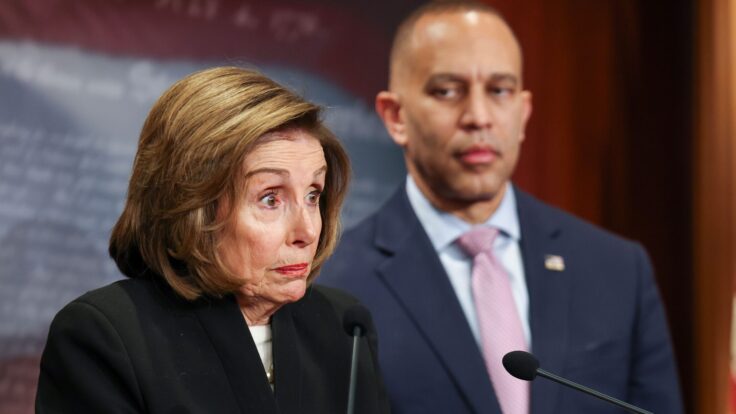
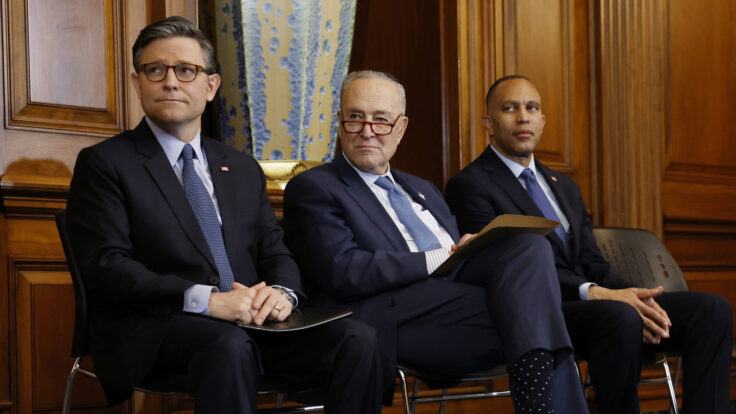
ICE funding pressure: In a closed-door caucus meeting this morning, House Democratic leader Hakeem Jeffries announced his opposition to the bill released earlier this week to fund the Department of Homeland Security. Jeffries and his colleagues believe the bill doesn't cut ICE funding enough, nor adequately rein in the deportation agency. The left had been putting pressure on members to oppose the funding, including a MoveOn call-in and letter-writing campaign. MoveOn
officials also contacted Democratic leadership offices and staff of the appropriations committee directly, I’m told. “Trump and Republicans slashed our healthcare to pay for masked ICE agents and armed troops scaring and killing our neighbors,” MoveOn spokesperson Britt Jacovich said in a statement. “If Democrats in Congress truly want to stop ICE in Minnesota and across the country, here’s their chance to prove it.”
Nevertheless, House Republicans should be able to pass
the bill with mostly Republican votes this week, especially if a few Democrats vote for it. Rep. Henry Cuellar, a border district Democrat who helped negotiate the bill, told me yesterday that he will support it. “I wish there would have been more things to it,” he said. “But it is what it is.”
Senate Democrats, who are expected to vote on it next week when they return to Washington, assuming the House passes it, might have an even harder time voting against the bill,
which will be tied to funding for the Defense, Transportation, Labor, and Health and Human Services departments.
|
And now, the return of our new fan-favorite segment, featuring anonymous insights from our friends
in the influence industry. (Text or email me if you’d like to appear here next.) Today’s entry comes from a plugged-in Republican lobbyist, with a tip for how to get the president to support your issue: |
- “Nobody is going to Trump and saying, ‘You’re wrong.’ If you’re going to talk to him and his team about an issue, you better have polling to back it up. Trump loves the 80-20 issues, which is how weed was reclassified. The reclassification of marijuana is an 80-20 issue. They took polling to the guy and won him over.
“Plus, it’s a lot of disparate voices. You can’t just have the lobbyist make
the case. Trump knows you’re getting paid to do that. You need to have 1,000 people who he’s friends with call him and give him the same message. That’s the same with his walking back on Greenland today. It’s an 80-20 issue, and I suspect he heard from enough people.”
|
Now, here’s Julia Ioffe on the other Davos news making the rounds in
Washington…
|
|
|

| Julia Ioffe
|
|
- Oh,
Canada…: Somehow, Donald Trump’s rambling address at Davos, where he backpedaled on his threats to use military force to conquer Greenland, wasn’t the speech that made the biggest waves in Washington and Brussels today. It was Canadian Prime Minister Mark Carney’s.
Last night, the mild-mannered technocrat took to the lectern and firmly drew a line in the sands of history: Pax Americana, he
declared, was dead. “Let me be direct,” Carney said. “We are in the midst of a rupture, not a transition.” The “fiction” of a rules-based, American-led international order, he said, had provided the world—and more specifically, the West—with stability and prosperity. But Trump, Carney suggested without naming the president, had turned the tools of
economic and political integration against America’s own allies—countries like Canada, or France and Germany—despite their strenuous efforts to appease Trump and massage his ego. “This is not sovereignty,” Carney said. “This is the performance of sovereignty while accepting subordination.” Canada, he concluded, was out. It would make its own alliances.
Carney’s address felt monumental and world-historical, like Churchill’s Iron Curtain speech, and it garnered a rare
standing ovation at Davos. (Watch the full version here, it’s worth it.) And it felt like it marked the end of something big, important, and mostly good. Even if Trump backed off his demands for Greenland, “the damage has already been done,” one Hill Democrat told me. Others were struck by Carney’s use of the term “middle power” to refer to countries other than the U.S., Russia, and China.
“In Afghanistan, the ‘middle powers’ did a lot of our heavy lifting for us,” a former senior U.S. official told me. “Same in Vietnam. The middle powers are, in fact, essential. And what we know about Xi and Putin is that the thing they both find the most unsettling is the U.S. system of alliances. That’s why they’ve spent so much time and money trying to separate them from each other.” Now, it seems, that system is unraveling without anyone firing a shot. The
American president has done it for them.
|
|
|
And finally, the main event… |
|
|
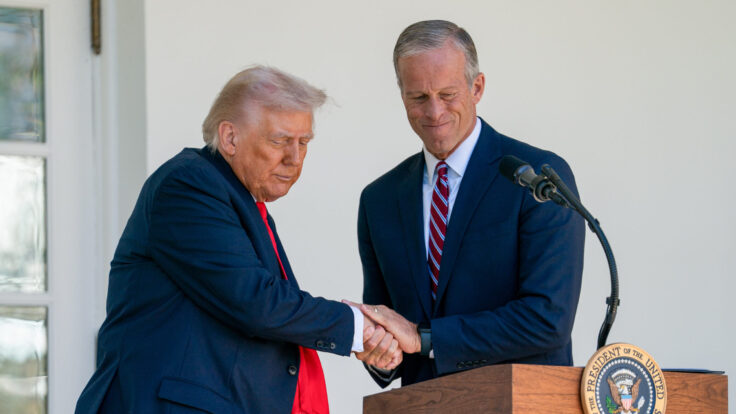
With his Davos speech, the president reassured jittery Republicans that invading
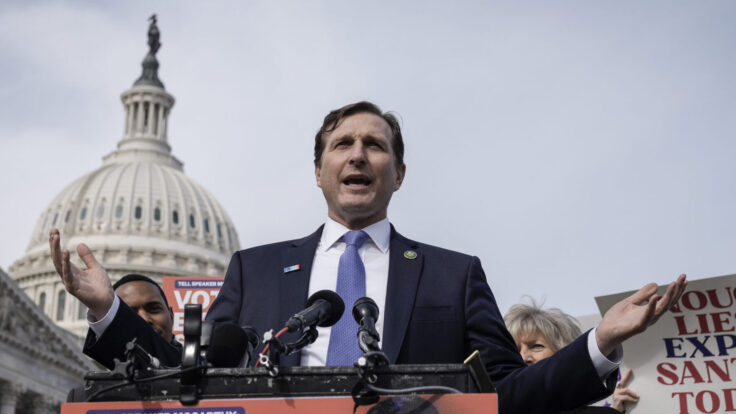
Greenland is, for now, off the table. But conversations on the Hill have escalated, as even Trump’s G.O.P. allies warn that any move that blows up NATO could end his midterm hopes—and lead to impeachment, too. |
|
|
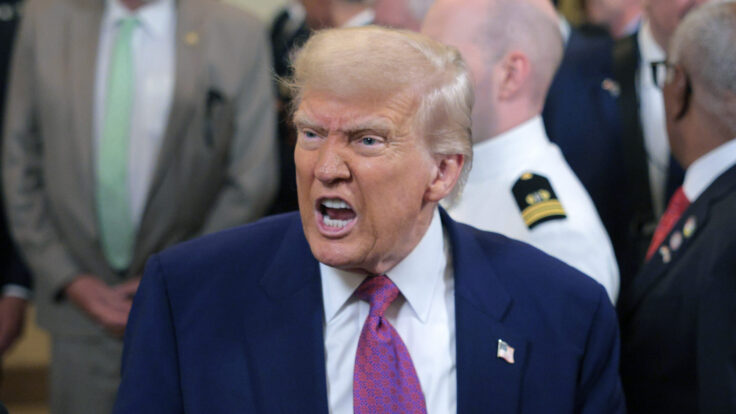
President Trump was supposed to focus on his half-hearted affordability
agenda this morning while addressing the international elites at Davos. But he devoted the preponderance of his speech to his latest obsession, acquiring Greenland. “I’m seeking immediate negotiations to once again discuss the acquisition of Greenland,” Trump said, the first sign of deescalation after his previous refusal to rule out military action. “I don’t want to use force,” he later added, apparently softening his stance. “I won’t use force.” That evening, he released a statement saying
that the U.S. had “formed the framework for a future deal” on Greenland—meaningless, perhaps, but a plausible off-ramp.
Perhaps the Davos concession was meant for congressional Republicans as much as it was for the mostly European audience. After all, Trump’s threat of military force against a NATO ally was always a bridge too far for most Republicans in Washington. Many have concerns that Trump’s imperialist ambitions could derail their odds of holding the House in the midterms. Some,
I’m told, have privately discussed the possibility that if he makes a move against Greenland, it could lead to his impeachment.
The conversations themselves represent a stark break for a party that has rarely drawn redlines for Trump in his second term. Several Republicans told me that they have privately brought their concerns about Greenland to the administration, and didn’t deny that the use of military force would be a Rubicon for them. One Republican member told me plainly that
invading Greenland would be “mind-blowing” and would “blow up NATO”—something most Republicans would like to avoid. “There’s some kind of gamesmanship that’s going on with the president, and we are not going to let it have a long-term corrosive effect on our relationship with NATO,” Rep. Mike Rogers, the Republican chair of the House Armed Services Committee, told me.
Publicly, Republicans have largely waved off Trump’s saber-rattling as geopolitical bluster, a
negotiating tactic that shouldn’t be taken at face value. “President Trump tried having that polite conversation in his first term, and no one really paid attention to him. Now everyone’s paying attention,” said Rep. Warren Davidson, a member of the House Foreign Affairs Committee. Rep. Brian Mast, the chair of that committee, told me that he wants NATO to stay intact, and that this is all part of Trump’s strategy. “You have to play it all out,” he said. “Every
down and every sack and every interception and every punt and everything that you get.”
But other party members have lost patience with this White House. Retiring Rep. Don Bacon has already floated the possibility that an invasion of Greenland would trigger impeachment proceedings. “Invading an ally who we have a treaty with is a high crime or misdemeanor,” Bacon told me, adding that some of his Republican colleagues have told him privately that they agree. Another
Republican member told me that only Congress could authorize military force in Greenland—not all that reassuring when Congress has proven itself more or less completely unwilling to tie the hands of this president. A Republican strategist who works closely with lawmakers confirmed the pushback on the Hill. “Trump will ultimately run into the brick wall of political consequences and geopolitical reality—which is, you can’t obtain territory from a NATO ally that isn’t willing to give it to you,”
the strategist said. “And he has a razor-thin margin in Congress.” |
Indisputably, Greenland is a lousy campaign issue for Republicans hoping to maintain control of the
House. “I don’t, at this point in time, think [Trump’s] intent and message on Greenland is helping us win the midterms,” one House Republican told me. “It’s deteriorating that goal.” The public overwhelmingly agrees: More than 90 percent of Democrats and independents, and 68 percent of Republicans, oppose military action in Greenland, according to a recent Quinnipiac poll—unheard of unanimity in this hyperpartisan age. A CNN poll that didn’t specify tactics for taking Greenland found that
three-quarters of respondents opposed the idea. The Republican lawmaker, who wanted to stay anonymous to avoid angering the administration, drily noted, “This isn’t going to be any messaging I plan to use in the midterms.”
Indeed, with turnout among the base crucial for winning the November midterms, Republicans are reluctant to criticize the president for fear of alienating his voters. Attempts to mark out some distance from Trump and convince independent voters you’ll be a check on the
president aren’t likely to save House Republicans from a no-win situation.
Of course, it’s not as if Trump’s other second-term obsessions—investigating Federal Reserve Chair Jerome Powell, kidnapping Venezuelan President Nicolás Maduro, building a White House ballroom, renaming the Kennedy Center, unleashing trigger-happy ICE recruits against non-citizen immigrants and citizens alike—are playing much better with the public. Another Republican strategist who works
with House Republicans told me that even members in solidly red districts are seeing “softening” in their numbers—a sign that November’s midterms could be reminiscent of the blue wave in 2018, when Democrats picked up more than 40 House seats. “Alarm bells are going off,” another strategist said. |
|
|
Join Emmy Award-winning journalist Peter Hamby, along with the team of expert journalists at Puck, as they let you in
on the conversations insiders are having across the four corners of power in America: Wall Street, Washington, Silicon Valley, and Hollywood. Presented in partnership with Audacy, new episodes publish daily, Monday through Friday. |
|
|
The industry’s go-to source for unflinching reporting on the trillion-dollar business of artificial intelligence -
perhaps the single most important technology of our time. Ian Krietzberg, the powerhouse journalist behind The Deep View, delivers twice-weekly insights into the latest dealmaking and breakthroughs in A.I., and how the intersecting worlds of finance, entertainment, media, and politics are being transformed in its wake. |
|
|
Need help? Review our FAQ page or contact us for assistance. For brand partnerships, email ads@puck.news. You received this email because you
signed up to receive emails from Puck, or as part of your Puck account associated with {{customer.email}}. To stop receiving this newsletter and/or manage all your email preferences, click here. |
Puck is published by Heat Media LLC. 107 Greenwich St., New York, NY 10006 |
|
|
|