{{ 'now' | timezone: 'America/New_York' | date: '%b %d, %Y' }} |
|
|
Welcome to The Hidden Layer. I’m Ian Krietzberg.
In today’s issue, I’m
unpacking Trump’s latest executive order, which aims to prevent states from passing their own A.I.-related legislation. It’s a clear win for Big Tech, but the order isn’t the end of the war between proponents of hands-off and hands-on approaches to A.I. regulation. In many ways, it seems more like the beginning.
Plus, news and notes on a multibillion-dollar injection into the A.I.-focused V.C. world, and Trump’s push to implement A.I. across the
government.
Mentioned in this issue: Donald Trump, Bejul Somaia, Igor Taber, Alex Bores, Kathy Hochul, Jared Polis, Gavin Newsom, Ron DeSantis, Spencer Cox, Hamid Ekbia, Charlie Bullock, Amy Klobuchar, David Sacks, Asad Ramzanali, and many
more…
Let’s get into it… |
Two Things You Should
Know…
|
-
The boom goes on forever: While many on Wall Street believe the A.I. market has entered bubble territory, nobody seems to have told Silicon Valley’s major V.C. firms. On Monday, Lightspeed Venture Partners announced that it had completed a $9 billion round across six different funds—the largest in its history. Some of that money will go toward new investments, but a large portion will be directed to help scale existing portfolio companies, including Anthropic, xAI, and Mistral.
“We’re executing against a future that looks very different from the past,” Bejul Somaia, a partner at Lightspeed, said in a statement. Of course, Lightspeed isn’t the only firm making these bets. In the third quarter alone, V.C. firms invested nearly $45 billion in A.I. companies, accounting for almost half the value of all venture deals over that period,
according to Crunchbase data.
How long until the music stops? Igor Taber, the founder of Cortical Ventures, another A.I.-focused V.C. fund, told me he believes a market correction is “inevitable”—and that might be a “good thing.” The volatility of the current investment cycle, he explained, has led his company to invest in
businesses “that are not really subject to the bubble. We try to be cognizant that the music will stop. I don’t know when, but I think it’s inevitable.” - A White House geek squad: As part of President Trump’s push to incorporate A.I. across the federal government, the administration is launching something called Tech Force, a corps of 1,000 engineers who will be
trained “to accelerate A.I. implementation and solve the federal government’s most critical technological challenges.” The two-year employment program, which will pay between $150,000 and $200,000 annually, will train engineers while allowing them to interface with “leading technology companies.” Afterward, those engineers “can seek employment with” those tech partners. A perfect circle.
|
“In 2025, amid all the talk about A.I. threats, ‘slop’ set a tone that’s less fearful, more mocking. The word
sends a little message to A.I.: When it comes to replacing human creativity, sometimes you don’t seem too superintelligent.” —Merriam-Webster’s (slightly defensive-sounding) editors on why they selected “slop” as their 2025 Word of the Year.
And now for the main event… |
|
|
The president’s new executive order is filled with directives aiming to curb states’ ability
to pass A.I. regulations. But there’s little consensus on how much impact the E.O. will actually have. |
|
|
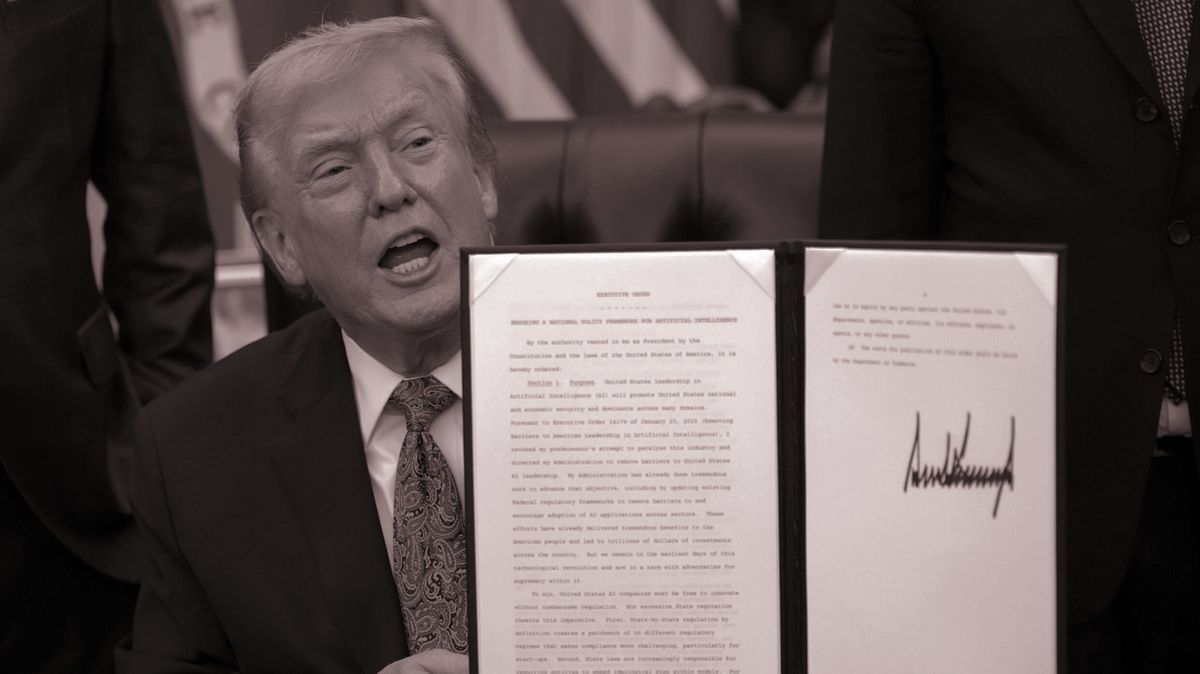
Last week, President Trump applied his bold Sharpie signature to a new, highly anticipated
executive order—one that attempts to establish a “national policy framework” for artificial intelligence. (I reported on the leaked draft several weeks ago.) The order, of course, is only the latest salvo in the administration’s ongoing campaign to prevent states from passing their own A.I.-related legislation—a move that Congress rejected earlier this year. As Trump put it: “We have the big investment coming, but if they had to get 50 different approvals from 50 different states, you can forget it because it’s impossible to do.”
In my conversations with industry sources across the political spectrum, many were uncertain about
how impactful the E.O. will be—but almost everyone agreed that it represents a huge win for Silicon Valley. After all, the E.O. largely echoes the arguments made by the likes of OpenAI and
Andreessen Horowitz in previous policy briefs submitted to the administration, calling for a federal preemption of state laws. “December 11, 2025, was a great day for Silicon Valley billionaires and a sad day for the rest of Americans,” Dr. Hamid Ekbia, the director of Syracuse University’s Autonomous Systems Policy
Institute, told me. Others were less convinced the order was all that meaningful. “It’s not nothing. [But] it’s definitely not preemption,” Charlie Bullock, a senior research fellow at Law AI, told me. “To really preempt state A.I. laws, you would need legislation, so they’re doing the best they can with what they’ve got.”
Indeed, Trump’s order basically attempts to get around Congress by kicking the issue to the courts. First, it instructs the attorney general to
establish an A.I. litigation task force focused on identifying and suing states that implement A.I. laws that contradict the president’s “framework.” Second, it asks the Commerce secretary and a few White House folks to evaluate state A.I. laws for referral to the aforementioned task force. Third, the order directs the Commerce secretary to establish a new policy limiting
BEAD funding for states with “onerous” legislation. And finally, it asks federal agencies to assess their discretionary grant programs to see what additional restrictions they can impose on these states, and tasks Trump’s A.I. advisor, David Sacks, with crafting an A.I. policy proposal for Congress.
As for the
details of those directives, Bullock doesn’t think the litigation taskforce is the “biggest deal.” In part, that’s because the legal arguments underpinning these efforts seem weak and somewhat easily contestable by the states. As Margaret Hu, a law professor at William & Mary, told me, “The White House appears to argue that the state A.I. laws interfere with interstate commerce,” which the administration itself cannot regulate. The order “seems to be an example
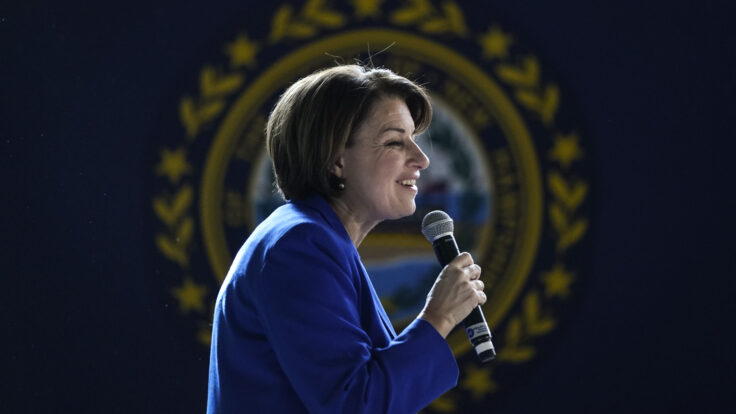
of executive overreach,” she said. Sen. Amy Klobuchar was more blunt: The E.O., she said, is “most likely illegal.”
Bullock, for his part, is more concerned with the order’s directive to withhold BEAD funding from states—a multibillion-dollar, carrot-shaped stick that could genuinely discourage state A.I. legislation. “It seems more plausible that
they could do that,” Bullock said. “States would probably sue over it. But it’s a bit unclear whether they would win that legal battle, and even if they did win, it’s still months and years that you’re not getting the billions of dollars your government wants. That chilling effect might be a bigger deal.” |
At least this much is clear: We’re looking at the onset of a yearslong legal battle, with some amount of
federal grant funding held hostage as leverage while states and the federal government figure out whether—or how—to play ball. For states interested in complying, for example, it wouldn’t be the simplest procedure to strike existing laws; they could choose not to enforce them, but it’s unclear whether that would suffice in the eyes of the administration.
Either way, state responses to the White House’s directives—particularly around BEAD and other grant funding—are likely to split
somewhat along partisan lines. As tech policy researcher Daniel Cochrane and legal fellow Jack Fitzhenry wrote in June, “Smaller conservative states with limited budgets and large rural populations need these funds. But wealthy progressive states like California and New York can afford to take a pass and just
keep enforcing their tech laws.”
Even so, larger states—especially those with A.I. laws already on the books—haven’t yet said how they plan to respond. California Gov. Gavin Newsom blasted the order in a statement, saying that Trump and Sacks, who also happens to be a very successful V.C., “aren’t making
policy—they’re running a con.” I followed up with Newsom about whether California intends to fight the order, but a spokesperson told me only that “the E.O. signals the first step in the preemption of state laws, but no state laws are currently impacted.”
I put the same question to Colorado Gov. Jared Polis, who said in an emailed statement that he is “very frustrated by the lack of action in Congress on this important issue,” and that lawmakers ought to “pass a
comprehensive, nationwide regulatory structure that provides important consumer protections while fostering innovation.” (Polis has delayed the implementation of a broad statewide A.I. bill after initially signing one in 2024.) He also noted that he’s putting together an “A.I. policy working group,” which is “working to find consensus on a new bill that can be introduced in 2026,” to avoid BEAD funding issues.
Intriguingly, at least a few Republican governors also seem to be charting
their own course on A.I. regulations. Utah Gov. Spencer Cox, whose state has passed A.I. laws, wrote on X that “an alternative A.I. executive order focused on human flourishing would strike the balance we need.” And a spokesperson for Florida Gov. Ron DeSantis, who recently pushed back against Trump’s preemption crusade, encouraged me to “stay
tuned” for more on that front. During a roundtable on A.I. that he hosted on Monday, DeSantis questioned whether “we should just turn over our destiny to these Big Tech companies, or whether we, the people, should have a say in how this develops.” |
While Silicon Valley’s lobbyists score their win at the White House, a countermeasure is quietly winding
through the New York legislature. Several months ago, lawmakers in Albany passed the RAISE Act, short for Responsible A.I. Safety and Education—precisely the kind of state-level A.I. regulation effort that Trump is trying to preempt. But Democratic Gov. Kathy Hochul never signed it. Now, sources familiar with the situation told me, Hochul has proposed a near-total rewrite that would make the RAISE Act closely resemble California’s weaker A.I. law, SB 53, which had been similarly
watered down shortly before being signed. In effect, those sources said, the new legislation would establish SB 53 as a de facto nationwide regulatory ceiling rather than a floor—a holiday gift to industry groups like Tech:NYC, which have sought greater alignment between New York and California. (Indeed, according to a document I reviewed, some of the language in the two bills is practically identical.)
The bill is currently under discussion in Albany, although people familiar
with the legislation said the governor is not interested in negotiating. (Not long ago, Leading the Future, the Andreessen Horowitz–backed super PAC, published their first ads against New York Assemblyman Alex Bores, one of the authors of the bill.) A spokesperson for Hochul said in a statement that the governor “remains committed to advancing A.I. responsibly as she reviews the legislation.” Hundreds of New York parents have
called on her to sign the bill as it was originally written.
In any event, it seems this war is just beginning, even as the White House tries to declare it over. “The E.O. rests on the same flawed premise as the failed state-law moratorium—that innovation requires squashing protections rather than governing responsibly,” Asad Ramzanali, the director of tech policy at the Vanderbilt Policy Accelerator, told me. “States are acting as laboratories of democracy to address real harms, protect competition, and safeguard consumers where federal law has lagged. I’ve seen no evidence state A.I. laws are slowing innovation.” |
That’s all for today. I’ll see you on Thursday.
Ian |
|
|
Join Emmy Award-winning journalist Peter Hamby, along with the team of expert journalists at Puck, as they let you in on the
conversations insiders are having across the four corners of power in America: Wall Street, Washington, Silicon Valley, and Hollywood. Presented in partnership with Audacy, new episodes publish daily, Monday through Friday. |
|
|
Unique and privileged insight into the private conversations taking place inside boardrooms and corner offices up and down Wall
Street, relayed by best-selling author, journalist, and former M&A senior banker William D. Cohan. |
|
|
|
|
MATTHEW BELLONI & WILLIAM D. COHAN |
|
|
Need help? Review our
FAQ page or contact us for assistance. For brand partnerships, email ads@puck.news.
You received this email because you signed up to receive emails from Puck, or as part of your Puck account associated with {{customer.email}}. To stop receiving this newsletter and/or manage all your email preferences, click here. |
Puck is published by Heat Media LLC. 107 Greenwich St., New York, NY 10006 |
|
|
|