 |

|
|
Happy Sunday, and welcome back to Dry Powder.
I recently had the good fortune of chatting with Simon Johnson, the esteemed British American MIT economist, who just last week won the Nobel Prize. During our conversation, I asked a question that, frankly, has vexed the Harris campaign immeasurably: Why, despite the fact that the economy is humming along, are so many Americans still complaining? His reflections—along with his warnings about Trump’s “misleading advertising” surrounding tariffs and other economic proposals—were as lucid and illuminating as one could hope for.
But first…
- A credit market warning: The economy appears to be humming along, at least statistically, even if many people are still complaining about high prices for food, services, and gasoline. Objectively speaking, the unemployment rate is low, inflation is coming down, stock markets are at all-time highs and, according to a recent Economist cover, the U.S. economy is “the envy of the world.” The magazine’s 16-page feature story proclaimed, “Our message is not only that it has left the rest of the rich world in the dust, but that America thrives despite its ugly politics.” Ain’t that the truth.
And yet, there’s an unmistakable warning seeping in from the credit markets—and it’s a message of caution about risk spiraling a bit out of control, as it has been known to do on many occasions, just when you think things are going great. Corporate bankruptcies accelerated in August, according to S&P Global, one of the Big Three ratings agencies, with 63 filings. And during the first eight months of 2024, corporate bankruptcy filings were at their highest level since 2020, and the second highest since 2010. The ratings agency reported 452 filings through August, almost matching the 466 filings amid the outbreak of the Covid pandemic.
Moody’s also issued a report earlier this week warning of a $2 trillion pile of junk-rated debt that will need to be refinanced sometime in the five-year period between 2025 and 2029, up 8.2 percent from the $1.87 trillion of junk-rated debt that needs to be refinanced between 2024 and 2028. In particular, some $735 billion of junk-rated debt comes due in 2028, which will need to be refinanced, or paid off, otherwise it could cause a further rash of corporate bankruptcies.
At the moment, many investors seem optimistic that the debt will be able to be refinanced, especially as the Fed has started cutting short-term interest rates after a four-year period of increases, and with more rate cuts expected. Counterintuitively, though, mortgage rates have surged upward, despite the Fed’s pivot to interest-rate reductions. The average rate on a 30-year fixed mortgage jumped 20 basis points in the second week of October, to 6.32 percent, from 6.12 percent. The yield on the 10-year Treasury note has also increased in the wake of the Fed’s move, to about 4.1 percent on Friday, from 3.6 percent in mid-September. As Hericlitus noted, “All is flux.”
Moody’s premonitions don’t even apply to the large corporations facing the most significant credit crises. Boeing, in particular, has $57 billion of debt, and is under review by both Moody’s and S&P for a possible downgrade into junk territory amid its myriad problems, including an ongoing worker strike—which could be resolved this coming week if workers ratify the agreed-upon deal. This past week, Boeing indicated it would try to raise as much as $15 billion in new capital, in both the convertible debt and equity markets. Boeing’s stock is down 38 percent this year.
Then there’s last week’s nutty, $650 million offering of “PIK Toggle Notes”—yep, a real thing—issued by Chobani Holdco, the parent company of Chobani. The notes are senior unsecured obligations, and will pay cash interest at 8.75 percent, or 9.5 percent if the issuer chooses to pay in more notes—the “PIK,” or payment-in-kind, feature—instead of cash. The net proceeds of the Chobani offering will be used to pay a dividend to its parent company. Chobani is still a private company, although there are ongoing murmurs of an I.P.O. sometime this year. The debt offering flew out the door, and was increased in size to $650 million, from the original $500 million. “I wish the Lord would take me now,” one junk-bond follower posted on Threads after the Chobani offering hit the market. More grist for the mill and lots to be worried about, it turns out.
|
|
Now, on to the main event…
|
 |
| The Trump Economic Disaster Warning |
| My recent chat with Simon Johnson, a newly minted Nobel laureate, covered all the pre-election anxiety touchstones: the inflation political headache, Biden’s financial comms challenge, Trump’s phony arithmetic, and some memories of 2008, too. |
|
|
|
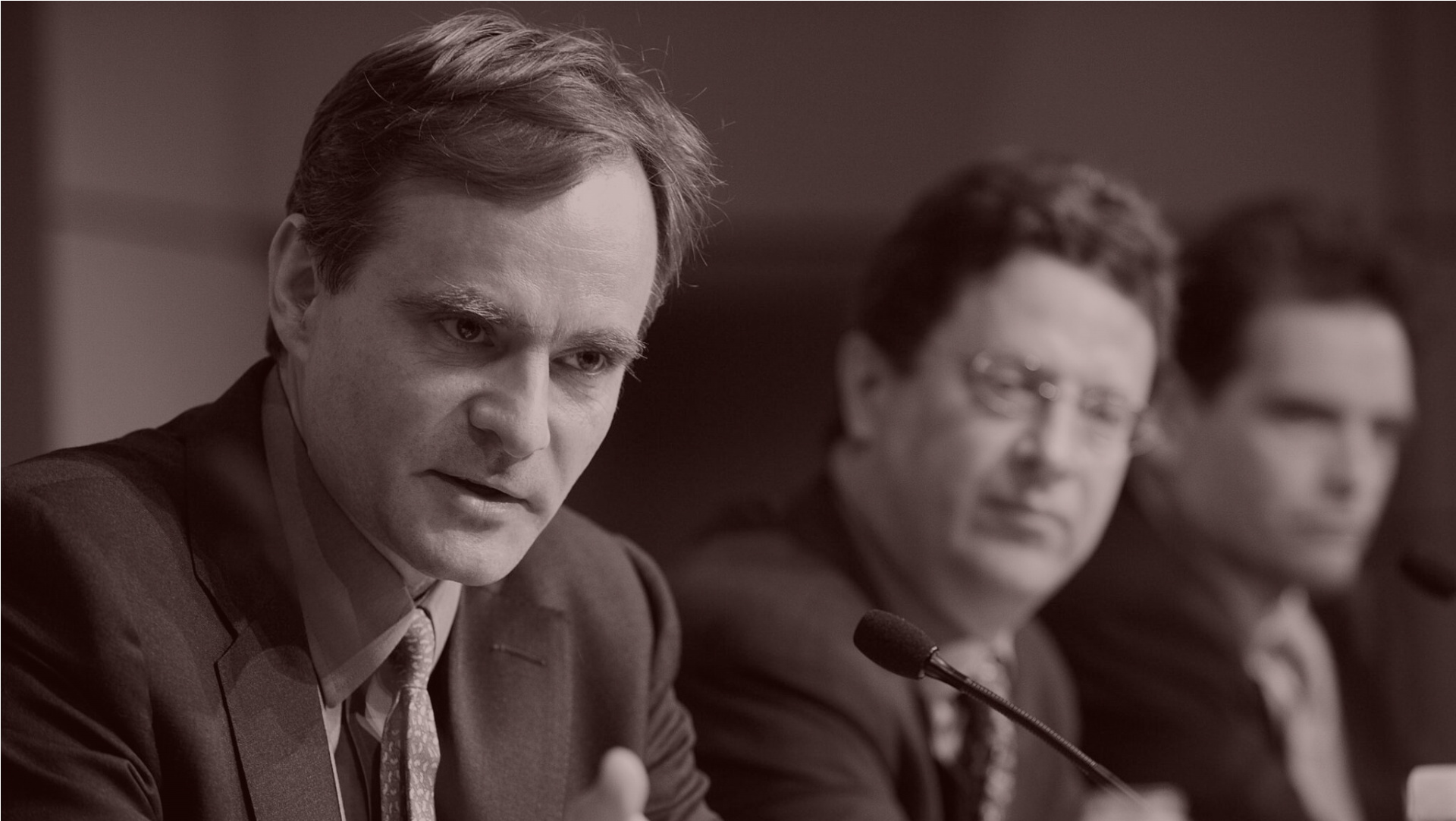
| Simon Johnson, the esteemed British American MIT economist, missed the phone call from Stockholm on Monday night telling him he had won a Nobel Prize. He was asleep. “I only found out when my colleague started texting me,” he told me. He also heard from an MIT staffer whose job, apparently, is to be especially attuned to the Swedish white smoke at this time of year, since MIT professors have won so many prizes. (More than one hundred and counting...) Johnson, his colleague Daron Acemoglu, and the University of Chicago’s James Robinson won the prize for their extraordinary research into the policies and realities that dictate the fortunes of countries—why some turn out wealthy, and others impoverished.
Later that afternoon, I had the good fortune of chatting with Simon, whom I have known and admired for years. I asked a question that, frankly, has vexed the Harris campaign to this point: With inflation starting to come under control, low unemployment, healthy G.D.P. growth, and the stock markets continuing to hit new highs, why are so many Americans still complaining? “The Biden people didn’t do a great job of selling what they did on the economy,” he said. Legislation such as the [American Rescue Plan] Act, the Inflation Reduction Act, and the CHIPS Act, haven’t been well explained and remain opaque to most people. He said the investments take time to be made and time to pay off, but that shifting to clean energy, to cite one obvious example, is going to give the U.S. an advantage in the long run. “The only way to get that point across is to hammer it relentlessly, day in, day out,” he said. “And that wasn’t done.” |
|
A MESSAGE FROM OUR SPONSOR
|

|
|
Range Rover Sport. As innovative as it is influential.
|
|
|
| Johnson said there is also an ongoing “misperception” that Republicans are better for the economy than Democrats. “It’s actually not true,” he said. He said he works hard at trying to persuade people that Democrats “care just as much about growth and productivity, and that’s how you get the opportunity to redistribute. But that’s not what comes across to people. What comes across is, ‘Oh, look, the Republicans want more jobs and higher G.D.P. above all else, and that’ll be good for me, and the Democrats want to take my money and give it to someone else.’ I think that’s a communication problem more than anything else.”
Regarding the current state of the U.S. economy, Simon confessed he worries about the corrosive effect of inflation on large swaths of the population. He cited the influence of Franco Modigliani, his former professor and the winner of the Nobel Prize in economics in 1985. “He impressed on me,” Simon said, that inflation was not only economically dangerous but also politically toxic. “Once inflation gets to 8 percent or 10 percent, it becomes the dominant topic,” he said. He remembered how he warned his “progressive friends” last decade, when they were telling him, “let’s juice the economy, let’s have more inflation,” to be “very careful” because if you “overheat an economy” it will become a “problem both politically and economically.”
That’s exactly what happened, of course, via 13 years of post-crash quantitative easing, which kept interest rates artificially low and made money cheap, topped off by a global pandemic and the disruption of supply lines. “People feel worse off,” he said, referring to the present, “because prices have gone up.” Wages have risen, he said, but people don’t feel that they have more buying power as a result—they just see the higher prices and feel less prosperous. Lack of affordable housing, he said, has become a significant contributor to the problem, both for potential buyers and renters. Millions of housing units didn’t get built after the 2008 financial crisis and now there is a supply and demand imbalance, which is exacerbated by high interest rates and high home prices. |
| Trump’s Misleading Advertising |
|
| As the conversation turned to the Republicans, Simon said he was wary of Trump’s infatuation with tariffs, in particular, and his return to the White House, in general. He said it’s “really shocking” how much Trump’s proposed tariffs will increase the cost of living for most Americans. He referred to Trump’s repeated calls for the contradictory remedy of tax cuts, tariffs, and fiscal responsibility as misleading advertising. “Even if you extend the Trump-era tax cuts, a few people at the top would be better off with that combination of tariffs plus tax cuts, but most people are going to be worse off,” Johnson said. “I don’t believe he would do it. He couldn’t do it. It would be a massive hit to the living standards of the people who support him. At best, it’s empty rhetoric and completely misleading. But of course, he might do it, because he’s Trump, and that would be really bad for working people. It would be a disaster.” |
|
|
|
|
| I figured if you win a Nobel Prize you get calls of congratulations from the likes of Larry Summers and Ben Bernanke. Apparently not. “I have received some very nice emails from previous Nobel Prize winners saying, ‘Welcome to the group,’” he said. He heard from his graduate school roommate from 40 years ago. “I had no idea he was still around,” he said. “It was very nice to hear from him.” He said the University of Manchester, where he spent one year in his 20s, has made a big deal of him. But Duke, where he taught at the Fuqua School of Business for five years in the mid-1990s, has been silent. “Duke didn’t get the memo yet or something,” he laughed.
Simon and I have known each other for years, part of a small group of writers who have tackled the 2008 financial crisis. My books on the topic include House of Cards, about the collapse of Bear Stearns, and Money & Power, a history of Goldman Sachs that explained how the bank squeaked through the era in much better shape than its peers. Simon, who co-authored, with James Kwak, 13 Bankers: The Wall Street Takeover and the Next Financial Meltdown, told me he was stunned that many of his recent and current students at MIT have no idea what the 2008 financial crisis was all about. “It’s a complete blank to them,” he said. “It’s actually a little bit worrying, or even a lot worrying, because some of these people are in financial positions, like C.F.O.s”
Naturally, we chatted about the legacy of 2008. The big banks, after all, are bigger than ever and eager to move risk off their balance sheet. And the financial system is more complex and sophisticated than it was 15 years ago for the reasons you all know. Simon said he’s reassured that Michael Barr, the vice chairman of the Federal Reserve, hasn’t forgotten what happened in 2008 and is in a position to make sure it doesn’t happen again. But, he continued, “There’s a real danger that you sort of drift off into the space where the banks can do whatever they want. And what they want, of course, is to run the whole show with much less capital and take a lot more risk. They get the upside and someone else gets the downside—which is a very old story and a very repetitive story, an incredibly debilitating story, when it plays out.”
Simon cited Covid and the failure of Silicon Valley Bank as recent events that sent tremors through the markets and that should “remind people to be careful.” Simon, who was the chief economist at the International Monetary Fund from March 2007 to August 2008, credited the regulators in Washington, who are more vigilant and less credulous than they were 15 years ago. Back then, he said, “The big bank guys were the smartest guys in the room, and the regulators were deferential to them. We had many conversations with the I.M.F. around this, including with people who were from that financial sector, who said, ‘You’re just not understanding the brilliance of the innovations in the American financial sector and how incredibly fantastic all of these sophisticated products are.’”
When he was at the I.M.F., he said, these Wall Street types told him, “Well, look, there’s a sucker born every minute. But the suckers are outside the United States, and so that’s not our problem,” and, “It’s just Citigroup that has a problem. Everyone else is fine.” These days, he said, regulators are less “cowed” by bankers, who are still “trying to find ways to juice the upside, pad the bonus, and not worry too much about the downside. The regulators are still very skeptical. But of course, the banks have a ton of money.”
He said that although winning a Nobel Prize was “not on his bucket list,” he has achieved many of his career aspirations. He told me it was important for people in their 20s to have “a secret career objective,” a “massive stretch goal” that you tell one person, and only one person, “because if you don't tell anyone, you’ll just pretend to yourself that it was a different goal.” He told his best friend at the time, who was best man at his wedding, that his secret, “far-fetched” goal was to be the chief economist at the I.M.F., something Johnson achieved in his early 40s. “Ever since I got that job, I have felt everything else is icing on the cake,” he said. “So this is a big layer of icing.” |
|
|
|
| FOUR STORIES WE’RE TALKING ABOUT |
 |
|
 |
| A Condé Crisis |
| Unpacking the D.E.I. crisis at Condé Nast. |
| LAUREN SHERMAN |
|
 |
| NFL Media Beef |
| Why are the league’s network partners so furious? |
| JOHN OURAND |
|
 |
|
|
|
|
|
 |
|
|
|
Need help? Review our FAQs
page or contact
us for assistance. For brand partnerships, email ads@puck.news.
|
|
You received this email because you signed up to receive emails from Puck, or as part of your Puck account associated with . To stop receiving this newsletter and/or manage all your email preferences, click here.
|
|
Puck is published by Heat Media LLC. 227 W 17th St New York, NY 10011.
|
|
|
|