 |
|
Welcome to Dry Power. I’m Bill Cohan.
|
|
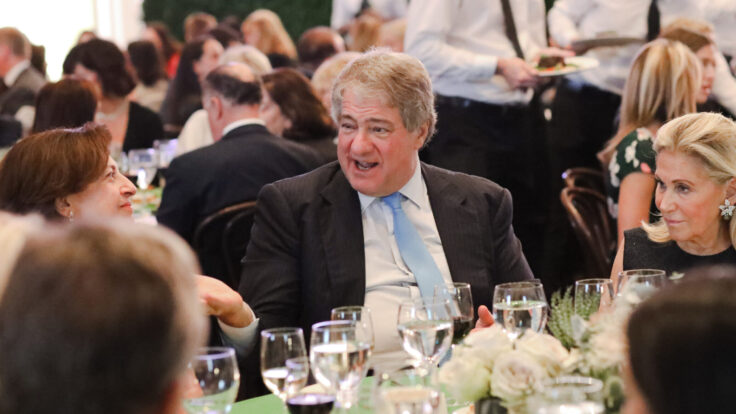
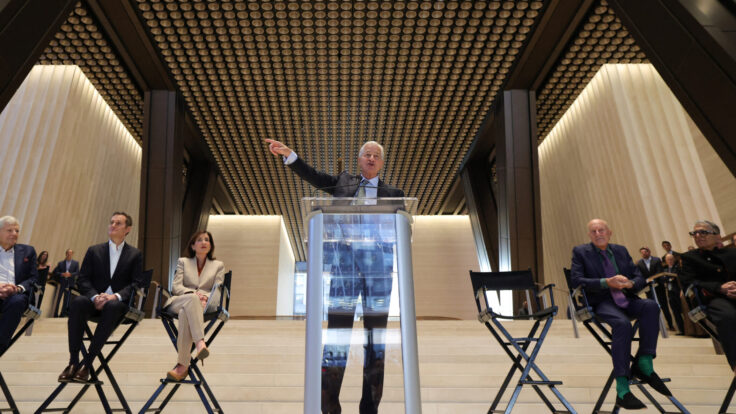
Before getting into today’s feature—a look at how, exactly, Donald Trump will be able to pay the more than $450 million penalty imposed on him last week—a quick note about our fabulous Puck event last night, sponsored by Mayer Brown, which took place in one of those new West 57th Street condominium towers high above Manhattan. It featured a stellar group of attendees, and my wide-ranging, off-the-record conversation with David Solomon, the C.E.O. of Goldman Sachs, who has now been at the helm of the firm for five years.
Alas, I can’t share the contents of our conversation, but David was alternatively charming, witty, and reflective. The mini-sliders and tiny lobster rolls were a big hit, too. It was also my birthday, which made the evening more special, all topped off by my later-night appearance on the glamorous Stephanie Ruhle show on MSNBC.
But first, an update from my partner Eriq Gardner on the legal rumblings of a Dry Powder all-star, Ron Perelman…
- Perelman’s Fire Sale: From the ’80s to the aughts, Revlon boss Ronald Perelman fully embodied a Manhattan corporate raider lifestyle that almost seemed ripped from the pages of a Tom Wolfe novel—you know, the extraordinary philanthropy, Upper East Side townhouses, Hamptons pile, yacht, jet, and Page Six divorces that Donald Trump merely aspired to. Now, of course, Perelman is seeking a “simpler life” as he told my Puck partner Bill Cohan a few years ago, selling off assets and unwinding various positions.
The truth, as he has acknowledged during depositions, is that the famed investor had massive bank debts. Thus, Perelman began liquidating much of his formidable art collection (and everything else that wasn’t nailed down). Over a span of two years, he offloaded 71 pieces for nearly $1 billion, including transactions with hedge fund titan Ken Griffin. Despite the lucrative sales, not everything found a buyer. At the center of a legal showdown in New York, which is on the path toward a consequential summary judgment hearing next month, are five pieces that have had journeys as fascinating as Perelman’s recent vicissitudes.
Perelman may desire a simpler existence, but he hasn’t outrun his litigious reputation. At issue now is his $410 million insurance claim, made in 2020, that a fire at his East Hampton estate ravaged two Warhols (including an iconic Campbell’s Soup Can), two Ruschas, and a Twombly. However, not only are the works still intact, they appear to be no worse for the wear. But months after rehanging the prized art, insurers write, Perelman had an epiphany that they had lost their “oomph”—his word—in the conflagration.
Court papers vividly recount the inferno, quoting firemen on the scene and stopping just short of likening the blaze to the Great Chicago Fire of 1871. Perelman’s legal team, composed of six lawyers at Covington & Burling and Williams & Connolly, staunchly maintained that the paintings indeed suffered damage in the fire. According to Perelman’s scientific expert, the excessive heat and humidity from the fire caused a chemical reaction, the effects of which may show up years or even decades from now. But at the moment, at least, the paintings look good enough to rehang—which Perelman did during a star-studded party he hosted in the summer of 2019, leading to the current uproarious and novel tussle over whether damage that’s not “visible” is grounds for denying coverage.
The insurers, represented by 11 lawyers at four firms including Steptoe, O’Melveny, and Quinn Emanuel, say these five paintings are really only worth $103 million, and that Perelman’s team of experts has been making too much of minor cracks and alleged chemical changes that have supposedly led to “accelerated aging.” The insurers tell the judge there’s ample evidence of bad faith on Perelman’s part, and that “Perelman’s greatly over-insured paintings, combined with margin calls on his debts, presented hundreds of millions of dollars of incentives for Perelman to suggest that his art was truly damaged and unsellable.”
The insurers also made a big argument pertaining to the 2019 party—guests included Pharrell, Tom Freston, and Andrew Garfield—during which the paintings were on prominent display. As the insurers put it, since Perelman used and enjoyed the artworks while secretly planning to make an insurance claim, he sacrificed his right under the policy to surrender them for $410 million. These artworks, the insurers argue, clearly weren’t worthless if Perelman was still showing them off to his famous friends.
The insurers not only discount Perelman’s view that “the colors no longer pop” on the paintings, they also allege that he concealed his efforts to sell the paintings with false testimony. (Perelman swore, for example, that the Twombly was “not offered for sale at any point in time,” despite the fact that art dealer Larry Gagosian and Griffin visited to potentially purchase that very painting, according to their depositions and contemporaneous emails.) The statements, they add, prevented a fair investigation and violated the “false swearing” provisions of the policy, voiding coverage altogether. Perelman’s legal team, of course, disputes there’s been any false testimony, noting that the 81-year-old was forgetful and that there were never any definitive terms contemplated for the Twombly.
A hearing is scheduled for March 25. In the meantime, a side battle has broken out regarding whether to seal much of the juiciest information.
|
|
|
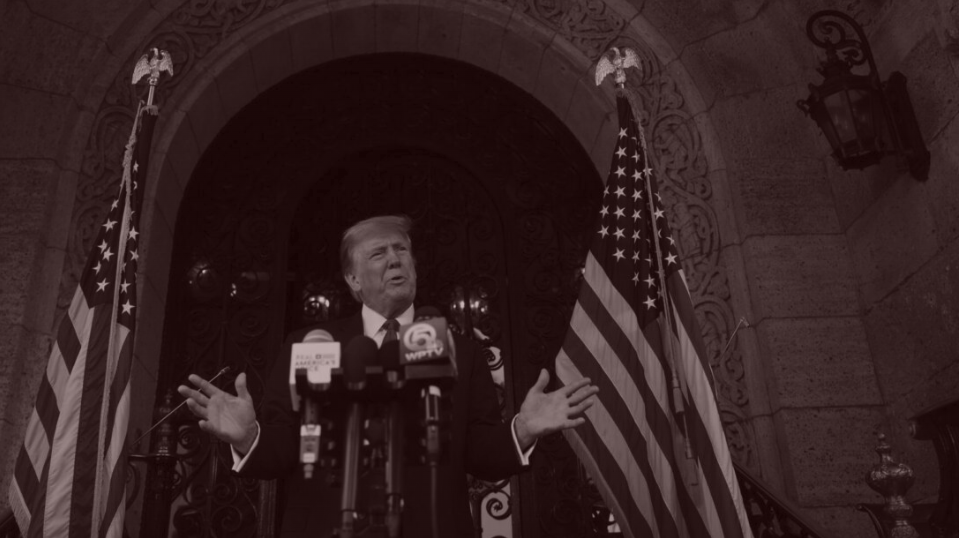
| Like many on Wall Street, I’ve been left wondering how Donald Trump will be able to afford the more than $450 million penalty, including interest, that Judge Arthur Engoron imposed on him last week as a result of the civil fraud lawsuit brought by New York State Attorney General Letitia James as well as the $83.3 million he owes E. Jean Carroll after he lost two defamation cases she brought against him. Assuming that at some point he loses all his appeals, can he get the cash he needs to pay his debts? Is he liquid enough for the appeal bond in the meantime? Will he be able to find someone to post the bond and take the risk of his credit? And that ignores, for the moment, the increasing possibility that he might also have to pay the I.R.S. $100 million or so in back taxes, as a result of his improper deductions over the years.
The challenge of forking over $530 million, or so, recalls for me the billions Trump’s various real estate and casino companies failed to repay to creditors back in the 1980s and 1990s, forcing some five or six of those companies to file for bankruptcy protection. As Trump is the first to point out, he himself has never filed for bankruptcy, even if the various corporate entities he once controlled have. Will the current round of legal setbacks force Trump into personal bankruptcy for the first time, as the high-octane investigative reporter and Pulitzer-prize winner David Cay Johnston has suggested?
It’s not likely, as enjoyable as that event might be for many. In 2015, credibly or not, Trump pegged his net worth at $10 billion, and then at $11 billion—although a material part of that calculus was based on the $4 billion-ish value he put on his “brand,” which of course is highly subjective, as even he admits. More recently, Forbes pegged his net worth at $2.5 billion. (Trump said in his April 2023 deposition in the civil fraud lawsuit that Forbes is “owned by the Chinese” with “their own agenda.” It’s actually owned by a Hong Kong-based investment firm, Integrated Whale Media, but whatever.)
Anyway, it’s probably safe to say that if Trump ends up having to pay some $530 million in fines and interest, he could come up with the money, as painful as it would be for him and as fun as it would be for various distressed-investing types to prey on his tough luck by paying him the bare minimum for the assets he would be forced to sell. But that April 2023 deposition is the most fascinating distillation of Trump’s assets, and it probably offers the best sense of what he will have to either sell or hock further to get out from under the massive financial penalty that James is determined to collect. |
|
|
| In the deposition, Trump claimed to have about $400 million in cash. “Which is a lot for a developer,” he added. “Developers usually don’t have cash. They have assets, not cash. We have, I believe, $400 [million] plus and going up very substantially every month. My biggest expense is probably legal fees, unfortunately. That’s okay.” Presumably, the only person who could verify Trump’s claim about his cash hoard is Barbara Jones, the court-appointed monitor of the Trump Organization.
He then moved on to itemize his “very salable assets”—his “glamour assets because I never liked non-glamour assets”—including Trump Tower, 40 Wall Street, Mar-a-Lago, Bedminister, the Turnberry Golf Club and property in Scotland, and Seven Springs, an estate in Westchester County. “There would be people that would do anything to own Doral,” he said, referring to his golf course in Miami. “There are people that would do anything to own Turnberry or Mar-a-Lago and Fifth Trump Tower or 40 Wall Street.” He said he paid $8 million for Mar-a-Lago, in 1985, and that now it is worth $1.5 billion—and “maybe more than that”—even though he signed a deed restriction that prevents the historic landmark from being anything other than a “private social club,” which severely curtails his development rights. (According to Engoron’s September 2023 ruling—where he initially determined that Trump had committed fraud—the Palm Beach County assessor appraised Mar-a-Lago at between $18 million and $28 million, as of 2021, although that seems low.)
Trump’s hyperbole is no surprise. His financial statements value 40 Wall Street, a fading office tower in the heart of New York City’s former financial district, and where he has a long-term ground lease but does not own the building, at $530 million. A bank appraisal, done by Cushman & Wakefield, pegged its value at $220 million. It also has a $90 million or so mortgage on it, provided by Ladder Capital, which also financed Trump Tower. In 2022, Trump refinanced Trump Tower with a $100 million mortgage from Axos Bank, in San Diego, run by a former Goldman Sachs banker who is reportedly a Trump supporter. In his deposition, Trump said he did not know how that value of 40 Wall Street was derived but that he thinks it’s worth more than $530 million now. He said he believed the building was “fully rented,” or nearly so.
Trump compared Seven Springs, the estate in Westchester County that was once owned by Eugene Meyer—the Lazard banker who bought The Washington Post out of bankruptcy once upon a time—to Mar-a-Lago. Trump reiterated that if New York City ever got its “act together” again, Seven Springs is “the most incredible place” and “has a great value.” He put a value on it of $291 million. “I think it’s the greatest house in New York State in a phenomenal location, in the Bedford area, which is, you know, the highest-income area,” he said. In his ruling, Engoron noted that a 2016 appraisal of Seven Springs put the value at $57 million.
Then there is, of course, the infamous Trump Tower triplex that Trump claimed was 30,000 square feet when it was actually just under 11,000 square feet. He also valued the apartment at as much as $207 million. In his April 2023 deposition, he said it could be worth even more. He also said that a value for the triplex at around $116 million was “very doable” but “I think that price is now low. An apartment just sold for $250 million on Central Park South. And I believe this is, you know—I don’t know, sort of say—it’s a better location. It’s Fifth Avenue.”
You get the idea. He has cash, but whether it’s as much as $400 million is unknown. He has assets that he can sell that collectively are certainly worth more than $530 million, even if he wishes they were worth much more. He’s also a 30 percent minority investor in two Vornado Realty Trust-owned office towers—one at 1290 Avenue of the Americas, in Manhattan, and one at 555 California Avenue, in San Francisco—but he has no ability to use or withdraw funds from the partnership or to force the sale of the properties. (Also, that would be an unwise divestiture given the challenges facing office towers in San Francisco and, to a lesser degree, parts of Midtown.)
Naturally, Trump believes that his brand enhances the value of everything he owns and wants to sell by virtue of the fact that he owns it and is selling it. (A recent data point: Trump’s limited-edition “Never Surrender” sneakers sold out on Saturday, at $399 per pair. According to Darren Rovell, they’re now selling for an average price of over $3,000 on eBay. The record-high sale is $7,500…) In any event, when he last had his “brand” valued many years ago, the professional who did it, Jonathan Low, pegged it at between $2.8 billion and $3 billion. “The brand is worth a lot more than it was then,” Trump said in the April 2023 deposition. |
|
|
| Ironically, Trump’s most valuable and easily salable asset these days may be Truth Social, his fledgling media company that is on the verge of consummating its long-awaited merger with Digital World Acquisition Corp., a special purpose acquisition corporation, or SPAC. If the merger occurs, after an upcoming shareholder vote following the Securities and Exchange Commission’s approval of the combination, Trump will own more than 78 million shares of DWAC, worth nearly $4 billion these days, even though during the first nine months of 2023 Truth Social generated revenue of $3.4 million and lost nearly $50 million. In other words, like the rest of the Trump empire, Trump’s stake in Truth Social/DWAC is dramatically overvalued but will likely be salable, at some point, at some price.
As part of the merger agreement, Trump agreed to a six-month lock-up on the sale of any DWAC shares he receives after the merger closes. But by the time he exhausts all his appeals on the recent Engoron and Carroll defamation rulings, he could probably sell shares in the SPAC and be able to cover what he owes. In other words, as usual, he’ll likely be able to slither away without a whole lot of pain, given the bonanza of the now fully discredited SPAC phenomenon. |
|
|
|
| FOUR STORIES WE’RE TALKING ABOUT |
 |
|
 |
| World War Z |
| Exclusive polling on Biden’s Gen Z Problem. |
| PETER HAMBY |
|
 |
|
 |
|
|
|
|
|
 |
|
|
|
Need help? Review our FAQs
page or contact
us for assistance. For brand partnerships, email ads@puck.news.
|
|
You received this email because you signed up to receive emails from Puck, or as part of your Puck account associated with . To stop receiving this newsletter and/or manage all your email preferences, click here.
|
|
Puck is published by Heat Media LLC. 227 W 17th St New York, NY 10011.
|
|
|
|