{{ 'now' | timezone: 'America/New_York' | date: '%b %d, %Y' }} |
|
|
Hello and welcome back to The Best & The Brightest. I’m Leigh Ann
Caldwell.
This morning, I sat down with South Dakota Republican Sen. Mike Rounds on the rooftop of the Riggs Hotel in D.C. as part of the Puck Power Breakfast series. Rounds, of course, has been at the forefront of A.I. issues in a legislative body still trying to understand what the technology even is. We discussed all that, as well as the government shutdown and whether Defense Secretary Pete Hegseth should go.
But
first… |
- Johnson
and Duffy turn up the heat: Earlier today, Senate Democrats blocked a Republican bill that would have allowed essential government workers to receive a paycheck during the shutdown. Democrats were mostly united against it on the grounds that it would give more power to the president and his Office of Management and Budget director, Russ Vought, to decide which employees to pay, and which to not. But three Democrats—Pennsylvania Sen. John Fetterman and
Georgia Sens. Raphael Warnock and Jon Ossoff—voted in favor of the bill. (Ossoff is the most vulnerable Senate Democrat this cycle, and this was an attempt to show he cares for government workers without having to drop his support for lower Obamacare subsidies.)
Tomorrow, the pressure on Congress will ratchet up a few notches, as federal employees are scheduled to miss their second biweekly paycheck of the shutdown—and the first one that covers a
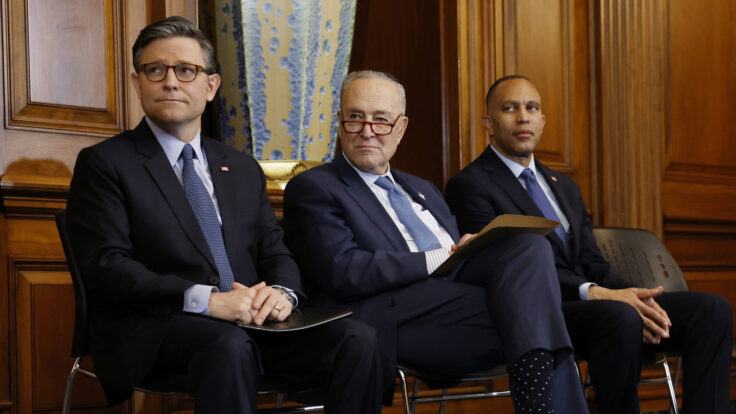
full pay period. To mark the occasion, House Speaker Mike Johnson held a news conference with Transportation Secretary Sean Duffy, in which they warned that air traffic controllers missing a full paycheck could lead to flight delays and safety concerns. Meanwhile, on the Hill, Senate staffers are set to miss their own second paycheck of the shutdown. (House staffers, who get paid monthly, will not get their checks if the government remains shuttered on
October 31.) The troops, whom Trump ordered paid on October 15 in a dubiously legal reallocation of already approved Pentagon funds, also have another pay date coming at the end of this month. No plans to cover it have yet been announced.
|
|
|
A MESSAGE FROM OUR SPONSOR |
Hospitals are here when you need us most – but hospitals across America are at risk of closure. |
|
|
- Republicans
dodge Trump’s $230 million question: Republicans on Capitol Hill are refusing to comment on the ethics of Trump essentially paying himself $230 million in taxpayer money that he has demanded as “damages” from Justice Department investigations into him. (Deputy Attorney General Todd Blanche, who could approve the settlement, was previously one of Trump’s criminal defense attorneys.) Yesterday, Johnson said he didn’t know much about the situation and didn’t have time to look
into it. When CNN’s Manu Raju asked the speaker about it again today, Johnson said that getting up to speed on the details is “still on my list of things to do.” Similarly, Sen. James Lankford told me he’s “still learning” about it. “I’m not obfuscating, I just don’t know,” he said. Sen. Rick Scott, a Trump ally, told me, “He shouldn't be disadvantaged just because he's the president.”
Meanwhile, Democrats on the House Oversight and
Judiciary Committees opened an investigation into the issue today, writing a letter to the president reminding him that the Emoluments Clause—a constitutional provision Trump has never paid much attention to—prevents a president from receiving a personal payment from the government outside their salary. “That is a categorical prohibition not even waivable by Congress,” Reps. Jamie Raskin and Robert Garcia wrote. In an interview today, Raskin called it an
“utterly fraudulent enterprise.” Plus, they argued, the Federal Torts Claim Act—the law via which Trump submitted his nine-figure request—doesn’t allow for punitive damages in cases involving the U.S. government.
|
|
|
The South Dakota senator dishes on A.I. policy, as well as the latest on the government
shutdown, and whether Pete Hegseth should go. |
|
|
Anyone who’s ever watched a congressional hearing focused on tech policy—say, social media, or digital data
collection—knows that our legislative body doesn’t have the most sophisticated understanding of any current technology, let alone the rapidly advancing field of artificial intelligence. That’s why then-Senate Majority Leader Chuck Schumer tapped Sen. Mike Rounds, the affable A.I. enthusiast and South Dakota Republican, during the last Congress to help educate his colleagues on the issue—including by convening top tech leaders such as Elon Musk,
Mark Zuckerberg, and Sam Altman to give a borderline geriatric Senate a crash course in Artificial Intelligence 101.
Since then, of course, the technology has found an unlikely champion in Donald Trump, a man who famously has avoided using email, and yet returned to office pursuing a win-at-all-costs agenda for global A.I. supremacy—including a designated A.I.
czar and releasing an “action plan.” Rounds isn’t far behind in his zeal, and is working the other side of Pennsylvania Avenue to push for more rapid A.I. adoption in finance, health, science, and more.
And yet,
when I interviewed Rounds at the Puck Power Breakfast at the Riggs Hotel this morning, he notably disagreed with the administration in several respects. He thinks Congress—and the states—need to regulate A.I., as well as support wind and solar sources to help meet its surging energy demands. Beyond that topic, he also offered some critical thoughts on Secretary of Defense Pete Hegseth’s resistance to sharing information with Congress, and why the legislative branch shouldn’t be
writing blank checks for the executive. This conversation has been lightly edited for length and clarity. |
“We’re Three Years Behind”
|
Leigh Ann Caldwell: How do you view regulations and A.I, and what do you
think Congress should do? Should they stay out of it or get involved?
Mike Rounds: If Congress is ineffective, then states will take it into their own hands. Congress is ineffective in a lot of cases, and because of that, states look at this and say, We might not be able to protect the rest of the country, but we can sure protect our people. My opinion is, Congress needs to take a leading role laying out standards for everybody in the country. But we have to
respect the fact that if we’re not going to do it, [the states are] going to do it. We need to keep our eyes on what [the states] are doing, but we need to step forward as well. |
|
|
A MESSAGE FROM OUR SPONSOR |
Hospitals need your help to stay. Protect 24/7 care—because when the doors close, it is too late. |
|
|
So Congress is behind?
Definitely. The last time we actually did an appropriations
bill was probably December 2023. How the hell are you supposed to make changes when you’re doing continuing resolutions and you don’t pass bills? You’ve got to have a working, operational, functional decisionmaking body. And it’s why I come back and tell folks we have a lot of work to do up here.
Three years ago, I got a briefing that was at a Special Access level, and it dealt with what the military had to do to integrate artificial intelligence into the defense of our country. As I
listened, all I kept thinking was, My gosh, this is stuff we got to get started on right now. It’s been three years, and we haven’t had an appropriations process in place since then to actually put the money into places so that we could develop the A.I. that will impact people’s lives forever. We’re three years behind from where we should be, just because we’re not doing appropriations.
Absent congressional regulation, should companies who are developing this technology
put in their own safeguards?
For them, it’s better to have the safeguards built in rather than be liable for something going south on them. Those that don’t are probably not going to be around very long, because the cost of fixing the problems could be significant. On the other hand, you’re going to have companies saying, We got some real whack jobs out there that aren’t taking care of their stuff. They're moving forward and breaking things. I got a system that will help fix
it, and I can make a lot of money doing that. We can’t stop the innovation that’s going on, but we can help it by laying out the framework in which we’re going to develop artificial intelligence, and how it’s going to be applied in the future.
The limiting factor is energy. We have about 1,300 gigawatts of energy right now that we use in the United States. Between now and 2028, we’re going to need between 75 and 100 gigawatts of additional power just for A.I. development in the
United States. China is developing a third of what we’re doing right now, every single year; so they’re doing 400 gigawatts a year in new development. Our supply chains can’t compete with that today.
The administration doesn’t believe in an all-of-the-above strategy, shutting down wind and solar projects around the country. Is that a mistake?
If they’re actually shutting them down, the answer is yes, because we need all of the above. We can’t build without turbines
until we literally go to space-based power—which, by the way, is not that far away—where you actually capture energy in space. Eventually, we will produce, some people say, anywhere between 30 to 50 percent of all the energy needs of our country in space.
How far away is that?
China is doing it now; China has been working on it for three years. Let’s just say it hasn’t gone unnoticed by our folks. You’ve got commercial interests that are looking at different ways
of doing it today. Easily within the next five years, you’re going to have space-based energy collection systems.
Is it necessary that the U.S. takes a posture that China is an adversary in A.I.?
Yes, no question. I would love to say that China is a competitor and not an adversary, but everything we see says that they’re an adversary. There’s a program right now where they’ve decided that their part of the world belongs to them, and they believe that it should be
Chinese standards, and it should be Chinese dominance in the Pacific Rim region. They’re moving in that direction—nothing that we’re seeing in the intel community suggests anything else. |
On a happier note, the government is shut down. How does this end?
Honestly, I’m not
playing politics on this; I don’t understand the logic of shutting down the government. We were having really good discussions about what we thought was the Democrats’ concern with an Obamacare product, which is continuing to explode in price. This year, those prices are going to go up somewhere between 24 and 36 percent. There’s two parts to the Obamacare subsidies: the ones that were there from the beginning, which have been increased a couple of times, and the enhanced Obamacare
products, which Joe Biden put in during Covid on a partisan basis through reconciliation. The Dems wanted to extend that, and when we got to looking at it, we found two problems with the enhanced subsidies. Number one, there was a significant amount of fraud that was involved—and it’s billions of dollars.
The second piece is that it appears as though, because of the way the enhanced subsidies were written, it isn’t subject to the Hyde Amendment protections, which say that
you can’t use taxpayer money for abortions. This particular piece appears to have found a way around it. Republicans have simply said, We’re not going to pay for abortions, whether it’s legal or not, using these dollars. We have to address that. |
|
|
So why don’t Republicans start talking to Democrats about this now?
We were talking
with them.
But leadership wasn’t involved. Should the leaders start talking?
Not yet. You can’t allow one side to say, We’re going to take this hostage and you’re going to deliver a deliverable to us, or we will shut down the government. Or that’ll be the way it’ll be every time.
One of the Democrats’ concerns is the administration’s unwillingness to follow what Congress does, especially when they pass appropriations bills. Do you have any
concerns that Congress is handing away too much of its power to the administration when it comes to appropriations?
We did already. In the continuing resolution, there was no report language that came with the one that was passed last year. There was nothing giving directions about where the money should be spent. It’s the reason why we have to get back to an appropriations process. And I know a lot of people don’t read appropriation bills, but we’ve really tried hard to include
specific language in them about where the money will be spent.
Is it a problem that the president doesn’t care about Congress?
Congress is not without dirty fingers in this thing. We’ve gotten lax. Congress has to do a better job of actually writing legislation. We should make sure they’re actually following the laws that we put in place. But yeah, the president, he just looks at it and says, You give me a blank check, of course I’m going to use it.
|
Do you still have confidence in Pete Hegseth?
We have not had a discussion with Pete
since we got him in to begin with—
Is that a problem?
Yeah, it is. I know they’re busy, I know they’re making major changes over there, but I’m more concerned about the most recent items saying they’re trying to limit the amount of data coming back and forth between folks within the department [and Congress]. That’s where my concern is now. It’s not so much with Pete himself; it’s more with the idea that [they] don’t want Congress to have a direct line into the
Pentagon. My guys in my office talk to people in the Pentagon every single day. And it’s not nefarious, it’s trying to figure out the right direction to go. If we have to go through legislative affairs every time we have a question, they don’t have enough people to take care of the House, let alone the Senate.
Should Pete Hegseth fix this? This is coming from his office.
Yeah. I mean, they’re going to have to modify it someplace along the line, or have a
clarification as to how this is going to work, because their teams can’t get things done without letting us help them. And we can’t do a good job without getting feedback about what’s working and what’s not.
Read more from the interview here. |
|
|
Join Emmy Award-winning journalist Peter Hamby, along with the team of expert journalists at Puck, as they let you in on the
conversations insiders are having across the four corners of power in America: Wall Street, Washington, Silicon Valley, and Hollywood. Presented in partnership with Audacy, new episodes publish daily, Monday through Friday. |
|
|
Unique and privileged insight into the private conversations taking place inside boardrooms and corner offices up and down Wall
Street, relayed by best-selling author, journalist, and former M&A senior banker William D. Cohan. |
|
|
Need help? Review our FAQ page or contact us for assistance. For brand partnerships, email ads@puck.news. You received this email because you signed up to receive emails from Puck, or as part of your Puck account associated with {{customer.email}}. To stop receiving this newsletter and/or manage all your email preferences,
click here. |
Puck is published by Heat Media LLC. 107 Greenwich St, New York, NY 10006 |
|
|
|